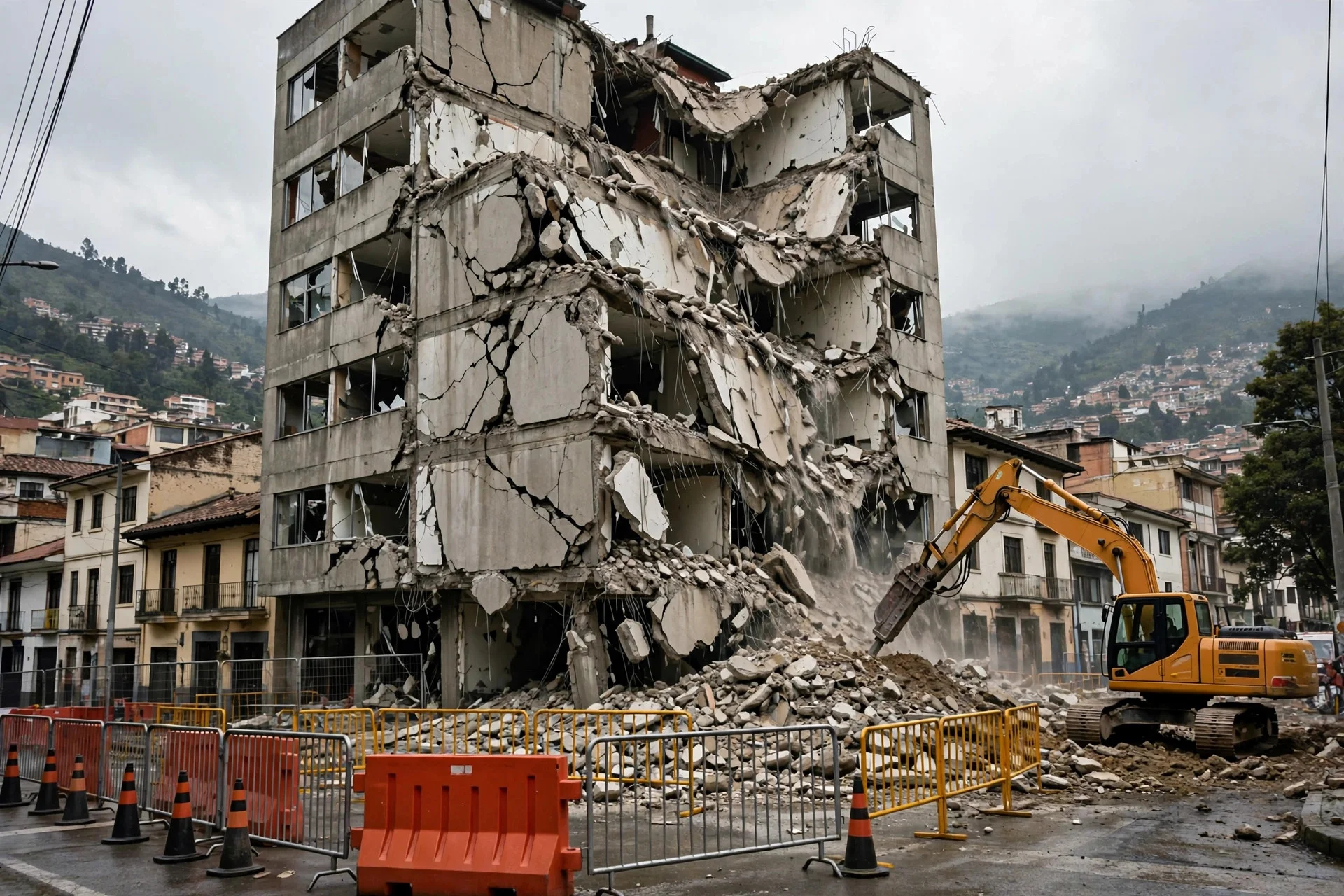
Cali to demolish 82 buildings after quake as Arábico work begins
Cali has approved the demolition of 82 buildings damaged by the August 10 earthquake, with 11 already demolished and two under intervention, while President…
Abelardo and Eder launch Arábico demolition in Cali
President Abelardo De La Espriella and Mayor Alejandro Eder visited Cali's Arábico building, one of the properties in the approved demolition of 82 buildings…
--- The context ---
Cali continues working to remove the structures that pose a risk after the earthquake of August 10. The official picture is of a city moving in stages, progressively addressing the damaged buildings and prioritising the properties that represent the greatest risk to the population.
--- The facts ---
As of Friday, October 23, the District Risk Management Council had approved the demolition of 82 buildings. According to the Secretariat for Emergency and Disaster Risk Management, 11 buildings have already been demolished and two others remain under intervention. Those already intervened include María Mercedes Lloreda, Cali Express, D’Corpus, CR Guadalupe and the former Molino Rojo motel, plus six other buildings in central Cali.
At the Hotel Metrópolis, at Calle 9 and Carrera 44, the work is close to completion, and in one intervention crews used nearby structures to control the fall and mitigate damage. The other focus is the Arábico building, at Calle 5 and Carrera 66, where work has already begun.
--- The positions ---
Colombia's president, Abelardo De La Espriella, was at the Arábico alongside Alejandro Eder, the city's mayor. The mayor said, in reported speech, that together with the President they were at Calle 5 and Carrera 66, where demolition began on the building, which had remained in the possession of the SAE and was damaged by the earthquake, and that, thanks to support from the national government's Fondo Milagro, resources would be allocated to address it.
Nelson Chiquiza, general manager of SDI Demoliciones y Excavaciones, said metal props were installed before entering the property to stabilise it and verify safety conditions, and that, once those checks were completed, personnel began executing the demolition plan.
--- What remains unknown ---
The company began internal interventions on the upper floors, and on Thursday, October 22, the process officially got under way. Because of the building's vulnerable state, the first work uses electric hammers on the upper levels. Once the top two floors are removed, a 22-tonne machine with a reach of 18 metres will be used.
When the construction reaches an approximate height of six metres, smaller equipment will move in to fragment the materials, separate them and move the waste to collection points. Demolition will take around three weeks.
--- Unanswered questions ---
How many of the 82 approved buildings will follow the same pace of intervention as the Arábico? What will happen to residents and nearby districts while the remaining demolitions move forward? In what order will the properties still awaiting their turn be addressed within the progressive plan?
--- EPM analysis ---
The process combines institutional decision-making with technical execution: an approved list, a report with concrete progress and priority by risk level. Recovery of the affected districts depends on the removal of structures advancing without stopping and without causing new accidents.
📌 EPM Take:
In EPM's view, what matters most in Cali is that protecting residents guides every step: demolishing the 82 approved buildings will only make sense if the progressive advance keeps nearby districts safe, controls the fall of each structure and prevents the affected sites from leading to accidents. The Arábico shows the right method, with prior stabilisation, safety verification and work level by level. Recovery will come when that care is repeated, property after property, until the list is completed without putting anyone else at risk.
--- The context ---
Cali continues the work of removing the structures that pose a risk after the earthquake of August 10. These are not isolated jobs: the District Risk Management Council approved the demolition of 82 buildings that show damage and could represent a danger to residents and nearby structures, with work carried out progressively.
--- The facts ---
As of Friday, October 23, the Secretariat for Emergency and Disaster Risk Management recorded 11 buildings already demolished and two others under intervention, prioritising the highest-risk properties. Those already intervened include María Mercedes Lloreda, Cali Express, D’Corpus, CR Guadalupe and the former Molino Rojo motel, plus six other buildings in central Cali.
At the Hotel Metrópolis, at Calle 9 and Carrera 44, the work is close to completion, and in one intervention crews used nearby structures to control the fall and mitigate damage, without harming the immediate surroundings.
--- The positions ---
Colombia's president, Abelardo De La Espriella, visited one of those buildings alongside Alejandro Eder, the city's mayor. The mayor said, in reported speech, that together with the President they were at Calle 5 and Carrera 66, where demolition began on the Arábico building, which had remained in the possession of the SAE and was damaged by the earthquake, and that, thanks to support from the national government's Fondo Milagro, resources would be allocated to address it.
SDI Demoliciones y Excavaciones began internal interventions on the upper floors, and on Thursday, October 22, the process officially got under way. Nelson Chiquiza, general manager of the company, said metal props were installed before entering to stabilise the property and verify safety conditions, and that, once those checks were done, personnel began executing the plan.
--- What remains unknown ---
Because of the building's vulnerable state, the first work uses electric hammers on the upper levels. Once the top two floors are removed, a 22-tonne machine with a reach of 18 metres will be used.
When the construction reaches an approximate height of six metres, smaller equipment will move in to fragment the materials, separate them and move the waste to collection points. Demolition will take around three weeks.
--- Unanswered questions ---
Will the pace of intervention be maintained until the 82 approved buildings are completed? What controls will be applied at each demolition to protect nearby structures? When will the next group of properties to enter intervention be announced?
--- EPM analysis ---
The sequence is one of authority and execution: district approval, an official report, a visit by the President and the mayor to the site, and a company working to a defined technical plan. The interventions seek to remove the affected structures, move toward recovery of the affected districts and prevent these sites from causing an accident.
📌 EPM Take:
In EPM's view, Cali gets it right when authority is exercised with order and without pause: there is an approved list of 82 buildings, a verifiable record of progress, and an Arábico demolition executed with prior stabilisation, control of the fall and a defined timetable of around three weeks. The presence of the President and the mayor on the ground reinforces that signal of command. What is needed now is to sustain efficient execution through the last property, because every at-risk structure left standing is an open danger to the city.
Cali demolerá 82 edificios tras el sismo y el Arábico ya se interviene
Cali aprobó la demolición de 82 edificaciones afectadas por el terremoto del 10 de agosto, con 11 ya demolidas y dos en intervención, mientras el presidente…
Abelardo y Eder inician la demolición del Arábico en Cali
El presidente Abelardo De La Espriella y el alcalde Alejandro Eder estuvieron en el edificio Arábico de Cali, uno de los inmuebles incluidos en la demolición…
--- El contexto ---
Cali continúa retirando las estructuras que representan un riesgo tras el terremoto del pasado 10 de agosto. El balance oficial muestra una ciudad que avanza por etapas, interviniendo de forma progresiva los inmuebles afectados y priorizando los que representan un mayor riesgo para la población.
--- Los hechos ---
Hasta el viernes 23 de octubre, el Consejo Distrital de Gestión del Riesgo había aprobado la demolición de 82 edificaciones. Según el balance de la Secretaría de Gestión del Riesgo de Emergencias y Desastres, 11 edificaciones ya fueron demolidas y otras dos continúan en intervención. Entre los inmuebles ya intervenidos están María Mercedes Lloreda, Cali Express, D’Corpus, CR Guadalupe y el antiguo motel Molino Rojo, además de otras seis edificaciones del centro de Cali.
En el Hotel Metrópolis, situado en la calle 9 con carrera 44, las labores están próximas a finalizar, y en una de las intervenciones los equipos utilizaron estructuras cercanas para controlar la caída y mitigar daños. El otro foco es el edificio Arábico, en la calle 5 con carrera 66, donde ya comenzaron los trabajos.
--- Las posiciones ---
El presidente de Colombia, Abelardo De La Espriella, estuvo en el Arábico junto a Alejandro Eder, alcalde de la ciudad. El alcalde señaló en indirecto que, junto al Presidente, estuvieron en la calle 5 con carrera 66, donde se inició la demolición del edificio, que permanecía bajo posesión de la SAE y resultó afectado tras el terremoto, y que, gracias al apoyo del Fondo Milagro del Gobierno Nacional, se destinarán recursos para atenderlo.
Nelson Chiquiza, gerente general de SDI Demoliciones y Excavaciones, indicó que antes de ingresar al inmueble se instalaron puntales metálicos para estabilizarlo y verificar las condiciones de seguridad, y que, realizadas estas comprobaciones, el personal comenzó a ejecutar el plan de demolición.
--- Lo que falta saber ---
La empresa inició las intervenciones internas en los pisos superiores y el jueves 22 de octubre se dio comienzo oficial al proceso. Por la vulnerabilidad de la edificación, los primeros trabajos se realizan con martillos eléctricos en los niveles superiores. Cuando se retiren los dos pisos de arriba, se utilizará una máquina de 22 toneladas, con un alcance de 18 metros.
Cuando la construcción alcance una altura aproximada de seis metros, ingresarán equipos más pequeños para fragmentar los materiales, separarlos y trasladar los residuos a los puntos de acopio. La demolición tardará alrededor de tres semanas.
--- Preguntas sin respuesta ---
¿Cuántas de las 82 edificaciones aprobadas seguirán el mismo ritmo de intervención del Arábico? ¿Qué pasará con los habitantes y sectores cercanos mientras avanzan las demoliciones restantes? ¿En qué orden se atenderán los inmuebles que aún esperan turno dentro del plan progresivo?
--- Análisis EPM ---
El proceso combina decisión institucional y ejecución técnica: lista aprobada, balance con avances y prioridad por nivel de riesgo. La recuperación de los sectores comprometidos depende de que el retiro de estructuras avance sin detenerse y sin provocar nuevos accidentes.
📌 Conclusion EPM:
A juicio de EPM, lo esencial en Cali es que la protección de los habitantes guíe cada paso: demoler 82 edificaciones aprobadas solo tendrá sentido si el avance progresivo mantiene la seguridad de los sectores cercanos, controla la caída de cada estructura y evita que los lugares afectados deriven en accidentes. El Arábico muestra el método correcto, con estabilización previa, verificación de seguridad y trabajo por niveles. La recuperación llegará cuando ese cuidado se repita, inmueble tras inmueble, hasta completar la lista sin poner en riesgo a nadie más.
--- El contexto ---
Cali continúa con las labores para retirar las estructuras que representan un riesgo tras el terremoto del pasado 10 de agosto. No se trata de obras aisladas: el Consejo Distrital de Gestión del Riesgo aprobó demoler 82 edificaciones que presentan afectaciones y podrían representar un peligro para los habitantes y las estructuras cercanas, con labores progresivas.
--- Los hechos ---
Hasta el viernes 23 de octubre, el balance de la Secretaría de Gestión del Riesgo de Emergencias y Desastres registraba 11 edificaciones ya demolidas y otras dos en intervención, priorizando los inmuebles de mayor riesgo. Entre los ya intervenidos están María Mercedes Lloreda, Cali Express, D’Corpus, CR Guadalupe y el antiguo motel Molino Rojo, además de otras seis edificaciones del centro de Cali.
En el Hotel Metrópolis, situado en la calle 9 con carrera 44, las labores están próximas a finalizar, y en una de las intervenciones los equipos utilizaron estructuras cercanas para controlar la caída y mitigar daños, sin afectar el entorno inmediato.
--- Las posiciones ---
El presidente de Colombia, Abelardo De La Espriella, visitó uno de esos edificios junto a Alejandro Eder, alcalde de la ciudad. El alcalde señaló en indirecto que, junto al Presidente, estuvieron en la calle 5 con carrera 66, donde se inició la demolición del edificio Arábico, que permanecía bajo posesión de la SAE y resultó afectado tras el terremoto, y que, gracias al apoyo del Fondo Milagro del Gobierno Nacional, se destinarán recursos para atenderlo.
SDI Demoliciones y Excavaciones inició las intervenciones internas en los pisos superiores y el jueves 22 de octubre se dio comienzo oficial al proceso. Nelson Chiquiza, gerente general de la compañía, indicó que antes de ingresar se instalaron puntales metálicos para estabilizar el inmueble y verificar las condiciones de seguridad, y que, realizadas estas comprobaciones, el personal comenzó a ejecutar el plan.
--- Lo que falta saber ---
Por la vulnerabilidad de la edificación, los primeros trabajos se realizan con martillos eléctricos en los niveles superiores. Cuando se retiren los dos pisos de arriba, se utilizará una máquina de 22 toneladas, con un alcance de 18 metros.
Cuando la construcción alcance una altura aproximada de seis metros, ingresarán equipos más pequeños para fragmentar los materiales, separarlos y trasladar los residuos a los puntos de acopio. La demolición tardará alrededor de tres semanas.
--- Preguntas sin respuesta ---
¿Se mantendrá el ritmo de intervención hasta completar las 82 edificaciones aprobadas? ¿Qué controles se aplicarán en cada derribo para proteger las estructuras cercanas? ¿Cuándo se conocerá el siguiente grupo de inmuebles que entrará en intervención?
--- Análisis EPM ---
La secuencia es de autoridad y ejecución: aprobación distrital, balance oficial, visita del Presidente y del alcalde al terreno y una empresa con un plan técnico definido. Las intervenciones buscan retirar las estructuras afectadas, avanzar hacia la recuperación de los sectores comprometidos y evitar que estos lugares causen algún accidente.
📌 Conclusion EPM:
A juicio de EPM, Cali acierta cuando la autoridad se ejerce con orden y sin pausa: hay una lista aprobada de 82 edificaciones, un balance verificable de avances y una demolición del Arábico ejecutada con estabilización previa, control de la caída y plazos definidos de alrededor de tres semanas. La presencia del Presidente y del alcalde en el terreno refuerza esa señal de mando. Lo que corresponde ahora es sostener la ejecución eficiente hasta el último inmueble, porque cada estructura en riesgo que permanece en pie es un peligro abierto para la ciudad.