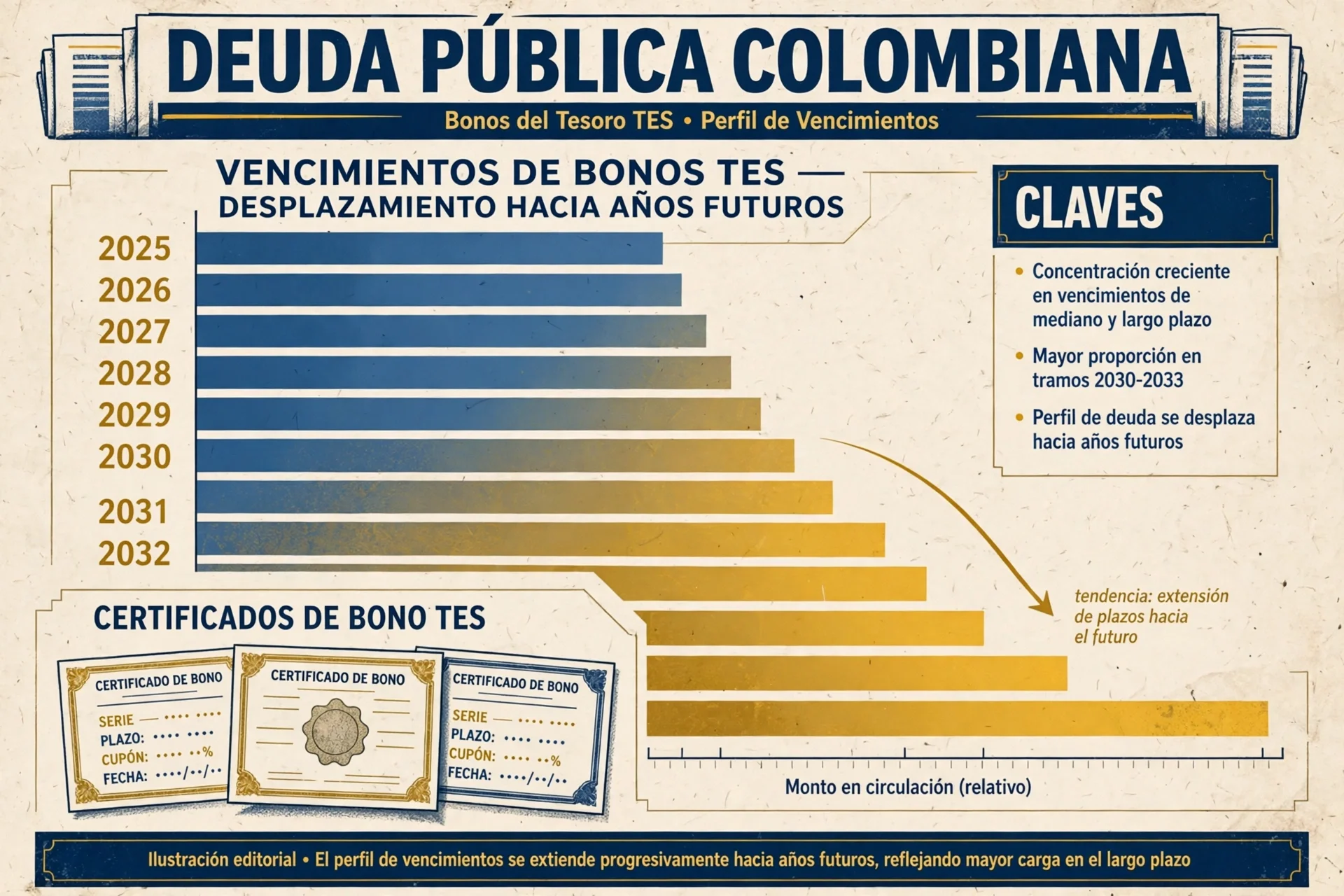
Imagen alusiva generada para esta cobertura. · Erick Prometeo Media
Colombia swaps COP$10,3 billones of debt and cuts 2026 maturities by 50%
The Colombian Government carried out a second domestic public debt reprofiling operation worth COP$10,3 billones (Colombian pesos), cutting 2026 maturities by…
Debt swap of COP$10,3 billones: term relief at a cost of 4,5%
Colombia completed a second domestic debt reprofiling operation worth COP$10,3 billones (Colombian pesos), at a cost of COP$467.000 millones, equivalent to…
--- The context ---
Colombia has moved the calendar of its domestic public debt once again. The Government carried out a second debt reprofiling operation worth COP$10,3 billones (Colombian pesos), cutting maturities by COP$1,5 billones in 2026 and COP$8,8 billones in 2027, as part of the Ministry of Finance strategy to modify the Nation amortization profile and reduce short-term refinancing pressures.
The operation was executed through an exchange of domestic public debt securities, known as TES, aimed at shifting part of the maturities to other terms, under market conditions and at costs the entity described as prudent.
--- The facts ---
With this second operation, the domestic public debt management program now accumulates exchanges worth COP$30,1 billones. According to the Ministry of Finance, the amount represents a 50% reduction in 2026 maturities and a 19% reduction in those of 2027, and in amortization terms the Government reported a decrease of COP$3,9 billones in 2026 and COP$26,2 billones in 2027, as the aggregate result of the operations carried out to date.
The exchange was developed in two tranches. In the first, a competitive auction, bids worth COP$7,5 billones were received, of which COP$6,2 billones were awarded, with an 83% acceptance rate. In the second tranche, COP$4,1 billones were awarded: market makers submitted offers worth COP$700.000 millones and the Dirección General de Crédito Público y Tesoro Nacional participated with COP$3,4 billones, under the same conditions approved in the competitive auction.
The total cost of the operation amounted to COP$467.000 millones, equivalent to 4,5% of the total amount exchanged. The average life of the domestic debt represented in TES rose from 10,14 años to 10,21 años, an increase of 0,07 años, and the operation focused on securities with maturities distributed between 2026 and 2062.
In the exchange, the Nation received securities maturing between November 2026 and November 2027 with a nominal value of COP$10,3 billones, including TES maturing on 17 de noviembre de 2026, worth COP$1,1 billones; 26 de enero de 2027, worth COP$2,1 billones; 17 de marzo de 2027, worth COP$3,2 billones, and 3 de noviembre de 2027, worth COP$3,5 billones. In return, it delivered securities from July 2027 to March 2058 with a nominal value of COP$10,2 billones, including TES maturing on 10 de agosto de 2027, worth COP$1,7 billones; 5 de octubre de 2027, worth COP$1,1 billones; 27 de febrero de 2030, worth COP$1,3 billones, and 28 de noviembre de 2040, worth COP$1,1 billones.
--- The positions ---
Finance Minister Miguel Gómez Martínez said in indirect terms that debt management has helped mitigate the risks associated with meeting the State financial obligations, and he thanked the 13 institutions of the market maker program for their active participation and local and foreign investors for their confidence in the Colombian capital market.
According to the entity, the central purpose was to ease the amortizations concentrated in 2026 and 2027 without increasing the Nation net indebtedness, while better managing the resource needs it faces to meet the maturities of its securities.
--- What remains unknown ---
The statement does not present an estimate of the fiscal savings the strategy would generate, nor does it quantify possible effects on the future cost of debt service. It also does not detail how the new payment calendar will be distributed year by year after maturities were shifted to later dates.
--- Unanswered questions ---
What results will the third TES exchange window bring, scheduled for 19 de noviembre de 2026 and announced as the last exchange operation of the year? How much additional relief on 2026 and 2027 maturities could that final operation achieve? Will the Ministry of Finance eventually present an estimate of this strategy effect on the future cost of debt service?
--- EPM analysis ---
The figure that orders the reading is the immediate relief: cutting 50% of 2026 maturities changes the short-term conversation, because refinancing pressures stop concentrating in the nearest years. The technical management, executed under market conditions and with broad demand at auction, shows a program advancing window by window and already accumulating COP$30,1 billones reprofiled.
The Ministry reported that the details of the transaction will be available on its website and that the results will be sent to the fiscal control bodies, in compliance with Resolución 2419 de 2026. The third window on 19 de noviembre de 2026 will close the year cycle and make it possible to measure the full scope of the program.
📌 EPM Take:
In EPM's view, this second operation confirms technical management that tangibly eases Colombia refinancing pressures: cutting 50% of 2026 maturities and 19% of those of 2027, with broad demand at auction and costs described as prudent, gives the amortization profile breathing room without increasing net indebtedness. The program, already accumulating COP$30,1 billones, orders the payment calendar, lengthens the average life of the debt from 10,14 años to 10,21 años and reduces the compliance risks the minister himself underlined. Its third window, on 19 de noviembre de 2026, will complete the year effort and allow the full relief achieved to be measured.
--- The context ---
The Colombian Government completed a second domestic public debt reprofiling operation worth COP$10,3 billones (Colombian pesos). The transaction is part of the Ministry of Finance strategy to modify the Nation amortization profile and reduce short-term refinancing pressures, cutting maturities by COP$1,5 billones in 2026 and COP$8,8 billones in 2027.
The operation was executed through an exchange of domestic public debt securities, known as TES, to shift part of the maturities to other terms. According to the official statement, the strategy has been developed under market conditions and at costs the entity described as prudent, a description that should be weighed against the exchange own figures.
--- The facts ---
With the second operation, the program accumulates exchanges worth COP$30,1 billones, with a 50% reduction in 2026 maturities and a 19% reduction in those of 2027. In amortizations, the Government reported a decrease of COP$3,9 billones in 2026 and COP$26,2 billones in 2027, as the aggregate result of the operations carried out to date.
The exchange was developed in two tranches. The competitive auction received bids worth COP$7,5 billones and awarded COP$6,2 billones, with an 83% acceptance rate. In the second tranche, COP$4,1 billones were awarded, with market maker offers worth COP$700.000 millones and participation by the Dirección General de Crédito Público y Tesoro Nacional worth COP$3,4 billones, under the same conditions approved in the auction.
The total cost of the operation amounted to COP$467.000 millones, equivalent to 4,5% of the total amount exchanged. The average life of the domestic debt represented in TES rose from 10,14 años to 10,21 años, an increase of 0,07 años, and the operation focused on securities with maturities distributed between 2026 and 2062.
The Nation received securities maturing between November 2026 and November 2027 with a nominal value of COP$10,3 billones: TES maturing on 17 de noviembre de 2026, worth COP$1,1 billones; 26 de enero de 2027, worth COP$2,1 billones; 17 de marzo de 2027, worth COP$3,2 billones, and 3 de noviembre de 2027, worth COP$3,5 billones. In return, it delivered securities from July 2027 to March 2058 with a nominal value of COP$10,2 billones: TES maturing on 10 de agosto de 2027, worth COP$1,7 billones; 5 de octubre de 2027, worth COP$1,1 billones; 27 de febrero de 2030, worth COP$1,3 billones, and 28 de noviembre de 2040, worth COP$1,1 billones.
--- The positions ---
Finance Minister Miguel Gómez Martínez said in indirect terms that debt management has helped mitigate the risks associated with meeting the State financial obligations, and he thanked the 13 institutions of the market maker program for their participation and local and foreign investors for their confidence.
According to the entity, the central purpose was to ease the amortizations concentrated in 2026 and 2027 without increasing the Nation net indebtedness. That precision matters: the exchange reorders terms, but it does not reduce the total amount of debt.
--- What remains unknown ---
The statement does not present an estimate of the fiscal savings the strategy would generate, nor does it quantify possible effects on the future cost of debt service. Without that figure, it is not possible to verify whether the cost of COP$467.000 millones, 4,5% of the amount exchanged, will be offset by lower financial expenses in the coming years.
--- Unanswered questions ---
How much will the State effectively save with this reprofiling, if the statement itself presents no estimate of fiscal savings? Does the cost of 4,5% of the amount exchanged offset the benefits of shifting maturities to later dates? What effect will the strategy have on the future cost of debt service, which was not quantified either?
--- EPM analysis ---
Fiscal discipline is measured in verifiable results, and here the verifiable result is twofold: there is real relief on 2026 and 2027 maturities, and there is a certain cost of COP$467.000 millones. The average life of the debt barely moved, from 10,14 años to 10,21 años, which shows a gradual adjustment of the profile rather than a fundamental change in the structure of obligations.
The Ministry reported that the details will be available on its website and that the results will be sent to the fiscal control bodies, in compliance with Resolución 2419 de 2026. The third window, on 19 de noviembre de 2026, will be the last of the year and another occasion to demand the savings figures that were not presented this time.
📌 EPM Take:
In EPM's view, the exchange orders the calendar and eases maturities, but fiscal discipline requires looking at the full cost: COP$467.000 millones, 4,5% of the amount exchanged, in return for shifting payments without increasing net indebtedness and without the statement presenting a single estimate of fiscal savings or quantifying the effect on the future cost of debt service. Reprofiled is not a synonym of saved: until the Ministry publishes that balance, the operation should be read as prudence on terms, not as a demonstrated gain for the taxpayer.
Colombia canjea COP$10,3 billones de deuda y recorta vencimientos de 2026
El Gobierno colombiano realizó una segunda operación de reperfilamiento de deuda pública interna por COP$10,3 billones, que redujo los vencimientos de 2026 en…
Canje de deuda por COP$10,3 billones: alivio de plazos con costo del 4,5%
Colombia completó una segunda operación de reperfilamiento de deuda interna por COP$10,3 billones, con un costo de COP$467.000 millones, equivalentes al 4,5%…
--- El contexto ---
Colombia volvió a mover el calendario de su deuda pública interna. El Gobierno realizó una segunda operación de reperfilamiento por COP$10,3 billones, con la que redujo los vencimientos de obligaciones por COP$1,5 billones en 2026 y COP$8,8 billones en 2027, dentro de la estrategia del Ministerio de Hacienda para modificar el perfil de amortizaciones de la Nación y disminuir las presiones de refinanciamiento en el corto plazo.
La operación se ejecutó mediante un intercambio de títulos TES, con el propósito de trasladar los vencimientos hacia otros plazos, en condiciones de mercado y con costos que la entidad calificó como prudentes.
--- Los hechos ---
Con esta segunda operación, el programa de gestión de deuda pública interna acumula intercambios por COP$30,1 billones. Según el Ministerio de Hacienda, el monto representa una reducción del 50% en los vencimientos de 2026 y del 19% en los correspondientes a 2027, y en términos de amortizaciones el Gobierno reportó una disminución de COP$3,9 billones en 2026 y de COP$26,2 billones en 2027, como resultado agregado de las operaciones realizadas hasta la fecha.
El canje se desarrolló en dos tramos. En el primero, una subasta competitiva, se recibieron demandas por COP$7,5 billones, de las cuales se adjudicaron COP$6,2 billones, con un porcentaje de aceptación del 83%. En el segundo tramo se adjudicaron COP$4,1 billones: los creadores de mercado presentaron ofertas por COP$700.000 millones y la Dirección General de Crédito Público y Tesoro Nacional participó por COP$3,4 billones, bajo las mismas condiciones aprobadas en la subasta.
El costo total de la operación ascendió a COP$467.000 millones, equivalentes al 4,5% del monto total canjeado. La vida media de la deuda interna representada en TES pasó de 10,14 años a 10,21 años, un incremento de 0,07 años, y la operación se concentró en títulos con vencimientos distribuidos entre 2026 y 2062.
En el intercambio, la Nación recibió títulos con vencimientos entre noviembre de 2026 y noviembre de 2027 por un valor nominal de COP$10,3 billones, entre ellos TES con vencimiento el 17 de noviembre de 2026, por COP$1,1 billones; el 26 de enero de 2027, por COP$2,1 billones; el 17 de marzo de 2027, por COP$3,2 billones, y el 3 de noviembre de 2027, por COP$3,5 billones. A cambio, entregó títulos desde julio de 2027 hasta marzo de 2058 por un valor nominal de COP$10,2 billones, entre ellos TES con vencimiento el 10 de agosto de 2027, por COP$1,7 billones; el 5 de octubre de 2027, por COP$1,1 billones; el 27 de febrero de 2030, por COP$1,3 billones, y el 28 de noviembre de 2040, por COP$1,1 billones.
--- Las posiciones ---
El ministro de Hacienda, Miguel Gómez Martínez, destacó en indirecto que la gestión de la deuda ha permitido mitigar los riesgos asociados con el cumplimiento de las obligaciones financieras del Estado, y agradeció la activa participación de las 13 instituciones del programa de creadores de mercado y la confianza de los inversionistas locales y extranjeros en el mercado de capitales colombiano.
De acuerdo con la entidad, el propósito central fue aliviar las amortizaciones concentradas en 2026 y 2027 sin aumentar el endeudamiento neto de la Nación, administrando mejor las necesidades de recursos para atender los vencimientos de sus títulos.
--- Lo que falta saber ---
El comunicado no presenta una estimación del ahorro fiscal que generaría la estrategia ni cuantifica posibles efectos sobre el costo futuro del servicio de la deuda. Tampoco detalla cómo quedará distribuido el nuevo calendario de pagos año a año tras el desplazamiento de vencimientos hacia fechas posteriores.
--- Preguntas sin respuesta ---
¿Qué resultados traerá la tercera ventana de intercambio de TES, programada para el 19 de noviembre de 2026 y anunciada como la última operación de canje del año? ¿Cuánto alivio adicional sobre los vencimientos de 2026 y 2027 podrá lograr esa operación final? ¿Presentará el Ministerio de Hacienda en algún momento una estimación del efecto de esta estrategia sobre el costo futuro del servicio de la deuda?
--- Análisis EPM ---
El dato que ordena la lectura es el alivio inmediato: recortar el 50% de los vencimientos de 2026 cambia la conversación de corto plazo, porque las presiones de refinanciamiento dejan de concentrarse en los años más cercanos. La gestión técnica, ejecutada en condiciones de mercado y con demanda amplia en la subasta, muestra un programa que avanza por ventanas y que ya acumula COP$30,1 billones reperfilados.
El Ministerio informó que los detalles estarán disponibles en su página web y que los resultados serán remitidos a los órganos de control fiscal, en cumplimiento de la Resolución 2419 de 2026. La tercera ventana del 19 de noviembre cerrará el ciclo del año.
📌 Conclusion EPM:
A juicio de EPM, esta segunda operación confirma una gestión técnica que alivia de forma tangible las presiones de refinanciamiento de Colombia: recortar el 50% de los vencimientos de 2026 y el 19% de los de 2027, con demanda amplia y costos calificados como prudentes, da aire al perfil de amortizaciones sin aumentar el endeudamiento neto. El programa, que ya acumula COP$30,1 billones, ordena el calendario de pagos y reduce los riesgos de cumplimiento que el propio ministro subrayó, a la espera de su última ventana del año.
--- El contexto ---
El Gobierno colombiano completó una segunda operación de reperfilamiento de deuda pública interna por COP$10,3 billones. La transacción forma parte de la estrategia del Ministerio de Hacienda para modificar el perfil de amortizaciones de la Nación y disminuir las presiones de refinanciamiento en el corto plazo, reduciendo los vencimientos de obligaciones por COP$1,5 billones en 2026 y COP$8,8 billones en 2027.
La operación se ejecutó mediante un intercambio de títulos de deuda pública interna, conocidos como TES, para trasladar parte de los vencimientos hacia otros plazos. Según el comunicado oficial, la estrategia se ha desarrollado en condiciones de mercado y con costos que la entidad calificó como prudentes.
--- Los hechos ---
Con la segunda operación, el programa acumula intercambios por COP$30,1 billones, con una reducción del 50% en los vencimientos de 2026 y del 19% en los de 2027. En amortizaciones, el Gobierno reportó una disminución de COP$3,9 billones en 2026 y de COP$26,2 billones en 2027, como resultado agregado de las operaciones realizadas hasta la fecha.
El canje se desarrolló en dos tramos. En la subasta competitiva se recibieron demandas por COP$7,5 billones y se adjudicaron COP$6,2 billones, con un porcentaje de aceptación del 83%. En el segundo tramo se adjudicaron COP$4,1 billones, con ofertas de los creadores de mercado por COP$700.000 millones y participación de la Dirección General de Crédito Público y Tesoro Nacional por COP$3,4 billones, bajo las mismas condiciones aprobadas en la subasta.
El costo total de la operación ascendió a COP$467.000 millones, equivalentes al 4,5% del monto total canjeado. La vida media de la deuda interna representada en TES pasó de 10,14 años a 10,21 años, un incremento de 0,07 años, y la operación se concentró en títulos con vencimientos distribuidos entre 2026 y 2062.
La Nación recibió títulos con vencimientos entre noviembre de 2026 y noviembre de 2027 por un valor nominal de COP$10,3 billones: TES con vencimiento el 17 de noviembre de 2026, por COP$1,1 billones; el 26 de enero de 2027, por COP$2,1 billones; el 17 de marzo de 2027, por COP$3,2 billones, y el 3 de noviembre de 2027, por COP$3,5 billones. A cambio, entregó títulos desde julio de 2027 hasta marzo de 2058 por un valor nominal de COP$10,2 billones: TES con vencimiento el 10 de agosto de 2027, por COP$1,7 billones; el 5 de octubre de 2027, por COP$1,1 billones; el 27 de febrero de 2030, por COP$1,3 billones, y el 28 de noviembre de 2040, por COP$1,1 billones.
--- Las posiciones ---
El ministro de Hacienda, Miguel Gómez Martínez, destacó en indirecto que la gestión de la deuda ha permitido mitigar los riesgos asociados con el cumplimiento de las obligaciones financieras del Estado, y agradeció la participación de las 13 instituciones del programa de creadores de mercado y la confianza de los inversionistas locales y extranjeros.
De acuerdo con la entidad, el propósito central fue aliviar las amortizaciones concentradas en 2026 y 2027 sin aumentar el endeudamiento neto de la Nación. Esa precisión importa: el canje reordena plazos, pero no reduce el monto total de la deuda.
--- Lo que falta saber ---
El comunicado no presenta una estimación del ahorro fiscal que generaría la estrategia ni cuantifica posibles efectos sobre el costo futuro del servicio de la deuda. Sin esa cifra, no es posible verificar si el costo de COP$467.000 millones, el 4,5% del monto canjeado, quedará compensado por menores gastos financieros en los próximos años.
--- Preguntas sin respuesta ---
¿Cuánto ahorrará efectivamente el Estado con este reperfilamiento, si el propio comunicado no presenta ninguna estimación de ahorro fiscal? ¿Compensa el costo del 4,5% del monto canjeado los beneficios de desplazar los vencimientos hacia fechas posteriores? ¿Qué efecto tendrá la estrategia sobre el costo futuro del servicio de la deuda, que tampoco fue cuantificado?
--- Análisis EPM ---
La disciplina fiscal se mide en resultados verificables, y aquí el resultado verificable es doble: hay un alivio real de vencimientos en 2026 y 2027, y hay un costo cierto de COP$467.000 millones. La vida media de la deuda apenas se movió, de 10,14 años a 10,21 años, lo que muestra un ajuste gradual del perfil y no un cambio de fondo en la estructura de obligaciones.
El Ministerio informó que los detalles estarán disponibles en su página web y que los resultados serán remitidos a los órganos de control fiscal, en cumplimiento de la Resolución 2419 de 2026. La tercera ventana, el 19 de noviembre de 2026, será la última del año y otra ocasión para exigir las cifras de ahorro que esta vez no se presentaron.
📌 Conclusion EPM:
A juicio de EPM, el canje ordena el calendario y alivia vencimientos, pero la disciplina fiscal exige mirar el costo completo: COP$467.000 millones, el 4,5% del monto canjeado, a cambio de desplazar pagos sin aumentar el endeudamiento neto y sin que el comunicado presente una sola estimación de ahorro fiscal ni cuantifique el efecto sobre el costo futuro del servicio de la deuda. Reperfilado no es sinónimo de ahorrado: hasta que Hacienda publique ese balance, la operación debe leerse como prudencia en los plazos, no como una ganancia demostrada para el contribuyente.