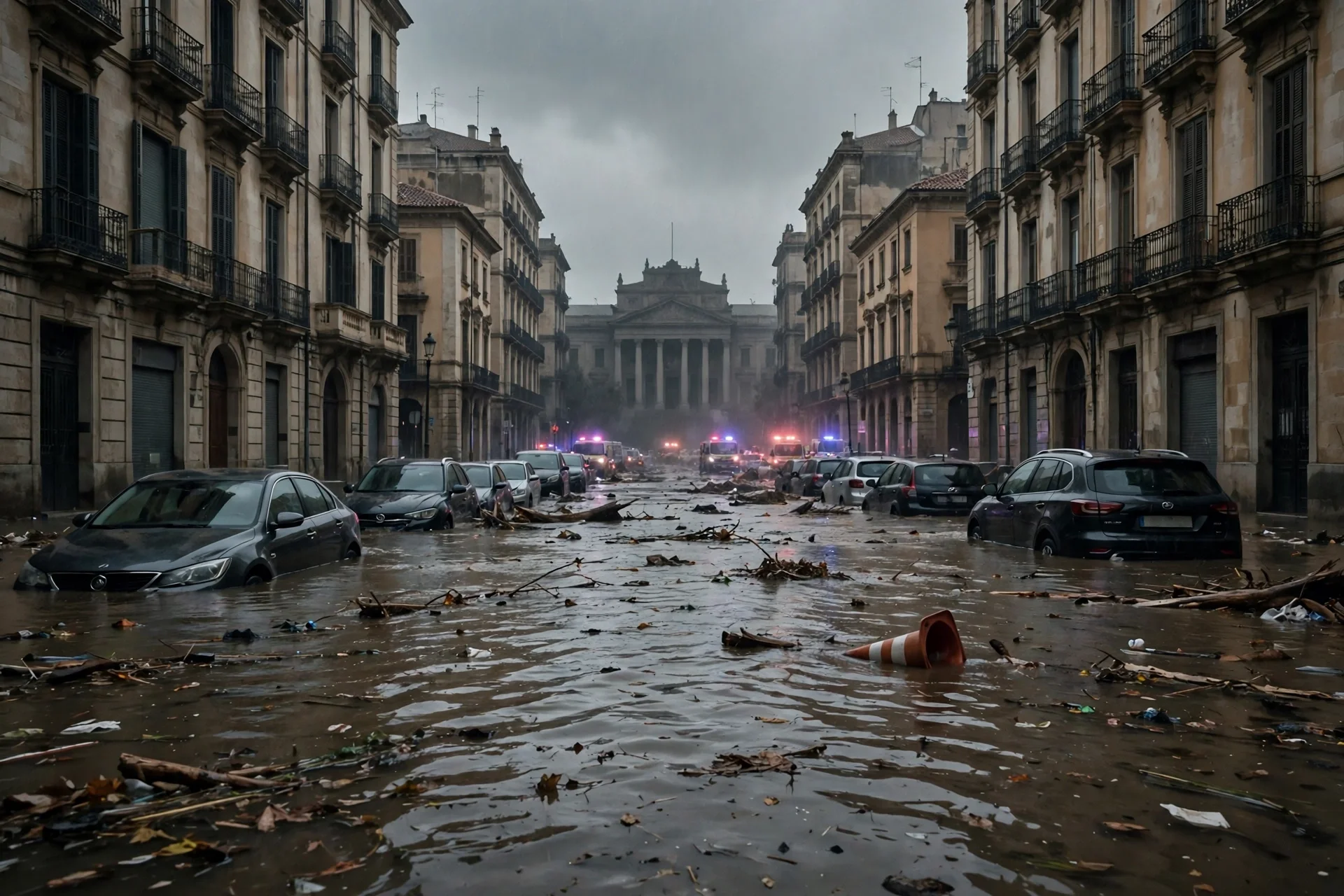
Imagen alusiva generada para esta cobertura. · Erick Prometeo Media
Pradas circle rejects charges in Valencia flood case near anniversary
The circle of Salomé Pradas, under investigation over management of the flood that left 233 dead in Valencia on 29 October 2024, says nobody should be charged…
Pradas allies say Valencia flood was unforeseeable, not a criminal matter
Allies of Salomé Pradas argue that the flood of 29 October 2024, which left 233 dead, was an unforeseeable tsunami without criminal responsibility, and point…
--- The context ---
As the second anniversary approaches of the catastrophe of 29 October 2024, which left 233 dead in Valencia, debate has returned over responsibility for the management of that emergency and its consequences.
--- The facts ---
Salomé Pradas, former regional minister for Justice and Interior in the Valencian government, is under investigation in the case over that management. Her circle maintains that nobody should be charged and that what happened was not a flood or a dana, but an unforeseeable tsunami.
--- The positions ---
From that position, it is argued that there may be political responsibilities but not criminal ones, and that Pradas is a politician, not a technician. It says that, if anyone is investigated, it should include those in charge of monitoring the rise of the Poyo ravine, the Júcar Hydrographic Confederation and former government delegate Pilar Bernabé.
--- What remains unknown ---
It remains to be seen how investigators will assess that argument and what weight the evidence on monitoring, forecasting and decisions during the emergency will carry.
--- Unanswered questions ---
Can the claim that nobody should be charged stand without reviewing every action? What responsibility lies with those who monitored the watercourses? Will the case provide clear answers to families before further court decisions?
--- EPM analysis ---
The case combines grief, a demand for truth and a substantive legal dispute. Separating political from criminal responsibility requires proven facts, not only partisan assessments, especially when the tragedy continues to shape life in Valencia.
📌 EPM Take: In EPM's view, drawing a line between political and criminal responsibility cannot become an early closure of the case, because the scale of the tragedy demands complete and verifiable answers. The defense of Pradas offers an argument that the courts must test against technical evidence, prior decisions and the concrete actions of each official involved. Without that test, the claim of unforeseeability risks leaving unexamined what happened before, during and after that decisive day for Valencia.
--- The context ---
With the second anniversary approaching of the catastrophe of 29 October 2024, which left 233 dead in Valencia, the case over management of the dana remains open.
--- The facts ---
Salomé Pradas, former regional minister for Justice and Interior in the Valencian government, is under investigation. Her circle maintains that nobody should be charged, that it was not a flood or a dana but a tsunami, and that it was a tragedy nobody could foresee.
--- The positions ---
That defense distinguishes political from criminal responsibility and recalls that Pradas is a politician, not a technician. It adds that those in charge of monitoring the rise of the Poyo ravine should also be investigated, along with the Júcar Hydrographic Confederation and former government delegate Pilar Bernabé, alongside Emilio Argüeso, the only other person charged.
--- What remains unknown ---
It remains to be determined whether investigators will widen the focus to those technical and monitoring areas, or keep the case centered on decisions under examination.
--- Unanswered questions ---
Was it truly impossible to foresee the scale of what happened in Valencia? Did the systems in charge of monitoring watercourses fail that day? Should criminal responsibility reach only those with direct technical capacity to intervene?
--- EPM analysis ---
The key is not to turn a tragedy into a simplistic trial. If its scale exceeded forecasting, proving that requires data; if failures were shared, the investigation should examine them under the same standard for all.
📌 EPM Take: In EPM's view, the investigation must carefully distinguish a political error, a technical failure and a criminal offence, because blurring those levels weakens both justice and accountability. The circle around Pradas argues that the catastrophe exceeded any reasonable forecast, a thesis that can only stand with data on monitoring, warnings and decisions. If failures occurred at several levels, examining them all, without exclusions or prejudgment, is the soundest path forward for everyone concerned in Valencia.
Pradas y la dana: su entorno rechaza imputaciones cerca del aniversario
El entorno de Salomé Pradas, investigada por la gestión de la dana que dejó 233 víctimas mortales en Valencia el 29 de octubre de 2024, sostiene que nadie…
El entorno de Pradas defiende que la dana fue imprevisible y sin culpa penal
El entorno de Salomé Pradas defiende que la dana del 29 de octubre de 2024, con 233 víctimas mortales, fue un tsunami imprevisible, sin responsabilidades…
--- El contexto ---
A punto de cumplirse el segundo aniversario de la catástrofe del 29 de octubre de 2024, que dejó 233 víctimas mortales en Valencia, vuelve el debate sobre las responsabilidades por la gestión de aquella emergencia.
--- Los hechos ---
Salomé Pradas, exconsellera de Justicia e Interior de la Generalitat Valenciana, está investigada en la causa por esa gestión. Su entorno sostiene que nadie debería estar imputado y que lo ocurrido no fue una riada ni una dana, sino un tsunami imprevisible.
--- Las posiciones ---
Desde esa posición se afirma que puede haber responsabilidades políticas, pero no penales, y se subraya que Pradas es política, no técnica. También se señala que, si hay investigados, deberían serlo los encargados de vigilar la subida del cauce del barranco del Poyo, la Confederación Hidrográfica del Júcar y la exdelegada del Gobierno Pilar Bernabé.
--- Lo que falta saber ---
Falta conocer cómo valorará la instrucción ese planteamiento y qué peso tendrán las pruebas sobre vigilancia, previsión y decisiones durante la emergencia.
--- Preguntas sin respuesta ---
¿Puede sostenerse que nadie debía estar imputado sin revisar todas las actuaciones? ¿Qué responsabilidad corresponde a quienes vigilaban los cauces? ¿Aportará la causa respuestas claras a las familias antes de nuevas decisiones judiciales?
--- Análisis EPM ---
El caso combina duelo, exigencia de verdad y una discusión jurídica. Separar la responsabilidad política de la penal exige hechos probados, no solo valoraciones de parte, especialmente cuando la tragedia sigue marcando a Valencia.
📌 Conclusion EPM: A juicio de EPM, distinguir entre responsabilidad política y penal no puede convertirse en un cierre anticipado del caso, porque la magnitud de la tragedia exige respuestas completas y verificables. La defensa de Pradas aporta un argumento que la justicia deberá contrastar con pruebas técnicas, decisiones previas y actuaciones concretas de cada responsable. Sin ese contraste, la idea de imprevisibilidad corre el riesgo de dejar sin examen lo que ocurrió antes, durante y después de aquella jornada decisiva para Valencia.
--- El contexto ---
Cuando está a punto de cumplirse el segundo aniversario de la catástrofe del 29 de octubre de 2024, que dejó 233 víctimas mortales en Valencia, la causa penal por la gestión de la dana sigue abierta.
--- Los hechos ---
Salomé Pradas, exconsellera de Justicia e Interior de la Generalitat Valenciana, está investigada en esa causa. Su entorno sostiene que nadie debería estar imputado, que no fue una riada ni una dana, sino un tsunami, y que fue una tragedia que nadie podía prever.
--- Las posiciones ---
Esa defensa distingue entre responsabilidades políticas y penales y recuerda que Pradas es política, no técnica. Añade que también deberían ser investigados los encargados de vigilar la subida del cauce del barranco del Poyo, la Confederación Hidrográfica del Júcar y la exdelegada del Gobierno Pilar Bernabé, con Emilio Argüeso como los únicos imputados.
--- Lo que falta saber ---
Queda por determinar si la instrucción ampliará el foco a esos ámbitos técnicos y de vigilancia, o mantendrá la causa centrada en las decisiones políticas investigadas.
--- Preguntas sin respuesta ---
¿Era imposible prever la magnitud de lo ocurrido en Valencia? ¿Fallaron los sistemas encargados de vigilar los cauces aquella jornada? ¿Debe la responsabilidad penal alcanzar solo a quien tenía capacidad técnica directa de intervención?
--- Análisis EPM ---
La clave está en no convertir una tragedia en un juicio simplista. Si la magnitud superó la previsión, probarlo exige datos; si hubo fallos compartidos, la investigación debería examinarlos con el mismo criterio para todos.
📌 Conclusion EPM: A juicio de EPM, la investigación debe distinguir con rigor entre un error político, una negligencia técnica y un delito penal, porque confundir esos planos debilita la justicia y la rendición de cuentas. El entorno de Pradas plantea que la catástrofe superó cualquier previsión razonable, una tesis que solo podrá sostenerse con datos sobre vigilancia, avisos y decisiones. Si hubo fallos en varios niveles, examinarlos todos, sin exclusiones ni juicios anticipados, es la vía más sólida.