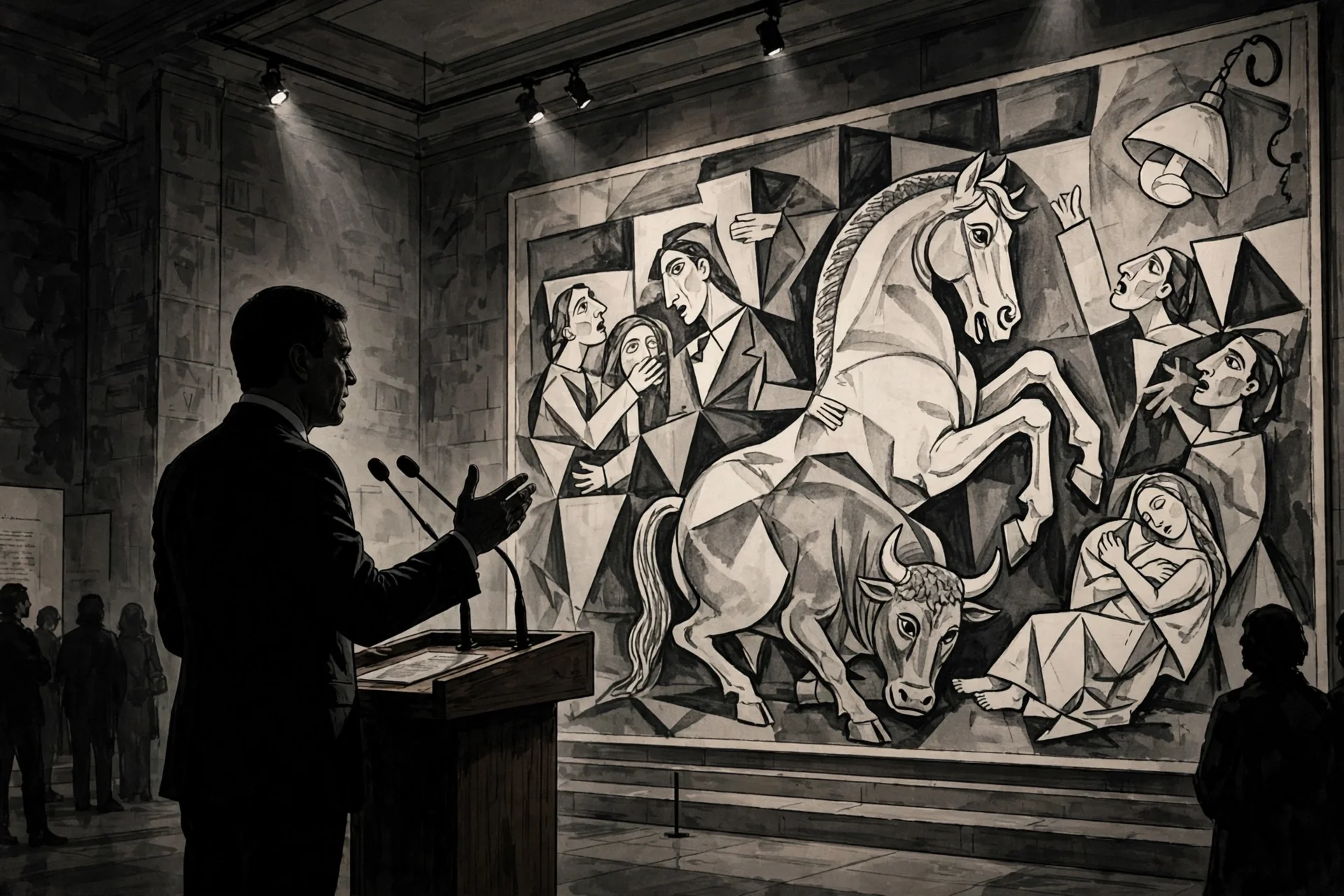
Imagen alusiva generada para esta cobertura. · Erick Prometeo Media
Sánchez invokes No to War before the Guernica
Spanish prime minister Pedro Sánchez, a candidate for re-election, posted a video this Saturday before the Guernica invoking No to War, boasting of holding the…
Sánchez turns No to War into a campaign argument
Pedro Sánchez released a video this Saturday before the Guernica invoking No to War and his coherence without double standards, rejecting a rise in military…
--- The context ---
Pedro Sánchez, Spain's prime minister and a candidate for re-election, chose a setting heavy with symbolism this Saturday to defend his government's line on wars. In a video posted on his official profile, he appears at the Museo Nacional Centro de Arte Reina Sofía, before Picasso's Guernica, a work that the message itself links to what happens when barbarism prevails over reason.
--- The facts ---
Sánchez said that Spain has argued that no war is inevitable, that no life is worth less than another and that looking the other way should never be an option.
He also acknowledged that holding that position has not been easy and that it has been maintained despite enormous pressure, in Europe and beyond, according to his account.
--- The positions ---
The prime minister tied that stance to concrete decisions by his government.
He said that, while some bet on bombs, his government said No to War, and that, while others demanded raising military spending to 5% of GDP, the Socialists refused to cut a single cent from the welfare state. In the same vein, he said that, when many stayed silent, his government denounced what he describes as the genocide of the Palestinian people in Gaza.
--- What remains unknown ---
The video does not detail which concrete measures will accompany that defense of principles in future conflicts, nor how the coexistence that the prime minister presents as a central idea will be sustained in practice. Nor does it specify what room for maneuver Spain will have in the face of the pressures that Sánchez himself acknowledges having received during these years.
--- Unanswered questions ---
How will the government translate that defense of principles into concrete decisions in each new conflict? Can it sustain its refusal to raise military spending without straining relations with its partners? What steps will Spain take to advance the coexistence that Sánchez presents as the answer even in the darkest moments?
--- EPM analysis ---
The message combines historical memory, foreign policy and defense of the welfare state in a single piece. By standing before the Guernica, Sánchez connects his anti-war stance with a recognized symbol of the suffering caused by war, and organizes his speech around coherence: the same principles, in his telling, applied to every conflict and without double standards.
📌 EPM Take: In EPM's view, the strength of the message is that it joins principle and program: rejecting war, according to Sánchez, is not an isolated gesture but a line his government says it has maintained in Europe and beyond, even under pressure. That coherence will be credible to the extent that it translates into verifiable decisions and an equally firm defense of the welfare state that the prime minister refuses to cut in order to fund greater military spending.
--- The context ---
Spain's prime minister, Pedro Sánchez, a candidate for re-election, released a video this Saturday on his official profile, recorded before the Guernica at the Museo Nacional Centro de Arte Reina Sofía. In it, he revives the spirit of No to War and boasts of having kept the same principles in every conflict of recent years, without double standards, in his own formulation.
--- The facts ---
In the video, Sánchez maintains that Spain has argued that no war is inevitable, that no life is worth less than another and that looking the other way should never be an option.
He also acknowledges that holding that position has not been easy and that it has been done despite enormous pressure, inside and outside Europe, according to his presentation.
--- The positions ---
Sánchez poses a closed choice: against those who, in his account, bet on bombs, his government said No to War; against those who demanded raising military spending to 5% of GDP, the Socialists refused to cut a single cent from the welfare state.
He adds that, while many stayed silent, his government denounced what he describes as the genocide of the Palestinian people in Gaza.
--- What remains unknown ---
The video does not explain how that refusal fits with the defense commitments Spain maintains with its partners, nor what cost holding it would carry if the pressures grow. Nor does it clarify whether the message foreshadows new government decisions or whether it simply claims, as a balance sheet, the course followed so far by the Socialists in office.
--- Unanswered questions ---
Is this video a statement of principles or the opening of an electoral argument ahead of the re-election bid? How does the government reconcile rejecting higher military spending with the demands of its partners? What practical consequences will that stance have if the pressures Sánchez himself mentions intensify again in the coming months?
--- EPM analysis ---
The piece is built as a balance sheet in campaign key: a historic symbol, a familiar slogan and a firm defense of the welfare state. Its effectiveness will depend on whether voters read coherence or electoral calculation into it, a debate that the video's own format, with no rebuttal and no new specifics, leaves entirely open for others to settle.
📌 EPM Take: In EPM's view, the video works better as an electoral narrative than as an accounting of decisions, because it presents defense and social spending choices as a closed election between bombs and welfare. That simplification helps the candidate, but it leaves the underlying question unanswered: how Spain will sustain its position before its allies if the context demands greater military commitment while, at the same time, it wants to preserve intact, in full, every euro of the welfare state.
Sánchez reivindica el No a la guerra ante el Guernica
Pedro Sánchez, presidente del Gobierno y candidato a la reelección, publicó este sábado un vídeo ante el Guernica en el que reivindica el No a la guerra…
Sánchez convierte el No a la guerra en argumento de campaña
Pedro Sánchez difundió este sábado un vídeo ante el Guernica en el que reivindica el No a la guerra y su coherencia sin dobles raseros, rechaza subir el gasto…
--- El contexto ---
Pedro Sánchez, presidente del Gobierno y candidato a la reelección, eligió este sábado un escenario cargado de simbolismo para defender la línea de su Gobierno ante las guerras. En un vídeo publicado en su perfil oficial, aparece en el Museo Nacional Centro de Arte Reina Sofía, ante el Guernica de Pablo Picasso, una obra que el propio mensaje asocia con lo que sucede cuando la barbarie se impone a la razón.
--- Los hechos ---
Sánchez afirmó que España ha defendido que ninguna guerra es inevitable, que ninguna vida vale menos que otra y que mirar hacia otro lado no debería ser nunca una opción.
También reconoció que esa posición no ha sido fácil y que se ha mantenido pese a enormes presiones, tanto en Europa como en el resto del mundo, según su relato.
--- Las posiciones ---
El presidente vinculó esa postura con decisiones concretas de su Gobierno.
Señaló que, mientras unos apostaban por las bombas, su Ejecutivo dijo No a la guerra, y que, mientras otros exigieron aumentar el gasto militar al 5% del PIB, los socialistas rechazaron recortar un solo céntimo del Estado de Bienestar. Afirmó además que, cuando muchos guardaron silencio, su Gobierno denunció lo que él califica de genocidio del pueblo palestino en Gaza.
--- Lo que falta saber ---
El vídeo no detalla qué medidas concretas acompañarán esa defensa de principios en los próximos conflictos ni cómo se sostendrá en la práctica la convivencia que el presidente presenta como idea central. Tampoco precisa qué margen de maniobra tendrá España ante las presiones que el propio Sánchez reconoce haber recibido durante estos años.
--- Preguntas sin respuesta ---
¿Cómo traducirá el Gobierno esa defensa de principios en decisiones concretas ante cada nuevo conflicto? ¿Podrá sostener el rechazo al aumento del gasto militar sin tensar sus relaciones con sus socios? ¿Qué pasos seguirá España para impulsar la convivencia que Sánchez presenta como respuesta incluso en los momentos más oscuros?
--- Análisis EPM ---
El mensaje combina memoria histórica, política exterior y defensa del Estado de Bienestar en una sola pieza. Al situarse ante el Guernica, Sánchez conecta su postura antibélica con un símbolo del sufrimiento causado por la guerra, y ordena su discurso en torno a la coherencia: los mismos principios, según él, aplicados en todos los conflictos y sin dobles raseros.
📌 Conclusion EPM: A juicio de EPM, la fuerza del mensaje está en que une principio y programa: rechazar la guerra, según Sánchez, no es un gesto aislado, sino una línea que su Gobierno dice haber mantenido en Europa y fuera de ella, incluso bajo presión. Esa coherencia será creíble en la medida en que se traduzca en decisiones verificables y en una defensa igualmente firme del Estado de Bienestar que el presidente se niega a recortar para financiar más gasto militar.
--- El contexto ---
El presidente del Gobierno, Pedro Sánchez, candidato a la reelección, difundió este sábado un vídeo en su perfil oficial grabado ante el Guernica, en el Museo Nacional Centro de Arte Reina Sofía. En él recupera el espíritu del No a la guerra y presume de haber mantenido los mismos principios en todos los conflictos de los últimos años, sin dobles raseros, según su propia formulación.
--- Los hechos ---
En el vídeo, Sánchez sostiene que España ha defendido que ninguna guerra es inevitable, que ninguna vida vale menos que otra y que mirar hacia otro lado no debería ser nunca una opción.
Reconoce, además, que sostener esa posición no ha sido fácil y que se ha hecho pese a enormes presiones, dentro y fuera de Europa, de acuerdo con su exposición.
--- Las posiciones ---
Sánchez plantea una disyuntiva cerrada: frente a quienes, según él, apostaban por las bombas, su Gobierno dijo No a la guerra; frente a quienes exigieron elevar el gasto militar al 5% del PIB, los socialistas se negaron a recortar un solo céntimo del Estado de Bienestar.
Y añade que, mientras muchos guardaron silencio, su Ejecutivo denunció lo que él califica de genocidio del pueblo palestino en Gaza.
--- Lo que falta saber ---
El vídeo no explica cómo encaja ese rechazo con los compromisos de defensa que España mantiene con sus socios ni qué coste tendría sostenerlo si las presiones aumentan. Tampoco aclara si el mensaje anticipa decisiones nuevas del Gobierno o si se limita a reivindicar, en clave de balance, la trayectoria seguida hasta ahora por los socialistas.
--- Preguntas sin respuesta ---
¿Es este vídeo una declaración de principios o el arranque de un argumento electoral de cara a la reelección? ¿Cómo compatibiliza el Gobierno el rechazo a elevar el gasto militar con las exigencias de sus socios? ¿Qué consecuencias prácticas tendrá esa postura si las presiones que el propio Sánchez menciona vuelven a intensificarse?
--- Análisis EPM ---
La pieza está construida como un balance en clave de campaña: un símbolo histórico, una consigna conocida y una defensa cerrada del Estado de Bienestar. Su eficacia dependerá de si los votantes leen en ella coherencia o cálculo electoral, una discusión que el propio formato del vídeo, sin réplica ni concreciones nuevas, deja completamente abierta.
📌 Conclusion EPM: A juicio de EPM, el vídeo funciona mejor como relato electoral que como rendición de cuentas, porque presenta las decisiones de defensa y de gasto social como una elección cerrada entre bombas y bienestar. Esa simplificación ayuda al candidato, pero deja sin responder la pregunta de fondo: cómo sostendrá España su posición ante sus aliados si el contexto exige más compromiso militar y, al mismo tiempo, quiere preservar intacto, en su totalidad, cada euro del Estado de Bienestar.