Florida seeks federal aid after Isaias: 46,509 claims in 15 counties
Governor Ron DeSantis requested a federal major disaster declaration on October 16 for 15 Panhandle counties hit by Hurricane Isaias.
Isaias in Florida: an orderly federal request for 15 Panhandle counties
Florida submitted its request for a federal major disaster declaration on October 16 after Hurricane Isaias, seeking public assistance for 15 counties and…
--- The context ---
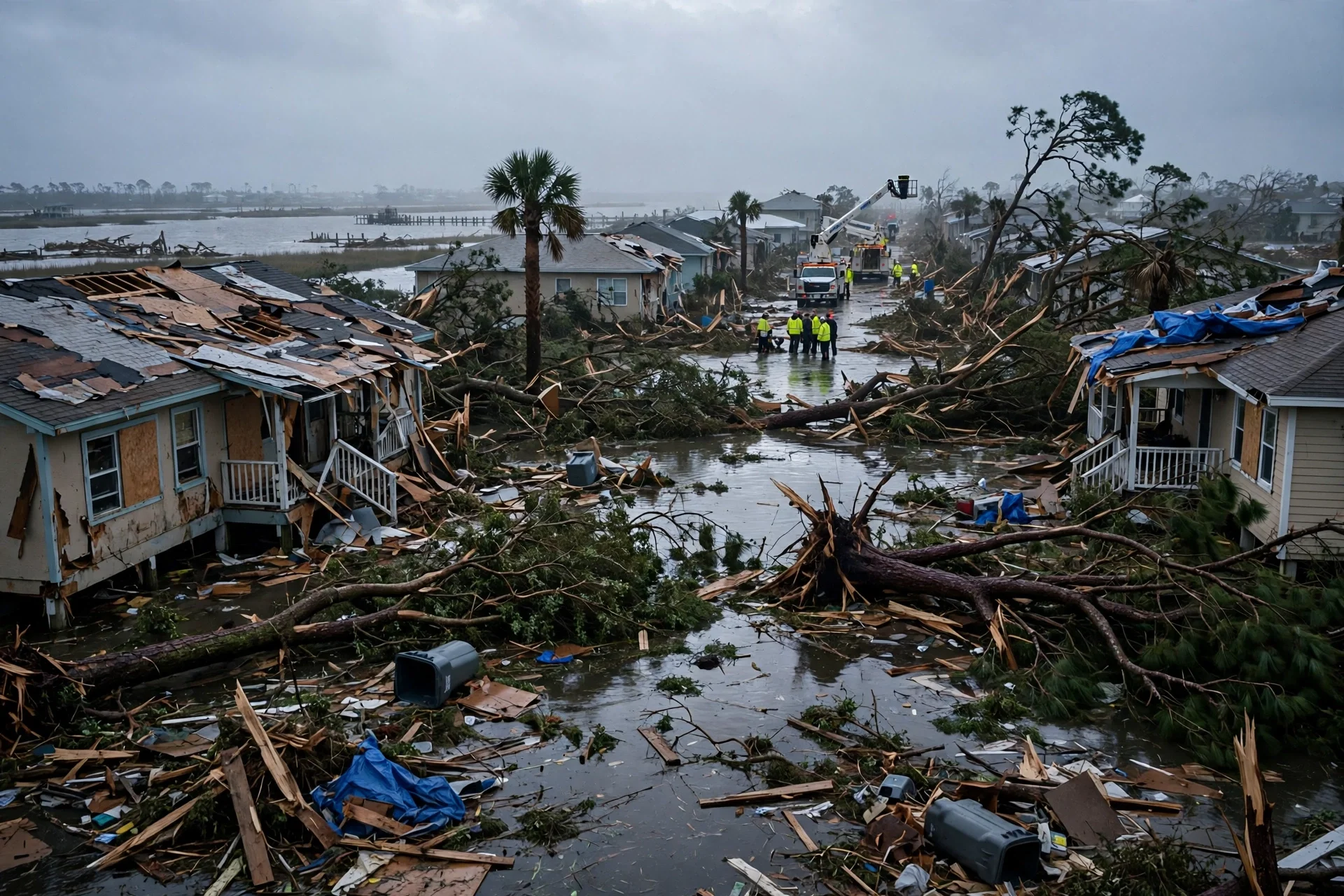
Hurricane Isaias swept through northwestern Florida and left its heaviest damage across the Panhandle, the northern strip of the state. Homes with destroyed roofs, damaged businesses and mass power outages defined the first days, as emergency crews cleared roads and assessed damage.
The central question now is who pays for which part of the recovery. Private policies cover whatever each contract includes, while federal assistance, if approved, can fund public costs and support residents who meet requirements. These are two different mechanisms.
--- The facts ---
Governor Ron DeSantis requested a federal major disaster declaration on October 16, in a petition addressed to President Donald Trump. The first tally from the state insurance regulator, dated October 15, counted 46,509 insurance claims and insured losses of around USD 582 million. The estimate is preliminary and may change as inspections and coverage decisions advance.
Homeowner policies accounted for most cases, with approximately 35,000 home claims and USD 558.6 million in estimated losses. The rest covered other properties, automobiles and commercial damage. Santa Rosa recorded 22,894 claims and Escambia 13,677, followed by Okaloosa with 4,334. Gusts reached 187 km/h (116 mph) in parts of Escambia and Santa Rosa, and more than 439,000 electricity accounts remained without power the following day.
--- The positions ---
The state request covers public assistance for 15 counties: Bay, Calhoun, Escambia, Franklin, Gadsden, Gulf, Holmes, Jackson, Jefferson, Liberty, Okaloosa, Santa Rosa, Wakulla, Walton and Washington. That program can fund governments and certain nonprofit organizations for debris removal, emergency measures and the repair of roads, bridges and public buildings.
The request also includes individual assistance for eligible residents of Bay, Escambia, Gulf, Holmes, Okaloosa, Santa Rosa, Walton and Washington. If approved, households meeting federal criteria could seek help with temporary housing, basic repairs and essential goods. Eligibility is not automatic.
--- What remains unknown ---
The federal decision is still pending and will determine which programs are activated and which expenses receive funds. Insurers must also complete inspections, so claims and totals may change. The total cost is likewise unknown, because the USD 582 million covers only reported insured losses.
--- Unanswered questions ---
When will the federal government rule on the declaration requested on October 16?
How much will the 46,509 claims and USD 582 million change once inspections are finished?
How many households in the eight counties listed for individual assistance will meet the requirements?
What share of the total damage will fall outside any coverage, public or private?
--- EPM analysis ---
The gap between the insured tally and the real damage deserves attention. One modeling firm estimated private insured losses of around USD 3,000 million in the United States and another calculated between USD 2,500 million and USD 4,500 million, using different models and territories than the Florida count. Standard homeowner policies usually exclude flood damage, governed by a specific federal program.
📌 EPM Take:
In EPM's view, the major disaster request is the right and urgent step, because the damage concentrated in Santa Rosa and Escambia exceeds what counties can handle on their own. But federal aid does not replace the transparency insurers owe when processing each claim, nor the clarity residents deserve about what their policy actually covers, especially regarding flooding. The recovery will be fair only if public funds arrive with verifiable speed, if compensation is paid without unjustified delays, and if the cost that remains invisible today, borne by households without sufficient coverage, is measured and acknowledged publicly instead of hidden.
--- The context ---
The passage of Hurricane Isaias through northwestern Florida tested the response capacity of the Panhandle communities. Within hours, the storm damaged homes, businesses and vehicles and left hundreds of thousands of accounts without electricity. The immediate response fell to emergency crews, who cleared roads and assessed the damage.
With the emergency under way, the state activated the mechanism designed for such cases: asking for a federal major disaster declaration that unlocks recovery funds. It is not a blank check, because it activates programs with rules and evaluations.
--- The facts ---
Governor Ron DeSantis announced on October 16 that Florida had submitted the request for a federal major disaster declaration to President Donald Trump. The public assistance request covers 15 counties: Bay, Calhoun, Escambia, Franklin, Gadsden, Gulf, Holmes, Jackson, Jefferson, Liberty, Okaloosa, Santa Rosa, Wakulla, Walton and Washington. Approval is required before the requested programs can be activated.
In parallel, the state insurance regulator compiled the first tally, with data as of October 15: 46,509 claims and insured losses of around USD 582 million. Homeowner policies accounted for most of them, with approximately 35,000 home claims and USD 558.6 million in estimated losses. The remainder covered other properties, automobiles and commercial damage. Santa Rosa recorded 22,894 claims and Escambia 13,677, followed by Okaloosa with 4,334. Gusts reached up to 187 km/h (116 mph) in parts of Escambia and Santa Rosa, and more than 439,000 electricity accounts were still without supply the following day.
--- The positions ---
The requested public assistance can fund governments and certain nonprofit organizations for concrete tasks: debris removal, emergency measures and the repair of roads, bridges and public buildings.
The request also contemplates individual assistance for eligible residents of Bay, Escambia, Gulf, Holmes, Okaloosa, Santa Rosa, Walton and Washington. If approved, households meeting federal criteria could apply for help with temporary housing, basic repairs and essential goods. The design is conditional: living in an included county does not create automatic eligibility.
--- What remains unknown ---
Federal approval is still missing, and with it the definition of which expenses will receive funds. The tally must also mature, because the USD 582 million is preliminary and may vary with inspections. The total cost is likewise missing from that figure.
--- Unanswered questions ---
Will the federal government approve the declaration, and with what scope for the 15 counties?
How will the 46,509 claims evolve once inspections and coverage determinations are complete?
Which specific expenses of local governments will be declared eligible under public assistance?
How many residents of the eight counties with individual assistance will prove they meet the requirements?
--- EPM analysis ---
The contrast between figures demands order. Against the Florida tally of USD 582 million, modeling companies projected private insured losses of around USD 3,000 million in one case and between USD 2,500 million and USD 4,500 million in another, for several states and with different models. Private insurance must also be distinguished from the federal flood program, which standard policies usually exclude.
📌 EPM Take:
In EPM's view, the correct order is the one the process itself imposes: first the local response, then a state request grounded in verified damage, and finally federal funds conditioned on eligible expenses and evaluations. That discipline protects the taxpayer while accelerating what is essential, with debris cleared, services restored and infrastructure repaired. Individual assistance, with requirements and documentation, reflects the same principle of helping those who prove the need, without turning an emergency into an automatic and indiscriminate allocation for every possible case at public expense.
Florida pide ayuda federal tras Isaias: 46.509 reclamos en 15 condados
El gobernador Ron DeSantis solicitó el 16 de octubre una declaración federal de desastre mayor para 15 condados del Panhandle afectados por el huracán Isaias.
Isaias en Florida: solicitud federal ordenada para 15 condados del Panhandle
Florida presentó el 16 de octubre su solicitud de declaración federal de desastre mayor tras el huracán Isaias, con asistencia pública para 15 condados y…
--- El contexto ---
El huracán Isaias atravesó el noroeste de Florida y dejó sus daños más graves en el Panhandle, la franja norte del estado. Viviendas sin techo, comercios afectados y cortes masivos de electricidad marcaron los primeros días, mientras los equipos de emergencia despejaban rutas y evaluaban daños.
La discusión central es quién paga cada parte de la recuperación. Las pólizas privadas cubren lo que contempla cada contrato, mientras que la ayuda federal, si se aprueba, puede financiar gastos públicos y apoyar a residentes que cumplan requisitos. Son mecanismos distintos.
--- Los hechos ---
El gobernador Ron DeSantis solicitó el 16 de octubre una declaración federal de desastre mayor ante el presidente Donald Trump. El primer balance del regulador estatal de seguros, con datos al 15 de octubre, contabilizó 46.509 reclamos y pérdidas aseguradas en torno a USD 582 millones. La estimación es preliminar y puede cambiar cuando avancen las inspecciones y las coberturas.
Las pólizas de propietarios concentraron la mayoría de los casos, con aproximadamente 35.000 reclamos de viviendas y USD 558,6 millones en pérdidas estimadas. El resto correspondió a otras propiedades, automóviles y daños comerciales. Santa Rosa registró 22.894 reclamos y Escambia 13.677, seguidos por Okaloosa con 4.334. Las ráfagas alcanzaron 187 km/h (116 mph) en sectores de Escambia y Santa Rosa, y más de 439.000 cuentas de electricidad seguían sin suministro al día siguiente.
--- Las posiciones ---
La petición estatal abarca asistencia pública para 15 condados: Bay, Calhoun, Escambia, Franklin, Gadsden, Gulf, Holmes, Jackson, Jefferson, Liberty, Okaloosa, Santa Rosa, Wakulla, Walton y Washington. Ese programa puede financiar a gobiernos y a determinadas organizaciones sin fines de lucro para remoción de escombros, medidas de emergencia y reparación de caminos, puentes y edificios públicos.
La solicitud contempla además asistencia individual para residentes elegibles de Bay, Escambia, Gulf, Holmes, Okaloosa, Santa Rosa, Walton y Washington. Si se aprueba, los hogares que cumplan los criterios federales podrían pedir ayuda para alojamiento temporal, reparaciones básicas y bienes esenciales. La elegibilidad no es automática.
--- Lo que falta saber ---
Falta la decisión federal, que determinará qué programas se activan y qué gastos recibirán fondos. Falta también que las aseguradoras completen inspecciones, por lo que reclamos y montos pueden modificarse. Y falta el costo total, porque los USD 582 millones solo reflejan pérdidas aseguradas notificadas.
--- Preguntas sin respuesta ---
¿Cuándo se pronunciará el gobierno federal sobre la declaración solicitada el 16 de octubre?
¿Cuánto cambiarán los 46.509 reclamos y los USD 582 millones cuando terminen las inspecciones?
¿Cuántos hogares de los ocho condados con asistencia individual cumplirán los requisitos para recibir ayuda?
¿Qué parte del daño total quedará fuera de toda cobertura, pública o privada?
--- Análisis EPM ---
La brecha entre el balance asegurado y el daño real exige atención. Una firma de modelización estimó pérdidas privadas aseguradas de alrededor de USD 3.000 millones en Estados Unidos y otra calculó entre USD 2.500 millones y USD 4.500 millones, con modelos y territorios distintos al conteo de Florida. Además, las pólizas convencionales suelen excluir los daños por inundación, regidos por un programa federal específico.
📌 Conclusion EPM:
A juicio de EPM, la solicitud de desastre mayor es el paso correcto y urgente, porque la magnitud concentrada en Santa Rosa y Escambia supera la capacidad de respuesta de los condados por sí solos. Pero la ayuda federal no sustituye la transparencia que deben las aseguradoras al procesar cada reclamo ni la claridad que merecen los residentes sobre qué cubre realmente su póliza, en especial frente a la inundación. La recuperación será justa solo si los fondos públicos llegan con rapidez verificable, si las indemnizaciones se pagan sin dilaciones injustificadas y si el costo hoy invisible de los hogares sin cobertura suficiente se mide y se reconoce públicamente.
--- El contexto ---
El paso del huracán Isaias por el noroeste de Florida puso a prueba la capacidad de respuesta de las comunidades del Panhandle. En pocas horas la tormenta dañó viviendas, comercios y vehículos y dejó a cientos de miles de cuentas sin electricidad. La respuesta inmediata corrió por cuenta de los equipos de emergencia, dedicados al despeje de rutas y a la evaluación de daños.
Con la emergencia en curso, el estado activó el mecanismo previsto: pedir una declaración federal de desastre mayor que habilite fondos de recuperación. No es un cheque en blanco, porque activa programas con reglas y evaluaciones que determinan qué se financia.
--- Los hechos ---
El gobernador Ron DeSantis anunció el 16 de octubre que Florida presentó ante el presidente Donald Trump la solicitud de declaración federal de desastre mayor. El pedido de asistencia pública abarca 15 condados: Bay, Calhoun, Escambia, Franklin, Gadsden, Gulf, Holmes, Jackson, Jefferson, Liberty, Okaloosa, Santa Rosa, Wakulla, Walton y Washington. La aprobación es requisito para que los programas solicitados puedan activarse.
En paralelo, el regulador estatal de seguros recopiló el primer balance, con datos al 15 de octubre: 46.509 reclamos y pérdidas aseguradas en torno a USD 582 millones. Las pólizas de propietarios concentraron la mayoría, con aproximadamente 35.000 reclamos de viviendas y USD 558,6 millones en pérdidas estimadas. El resto correspondió a otras propiedades, automóviles y daños comerciales. Santa Rosa registró 22.894 reclamos y Escambia 13.677, seguidos por Okaloosa con 4.334. Las ráfagas llegaron a 187 km/h (116 mph) en sectores de Escambia y Santa Rosa, y más de 439.000 cuentas seguían sin electricidad al día siguiente.
--- Las posiciones ---
La asistencia pública puede financiar a gobiernos y a determinadas organizaciones sin fines de lucro en tareas concretas: remoción de escombros, medidas de emergencia y reparación de caminos, puentes y edificios públicos.
La solicitud también contempla asistencia individual para residentes elegibles de Bay, Escambia, Gulf, Holmes, Okaloosa, Santa Rosa, Walton y Washington. De aprobarse, los hogares que cumplan los criterios federales podrían solicitar ayuda para alojamiento temporal, reparaciones básicas y bienes esenciales. El diseño es condicionado: residir en un condado incluido no genera elegibilidad automática.
--- Lo que falta saber ---
Falta la aprobación federal y la definición de qué gastos recibirán fondos. Falta también que el balance madure, porque los USD 582 millones son preliminares y pueden variar con las inspecciones. Y falta el costo total, que esa cifra no representa.
--- Preguntas sin respuesta ---
¿Aprobará el gobierno federal la declaración y con qué alcance para los 15 condados?
¿Cómo evolucionarán los 46.509 reclamos cuando concluyan las inspecciones y las coberturas?
¿Qué gastos concretos de los gobiernos locales serán declarados elegibles en la asistencia pública?
¿Cuántos residentes de los ocho condados con asistencia individual acreditarán los requisitos?
--- Análisis EPM ---
El contraste entre cifras exige orden. Frente a los USD 582 millones de Florida, las empresas de modelización proyectaron pérdidas privadas aseguradas de alrededor de USD 3.000 millones en un caso y entre USD 2.500 millones y USD 4.500 millones en otro, para varios estados y con modelos distintos. Tampoco debe confundirse el seguro privado con el programa federal contra inundaciones, que las pólizas convencionales suelen excluir.
📌 Conclusion EPM:
A juicio de EPM, el orden correcto es el que impone el propio trámite: primero la respuesta local, después la solicitud estatal fundada en daños verificados y por último fondos federales condicionados a gastos elegibles y evaluaciones. Esa disciplina protege al contribuyente y a la vez acelera lo esencial, con escombros retirados, servicios restaurados e infraestructura reparada. La asistencia individual, con requisitos y documentación, refleja el mismo principio de ayudar a quien acredita la necesidad, sin convertir la emergencia en una asignación automática e indiscriminada para todos los casos posibles.