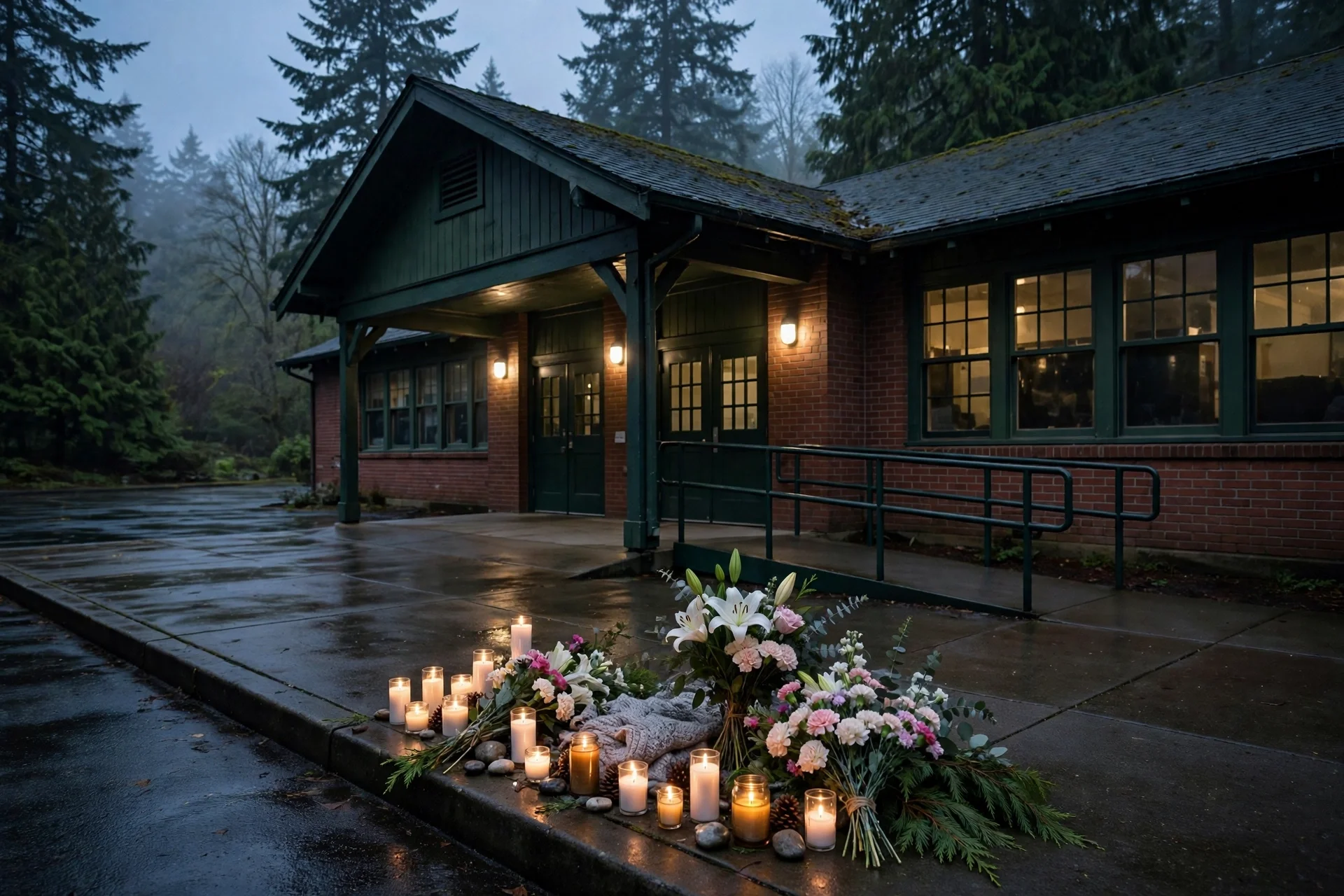
Memorial comunitario frente a una escuela primaria en Oregón. · Imagen generada para EPM
Father who stopped Bend school attack apologizes to families
Carpenter Kaylub Giamanco, 36, father of two Silver Rail Elementary students in Bend, described in an interview how he stopped the October 15 attacker…
Carpenter who protected Bend school speaks after the attack
Carpenter Kaylub Giamanco, 36, stopped the October 15 attacker at Silver Rail Elementary in Bend after seeing him fire outside, protected the special education…
--- The context ---
Silver Rail Elementary School in Bend, Oregon, is the school attended by the two daughters of Kaylub Giamanco, a 36-year-old carpenter who grew up in the same city as the oldest of seven siblings. His father left the family when he was 15 and his mother raised the children with limited resources. On October 15, the day of the attack, his daughters had attended the school photo session.
--- The facts ---
At around 12.58 that day, a 16-year-old armed with a shotgun entered the school and killed three children and a teacher, while also wounding a girl and another teacher. Giamanco was returning home to have lunch with his wife when he saw the armed teenager on a nearby street and at first thought the long gun might be fake. That doubt ended when he saw him fire twice at a red pickup truck and shoot again toward a woman who was mowing the lawn at the school, before throwing the shotgun over a fence, climbing it and moving toward the building.
Giamanco had taken Brentwood Avenue four blocks from home and passed the school during the attack. He opened the center console of his truck, where he kept a .40 caliber pistol that he hardly used, took the magazine from another compartment and asked for 911 to be called. After climbing the fence, he moved along the opposite side of the school yard so that he would not be exposed, heard shots against the glass doors and, crouching by the windows, heard children pleading for their lives amid further gunfire.
Inside the building he moved along the floor until he reached the special education classroom, where he saw a teacher struggling with the attacker, who was in profile and had not noticed him. He opened the door and fired, the teacher and the teenager fell to the floor and she ran out because she believed he was a second attacker. When the teenager tried to reach his weapon, Giamanco fired twice more to stop him from shooting anyone again. When he heard the sirens he left to look for the teacher, lowered his pistol and raised his hands when the first officer appeared.
--- The positions ---
In an interview with a public radio station in Oregon, Giamanco explained that he decided to tell what happened because, if he was going to have a voice, he wanted to use it to make the world a better place, while acknowledging that until then he had felt like just a carpenter from Bend. His mother tried to calm him by telling him that he had done the right thing and had saved lives, but he answered that he had not saved everyone. About the teacher who struggled with the attacker, he said that he still does not know her name, that her intervention gave him the time he needed to fire and that he considers her a true heroine whom he would like to embrace.
--- What remains unknown ---
The account known so far comes from Giamanco himself and leaves central questions open for the families and for the Bend community. His testimony does not give the name of the teacher who confronted the attacker in the classroom, nor does it provide details about how the wounded girl and teacher are recovering. It is also unknown whether his proposal to raise funds will move forward or when his daughters will be able to return to a normal school routine, after the family left their home to stay in a hotel and later in a temporary rental home.
--- Unanswered questions ---
Who is the teacher who struggled with the attacker in the special education classroom and whose name Giamanco still does not know? How are the girl and the teacher who were wounded during the October 15 attack recovering? Will the proposed motocross race to fund school safety measures actually take place? When will Giamanco daughters be able to return to a school routine after leaving their home?
--- EPM analysis ---
The strength of this testimony is that it is not offered as a celebration, but as an accounting marked by the guilt of someone who survived and acted. Giamanco attributes his reaction to a life of early responsibilities and to training he received years later from former service members, while he was working on the construction of a restaurant in Redmond, and he maintains that without that preparation he probably would not be alive today. His reflection does not stop at physical security, because he also thinks about the teenager he shot and suggests that greater support could prevent attacks like this one.
📌 EPM Take: In EPM's view, the value of this account lies in its uncomfortable honesty, because the man who stopped the attack does not hide behind the hero label that others give him and instead apologizes to the families for every life he did not manage to protect in time. That public apology, spoken through sleepless nights and returning memories of faces, voices and screams, is a reminder that behind every figure there are concrete households still waiting for answers and support. Listening to victims and to those who defended them, without turning their pain into spectacle, is the first duty of any responsible coverage of a school tragedy like this one.
--- The context ---
Kaylub Giamanco is a 36-year-old carpenter from Bend, Oregon, and the father of two students at Silver Rail Elementary School, the school attacked on October 15. He grew up in the city as the oldest of seven siblings, in a home that his mother sustained with limited resources after his father left the family when he was 15. His grandfather gave him a shotgun at 7 and taught him its handling, although as he grew older he set it aside for a time, studied geography and trained as a carpenter.
--- The facts ---
The attack happened at around 12.58 on October 15, the same day on which Giamanco daughters had attended the school photo session. A 16-year-old armed with a shotgun killed three children and a teacher and wounded a girl and another teacher. Giamanco was on his way home to have lunch with his wife when he saw him on a nearby street and at first believed the gun might be fake, until he saw him fire at a red pickup truck and toward a woman mowing the lawn, then climb the fence toward the building.
The carpenter opened the center console of his truck and took out a .40 caliber pistol that he kept there and hardly used, along with the magazine, which was in another compartment. He asked for 911 to be called and, during the call, decided to go in because he understood that people were going to die if nobody acted. He climbed the fence, advanced along the opposite side of the school yard, heard shots against the glass doors and, crouching by the windows, heard the children pleading for their lives.
Once inside, he moved along the floor to the special education classroom and saw a teacher struggling with the attacker, who was in profile and had not seen him. He opened the door and fired, both fell to the floor and the teacher fled because she believed he was a second attacker. When the teenager tried to reach his weapon, Giamanco fired twice more to make sure he could not move or shoot anyone again. When he heard the sirens he left the classroom, lowered his pistol and raised his hands as soon as the first officer appeared.
--- The positions ---
In an interview with a public radio station in Oregon, Giamanco maintained that his earlier training proved decisive, because years earlier, while working on the construction of a restaurant in Redmond, he met a client who was a veteran of the Iraq war and received preparation from other former service members who traveled to Bend, and he said that without that training he probably would not be alive today. His mother told him afterward to calm down, that he had done the right thing and that he was a hero who had saved lives, a judgment that he qualified by answering that he had not saved everyone. He also proposed organizing a motocross race to raise funds to strengthen school security, through bullet resistant glass, locks and security officers at every school.
--- What remains unknown ---
The testimony leaves unresolved matters that matter both to the families and to Giamanco himself. He acknowledges that he still does not know the name of the teacher who confronted the attacker and whose resistance gave him time to act. His account also does not specify how the wounded girl and teacher are doing now, or whether the fundraising initiative for security improvements will actually be held. His family remains away from their home, staying in a hotel and later in a temporary rental home, and his daughters will not return to the school for a time.
--- Unanswered questions ---
What is the name of the teacher who struggled with the attacker and whom Giamanco considers a true heroine? What is the current condition of the girl and the teacher who were wounded in the attack? Will the motocross race intended to pay for resistant glass, locks and security officers at schools actually happen? How long will the family remain away from their home and away from Silver Rail Elementary?
--- EPM analysis ---
This case returns a simple fact to the center of the debate, that the first response to an emergency rarely comes from a distant institution and often comes, instead, from the people who are already there and know those at risk. Giamanco did not act as a stranger, he acted as the father of two students who that same day had been at the school photo session, and his decision to go in is also explained by that closeness. His later proposal, focused on resistant glass, locks and officers at every school, holds that the protection of children should not depend on an armed father happening to drive past the school at lunchtime.
📌 EPM Take: In EPM's view, the firmest lesson from Bend is that school safety cannot rest on the chance that a prepared citizen happens to be in the exact place at the exact moment. Giamanco did what his conscience as a father required of him and still carries sleepless nights, returning faces and screams and the need to apologize to the families for not having saved all of their children. Honoring that effort means turning his proposal into real and sustained measures, with better protected schools and adults trained to respond, so that no other father has to choose between lunch at home and entering a classroom under fire.
El padre que detuvo el ataque en Bend pide perdón a las familias
Kaylub Giamanco, carpintero de 36 años y padre de dos alumnas de la escuela Silver Rail de Bend, relató en una entrevista cómo detuvo al atacante del 15 de…
Un carpintero protegió a su familia y a la escuela de Bend
El carpintero Kaylub Giamanco, de 36 años, detuvo el 15 de octubre al atacante de la escuela Silver Rail de Bend tras verlo disparar en el exterior, protegió…
--- El contexto ---
La escuela primaria Silver Rail, en Bend, Oregón, es el centro al que asistían las dos hijas de Kaylub Giamanco, un carpintero de 36 años que creció en esa ciudad como el mayor de siete hermanos. Su padre dejó a la familia cuando él tenía 15 años y su madre sostuvo el hogar con recursos limitados. El 15 de octubre, día del ataque, sus hijas habían participado en la sesión de fotos escolares.
--- Los hechos ---
Cerca de las 12.58 de ese día, un adolescente de 16 años armado con una escopeta irrumpió en el establecimiento y asesinó a tres niños y a una docente, además de herir a una niña y a otra maestra. Giamanco regresaba a casa para almorzar con su esposa cuando vio al joven armado en una calle cercana y al principio pensó que el arma larga podía ser falsa. La duda se disipó cuando lo vio disparar dos veces contra una camioneta roja y otra vez en dirección a una mujer que cortaba el césped de la escuela, antes de arrojar la escopeta sobre una reja, trepar el cerco y avanzar hacia el edificio.
Giamanco tomó la avenida Brentwood a cuatro cuadras de su casa y pasó frente a la escuela en pleno ataque. Abrió la consola central de su camioneta, donde guardaba una pistola calibre .40 que casi no usaba, tomó el cargador de otro compartimiento y pidió que se llamara al 911. Saltó el cerco, avanzó por el lado opuesto de la cancha para no quedar expuesto, oyó disparos contra las puertas de vidrio y, agachado junto a las ventanas, escuchó a niños que pedían ayuda entre nuevas detonaciones.
Dentro del edificio se desplazó por el suelo hasta el aula de educación especial, donde vio a una maestra forcejeando con el atacante, que estaba de perfil y no había advertido su presencia. Abrió la puerta y disparó, la docente y el adolescente cayeron al suelo y ella salió corriendo porque creyó que era un segundo atacante. Cuando el joven intentó alcanzar su arma, Giamanco disparó otras dos veces para impedir que volviera a disparar. Al oír las sirenas salió a buscar a la maestra, bajó la pistola y levantó las manos ante el primer policía.
--- Las posiciones ---
En una entrevista con una emisora pública de Oregón, Giamanco explicó que decidió contar lo ocurrido porque, si iba a tener una voz, quería usarla para hacer del mundo un lugar mejor, y reconoció sentirse hasta entonces como un carpintero más de Bend. Su madre trató de tranquilizarlo al decirle que había hecho lo correcto y que había salvado vidas, pero él le respondió que no había salvado a todo el mundo. Sobre la maestra que forcejeó con el atacante, afirmó que aún desconoce su nombre, que la intervención de ella le dio el tiempo necesario para disparar y que la considera una verdadera heroína a la que le gustaría abrazar.
--- Lo que falta saber ---
El relato conocido procede de la propia voz de Giamanco y deja abiertas cuestiones centrales. No se conoce en su testimonio el nombre de la maestra que se enfrentó al agresor, ni hay detalles sobre la evolución de la niña y la maestra heridas. Tampoco se sabe si su propuesta de recaudar fondos tendrá continuidad ni cuándo podrán sus hijas retomar una rutina escolar, tras dejar la familia su casa para alojarse en un hotel y luego en una vivienda temporal.
--- Preguntas sin respuesta ---
¿Quién es la maestra que forcejeó con el atacante en el aula de educación especial y cuyo nombre Giamanco aún desconoce? ¿Cómo evolucionan la niña y la maestra que resultaron heridas durante el ataque del 15 de octubre? ¿Llegará a organizarse la carrera de motocross propuesta para financiar medidas de seguridad en las escuelas? ¿Cuándo podrán las hijas de Giamanco volver a una rutina escolar tras haber dejado su casa?
--- Análisis EPM ---
La fuerza de este testimonio está en que no se presenta como una celebración, sino como una rendición de cuentas atravesada por la culpa de quien sobrevivió y actuó. Giamanco atribuye su reacción a una vida de responsabilidades tempranas y a un entrenamiento recibido años después de manos de exmilitares, mientras trabajaba en la construcción de un restaurante en Redmond, y sostiene que sin esa preparación probablemente no estaría vivo. Su mirada no se detiene solo en la seguridad física, porque también piensa en el adolescente al que disparó y plantea que una mayor contención podría evitar ataques como este.
📌 Conclusion EPM: A juicio de EPM, el valor de este relato está en su honestidad incómoda, porque quien detuvo el ataque no se refugia en la condición de héroe que otros le atribuyen y, en cambio, pide perdón a las familias por cada vida que no alcanzó a proteger a tiempo. Esa disculpa pública, pronunciada entre dificultades para dormir y recuerdos que regresan con rostros, voces y gritos, recuerda que detrás de cada cifra hay hogares concretos que siguen esperando respuestas y acompañamiento. Escuchar a las víctimas y a quienes las defendieron, sin convertir su dolor en espectáculo, es la primera obligación de cualquier cobertura responsable sobre una tragedia escolar como esta.
--- El contexto ---
Kaylub Giamanco es un carpintero de 36 años de Bend, Oregón, y padre de dos alumnas de la escuela primaria Silver Rail, el centro atacado el 15 de octubre. Creció en la ciudad como el mayor de siete hermanos, en un hogar que su madre sostuvo con recursos limitados después de que el padre dejara a la familia cuando él tenía 15 años. Su abuelo le regaló una escopeta a los 7 años y le enseñó su manejo, aunque al crecer la dejó un tiempo, estudió geografía y se formó como carpintero.
--- Los hechos ---
El ataque ocurrió cerca de las 12.58 del 15 de octubre, el mismo día en que las hijas de Giamanco habían asistido a la sesión de fotos escolares. Un adolescente de 16 años, armado con una escopeta, asesinó a tres niños y a una docente e hirió a una niña y a otra maestra. Giamanco volvía a casa para almorzar con su esposa cuando lo vio en una calle cercana y creyó al principio que el arma podía ser falsa, hasta que lo vio disparar contra una camioneta roja y hacia una mujer que cortaba el césped, y trepar el cerco hacia el edificio.
El carpintero abrió la consola central de su camioneta y tomó una pistola calibre .40 que guardaba allí y que casi no usaba, además del cargador, que estaba en otro compartimiento. Pidió que se llamara al 911 y, durante la comunicación, decidió entrar porque entendió que la gente iba a morir si nadie actuaba. Saltó el cerco, avanzó por el lado opuesto de la cancha, oyó disparos contra las puertas de vidrio y, agachado junto a las ventanas, escuchó a los niños pedir por sus vidas.
Ya dentro, se desplazó por el suelo hasta el aula de educación especial y vio a una maestra forcejeando con el atacante, que estaba de perfil y no lo había visto. Abrió la puerta y disparó, ambos cayeron al suelo y la docente huyó al creer que era un segundo atacante. Cuando el adolescente intentó alcanzar su arma, Giamanco disparó otras dos veces para asegurarse de que no pudiera volver a disparar contra nadie. Al escuchar las sirenas salió del aula, bajó la pistola y levantó las manos ante el primer policía.
--- Las posiciones ---
En una entrevista con una emisora pública de Oregón, Giamanco sostuvo que su entrenamiento previo resultó decisivo, porque años atrás, mientras trabajaba en la construcción de un restaurante en Redmond, conoció a un cliente veterano de la guerra de Irak y recibió preparación de otros exmilitares que viajaban a Bend, y afirmó que sin ese entrenamiento probablemente no estaría vivo. Su madre le dijo después que se calmara, que había hecho lo correcto y que era un héroe que había salvado vidas, una valoración que él matizó al responderle que no había salvado a todo el mundo. También propuso organizar una carrera de motocross para recaudar fondos con los que reforzar la seguridad de las escuelas, mediante cristales resistentes a balas, cerraduras y agentes de seguridad en cada establecimiento.
--- Lo que falta saber ---
El testimonio deja sin resolver aspectos que importan a las familias y al propio Giamanco. Él reconoce que aún desconoce el nombre de la maestra que se enfrentó al agresor y cuya resistencia le dio tiempo para actuar. Su relato tampoco precisa cómo se encuentran ahora la niña y la maestra heridas, ni si la iniciativa para financiar mejoras de seguridad llegará a celebrarse. Su familia permanece fuera de su casa, alojada en un hotel y luego en una vivienda temporal, y sus hijas no regresarán al establecimiento por un tiempo.
--- Preguntas sin respuesta ---
¿Cuál es el nombre de la maestra que forcejeó con el atacante y a la que Giamanco considera una verdadera heroína? ¿Cuál es el estado actual de la niña y de la maestra que resultaron heridas en el ataque? ¿Se concretará la carrera de motocross destinada a pagar cristales resistentes, cerraduras y agentes de seguridad en las escuelas? ¿Cuánto tiempo permanecerá la familia fuera de su casa y lejos de la escuela Silver Rail?
--- Análisis EPM ---
Este caso vuelve a poner en el centro una evidencia sencilla, que la primera respuesta ante una emergencia rara vez llega de una institución lejana y sí, muchas veces, de las personas que ya están en el lugar y conocen a quienes están en riesgo. Giamanco no actuó como un extraño, actuó como padre de dos alumnas que ese mismo día habían estado en la sesión de fotos del centro, y su decisión de entrar se explica también por esa cercanía. Su propuesta posterior, centrada en cristales resistentes, cerraduras y agentes en cada establecimiento, plantea que la protección de los niños no dependa de que un padre armado pase por casualidad frente a la escuela.
📌 Conclusion EPM: A juicio de EPM, la lección más firme de Bend es que la seguridad escolar no puede descansar en la casualidad de que un ciudadano preparado se encuentre en el lugar exacto en el momento exacto. Giamanco hizo lo que su conciencia de padre le exigió y aun así carga con dificultades para dormir, con rostros y gritos que regresan y con la necesidad de pedir perdón a las familias por no haber salvado a todos sus niños. Honrar ese esfuerzo obliga a convertir su propuesta en medidas reales y sostenidas, con centros mejor protegidos y adultos formados para responder, para que ningún otro padre tenga que entrar en un aula bajo fuego.