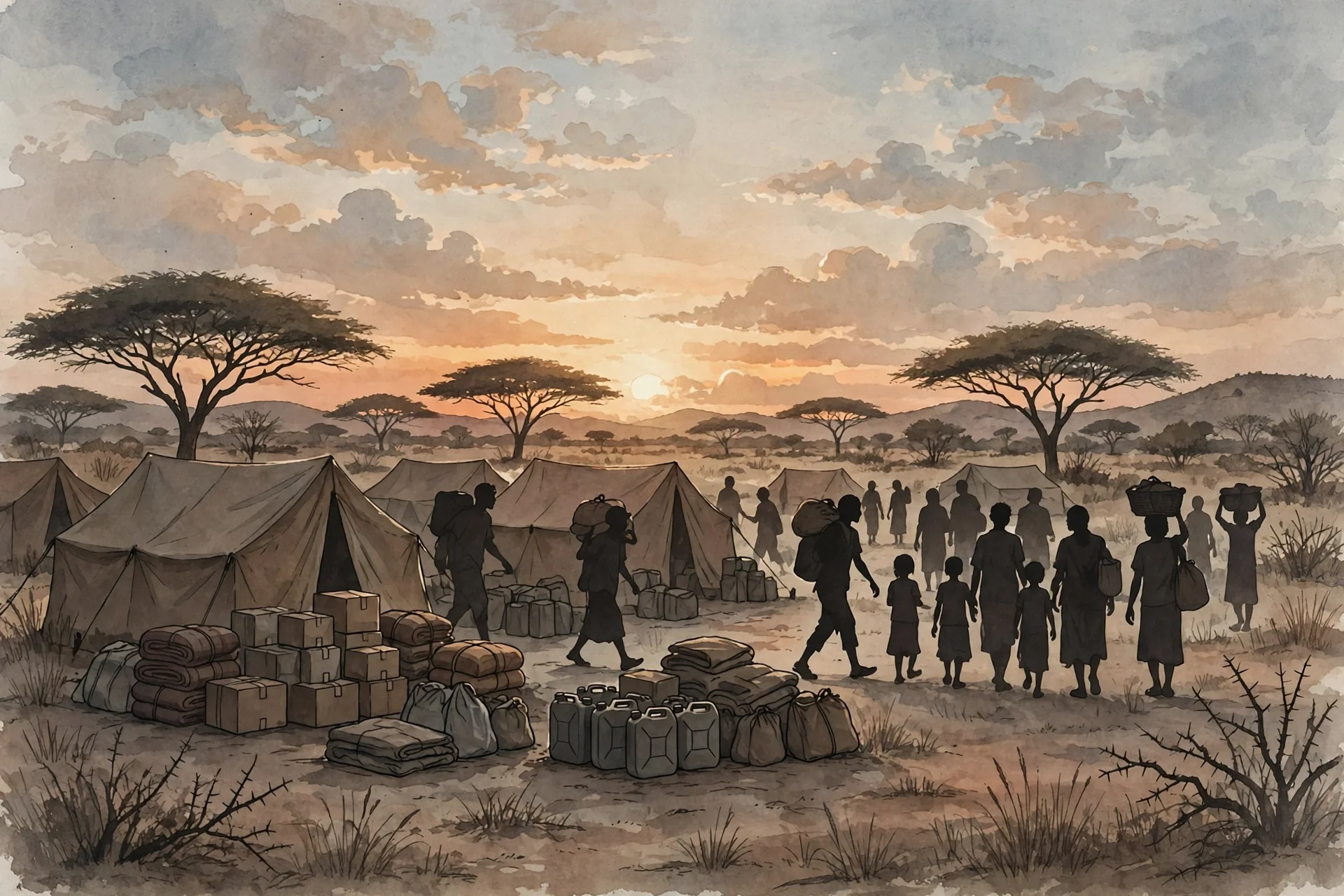
Illustrative image: a humanitarian aid camp at sunset in the Sahel. · Erick Prometeo Media
One year after El Fasher, the Coalition seeks justice for Sudan
One year after the 26 October 2025 atrocity in El Fasher, the Coalition on Atrocity Prevention and Justice for Sudan remembered victims and survivors, backed…
El Fasher one year on: no military solution, justice still pending
One year after the events of 26 October 2025 in El Fasher, the Coalition said there is no military solution to the conflict, called for full compliance with…
--- The context ---
One year ago, on 26 October 2025, violence in and around El Fasher reached a devastating peak following months of siege and escalating attacks by the Rapid Support Forces, according to the statement. The Coalition on Atrocity Prevention and Justice for Sudan, whose members are Canada, Denmark, the European Union, France, Germany, Ireland, the Netherlands, Norway, Sierra Leone, Sweden and the United Kingdom, marked the anniversary with a joint declaration.
--- The facts ---
The statement says civilians were subjected to atrocities including mass killings, ethnically motivated killings, summary executions, torture, disappearances, forced recruitment, arbitrary detentions and widespread sexual and gender-based violence. Entire communities were forcibly displaced and humanitarian access was obstructed, which, according to the text, exacerbated hunger, insecurity, human suffering and deprivation among the affected population.
The Coalition says the findings of the UN Fact-Finding Mission for Sudan laid bare the scale and severity of violations of international humanitarian law and of human rights law committed in and around El Fasher. The statement supports that mission, welcomes the renewal of its mandate, and also welcomes the work of the African Union's fact-finding mission.
--- The positions ---
One year on, the Coalition states that it remembers and recognises the suffering of victims and survivors and reaffirms its shared determination to prevent further atrocities and pursue accountability. The text stresses that justice and accountability are vital to achieving sustainable peace, and that those responsible for serious violations and abuses must be investigated and held to account.
The Coalition says it will keep working with Sudanese and international partners to support credible accountability processes, including the work of the International Criminal Court concerning Darfur, and meaningful transitional justice for the people of Sudan. It also highlights the crucial role of Sudanese human rights defenders and civil society, which often work at great personal risk.
--- What remains unknown ---
The statement warns that the risk of further large-scale atrocities in Sudan remains acute. Among the factors it cites are the systemic and widespread use of sexual violence, displacement, attacks on civilian infrastructure, the growing use of drones in attacks affecting civilians, and restrictions on humanitarian assistance. It describes those restrictions and repeated attacks on humanitarian actors and local and frontline responders as unacceptable.
--- Unanswered questions ---
Who will be held to account for the crimes committed in El Fasher, and when will those processes begin? How will safe, rapid and unimpeded humanitarian access be guaranteed in areas where it is now restricted? Will all states cease arming, financing or otherwise enabling the war and fully respect the arms embargo on Darfur?
--- EPM analysis ---
The statement combines remembrance with warning: it honours the victims of the anniversary while describing a present risk that has not closed. Its emphasis on international investigation, on the International Criminal Court and on transitional justice places accountability as a condition of peace, and its defence of Sudanese civil society recognises those who document abuses from within, at great personal risk.
📌 EPM Take:
In EPM's view, the value of this statement is that it does not treat El Fasher as a closed episode, but as an open obligation: to investigate, to protect and to guarantee unimpeded aid. Its most demanding point is the call to stop arming and financing the war, because it places responsibility also on states that enable it from outside. If that commitment does not translate into effective humanitarian access and credible accountability processes, the anniversary risks remaining a solemn gesture without consequences for victims or survivors.
--- The context ---
On 26 October 2025, after months of siege and escalating attacks by the Rapid Support Forces, violence in and around El Fasher reached a devastating peak, according to the statement from the Coalition on Atrocity Prevention and Justice for Sudan. The group, made up of Canada, Denmark, the European Union, France, Germany, Ireland, the Netherlands, Norway, Sierra Leone, Sweden and the United Kingdom, spoke out one year after those events.
--- The facts ---
The statement says civilians endured mass killings, ethnically motivated killings, summary executions, torture, disappearances, forced recruitment, arbitrary detentions and widespread sexual and gender-based violence. Entire communities were forcibly displaced and humanitarian access was obstructed, which, according to the text, worsened hunger, insecurity, suffering and deprivation.
According to the Coalition, the findings of the UN Fact-Finding Mission for Sudan exposed the scale and severity of violations of international humanitarian law and of human rights law in the area. The statement supports the mission's work, welcomes the renewal of its mandate, and also welcomes the work of the African Union's fact-finding mission and its collaboration with the UN.
--- The positions ---
The Coalition states that it remembers and recognises the suffering of victims and survivors and reaffirms its determination to prevent further atrocities and pursue accountability. In its position, justice is vital to achieving sustainable peace, and those responsible for serious violations and abuses must be investigated and held to account. No one, the text holds, should stand outside that scrutiny.
The statement supports credible accountability processes, including the work of the International Criminal Court concerning Darfur, and meaningful transitional justice for Sudan. It also recognises the crucial role of Sudanese human rights defenders and civil society, which support victims and document abuses, often at great personal risk, and it says victims of sexual violence must have safe and confidential access to medical, psychosocial and legal support.
--- What remains unknown ---
The text warns that the risk of further large-scale atrocities remains acute. It notes that systemic sexual violence, displacement, attacks on civilian infrastructure and a growing use of drones affecting civilians persist, alongside restrictions on humanitarian access and repeated attacks on aid workers and local responders. For the Coalition, that combination requires collective action to prevent a repetition of those events.
--- Unanswered questions ---
What concrete steps will follow so that those responsible are investigated and held to account? Who will guarantee the protection of civilians and safe, rapid and unimpeded humanitarian access while the conflict continues? Will all states fully respect UN sanctions, including the arms embargo on Darfur?
--- EPM analysis ---
The statement closes with a statement of principle: there is no military solution to this conflict and the war must end. Its call on all parties to comply fully with international humanitarian law, and on all states to cease arming, financing and otherwise enabling the war, sets a clear standard of conduct. The measure of its seriousness will be whether that demand is applied without exceptions and whether protecting civilians becomes the immediate priority.
📌 EPM Take:
In EPM's view, the strongest element of this statement is its order of priorities: first the protection of civilians and humanitarian access, then justice that makes those responsible answer for their acts. Its affirmation that there is no military solution and its demand to respect the arms embargo on Darfur place the weight where it belongs, on stopping the capacity to keep inflicting harm. The anniversary demands more than remembrance: it demands that these words become real protection for the Sudanese population.
Un año después de El Fasher, la Coalición pide justicia para Sudán
Al cumplirse un año de la atrocidad del 26 de octubre de 2025 en El Fasher, la Coalición para la Prevención de Atrocidades y la Justicia para Sudán recordó a…
El Fasher, un año después: sin solución militar y con justicia pendiente
A un año de los hechos del 26 de octubre de 2025 en El Fasher, la Coalición afirmó que no hay solución militar para el conflicto, exigió cumplir el derecho…
--- El contexto ---
Hace un año, el 26 de octubre de 2025, la violencia en El Fasher y sus alrededores alcanzó un pico devastador tras meses de asedio y de ataques de las Fuerzas de Apoyo Rápido. La Coalición para la Prevención de Atrocidades y la Justicia para Sudán, integrada por Canadá, Dinamarca, la Unión Europea, Francia, Alemania, Irlanda, Países Bajos, Noruega, Sierra Leona, Suecia y el Reino Unido, se pronunció en el aniversario.
--- Los hechos ---
La declaración sostiene que los civiles sufrieron atrocidades que incluyeron asesinatos en masa, asesinatos por motivos étnicos, ejecuciones sumarias, tortura, desapariciones, reclutamiento forzado, detenciones arbitrarias y violencia sexual y de género generalizada. Comunidades enteras fueron desplazadas por la fuerza y el acceso humanitario quedó obstruido, lo que agravó el hambre, la inseguridad y el sufrimiento.
La Coalición afirma que los hallazgos de la Misión de Investigación de la ONU para Sudán expusieron la escala y la gravedad de las violaciones del derecho internacional humanitario y de los derechos humanos cometidas en la zona. El pronunciamiento respalda a esa misión, celebra la renovación de su mandato y valora el trabajo de la misión de la Unión Africana y su colaboración con la ONU.
--- Las posiciones ---
Un año después, la Coalición recuerda y reconoce el sufrimiento de víctimas y supervivientes y reafirma su determinación de prevenir nuevas atrocidades y buscar rendición de cuentas. El texto subraya que la justicia es vital para una paz sostenible, y que los responsables de violaciones y abusos graves deben ser investigados y responder ante la justicia.
La Coalición señala que seguirá trabajando con socios sudaneses e internacionales para apoyar procesos creíbles de rendición de cuentas, incluido el trabajo de la Corte Penal Internacional sobre Darfur, y una justicia transicional significativa. También destaca el papel crucial de los defensores de derechos humanos y de la sociedad civil sudanesa, que a menudo trabajan con gran riesgo personal.
--- Lo que falta saber ---
La declaración advierte que el riesgo de nuevas atrocidades a gran escala en Sudán sigue siendo agudo. Entre los factores que cita figuran la violencia sexual sistemática, los desplazamientos, los ataques contra infraestructura civil, el uso creciente de drones que afecta a civiles y las restricciones a la asistencia humanitaria. El texto considera inaceptables esas restricciones y los ataques reiterados contra cooperantes.
--- Preguntas sin respuesta ---
¿Quién responderá ante la justicia por los crímenes cometidos en El Fasher y cuándo comenzarán esos procesos? ¿Cómo se garantizará un acceso humanitario seguro, rápido y sin obstáculos donde hoy está restringido? ¿Dejarán todos los Estados de armar, financiar o facilitar la guerra y respetarán plenamente el embargo de armas sobre Darfur?
--- Análisis EPM ---
El pronunciamiento combina memoria y advertencia: honra a las víctimas y describe un riesgo presente que no se ha cerrado. Su énfasis en la investigación internacional y en la justicia transicional sitúa la rendición de cuentas como condición de la paz, y su defensa de la sociedad civil sudanesa reconoce a quienes documentan los abusos desde dentro.
📌 Conclusion EPM:
A juicio de EPM, el valor de esta declaración está en que no trata El Fasher como un episodio cerrado, sino como una obligación abierta: investigar, proteger y garantizar ayuda sin obstáculos. Su punto más exigente es el llamado a dejar de armar y financiar la guerra, porque traslada la responsabilidad a los Estados que la facilitan desde fuera. Si ese compromiso no se traduce en acceso humanitario efectivo y en procesos creíbles de rendición de cuentas, el aniversario corre el riesgo de quedar en un gesto solemne sin consecuencias.
--- El contexto ---
El 26 de octubre de 2025, tras meses de asedio y de ataques de las Fuerzas de Apoyo Rápido, la violencia en El Fasher y sus alrededores llegó a un pico devastador, según la declaración de la Coalición para la Prevención de Atrocidades y la Justicia para Sudán. El grupo, formado por Canadá, Dinamarca, la Unión Europea, Francia, Alemania, Irlanda, Países Bajos, Noruega, Sierra Leona, Suecia y el Reino Unido, se pronunció al cumplirse un año de los hechos.
--- Los hechos ---
La declaración afirma que los civiles sufrieron asesinatos en masa, asesinatos por motivos étnicos, ejecuciones sumarias, tortura, desapariciones, reclutamiento forzado, detenciones arbitrarias y violencia sexual y de género generalizada. Comunidades enteras fueron desplazadas por la fuerza y el acceso humanitario fue obstruido, con lo que se agravaron el hambre, la inseguridad y el sufrimiento.
Según la Coalición, los hallazgos de la Misión de Investigación de la ONU para Sudán dejaron al descubierto la escala de las violaciones del derecho internacional humanitario y de los derechos humanos en la zona. El pronunciamiento respalda la labor de esa misión, celebra la renovación de su mandato y acoge el trabajo de la misión de la Unión Africana.
--- Las posiciones ---
La Coalición declara que recuerda y reconoce el sufrimiento de víctimas y supervivientes, y reafirma su determinación de prevenir más atrocidades y de buscar rendición de cuentas. En su posición, la justicia es vital para una paz sostenible, y los responsables de violaciones y abusos graves deben ser investigados y responder por ellos.
El pronunciamiento apoya procesos creíbles de rendición de cuentas, incluido el trabajo de la Corte Penal Internacional sobre Darfur, y una justicia transicional significativa. También reconoce el papel crucial de los defensores y de la sociedad civil sudanesa, que documentan los abusos con gran riesgo personal, y pide que las víctimas de violencia sexual tengan acceso seguro y confidencial a apoyo médico, psicosocial y legal.
--- Lo que falta saber ---
El texto advierte que el riesgo de nuevas atrocidades a gran escala sigue siendo agudo. Señala que persisten la violencia sexual sistemática, los desplazamientos, los ataques a infraestructura civil y un uso creciente de drones que afecta a civiles, además de restricciones al acceso humanitario y ataques contra cooperantes. Para la Coalición, ese conjunto exige actuar de forma colectiva para evitar que se repitan.
--- Preguntas sin respuesta ---
¿Qué pasos seguirán para que los responsables sean investigados y respondan ante la justicia? ¿Quién garantizará la protección de los civiles y un acceso humanitario seguro, rápido y sin obstáculos mientras el conflicto continúa? ¿Respetarán todos los Estados plenamente las sanciones de la ONU, incluido el embargo de armas sobre Darfur?
--- Análisis EPM ---
La declaración cierra con una afirmación de principio: no hay solución militar para este conflicto y la guerra debe terminar. Su llamado a cumplir plenamente el derecho internacional humanitario y a dejar de armar, financiar o facilitar la guerra fija una vara clara de conducta. La medida de su seriedad será si esa exigencia se aplica sin excepciones.
📌 Conclusion EPM:
A juicio de EPM, lo más sólido de este pronunciamiento es su orden de prioridades: primero la protección de los civiles y el acceso humanitario, después una justicia que haga responder a los responsables. Su afirmación de que no hay solución militar y su exigencia de respetar el embargo de armas sobre Darfur ponen el peso donde corresponde, en detener la capacidad de seguir haciendo daño. El aniversario obliga a que esas palabras se conviertan en protección real para la población sudanesa.