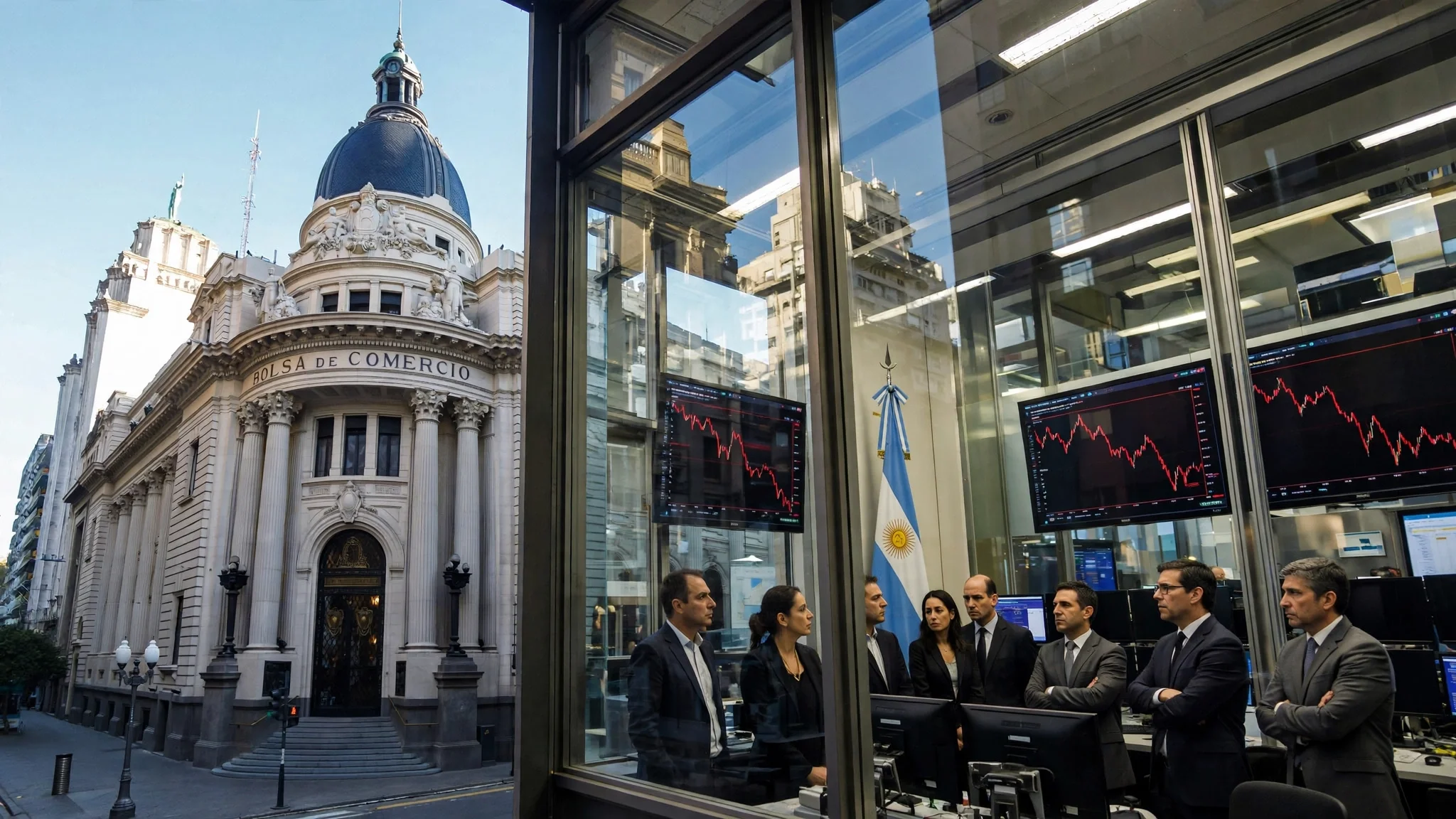
La Bolsa de Comercio de Buenos Aires y pantallas en rojo, imagen alusiva al impacto del resultado electoral brasileño en los mercados argentinos. · Erick Prometeo Media
Brazil effect: Argentine markets slide after Lula's runoff win
Lula da Silva's runoff victory in Brazil hit Argentine markets: the Merval fell 3%, Global bonds dropped 2.1%, country risk rose 57 units to 765 points and the…
Brazil effect: Argentine assets pay for the new uncertainty
After Lula da Silva's victory in Brazil, the Merval lost 3%, Global bonds fell 2.1%, country risk advanced 57 units to 765 points and the retail dollar reached…
--- The context ---
Brazil's runoff ended with Luiz Inácio Lula da Silva winning 51.79% of the vote against 48.21% for Flávio Bolsonaro, with 100 percent of ballot boxes counted in the official results. The outcome immediately reshaped investor expectations for the largest economy in the region and its neighbours.
Argentina watched that contest from a particularly sensitive position. Brazil is Argentina's main trading partner and both countries are the largest economies in Mercosur, so a shock to Brazilian assets passes through to local prices. President Javier Milei had also backed Bolsonaro during the campaign, adding a diplomatic question.
--- The facts ---
At the close, the MSCI Merval index of the Buenos Aires Stock Exchange cut 3%, to 99,227 points. Global bonds, dollar-denominated under Argentine law, fell 2.1% on average on Wall Street. Shares and sovereign debt fell together in one broad session of correction across Argentine assets.
The JP Morgan country risk index, which measures the spread between United States Treasury bond yields and similar emerging-market issues, rose 57 units for Argentina by 17:10 hours, to 765 basis points. That was its highest level since October 24 last year.
The retail dollar gained 10 pesos or 0.7%, to $1,560 for sale, according to the Banco Nación reference, a nominal record, and the blue dollar also gained ten pesos, to 1,575 pesos. On Wall Street, Argentine ADRs sank by up to 8%, led by Mercado Libre stock and the banks.
--- The positions ---
Flávio Bolsonaro did not concede defeat and announced that he will seek to have the election annulled. He challenged the Brazilian Supreme Federal Court's decision to extend voting hours by two hours, after complaints about voter transport, and argued in attributed terms that the measure broke equality among voters in different states.
From financial analysis, Mariano Sardáns of FDI said in remarks reported in the source that a real depreciating 10% against the dollar and a Bovespa falling -15% leave Brazil's stock market, in dollar terms, 25% lower. That scale, attributed to the analyst, helps explain the force of the regional contagion.
On the Argentine side there was no official statement after the result. Neither President Milei nor the Foreign Ministry issued any communication on the election, even though Milei actively backed Bolsonaro and launched strong attacks against Lula during the campaign. In July, Brazil had already recalled its ambassador in Buenos Aires for consultations.
--- What remains unknown ---
It remains unknown how Brazil will process the annulment bid announced by Bolsonaro, what scope that request will have and whether institutions will formally answer the challenges over the voting-hours extension. The first official Argentine reaction is also unknown, as is the tone the bilateral relationship will take between both partners.
--- Unanswered questions ---
Will Bolsonaro formally file the annulment request and what answer will he receive from the Brazilian authorities? Will Milei's government issue a statement on Lula's victory and in what terms will it do so? Will the Merval and Global bonds recover when markets reopen? How will this scenario affect bilateral trade inside Mercosur?
--- EPM analysis ---
The contagion was immediate because the transmission channels are concrete: a main trading partner, Argentine companies with decisive revenue in Brazil and sovereign debt sensitive to the external climate. When the real and Brazilian shares fall in dollar terms, investors unwind regional positions as a bloc and punish Argentine assets too.
📌 EPM Take:
In EPM's view, the session leaves a lesson in interdependence that Argentina cannot avoid: its main trading partner chose a government with which Milei holds an open dispute, and markets have already charged that tension to shares, bonds, the dollar and country risk. The priority now should be to separate campaign confrontation from managing a strategic relationship, because trade, companies exposed to Brazil and local financial stability need diplomatic predictability. If Buenos Aires takes too long to set a clear institutional position, uncertainty will keep trading every day in Argentine prices.
--- The context ---
Brazil decided its presidency in a runoff won by Luiz Inácio Lula da Silva, who took 51.79% of the vote against 48.21% for Flávio Bolsonaro, with 100 percent of ballot boxes counted in the official tally. Bolsonaro, son of former president Jair Bolsonaro, in office in 2019-2022, held the market's favourable expectations.
For Argentina, the outcome arrived with direct exposure. Brazil is Argentina's main trading partner and both countries are the largest economies in Mercosur, so a sharp correction in Brazilian assets does not stay across the border. President Javier Milei had also publicly backed Bolsonaro, turning the result into a political and economic matter.
--- The facts ---
At the close, the MSCI Merval index of the Buenos Aires Stock Exchange cut 3%, to 99,227 points, while Global bonds, dollar-denominated under Argentine law, fell 2.1% on average on Wall Street. The correction reached shares and debt at the same time, a sign of a broad regional exit.
The JP Morgan country risk index, which measures the spread between United States Treasury bond yields and similar emerging-market issues, rose 57 units for Argentina by 17:10 hours, to 765 basis points, its highest level since October 24 last year.
In the currency market, the retail dollar gained 10 pesos or 0.7%, to $1,560 for sale, according to the Banco Nación reference, a nominal record, and the blue dollar also gained ten pesos, to 1,575 pesos. On Wall Street, Argentine ADRs sank by up to 8%, led by Mercado Libre and the banks.
--- The positions ---
Bolsonaro did not concede defeat and announced that he will seek to have the election annulled. His challenge targeted the Brazilian Supreme Federal Court's decision to extend voting hours by two hours, after complaints about voter transport, and he argued in attributed terms that the measure broke equality among voters in different states.
Mariano Sardáns of FDI assessed in remarks reported in the source that a real depreciating 10% against the dollar and a Bovespa falling -15% leave Brazil's stock market, in dollar terms, 25% lower. That scale explains the speed of the contagion toward Argentine assets.
The Argentine government did not comment after Lula's victory. Neither President Milei nor the Foreign Ministry issued any communication on the result, even though Milei intervened actively in the campaign for Bolsonaro and launched strong attacks against Lula. In July, Brazil had already recalled its ambassador in Buenos Aires for consultations.
--- What remains unknown ---
It remains unknown whether Bolsonaro's annulment bid will formally advance and what answer Brazilian institutions will give. The first official signal from the Argentine government toward the new president of its main trading partner is also pending, and whether the correction was a one-session adjustment or longer pressure.
--- Unanswered questions ---
Will the annulment bid announced by Bolsonaro advance and on what formal grounds will it be presented in Brazil? When will Milei's government set an official position on Lula's victory? Can the Merval and Global bonds recover ground if pressure on Brazilian assets eases? How long will country risk stay near 765 basis points?
--- EPM analysis ---
The market reaction was less ideological than arithmetic: investors had priced in a different outcome in Brazil and corrected prices as a bloc when the result was the opposite. Argentina stood at the centre because of its trade link, its companies' exposure to Brazil and its debt's sensitivity to external conditions.
📌 EPM Take:
In EPM's view, the punishment of Argentine assets shows the immediate cost of uncertainty when the main trading partner changes political direction and the result contradicts what the market had priced in. The sensible response is not to deny the blow, but to manage it with predictability: a clear official position toward Brazil, respect for institutional channels and signals of stability so the correction does not become a trend. Argentina needs its link with the largest economy in Mercosur to work under stable rules, beyond campaign affinities.
Efecto Brasil: Argentina sintió el golpe del triunfo de Lula
El triunfo de Lula da Silva en la segunda vuelta brasileña golpeó a los mercados argentinos: el Merval cayó 3%, los bonos Globales retrocedieron 2,1%, el…
Efecto Brasil: los mercados argentinos pagaron la incertidumbre
Tras el triunfo de Lula da Silva en Brasil, el Merval perdió 3%, los bonos Globales cayeron 2,1%, el riesgo país avanzó 57 unidades hasta 765 puntos y el dólar…
--- El contexto ---
La segunda vuelta en Brasil terminó con el triunfo de Lula da Silva, que obtuvo 51,79% de los votos frente a 48,21% de Flávio Bolsonaro, con el 100 por ciento de las urnas escrutadas. El resultado reordenó las expectativas de los inversores sobre la mayor economía de la región.
Argentina llegó expuesta a esa definición. Brasil es el principal socio comercial de Argentina y ambos países son las mayores economías del Mercosur, por lo que una sacudida brasileña se traslada a los precios locales. Además, el presidente Javier Milei había respaldado a Bolsonaro durante la campaña.
--- Los hechos ---
Al cierre, el índice MSCI Merval de la Bolsa de Comercio de Buenos Aires recortó 3%, a los 99.227 puntos. Los bonos Globales, en dólares con ley argentina, retrocedieron 2,1% en promedio en Wall Street. Acciones y deuda cayeron juntas en una misma jornada de corrección.
El riesgo país de JP Morgan, que mide el diferencial de tasas entre los bonos del Tesoro de Estados Unidos y similares emisiones emergentes, ascendía a las 17:10 horas 57 unidades para Argentina, hasta los 765 puntos básicos, el nivel más alto desde el 24 de octubre del año pasado.
El dólar al público ganó 10 pesos o 0,7%, a $1.560 para la venta, según el Banco Nación, un máximo nominal, y el dólar blue también ganó diez pesos, a 1.575 pesos. En Wall Street, los ADR argentinos se hundían hasta 8%, con Mercado Libre y los bancos al frente.
--- Las posiciones ---
Flávio Bolsonaro no reconoció su derrota y anunció que pedirá la anulación de las elecciones. Cuestionó la decisión del Supremo Tribunal Federal brasileño de extender dos horas el horario de votación, tras denuncias sobre problemas en el transporte de electores, y sostuvo en términos atribuidos que esa medida alteró la igualdad entre votantes.
Desde el análisis financiero, Mariano Sardáns, de FDI, planteó en declaraciones recogidas en la fuente que un real que se deprecia 10% contra el dólar y un Bovespa que cae -15% dejan al mercado de acciones de Brasil, en dólares, 25% abajo. Esa magnitud ayuda a entender la fuerza del contagio regional.
Del lado argentino no hubo pronunciamiento oficial. Ni el presidente Milei ni la Cancillería emitieron comunicación alguna sobre los comicios, pese a que Milei respaldó activamente a Bolsonaro y lanzó fuertes ataques contra Lula durante la campaña. En julio, Brasil ya había convocado a consultas a su embajador en Buenos Aires.
--- Lo que falta saber ---
Todavía falta saber cómo procesará Brasil la impugnación anunciada por Bolsonaro, qué alcance tendrá el pedido de anulación y si habrá respuesta formal sobre la extensión del horario. También falta la primera reacción oficial argentina y el tono de la relación bilateral.
--- Preguntas sin respuesta ---
¿Presentará Bolsonaro formalmente el pedido de anulación y qué respuesta recibirá de las autoridades brasileñas? ¿Emitirá el gobierno de Milei un pronunciamiento sobre el triunfo de Lula y en qué términos lo hará? ¿Se recuperarán el Merval y los bonos Globales cuando reabran los mercados? ¿Cómo afectará este escenario al comercio bilateral dentro del Mercosur?
--- Análisis EPM ---
El contagio fue inmediato porque los canales de transmisión son concretos: un socio comercial principal, empresas argentinas con ingresos decisivos en Brasil y una deuda soberana sensible al clima externo. Cuando caen el real y las acciones brasileñas en dólares, el inversor desarma posiciones regionales en bloque y castiga los activos argentinos.
📌 Conclusion EPM:
A juicio de EPM, la jornada deja una lección de interdependencia que Argentina no puede eludir: su principal socio comercial eligió un gobierno con el que Milei mantiene una disputa abierta, y los mercados ya cobraron esa tensión en acciones, bonos, dólar y riesgo país. La prioridad ahora debería ser separar la confrontación de campaña de la gestión de una relación estratégica, porque el comercio, las empresas expuestas a Brasil y la estabilidad financiera necesitan previsibilidad diplomática. Si Buenos Aires tarda en fijar una posición institucional clara, la incertidumbre seguirá cotizando en los precios argentinos.
--- El contexto ---
Brasil definió su presidencia en segunda vuelta con el triunfo de Lula da Silva, que reunió 51,79% de los votos frente a 48,21% de Flávio Bolsonaro, con el 100 por ciento de las urnas escrutadas. El senador, hijo del ex presidente Jair Bolsonaro, en gestión entre 2019-2022, concentró las expectativas del mercado.
Para Argentina, el desenlace llegó con exposición directa. Brasil es el principal socio comercial de Argentina y ambos países son las mayores economías del Mercosur, de modo que una corrección brasileña no permanece del otro lado de la frontera. Milei, además, había respaldado públicamente a Bolsonaro.
--- Los hechos ---
Al cierre, el índice MSCI Merval de la Bolsa de Comercio de Buenos Aires recortó 3%, a los 99.227 puntos, mientras los bonos Globales, en dólares con ley argentina, retrocedieron 2,1% en promedio en Wall Street. La corrección alcanzó a acciones y deuda soberana.
El riesgo país de JP Morgan, que mide el diferencial de tasas entre los bonos del Tesoro de Estados Unidos y similares emisiones emergentes, ascendía a las 17:10 horas 57 unidades para Argentina, hasta los 765 puntos básicos, el nivel más alto desde el 24 de octubre del año pasado.
El dólar al público ganó 10 pesos o 0,7%, a $1.560 para la venta, según la referencia del Banco Nación, un máximo nominal, y el dólar blue también ganó diez pesos, a 1.575 pesos. En Wall Street, los ADR argentinos se hundían hasta 8%, con Mercado Libre y los bancos al frente.
--- Las posiciones ---
Bolsonaro no reconoció la derrota y anunció que pedirá la anulación de las elecciones. Cuestionó la decisión del Supremo Tribunal Federal brasileño de extender dos horas el horario de votación, tras denuncias sobre problemas en el transporte de electores, y planteó, en términos atribuidos, que quebró la igualdad entre votantes.
Mariano Sardáns, de FDI, evaluó en declaraciones recogidas en la fuente que un real que se deprecia 10% contra el dólar y un Bovespa que cae -15% dejan al mercado de acciones de Brasil, en términos de dólares, 25% abajo. Esa magnitud explica la velocidad del contagio argentino.
El gobierno argentino no se pronunció tras la victoria de Lula. Ni el presidente Milei ni la Cancillería emitieron comunicación sobre el resultado, pese a que Milei intervino activamente en la campaña a favor de Bolsonaro y lanzó fuertes ataques contra Lula. En julio, Brasil había convocado a consultas a su embajador en Buenos Aires.
--- Lo que falta saber ---
Aún falta saber si el pedido de anulación avanzará y qué respuesta darán las instituciones brasileñas. También falta la primera señal oficial argentina frente al nuevo presidente de su principal socio, y comprobar si la corrección fue de una rueda o más prolongada.
--- Preguntas sin respuesta ---
¿Avanzará el pedido de anulación anunciado por Bolsonaro y con qué fundamentos se presentará en Brasil? ¿Cuándo fijará el gobierno de Milei una posición oficial sobre el triunfo de Lula? ¿Podrán el Merval y los bonos Globales recuperar terreno si cede la presión brasileña? ¿Cuánto seguirá el riesgo país en torno a los 765 puntos básicos?
--- Análisis EPM ---
La reacción del mercado fue menos ideológica que aritmética: los inversores habían descontado un desenlace distinto en Brasil y corrigieron precios cuando el resultado fue el contrario. Argentina quedó en el centro por su vínculo comercial, por la exposición de sus empresas a Brasil y por su deuda sensible al exterior.
📌 Conclusion EPM:
A juicio de EPM, el castigo a los activos argentinos muestra el costo inmediato de la incertidumbre cuando el principal socio comercial cambia de signo político y el resultado contradice lo que el mercado había descontado. La respuesta sensata no es negar el golpe, sino administrarlo con previsibilidad: una posición clara hacia Brasil, respeto por los canales institucionales y señales de estabilidad para que la corrección no se convierta en tendencia. Argentina necesita que su vínculo con la economía mayor del Mercosur funcione con reglas estables, más allá de las afinidades de campaña.