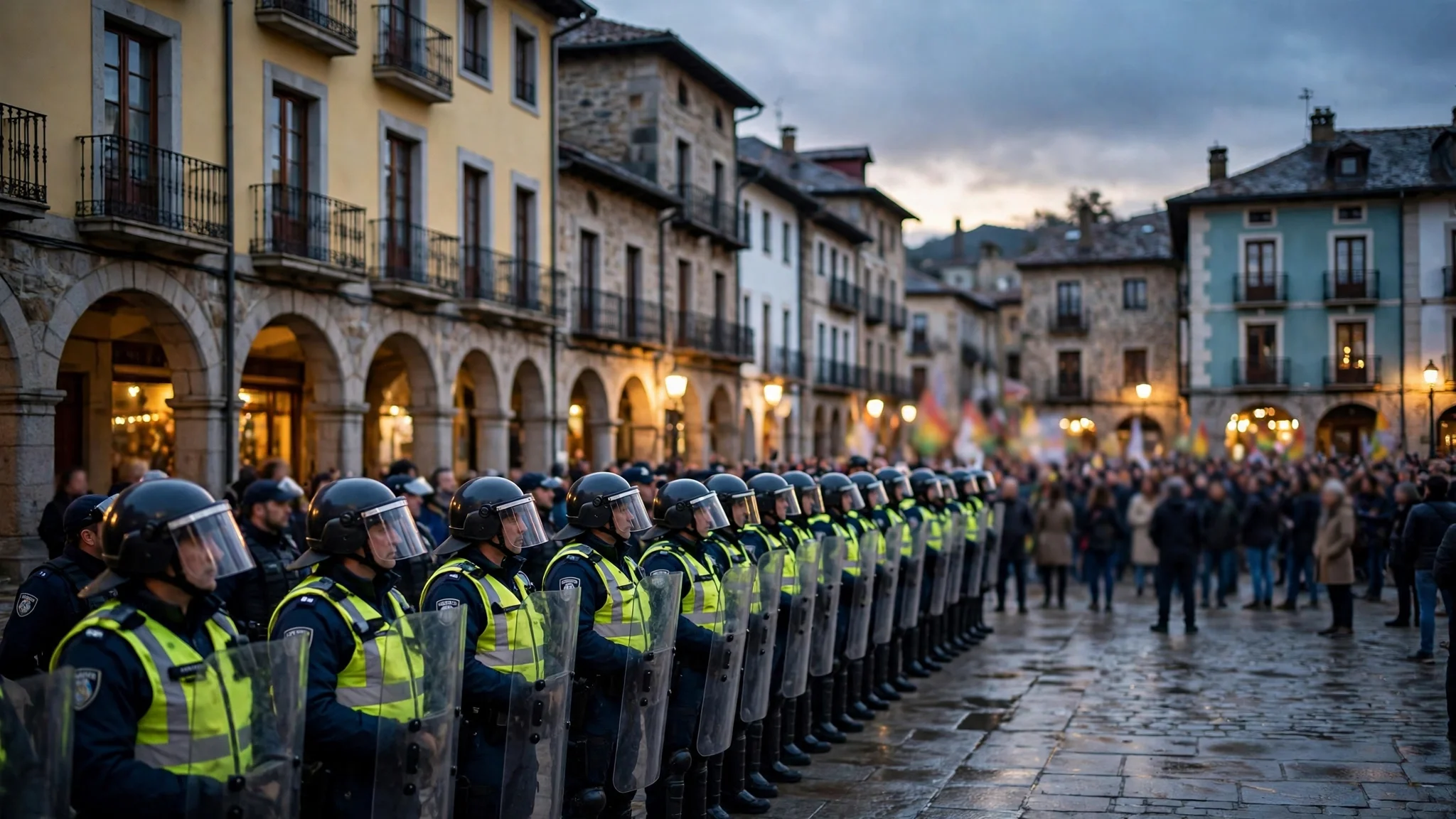
Un dispositivo policial en una plaza durante una jornada de protestas, en una imagen alusiva a los hechos de Avilés. · Erick Prometeo Media
Vox Sues Lastra Over Protection at Abascal Rally in Avilés
Vox has filed a complaint before the Court of First Instance in Avilés against Adriana Lastra, Cecilia Pérez and other possible officials over the incidents at…
Vox Files Complaint Over Violence at Abascal Event in Avilés
Vox has filed a complaint before the Court of First Instance in Avilés against Adriana Lastra, Cecilia Pérez and other possible officials over the lack of…
--- The context ---
Santiago Abascal, the Vox candidate for prime minister, held a public event on October 21 in Camposagrado square in Avilés. A counter-demonstration had been called just a few metres away and half an hour earlier. That overlap in time and place, together with serious disturbances that same morning in La Coruña during another Vox event, lies at the heart of the legal complaint now filed.
--- The facts ---
Vox said on Tuesday that it has filed a complaint before the Court of First Instance in Avilés against Adriana Lastra, the PSOE's lead candidate in Asturias and the central government's delegate until her removal was agreed on October 20, as well as against her successor at the delegation, Cecilia Pérez, and any other officials found responsible during the investigation.
According to the party's account, groups of demonstrators tried to force their way into the event, and there were fireworks and objects thrown, assaults on officers and damage to street furniture. The National Police arrested three people for public disorder. Vox also maintains that the delegation allowed the counter-demonstration to go ahead without changing its location or its timing.
--- The positions ---
The party's position is that this decision was taken despite knowledge of the serious disturbances that morning in La Coruña. It therefore asks for an investigation into the government delegation's decisions, the police operation deployed on the day and any criminal responsibilities that may arise from what happened in Avilés.
In its filing, Vox attributes to Lastra, Pérez and any other responsible authorities or officials an alleged offence of administrative prevarication by omission and an alleged offence of denial of assistance. Against the promoters linked to Asturies Antifascista, the Sindicato de Estudiantes and Izquierda Revolucionaria it alleges an electoral offence, incitement to hatred and violently preventing or seriously disrupting a meeting, in attempted form. For the material authors it seeks investigation of an alleged electoral offence, the offence under article 514.4 in attempted form, assault on officers, public disorder and damage.
--- What remains unknown ---
No public response from the people and institutions named is included in the available information, nor is there any known outcome yet from the investigation the complaint requests. It also remains unknown whether the court will admit the filing or what steps it might order regarding the police operation and the decisions taken beforehand.
--- Unanswered questions ---
Why was the counter-demonstration kept just a few metres away and half an hour earlier despite that morning's disturbances in La Coruña? What risk assessments did the government delegation make before allowing that overlap? Will Adriana Lastra and Cecilia Pérez respond publicly to the accusations the complaint attributes to them?
--- EPM analysis ---
The case brings together two demands that must be protected at the same time: the right of protesters to gather and the right of a party to hold a public event without violence. When two demonstrations share the same space, advance planning and a safe distance stop being administrative details and become the practical guarantee of those rights for everyone involved.
📌 EPM Take: In EPM's view, the complaint raises a legitimate question about how security in Avilés was planned, because keeping two opposing gatherings just a few metres apart required an especially careful risk assessment after the La Coruña disturbances. That does not make the accusations against Lastra, Pérez or the promoters proven, since today they are only one side's allegations. The investigation must separate political criticism from criminal responsibility, and do so with evidence rather than slogans of any kind.
--- The context ---
Camposagrado square in Avilés hosted an event by Santiago Abascal, the Vox candidate for prime minister, on October 21. A counter-demonstration had been called just a few metres away and half an hour earlier. That proximity, combined with disturbances recorded that same morning in La Coruña during another event by the party, forms the core of the complaint that has now been presented.
--- The facts ---
Vox said on Tuesday that it has filed a complaint before the Court of First Instance in Avilés against Adriana Lastra, the PSOE's lead candidate in Asturias and the central government's delegate until her removal was agreed on October 20, as well as against her successor at the delegation, Cecilia Pérez, and any other officials found responsible during the investigation.
According to the party's filing, groups of demonstrators tried to force their way into the event, and there were fireworks and objects thrown, assaults on officers and damage to street furniture, with three people arrested by the National Police for public disorder. Vox maintains that the delegation allowed the counter-demonstration to go ahead without changing its location or its timing.
--- The positions ---
The party asks for an investigation into the government delegation's decisions, the police operation and any criminal responsibilities arising from the events. In its view, the authorities knew the risk because serious disturbances had taken place that same morning in La Coruña during another of its events, and yet the rival gathering was not altered in any way.
The complaint attributes to Lastra, Pérez and any other responsible officials an alleged offence of administrative prevarication by omission and an alleged offence of denial of assistance. Against the promoters linked to Asturies Antifascista, the Sindicato de Estudiantes and Izquierda Revolucionaria it alleges an electoral offence, incitement to hatred and violently preventing or seriously disrupting a meeting, in attempted form. For the material authors of the violence it seeks investigation of an alleged electoral offence, the offence under article 514.4 in attempted form, assault on authority officers, public disorder and damage.
--- What remains unknown ---
For now, neither the path the filing will take before the court nor a public version from the people named is known. It remains to be established what documentation existed on the risk assessment, how the police operation was designed and what concrete responsibilities the investigation attributes to each of the parties mentioned in the complaint.
--- Unanswered questions ---
What risk reports did the government delegation have before the Avilés event? Why were the counter-demonstration's location and timing not changed after the La Coruña disturbances? Will the Court of First Instance in Avilés admit the complaint and order inquiries into the police operation?
--- EPM analysis ---
Public order is not a favour the administration grants to one party, but an obligation that protects equally those who hold an event and those who protest against it. If the planning failed, that must be known and corrected; if the accusations do not hold up, that must also be made clear. In both cases, the answer belongs to the investigation and not to partisan controversy.
📌 EPM Take: In EPM's view, ensuring that a political event can be held without objects being thrown or officers assaulted is a basic requirement of public order, and examining whether the delegation acted with due diligence is entirely reasonable. But the complaint contains allegations, not proven facts, and it would be unjust to treat Lastra, Pérez, the promoters or any detainee as guilty before the investigation and the court rule on tested evidence.
Vox se querella contra Lastra por la protección del acto de Abascal en Avilés
Vox ha presentado una querella ante el Tribunal de Instancia de Avilés contra Adriana Lastra, Cecilia Pérez y otros posibles responsables por los incidentes…
Querella de Vox por los incidentes del acto de Abascal en Avilés
Vox se ha querellado ante el Tribunal de Instancia de Avilés contra Adriana Lastra, Cecilia Pérez y otros posibles responsables por la falta de protección que…
--- El contexto ---
El acto de Santiago Abascal, candidato de Vox a la Presidencia, reunió el pasado 21 de octubre en la plaza de Camposagrado de Avilés a simpatizantes de la formación. A escasos metros del lugar y media hora antes se había convocado una contramanifestación, una coincidencia que está en el origen de la controversia que ahora llega a los tribunales.
--- Los hechos ---
Vox ha informado este martes de que ha formulado una querella ante el Tribunal de Instancia de Avilés contra Adriana Lastra, cabeza de lista del PSOE por Asturias y delegada del Gobierno hasta el cese acordado el 20 de octubre, así como contra su sucesora en la Delegación, Cecilia Pérez, y contra los demás responsables que resulten de la investigación, por los incidentes registrados durante ese acto.
Según el relato de la formación, grupos de manifestantes intentaron acceder por la fuerza al acto y se produjeron lanzamientos de petardos y objetos, agresiones a agentes y daños en el mobiliario urbano. La Policía Nacional detuvo a tres personas por desórdenes públicos.
--- Las posiciones ---
La posición de Vox es que esa decisión se adoptó pese a conocer los graves disturbios ocurridos esa misma mañana en La Coruña durante otro acto de la formación. Por ello solicita que se investiguen las decisiones de la Delegación del Gobierno, el dispositivo policial desplegado y las responsabilidades penales que pudieran derivarse de los hechos.
En su escrito, la formación atribuye a Lastra, a Pérez y a las demás autoridades o funcionarios que resulten responsables un presunto delito de prevaricación administrativa en su modalidad omisiva y un presunto delito de denegación de auxilio. Contra los promotores vinculados a Asturies Antifascista, el Sindicato de Estudiantes e Izquierda Revolucionaria alega un presunto delito electoral, uno de incitación al odio y otro de impedir o perturbar gravemente con violencia una reunión, en grado de tentativa. Para los autores materiales pide investigar un presunto delito electoral, el del artículo 514,4 en grado de tentativa, atentado contra agentes, desórdenes públicos y daños.
--- Lo que falta saber ---
Todavía no consta en la información disponible una respuesta pública de las personas e instituciones señaladas ni el resultado de la investigación que la querella solicita. Tampoco se conoce si el tribunal admitirá el escrito ni qué diligencias podría ordenar sobre el dispositivo policial y sobre las decisiones previas al acto.
--- Preguntas sin respuesta ---
¿Por qué se mantuvo la contramanifestación a escasos metros y media hora antes del acto pese a los disturbios de esa mañana en La Coruña? ¿Qué valoraciones de riesgo hizo la Delegación del Gobierno antes de autorizar esa coincidencia? ¿Se pronunciarán Adriana Lastra y Cecilia Pérez sobre las acusaciones que la querella les atribuye?
--- Análisis EPM ---
El caso combina dos exigencias que deben protegerse a la vez: el derecho de reunión de quienes protestan y el derecho de un partido a celebrar un acto público sin violencia. Cuando ambas manifestaciones coinciden en el mismo espacio, la planificación previa y la distancia de seguridad dejan de ser detalles administrativos y se convierten en la garantía práctica de esos derechos para todos.
📌 Conclusion EPM: A juicio de EPM, la querella plantea una pregunta legítima sobre cómo se planificó la seguridad de Avilés, porque mantener dos convocatorias enfrentadas a escasos metros exigía una valoración de riesgo especialmente cuidadosa tras los disturbios de La Coruña. Eso no convierte en probadas las acusaciones contra Lastra, Pérez o los promotores, que hoy son solo alegaciones de una parte. La investigación deberá separar la crítica política de la responsabilidad penal y hacerlo con datos, no con consignas de ningún signo.
--- El contexto ---
La plaza de Camposagrado de Avilés acogió el pasado 21 de octubre un acto de Santiago Abascal, candidato de Vox a la Presidencia. A escasos metros del lugar y media hora antes se había convocado una contramanifestación. Esa proximidad, unida a los disturbios de esa misma mañana en La Coruña durante otro acto de la formación, forma el núcleo de la querella.
--- Los hechos ---
Vox ha informado este martes de que ha formulado una querella ante el Tribunal de Instancia de Avilés contra Adriana Lastra, cabeza de lista del PSOE por Asturias y delegada del Gobierno hasta el cese acordado el 20 de octubre, así como contra su sucesora en la Delegación, Cecilia Pérez, y contra los demás responsables que resulten de la investigación.
De acuerdo con el escrito de la formación, grupos de manifestantes intentaron acceder por la fuerza al acto y se produjeron lanzamientos de petardos y objetos, agresiones a agentes y daños en el mobiliario urbano, con tres personas detenidas por la Policía Nacional por desórdenes públicos. Vox sostiene que la Delegación permitió que la contramanifestación siguiera adelante sin modificar su ubicación ni su horario.
--- Las posiciones ---
La formación pide que se investiguen las decisiones de la Delegación del Gobierno, el dispositivo policial y las responsabilidades penales derivadas de los hechos. En su criterio, las autoridades conocían el riesgo porque esa mañana se habían producido disturbios en La Coruña durante otro de sus actos, y aun así no se alteró la convocatoria contraria.
La querella atribuye a Lastra, a Pérez y a los demás responsables que resulten un presunto delito de prevaricación administrativa en su modalidad omisiva y un presunto delito de denegación de auxilio. Contra los promotores vinculados a Asturies Antifascista, el Sindicato de Estudiantes e Izquierda Revolucionaria alega un presunto delito electoral, uno de incitación al odio y otro de impedir o perturbar gravemente con violencia una reunión, en grado de tentativa. Para los autores materiales de la violencia reclama que se investiguen un presunto delito electoral, el del artículo 514,4 en grado de tentativa, atentado contra agentes de la autoridad, desórdenes públicos y daños.
--- Lo que falta saber ---
Por ahora no se conoce el recorrido que tendrá el escrito ante el tribunal ni una versión pública de las personas señaladas. Falta saber qué documentación existía sobre la valoración del riesgo, cómo se diseñó el dispositivo policial y qué responsabilidades atribuye la investigación a cada una de las partes mencionadas.
--- Preguntas sin respuesta ---
¿Qué informes de riesgo manejó la Delegación del Gobierno antes del acto de Avilés? ¿Por qué no se modificó la ubicación o el horario de la contramanifestación tras los disturbios de La Coruña? ¿Admitirá el Tribunal de Instancia de Avilés la querella y ordenará diligencias sobre el dispositivo policial?
--- Análisis EPM ---
El orden público no es un favor que la administración concede a un partido, sino una obligación que protege por igual a quien celebra un acto y a quien protesta contra él. Si la planificación falló, debe saberse y corregirse; si las acusaciones no se sostienen, también debe quedar claro. En ambos casos, la respuesta corresponde a la investigación y no a la controversia partidista.
📌 Conclusion EPM: A juicio de EPM, garantizar que un acto político pueda celebrarse sin lanzamientos ni agresiones es una exigencia básica del orden público, y examinar si la Delegación actuó con la diligencia debida es perfectamente razonable. Pero la querella contiene alegaciones, no hechos probados, y sería injusto dar por culpables a Lastra, Pérez, los promotores o cualquier detenido antes de que la investigación y el tribunal se pronuncien con pruebas contrastadas.