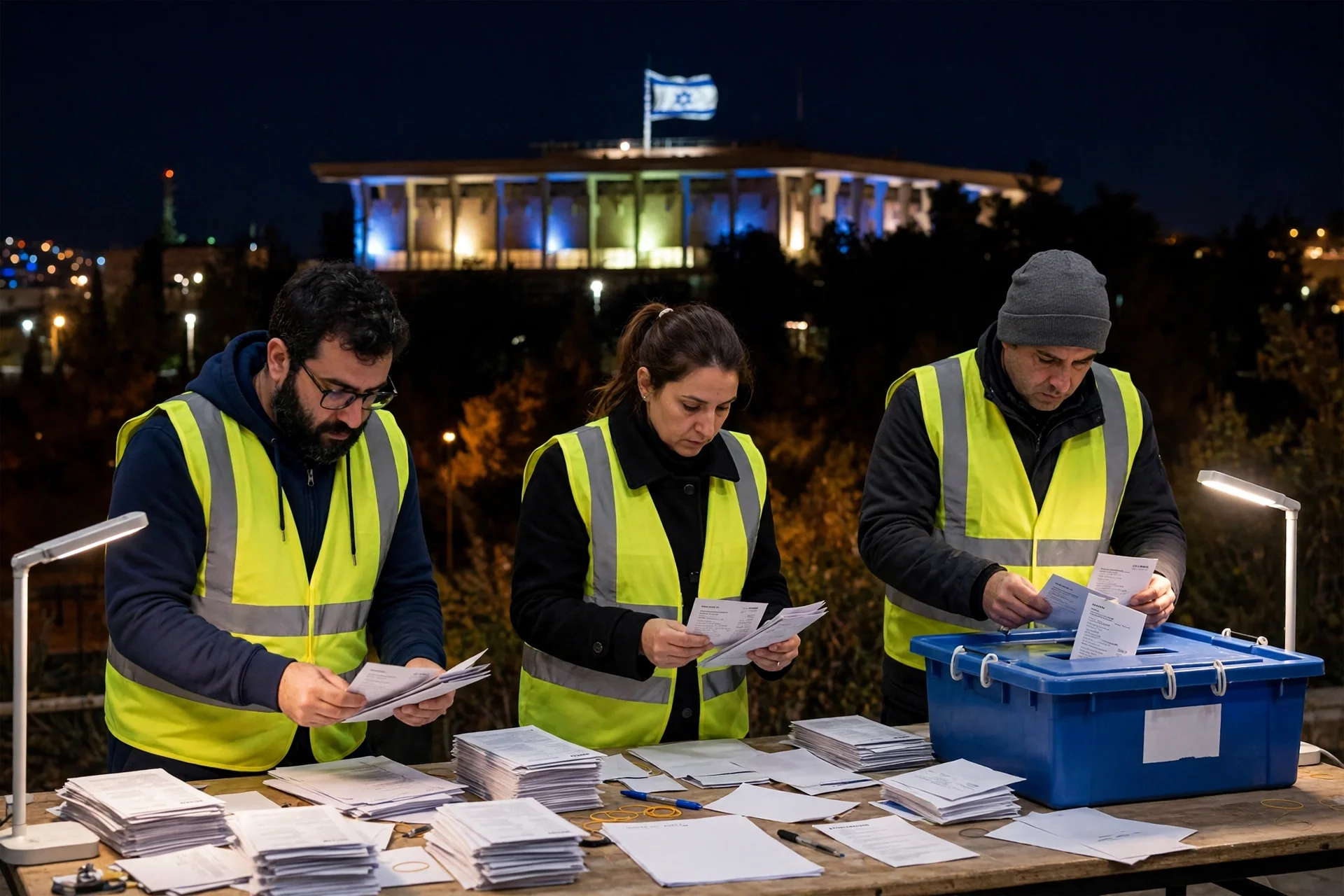
Imagen alusiva: conteo de papeletas en Israel, con la Knéset iluminada al fondo. · Erick Prometeo Media
With 53.7% counted, Netanyahu bloc holds 55 seats to opposition 50
With 53.7% of ballot boxes counted, the bloc favorable to Benjamin Netanyahu held 55 seats against 50 for the opposing bloc, with neither reaching the majority…
Netanyahu bloc leads 55 to 50 as no side reaches the 61-seat majority
The 3.25% threshold leaves three parties out for now and, with 53.7% counted, the Netanyahu bloc holds 55 seats to the opposition's 50, with neither gathering…
--- The context ---
Israel elects the composition of the Knesset, its 120-seat parliament, through a system of proportional representation based on national lists. Each party receives seats according to the share of votes it wins across the country and only enters the distribution if it clears the electoral threshold of 3.25%, equivalent to about four seats. Forming a government requires assembling a majority of 61 lawmakers, so the result of each force matters less in isolation than the ability of the blocs to negotiate a stable coalition once the official count is complete.
The country entered this vote with a background of prolonged political instability. Between April 2019 and November 2022 it held five elections, a cycle that produced short-lived governments and complex negotiations after each contest. In the previous election Likud won 32 seats and its leader, Benjamin Netanyahu, managed to assemble a coalition with smaller parties after traditional allies distanced themselves in a context marked by the corruption cases facing the prime minister.
--- The facts ---
With 53.7% of ballot boxes counted, according to the partial results released by the Central Electoral Commission at 7:27, the bloc favorable to Benjamin Netanyahu held 55 seats and the opposing bloc totaled 50. Neither side reached on its own the majority of 61 lawmakers needed to form a government. The count has not yet concluded and the distribution of seats may still change as the tally advances.
The evolution of the count shows a progressive narrowing of the gap. With 32.5% counted, the bloc favorable to Netanyahu held 59 seats against 46 for the opposing bloc. Later, with 41.9% counted, in the tally released at 5:58, the favorable bloc held 57 seats and the opposing bloc totaled 47, while Raam and the Joint List shared the remaining 16 seats. The advance of the count reduced the initial advantage.
In the most recent stage, three formations remained below the 3.25% threshold: Reservists, with 2.7% of the vote; People of Israel, with 1.7%; and the Haredi Public Party, with 0.2%. Those forces, for now, do not enter the distribution of seats. In addition, the electoral authority will later count the ballots cast in double envelopes, including the votes of soldiers, a pending set that may alter the final percentages and, with them, the allocation of seats among the parties that clear the threshold.
The exit polls released at the close of voting on Tuesday offered a different picture from the official count. The main pollsters projected that the opposition bloc would win between 52 and 53 seats, against 50 for the Netanyahu bloc, with neither reaching an absolute majority. In those projections Likud emerged as the largest individual formation in parliament, with 24 or 25 seats, and the two majority-Arab groupings, Raam and the Joint List, totaled between 17 and 18 seats, driven by high turnout among their electoral base.
--- The positions ---
Netanyahu defended the formation of a strong national right-wing government after the polls closed and maintained, in reported speech, that his party was still awaiting the real results of the count while being confirmed as the largest force in the country. The prime minister ruled out cooperation with the Arab parties, appealed to the Zionist Jewish majority to unite and linked the political scenario to the relationship with the United States and to the possibility of countering Iran.
On the opposition side, Gadi Eisenkot said he would do everything possible to form a government without Netanyahu and raised, in reported speech, the need for an executive that represented all citizens equally. The leader argued that voters had expressed themselves against the continuation of Netanyahu as prime minister and considered that it would be a mistake to call elections again. Several formations committed to collaborating with Eisenkot's party to build an opposition coalition, although that commitment still has to become a concrete majority.
--- What remains unknown ---
The count still has to be completed and the ballots cast in double envelopes, including those of soldiers, have to be tallied before the final distribution of the 120 seats is known. Without the definitive result it cannot be established which bloc can gather 61 supporters.
--- Unanswered questions ---
Will either of the two blocs manage to reach or assemble the majority of 61 seats when the full count concludes? Will the ballots in double envelopes, including those of soldiers, change the current 55 to 50 advantage? Will Eisenkot be able to turn the commitment of several formations into a coalition capable of governing without Netanyahu? Will the bloc favorable to Netanyahu accept negotiating with partners that impose conditions different from those defended during the campaign?
--- EPM analysis ---
The shift between the exit polls and the official count reveals a contest far more open than election night suggested. No bloc can present itself as the clear winner, and that uncertainty moves the center of gravity to the negotiations that follow, where every seat and every policy condition will matter. For citizens, the central fact is not only who leads, but what kind of coalition can hold together without immediately returning to another election. The recent experience of instability shows the cost of fragile governments and of majorities built only to block an opponent.
📌 EPM Take: In EPM's view, the verifiable fact at this hour is a functional tie below the required majority: 55 against 50 with 53.7% counted and no bloc at the 61 seats needed to govern. The priority should be a verifiable majority, transparent in its agreements and able to govern without internal blackmail. If no bloc reaches 61, prolonging the uncertainty with partisan calculations would deepen electoral fatigue. The country needs the result, whatever it is, to produce an executive that is stable and accountable to the Knesset.
--- The context ---
A country cannot be run on a lead that evaporates at the first parliamentary vote, and that simple fact frames this election from the opening seat. The Knesset brings together 120 lawmakers chosen from national lists under proportional allocation, so every share of the vote won across Israel converts directly into parliamentary seats. No party takes part in that allocation unless it first clears the electoral threshold of 3.25%, a barrier designed to limit fragmentation that would make forming any executive practically impossible.
Recent experience explains why stability itself has become a scarce commodity. Israelis voted five times between April 2019 and November 2022, enduring short-lived governments and bargains that proved hard to sustain after each contest. At the previous election Likud secured 32 seats and Benjamin Netanyahu was able to govern with support from smaller formations, after habitual allies stepped back while corruption cases weighed on the prime minister.
--- The facts ---
The first filter imposed by the count already leaves three forces, for the moment, on the outside of the 3.25% threshold. Reservists stand at 2.7% of the vote, People of Israel record 1.7% and the Haredi Public Party reaches only 0.2%. Unless they cross that barrier, none of them will share in the assignment of seats, and ballots cast for them will not translate into parliamentary representation.
Beyond that filter, the coalition arithmetic remains unresolved. Once 53.7% of ballot boxes had been counted, in partial figures released at 7:27 by the Central Electoral Commission, the bloc backing Benjamin Netanyahu had accumulated 55 seats, while the collection of forces opposed to his remaining in office held 50. Five seats separate the two camps, yet neither touches the figure that actually decides the outcome: the 61 lawmakers required to install a government in a 120-seat chamber.
The picture has shifted as more ballot boxes have entered the tally. At an earlier stage, with 41.9% counted in figures released at 5:58, supporters of Netanyahu totaled 57 seats and his adversaries were left on 47, with the remaining 16 divided between Raam and the Joint List. Counting has therefore narrowed the margin without reversing the order, and ballots cast in double envelopes, including those submitted by soldiers, still remain to be added at a later stage and could yet move seats between camps.
That narrowing runs against what had been anticipated when polling stations closed on Tuesday. Exit polls then placed the opposition bloc ahead, within a range of 52 to 53 seats, compared with 50 assigned to the Netanyahu camp. Even in those estimates Likud stood out as the largest single party, on 24 or 25 seats, while the two predominantly Arab groupings together reached between 17 and 18. Official counting has overturned the order forecast by the surveys, while confirming their central point: neither side was reaching an outright majority on its own.
--- The positions ---
Netanyahu has framed the way forward in terms of governability and of a national bloc. After voting ended he argued, in reported summary, for building a strong national right-wing government, said his formation was still waiting for the real results and presented Likud as the largest party in the country. The prime minister refused to rely on Arab formations, called on the Zionist Jewish majority to close ranks and tied the domestic decision to the alliance with the United States and to their joint capacity to confront Iran.
Facing him, Gadi Eisenkot has pledged to exhaust every route toward an alternative without Netanyahu. The opposition leader maintained, in indirect formulation, that he would seek a Zionist executive able to represent every citizen equally, read the vote as a statement against the current prime minister continuing in office and warned that holding elections again would be a mistake. Several formations have offered to work alongside his party, Yashar, in order to assemble that alternative coalition.
--- What remains unknown ---
Counting must be finished and the double envelopes, including the ballots of servicemembers, must be processed before the definitive distribution of all 120 seats is fixed. Until that official close arrives, every coalition calculation rests on provisional numbers.
--- Unanswered questions ---
Who will present first a closed and verifiable list of 61 firm backers to the Knesset? Might the double envelopes shift any seat between the blocs once they enter the definitive total? Will the Netanyahu camp preserve its 55 to 50 edge, or will the trend seen during counting keep eroding it to the end? Can Eisenkot turn scattered promises of cooperation into a governing agreement with common content and shared discipline?
--- EPM analysis ---
Read through the lens of order and governability, the central problem is not which camp heads a partial tally, but which one can offer the country an executive built to last. A clear majority delivers predictability on security, on the economy and in relations with allies, whereas a coalition improvised merely to remove a leader tends to pay for its weakness at every parliamentary division.
The recovery by the Netanyahu bloc, after surveys had placed it behind, also strengthens a case for institutional caution. The proper course is to wait for the last envelope to be counted, to respect the electoral authority and its procedures and to avoid proclamations that later have to be withdrawn. If the opposition hopes to govern, it will need to show real cohesion and not merely agreement in rejecting the prime minister.
📌 EPM Take: In EPM's view, Israel needs this count to end with a sharp majority rather than another precarious balance destined to break apart. The partial score of 55 to 50, with 53.7% counted, gives the Netanyahu bloc the advantage, yet still leaves it six seats short of the 61 that confer a real capacity to govern. The strongest option will be whichever presents settled backing, an explicit program and a commitment to stability for the full term. Anything less, whoever finishes ahead in the tally, would prolong uncertainty the country has already paid for with five consecutive elections.
Con el 53,7% escrutado, Netanyahu suma 55 y la oposición 50 sin mayoría
Con el 53,7% de las urnas escrutadas, el bloque favorable a Benjamin Netanyahu obtenía 55 escaños frente a los 50 del bloque contrario, sin que ninguno…
El bloque de Netanyahu lidera 55 a 50 y nadie alcanza los 61 escaños
El umbral del 3,25% deja fuera por ahora a tres partidos y, con el 53,7% escrutado, el bloque de Netanyahu suma 55 escaños por 50 de la oposición, sin que…
--- El contexto ---
Israel elige la composición de la Knéset, su Parlamento de 120 escaños, mediante un sistema de representación proporcional basado en listas nacionales. Cada partido recibe bancas en función del porcentaje de votos obtenido en todo el país y solo accede a la distribución si supera el umbral electoral del 3,25%, equivalente a cerca de cuatro escaños. Para formar gobierno se necesita reunir una mayoría de 61 diputados, por lo que el resultado de cada fuerza importa menos de forma aislada que la capacidad de los bloques para negociar una coalición estable una vez concluido el escrutinio oficial.
El país llega a esta votación con un antecedente de inestabilidad política prolongada. Entre abril de 2019 y noviembre de 2022 se celebraron cinco elecciones, un ciclo que dejó gobiernos de duración limitada y negociaciones complejas tras cada convocatoria. En los comicios anteriores el Likud obtuvo 32 escaños y su líder, Benjamin Netanyahu, logró articular una coalición con partidos menores después de que aliados tradicionales se distanciaran en un contexto marcado por los casos de corrupción que enfrentaba el primer ministro.
--- Los hechos ---
Con el 53,7% de las urnas escrutadas, según los resultados parciales divulgados por la Comisión Electoral Central a las 7:27, el bloque favorable a Benjamin Netanyahu obtenía 55 escaños y el bloque contrario sumaba 50. Ninguno de los dos alcanzaba por sí solo la mayoría de 61 diputados necesaria para formar gobierno. El conteo todavía no concluyó y la distribución de escaños puede variar a medida que avance el escrutinio.
La evolución del recuento muestra un estrechamiento progresivo de la diferencia. Con el 32,5% escrutado, el bloque favorable a Netanyahu obtenía 59 escaños frente a los 46 del bloque contrario. Más tarde, con el 41,9% escrutado, en el recuento difundido a las 5:58, el bloque favorable reunía 57 escaños y el bloque contrario sumaba 47, mientras Raam y la Lista Conjunta se repartían los 16 escaños restantes. El avance del conteo redujo la ventaja inicial.
En la etapa más reciente permanecían por debajo del umbral del 3,25% tres formaciones: Reservistas, con el 2,7% de los votos; Pueblo de Israel, con el 1,7%; y el Partido Público Jaredí, con el 0,2%. Esas fuerzas, por ahora, no acceden a la distribución de escaños. Además, se contarán más tarde los sufragios en sobres dobles, entre ellos los de los soldados, que pueden modificar la asignación de bancas.
Los sondeos a pie de urna difundidos al cierre de la votación del martes ofrecían un panorama distinto al del escrutinio oficial. Las principales encuestadoras proyectaron que el bloque opositor obtendría entre 52 y 53 escaños, frente a los 50 del bloque de Netanyahu, sin que ninguno alcanzara la mayoría absoluta. En esas proyecciones el Likud era la formación individual más grande, con 24 o 25 escaños, y Raam y la Lista Conjunta sumaban entre 17 y 18 escaños.
--- Las posiciones ---
Netanyahu defendió la formación de un gobierno nacional de derecha fuerte tras el cierre de las urnas y sostuvo, en indirecto, que su partido seguía esperando los resultados reales del recuento mientras se confirmaba como la fuerza más grande del país. El primer ministro descartó la cooperación con los partidos árabes y vinculó el escenario con la relación con Estados Unidos y con la posibilidad de contrarrestar a Irán.
Del lado opositor, Gadi Eisenkot afirmó que haría todo lo posible por formar un gobierno sin Netanyahu y planteó, en indirecto, la necesidad de un Ejecutivo que representara a todos los ciudadanos por igual. El dirigente sostuvo que los votantes se habían expresado en contra de la continuidad de Netanyahu como primer ministro y consideró que sería un error volver a convocar elecciones. Varias formaciones se comprometieron a colaborar con el partido de Eisenkot para conformar una coalición opositora, aunque ese compromiso todavía debe traducirse en una mayoría concreta.
--- Lo que falta saber ---
Falta completar el escrutinio y contabilizar los votos emitidos en sobres dobles, incluidos los de los soldados, antes de conocer la distribución final de los 120 escaños. Sin el resultado definitivo no puede establecerse qué bloque puede reunir 61 apoyos.
--- Preguntas sin respuesta ---
¿Logrará alguno de los dos bloques alcanzar o reunir la mayoría de 61 escaños cuando concluya el conteo completo? ¿Modificarán los votos en sobres dobles, incluidos los de los soldados, la ventaja actual de 55 frente a 50? ¿Podrá Eisenkot convertir el compromiso de varias formaciones en una coalición capaz de gobernar sin Netanyahu? ¿Aceptará el bloque favorable a Netanyahu negociar con socios que impongan condiciones distintas a las defendidas durante la campaña?
--- Análisis EPM ---
El giro entre los sondeos y el escrutinio oficial revela una contienda mucho más abierta de lo que sugería la noche electoral. Ningún bloque puede presentarse como ganador claro y esa indefinición traslada el centro de gravedad a las negociaciones posteriores, donde cada escaño y cada condición programática pesarán. Para la ciudadanía, el dato central no es solo quién suma más, sino qué tipo de coalición puede sostenerse sin recurrir de inmediato a otra convocatoria. La experiencia reciente de inestabilidad muestra el costo de los gobiernos frágiles y de las mayorías construidas solo para bloquear al adversario.
📌 Conclusion EPM: A juicio de EPM, el dato verificable a esta hora es un empate funcional bajo la mayoría exigida: 55 frente a 50 con el 53,7% escrutado y sin ningún bloque en los 61 escaños necesarios para gobernar. La prioridad debería ser una mayoría verificable, transparente en sus acuerdos y capaz de gobernar sin chantajes internos. Si ningún bloque alcanza los 61, prolongar la incertidumbre con cálculos partidarios agravaría la fatiga electoral. El país necesita que el resultado, sea cual sea, se traduzca en un Ejecutivo estable y controlable por la Knéset.
--- El contexto ---
Gobernar exige una mayoría que se sostenga en el tiempo, y esa exigencia marca esta elección desde el primer escaño. La Knéset reúne 120 diputados elegidos por listas nacionales en un reparto proporcional, de modo que cada porcentaje obtenido en las urnas se traduce directamente en bancas parlamentarias. Ninguna formación entra en ese reparto si no franquea antes el umbral electoral del 3,25%, una barrera pensada para evitar una fragmentación que haga imposible formar Ejecutivo.
La memoria inmediata explica por qué la estabilidad se ha convertido en un bien escaso. Entre abril de 2019 y noviembre de 2022 los israelíes votaron cinco veces, con gobiernos breves y pactos difíciles de mantener tras cada cita electoral. En la convocatoria anterior el Likud sumó 32 escaños y Benjamin Netanyahu logró gobernar apoyado en formaciones menores, después de que aliados habituales tomaran distancia mientras pesaban sobre el primer ministro causas por corrupción.
--- Los hechos ---
El primer filtro del escrutinio ya deja fuera, de momento, a tres fuerzas que no alcanzan el umbral del 3,25%. Reservistas se queda en el 2,7% de los sufragios, Pueblo de Israel marca el 1,7% y el Partido Público Jaredí apenas llega al 0,2%. Mientras no superen esa barrera, ninguno de ellos participa en la asignación de escaños, y sus votos no se convierten en representación parlamentaria.
Superado ese filtro, la aritmética de coalición sigue sin resolverse. Con el 53,7% de las urnas escrutadas, y según los datos parciales difundidos a las 7:27 por la Comisión Electoral Central, el bloque que respalda a Benjamin Netanyahu acumula 55 escaños, mientras el conjunto de fuerzas contrarias a su continuidad reúne 50. La distancia entre ambos es de cinco bancas, pero ninguno toca la cifra que realmente decide: los 61 diputados imprescindibles para investir un gobierno en una cámara de 120.
La fotografía ha ido cambiando a medida que entraban más urnas. En una fase anterior, con el 41,9% escrutado y datos difundidos a las 5:58, los partidarios de Netanyahu sumaban 57 escaños y sus adversarios se quedaban en 47, con los 16 restantes repartidos entre Raam y la Lista Conjunta. El recuento, por tanto, ha estrechado el margen sin invertir el orden, y quedan por incorporar los votos llegados en sobres dobles, entre ellos los emitidos por soldados, cuyo cómputo se realiza en una etapa posterior y aún puede mover bancas.
Ese estrechamiento contrasta con lo anticipado al cierre de los colegios el martes. Los sondeos a pie de urna situaban entonces por delante al bloque opositor, con una horquilla de 52 a 53 escaños, frente a 50 atribuidos al entorno de Netanyahu. En aquellas estimaciones el Likud aparecía igualmente como primera fuerza individual, con 24 o 25 escaños, y las dos agrupaciones de mayoría árabe totalizaban entre 17 y 18. El conteo oficial ha desmentido el orden previsto por las encuestas, aunque ha confirmado lo esencial: ningún campo alcanzaba por sí solo la mayoría absoluta.
--- Las posiciones ---
Netanyahu ha planteado la salida en términos de gobernabilidad y de bloque nacional. Tras el cierre de la votación defendió, en síntesis atribuida, la construcción de un gobierno nacional de derecha fuerte, aseguró que su formación aguardaba todavía los resultados reales y reivindicó al Likud como el partido más grande del país. El primer ministro rechazó apoyarse en formaciones árabes, apeló a la unidad de la mayoría judía sionista y conectó la decisión interna con la alianza con Estados Unidos y con la capacidad conjunta de hacer frente a Irán.
Enfrente, Gadi Eisenkot ha prometido agotar todas las vías para levantar una alternativa sin Netanyahu. El dirigente opositor sostuvo, en formulación indirecta, que buscaría un Ejecutivo sionista capaz de representar por igual al conjunto de la ciudadanía, interpretó el voto como un pronunciamiento contra la continuidad del actual primer ministro y advirtió de que repetir elecciones sería un error. Distintas formaciones han ofrecido colaborar con su partido, Yashar, para articular esa coalición alternativa.
--- Lo que falta saber ---
Queda por completar el escrutinio y por computar los sobres dobles, incluidos los votos de los militares, antes de fijar la distribución definitiva de los 120 escaños. Hasta que ese cierre sea oficial, cualquier cálculo de coalición descansa sobre cifras provisionales.
--- Preguntas sin respuesta ---
¿Quién presentará primero una lista cerrada de 61 apoyos firmes y verificables ante la Knéset? ¿Desplazarán los sobres dobles alguna banca entre bloques cuando se incorporen al total definitivo? ¿Mantendrá el campo de Netanyahu su ventaja de 55 a 50 o la tendencia del recuento seguirá recortándola hasta el final? ¿Conseguirá Eisenkot transformar promesas de colaboración dispersas en un acuerdo de gobierno con contenido y disciplina comunes?
--- Análisis EPM ---
Desde una lectura de orden y gobernabilidad, el problema central no es quién encabeza un recuento parcial, sino quién puede ofrecer al país un Ejecutivo que dure. Una mayoría clara aporta previsibilidad en seguridad, en economía y en la relación con los aliados, mientras que una coalición improvisada solo para desplazar a un líder suele pagar su debilidad en cada votación parlamentaria.
El avance del bloque de Netanyahu frente a unos sondeos que lo daban por detrás refuerza, además, una exigencia de prudencia institucional. Conviene esperar al último sobre contado, respetar el procedimiento de la autoridad electoral y evitar proclamaciones que luego deban corregirse. Si la oposición aspira a gobernar, deberá demostrar cohesión real y no solo coincidencia en el rechazo al primer ministro.
📌 Conclusion EPM: A juicio de EPM, Israel necesita cerrar este recuento con una mayoría nítida y no con otro equilibrio precario condenado a romperse. El marcador parcial de 55 a 50, con el 53,7% escrutado, otorga ventaja al bloque de Netanyahu, pero todavía lo deja a seis escaños de los 61 que confieren capacidad real de gobierno. La opción más sólida será la que presente apoyos cerrados, programa explícito y compromiso de estabilidad para toda la legislatura. Todo lo demás, venza quien venza en el escrutinio, prolongaría la incertidumbre que el país ya ha pagado con cinco elecciones seguidas.