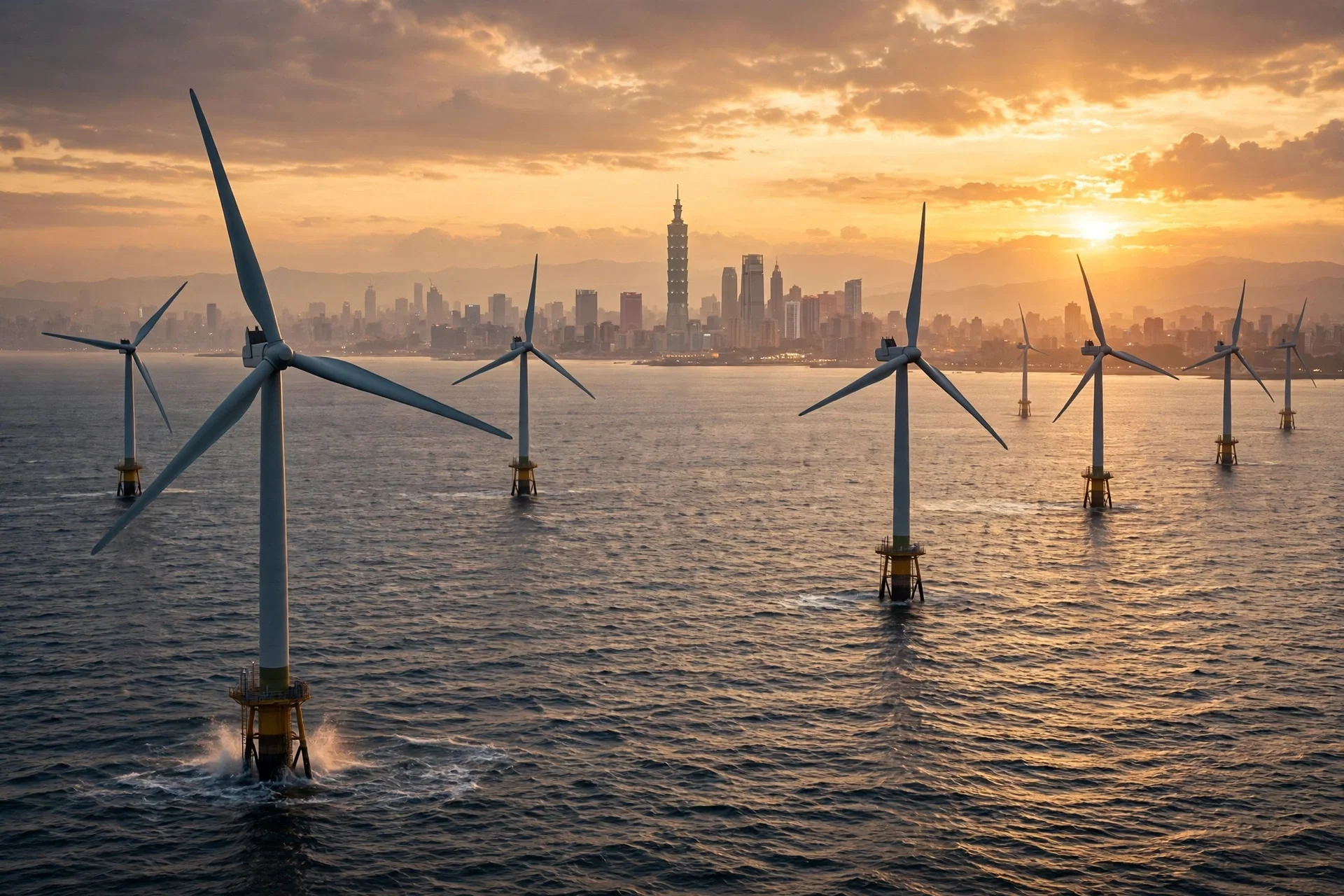
Energía eólica marina, eje de la cooperación energética entre el Reino Unido y Taiwán · Imagen generada — Erick Prometeo Media
UK and Taiwan launch a carbon capture partnership in Taipei
The eighth UK-Taiwan Energy Dialogue, held in Taipei on 20 October, launched a bilateral carbon capture, utilisation and storage partnership with three…
Security and industry frame the energy dialogue in Taipei
The UK and Taiwan launched a carbon capture partnership in Taipei with three workstreams and a future joint secretariat, in a dialogue focused on energy…
--- The context ---
Energy cooperation between the United Kingdom and Taiwan already spans more than two decades of joint work on renewable energy, and its latest meeting in Taipei comes at a moment when security of supply, the climate crisis and the rising electricity demand of the digital economy have become inseparable. The eighth Energy Dialogue and the 21st Renewable Energy Conference brought together policymakers, regulators, industry representatives and experts from both sides in Taipei on 20 October to deepen that relationship. The event, organised by the British Office Taipei and Taiwan's Energy Administration, was more than another ceremonial fixture: it launched a new instrument devoted to one of the most debated technologies of the transition, carbon capture, utilisation and storage, known as CCUS, aimed at cutting emissions from industries that cannot simply switch to renewable electricity.
--- The facts ---
The day was opened by Ruth Bradley-Jones, Representative at the British Office Taipei, and Cynthia Kiang, Deputy Minister of Economic Affairs, and chaired by Simon Payne, Head of International Bilateral Cooperation at the UK Department for Energy Security and Net Zero, and Chih-Wei Wu, Director General of Taiwan's Energy Administration. The central outcome was the launch of the UK-Taiwan CCUS Partnership, a flagship project under the Energy and Net Zero pillar of the Enhanced Trade Partnership between the two sides. The partnership is organised around three workstreams: policy and regulatory cooperation, covering policy design, regulatory frameworks and financing models; technical cooperation on research, innovation and deployment, connecting researchers, technical institutions and clusters around storage, monitoring and verification; and commercial pipeline and investor engagement, connecting companies, investors and project owners at an appropriate time.
Over time, a joint secretariat will be established to coordinate activities and monitor delivery across the three workstreams, overseen by senior officials from both sides and supported by working-level leads. The dialogue itself consisted of three sessions on energy security, offshore wind and CCUS, while the parallel conference featured representatives from 13 leading UK companies and covered grid resilience in the AI era, floating offshore wind, subsea cable technologies, operational optimisation and marine services, alongside the next phase of the wider energy transition.
--- The positions ---
In the energy security session, Simon Payne presented the impact of the Strait of Hormuz crisis on the UK transition and argued, as he set out in the session, that recent market disruption reinforced the view that clean energy deployment strengthens security by reducing exposure to international fossil fuel price shocks, while also supporting affordability and climate goals. Fang-Ling Liao, Director of the Energy Policy and Climate Change Division at Taiwan's Energy Administration, set out Taiwan's response to two linked challenges: rising electricity demand from AI and semiconductor supply chains, and geopolitical risks to fuel supply. Liao outlined Taiwan's Second Energy Transition, focused on diversified green energy, efficiency, storage and grid resilience, together with regular reviews of long-term power demand, additional gas-fired capacity, stronger requirements for large data centres, emergency response arrangements, diversified fuel supplies and strategic reserves. Bradley-Jones highlighted the increasingly close relationship between energy security, economic security and the energy transition, and welcomed the partnership as a step forward for bilateral cooperation, while Kiang linked energy security to the net-zero transition in the face of geopolitical tensions, extreme weather events and volatility in energy markets across the region and beyond.
--- What remains unknown ---
The official account gives no concrete timetable for the joint secretariat to begin work, and no named projects that the new partnership will advance in its first phase. It also does not specify what funding will accompany the three workstreams, nor which companies will take part in the commercial and investor line, which the partnership itself places at an appropriate time still to be defined. On offshore wind, the next Taiwanese allocation rounds within its long-term plan and the timetable for floating wind demonstration projects remain to be detailed, as does the practical division of work between clusters and research institutions on both sides on storage, monitoring and verification of captured carbon, and on strengthening local supply chains and financing for the next phase of deployment.
--- Unanswered questions ---
When will the joint secretariat of the partnership start operating, and what resources will it have to coordinate the three workstreams? Which concrete projects will be the first to benefit from the new bilateral cooperation on carbon capture? How will progress be measured: by agreements signed, by investment mobilised or by emissions avoided? What role will the 13 leading UK companies represented at the conference play in the next phase of cooperation?
--- EPM analysis ---
The significance of the Taipei meeting lies in joining three fronts that are often treated separately: security of supply, renewable expansion and the decarbonisation of heavy industry. Offshore wind provides renewable scale, with the UK already at 16.7 GW installed and a record allocation round, and Taiwan at around 5 GW with 515 turbines in operation. CCUS supplies the missing piece for hard-to-abate sectors, where neither electrification nor renewables are enough on their own. Taiwan's flagship carbon reduction action plan aims to cut emissions by 6 million metric tonnes of CO₂e annually by 2035, while the UK is advancing its HyNet and East Coast clusters with tailored business models for capture, transport and storage and shared infrastructure for sectors such as cement.
📌 EPM Take: In EPM's view, the partnership launched in Taipei matters because it turns a long-standing bilateral relationship into a permanent mechanism, with a joint secretariat, three workstreams and oversight by senior officials, instead of leaving it at declarations of intent. Its real test will not be the announcement, but the speed with which it produces verifiable projects in carbon capture, offshore wind and grid resilience, against a backdrop of rising electricity demand from artificial intelligence and volatile energy markets that affect both partners equally in this decisive century for the climate and for clean industry everywhere.
--- The context ---
For two economies exposed to volatile energy markets, the Taipei meeting on 20 October carried a practical meaning before a symbolic one: how to guarantee supply, bearable prices and competitive industry while the transition advances. The eighth UK-Taiwan Energy Dialogue and the 21st UK-Taiwan Renewable Energy Conference brought together policymakers, regulators, industry and experts, in a bilateral relationship that already spans more than two decades of collaboration on renewable energy. The event was organised by the British Office Taipei and Taiwan's Energy Administration, and its headline announcement was the launch of a dedicated partnership on carbon capture, utilisation and storage, the technology both governments regard as necessary for industrial sectors that cannot decarbonise through renewable electricity alone, however fast wind and other clean sources continue to grow in the coming years ahead.
--- The facts ---
The day was opened by Ruth Bradley-Jones, Representative at the British Office Taipei, and Cynthia Kiang, Deputy Minister of Economic Affairs, and chaired by Simon Payne, Head of International Bilateral Cooperation at the UK Department for Energy Security and Net Zero, and Chih-Wei Wu, Director General of Taiwan's Energy Administration. The CCUS Partnership is established under the Energy and Net Zero pillar of the Enhanced Trade Partnership and is presented as a flagship project in this field. Its structure rests on three workstreams: policy and regulatory cooperation, including regulatory frameworks and financing models; technical cooperation on research, innovation and deployment, with attention to storage, monitoring and verification; and a commercial pipeline and investor engagement line to connect companies, investors and project owners at an appropriate time.
The partnership will be overseen by senior officials from both sides, supported by working-level leads, and will in time have a joint secretariat to coordinate activities and monitor delivery. On offshore wind, the UK set out its 16.7 GW of installed capacity, its ambition to reach 43-50 GW by 2030 and the record result of Allocation Round 7, which secured 8.4 GW through the Contracts for Difference mechanism. Taiwan has around 5 GW installed, with 515 turbines in operation as of 1 October 2026, and a 2026-2039 plan involving further allocation rounds and regular releases of new capacity, plus cross-government coordination on available sites for additional projects.
--- The positions ---
The energy security session set out the shared diagnosis of the day. Simon Payne presented the impact of the Strait of Hormuz crisis on the UK transition and argued, in his presentation, that recent market disruption reinforced the UK view that clean energy strengthens security by reducing exposure to international fossil fuel price shocks, while also supporting affordability and climate goals. He also described the UK response through measures to support consumers, strengthen system resilience and accelerate investment in domestic clean energy, alongside renewable generation, market design and long-term infrastructure planning. Fang-Ling Liao, of Taiwan's Energy Administration, set out Taiwan's two fronts: rising electricity demand from AI and semiconductor supply chains, and geopolitical risks to fuel supply. Her answer runs through the Second Energy Transition, with diversified green energy, efficiency, storage and grid resilience, plus additional gas-fired capacity, stronger requirements for large data centres, emergency response arrangements, diversified fuel supplies and strategic reserves. On CCUS, Chloe Healy outlined lessons from earlier UK programmes and progress on the HyNet and East Coast clusters, while Ciao-Kai Liang presented Taiwan's flagship plan and its international cooperation.
--- What remains unknown ---
The announcement includes no quantified investment commitments and no fixed calendar for the joint secretariat, and the partnership's commercial line is expressly conditional on the appropriate time arriving to connect companies and investors. The first carbon capture projects to use the new framework are not yet known, nor are the criteria for choosing further clusters after HyNet and East Coast. On wind, the exact pace of Taiwan's allocation rounds under the 2026-2039 plan, the progress of floating wind in both markets and the promised improvements in financing, administrative processes and local supply chains remain to be detailed. Those factors will decide whether targets are met on time and without extra costs ultimately falling on households and businesses that already face high energy bills.
--- Unanswered questions ---
What concrete investment, public or private, will accompany the partnership in its first stage of operation? When will the first carbon capture projects under the new bilateral framework be announced? Can Taiwan sustain the installation pace required by its 2026-2039 plan with stronger local supply chains? How will each government protect consumers if transition costs again put upward pressure on energy prices?
--- EPM analysis ---
Read through the lens of competitiveness, the meeting combines complementary assets. The UK brings offshore wind scale, an allocation mechanism that has just secured 8.4 GW in a single round, and experience with industrial carbon capture clusters using shared infrastructure, valuable for sectors such as cement. Taiwan brings growing electricity demand driven by semiconductors and artificial intelligence, an expanding wind fleet and a flagship CCUS plan that aims to reduce emissions by 6 million metric tonnes of CO₂e annually by 2035 through policy and regulation, technology development, financial incentives, green investment and international cooperation. The conference, with representatives from 13 leading UK companies, added the commercial component that sets this forum apart from a purely academic exchange between administrations, linking officials, investors and project developers directly.
📌 EPM Take: In EPM's view, the strength of the Taipei dialogue is that it treats the transition as a problem of security and industry, not only of climate: firm supply, defensible prices and factories able to keep producing. The carbon capture partnership will prove its worth if it delivers financeable projects, with clear rules and controlled costs, and if the joint secretariat accounts for itself with measurable results. Meanwhile, wind cooperation and regulatory exchange already offer concrete benefits to two partners that share exposure to the same volatile energy markets and the same regional geopolitical tensions of this demanding period for governments.
Reino Unido y Taiwán lanzan una alianza de captura de carbono
El octavo Diálogo Energético entre el Reino Unido y Taiwán, celebrado en Taipéi el 20 de octubre, lanzó una alianza bilateral de captura, utilización y…
Seguridad e industria centran el diálogo energético en Taipéi
Reino Unido y Taiwán lanzaron en Taipéi una alianza de captura de carbono con tres líneas de trabajo y secretaría conjunta futura, en un diálogo centrado en…
--- El contexto ---
La cooperación energética entre el Reino Unido y Taiwán suma ya más de dos décadas de trabajo conjunto en energías renovables, y su última cita en Taipéi llega cuando la seguridad del suministro, la crisis climática y la creciente demanda eléctrica de la economía digital se han vuelto inseparables. El octavo Diálogo Energético y la vigésimo primera Conferencia de Energías Renovables reunieron el 20 de octubre a responsables políticos, reguladores, industria y expertos de ambos lados para profundizar esa relación. El encuentro, organizado por la British Office Taipei y la Administración de Energía de Taiwán, sirvió para poner en marcha un instrumento nuevo dedicado a una de las tecnologías más debatidas de la transición, la captura, utilización y almacenamiento de carbono, conocida por sus siglas en inglés como CCUS.
--- Los hechos ---
La jornada fue inaugurada por Ruth Bradley-Jones, representante de la British Office Taipei, y por Cynthia Kiang, viceministra de Asuntos Económicos, y estuvo presidida por Simon Payne, responsable de Cooperación Bilateral Internacional del departamento británico de Seguridad Energética y Cero Neto, y por Chih-Wei Wu, director general de la Administración de Energía de Taiwán. El resultado central fue el lanzamiento de la Alianza CCUS entre el Reino Unido y Taiwán, proyecto insignia del pilar de Energía y Cero Neto de la Asociación Comercial Reforzada entre ambos.
La alianza se organiza en tres líneas de trabajo: cooperación en política y regulación, con intercambio sobre diseño de políticas, marcos regulatorios y modelos de financiación; cooperación técnica en investigación, innovación y despliegue, conectando a investigadores, instituciones técnicas y clústeres en torno al almacenamiento, la supervisión y la verificación; y una línea comercial y de inversores para conectar, en el momento oportuno, a empresas, inversores y promotores. Con el tiempo se creará una secretaría conjunta que coordinará las actividades y vigilará el cumplimiento, bajo la supervisión de altos funcionarios de ambas partes. El diálogo se dividió en tres sesiones dedicadas a la seguridad energética, la eólica marina y el CCUS, mientras que la conferencia paralela contó con representantes de 13 empresas británicas líderes y abordó también la resiliencia de la red en la era de la inteligencia artificial, la eólica flotante y las tecnologías de cables submarinos.
--- Las posiciones ---
En la sesión de seguridad energética, Simon Payne expuso el impacto de la crisis del estrecho de Ormuz sobre la transición británica y sostuvo, según lo expuesto en la sesión, que la reciente perturbación del mercado refuerza la idea de que desplegar energía limpia fortalece la seguridad al reducir la exposición a las sacudidas de precios internacionales de los combustibles fósiles, al tiempo que apoya la asequibilidad y los objetivos climáticos. Fang-Ling Liao, directora de la división de Política Energética y Cambio Climático de la Administración de Energía de Taiwán, planteó la respuesta taiwanesa a dos desafíos ligados entre sí: la creciente demanda eléctrica procedente de la inteligencia artificial y de las cadenas de suministro de semiconductores, y los riesgos geopolíticos para el suministro de combustible. Liao presentó la Segunda Transición Energética de Taiwán, centrada en energía verde diversificada, eficiencia, almacenamiento y resiliencia de la red, junto con medidas como revisiones periódicas de la demanda a largo plazo, capacidad adicional de gas, requisitos más estrictos para los grandes centros de datos, suministros diversificados y reservas estratégicas.
--- Lo que falta saber ---
La comunicación oficial no detalla plazos concretos para la puesta en marcha de la secretaría conjunta ni proyectos específicos que la nueva alianza vaya a impulsar en su primera etapa. Tampoco precisa qué financiación acompañará a las tres líneas de trabajo ni qué empresas participarán en la línea comercial y de inversores, que la propia alianza sitúa en un momento oportuno todavía por definir. Sobre la eólica marina, quedan por conocer las próximas rondas de asignación taiwanesas y el calendario de demostración de la eólica flotante, así como el reparto de esfuerzos entre clústeres e instituciones de investigación en almacenamiento, supervisión y verificación del carbono capturado.
--- Preguntas sin respuesta ---
¿Cuándo empezará a operar la secretaría conjunta de la alianza y con qué recursos contará para coordinar las tres líneas de trabajo? ¿Qué proyectos concretos serán los primeros en beneficiarse de la cooperación en captura de carbono entre ambos territorios? ¿Cómo se medirá el avance de la alianza: por acuerdos firmados, por inversión movilizada o por emisiones evitadas?
--- Análisis EPM ---
El valor de la cita de Taipéi está en que conecta tres frentes que suelen tratarse por separado: la seguridad del suministro, la expansión renovable y la descarbonización de la industria pesada. La eólica marina aporta la escala renovable, con un Reino Unido que ya suma 16,7 GW instalados y una ronda récord, y un Taiwán que ronda los 5 GW con 515 turbinas en operación. El CCUS aporta la pieza que falta para los sectores difíciles de descarbonizar. Taiwán ha fijado en su plan insignia la meta de reducir 6 millones de toneladas métricas de CO₂e al año para 2035, y el Reino Unido avanza con sus clústeres HyNet y East Coast y con modelos de negocio específicos para captura, transporte y almacenamiento.
📌 Conclusion EPM: A juicio de EPM, la alianza lanzada en Taipéi es relevante porque convierte una relación bilateral veterana en un mecanismo permanente, con secretaría conjunta, tres líneas de trabajo y supervisión de altos funcionarios, en lugar de dejarla en declaraciones de intenciones. Su prueba real no será el anuncio, sino la velocidad con la que produzca proyectos verificables en captura de carbono, eólica marina y resiliencia de red, en un contexto de demanda eléctrica creciente por la inteligencia artificial y de mercados energéticos volátiles que afectan a ambos socios por igual en este siglo decisivo para el clima.
--- El contexto ---
Para dos economías que dependen de mercados energéticos volátiles, la cita de Taipéi del 20 de octubre tuvo una lectura práctica antes que simbólica: cómo garantizar suministro, precios soportables e industria competitiva mientras avanza la transición. El octavo Diálogo Energético y la vigésimo primera Conferencia de Energías Renovables entre el Reino Unido y Taiwán reunieron a responsables políticos, reguladores, industria y expertos, en una relación bilateral que acumula más de dos décadas de colaboración en renovables. El encuentro fue organizado por la British Office Taipei y la Administración de Energía de Taiwán, y su anuncio principal fue el lanzamiento de una alianza específica sobre captura, utilización y almacenamiento de carbono, la tecnología que ambos gobiernos consideran necesaria para los sectores industriales que no pueden descarbonizarse solo con electricidad renovable.
--- Los hechos ---
Inauguraron la jornada Ruth Bradley-Jones, representante de la British Office Taipei, y Cynthia Kiang, viceministra de Asuntos Económicos, y la presidieron Simon Payne, responsable de Cooperación Bilateral Internacional del departamento británico de Seguridad Energética y Cero Neto, y Chih-Wei Wu, director general de la Administración de Energía de Taiwán. La Alianza CCUS nace bajo el pilar de Energía y Cero Neto de la Asociación Comercial Reforzada y se presenta como su proyecto insignia en esta materia. Su estructura contempla tres líneas de trabajo: cooperación en política y regulación, incluidos marcos regulatorios y modelos de financiación; cooperación técnica en investigación, innovación y despliegue, con atención al almacenamiento, la supervisión y la verificación; y una línea de cartera comercial y captación de inversores para conectar empresas, inversores y promotores cuando sea oportuno.
La alianza estará supervisada por altos funcionarios de ambas partes, contará con responsables de trabajo y, con el tiempo, dispondrá de una secretaría conjunta encargada de coordinar y vigilar la entrega. En eólica marina, el Reino Unido expuso sus 16,7 GW instalados, su ambición de alcanzar entre 43-50 GW para 2030 y el resultado récord de su séptima ronda de asignación, con 8,4 GW asegurados mediante el mecanismo de Contratos por Diferencia. Taiwán, por su parte, ronda los 5 GW instalados con 515 turbinas en operación a fecha de 1 de octubre de 2026, y mantiene un plan 2026-2039 con nuevas rondas de asignación y liberaciones periódicas de capacidad.
--- Las posiciones ---
La sesión de seguridad energética dejó el diagnóstico compartido de la jornada. Simon Payne expuso cómo la crisis del estrecho de Ormuz ha afectado a la transición británica y defendió, según su intervención, que la perturbación reciente del mercado refuerza la convicción de que la energía limpia fortalece la seguridad al reducir la exposición a los choques internacionales de precios de los combustibles fósiles, además de apoyar la asequibilidad y los objetivos climáticos. También describió la respuesta británica con medidas de apoyo a los consumidores, refuerzo de la resiliencia del sistema y aceleración de la inversión en energía limpia nacional, junto con generación renovable, diseño de mercado y planificación a largo plazo. Fang-Ling Liao, de la Administración de Energía de Taiwán, expuso los dos frentes taiwaneses: la demanda eléctrica creciente de la inteligencia artificial y de los semiconductores, y los riesgos geopolíticos sobre el suministro de combustible. Su respuesta pasa por la Segunda Transición Energética, con energía verde diversificada, eficiencia, almacenamiento y resiliencia de red, además de capacidad adicional de gas, requisitos más exigentes para grandes centros de datos, reservas estratégicas y suministros diversificados.
--- Lo que falta saber ---
El anuncio no incluye compromisos de inversión cifrados ni un calendario cerrado para la secretaría conjunta, y la línea comercial queda condicionada a que llegue el momento oportuno para conectar empresas e inversores. Tampoco se conocen aún los proyectos de captura de carbono que estrenarán la cooperación ni los criterios para elegir los próximos clústeres tras HyNet y East Coast. En el frente eólico, falta por detallar el ritmo de las rondas taiwanesas dentro del plan 2026-2039, el avance de la eólica flotante y las mejoras en financiación, procesos administrativos y cadenas de suministro locales, determinantes para cumplir en plazo y sin sobrecostes para el consumidor.
--- Preguntas sin respuesta ---
¿Qué inversión concreta, pública o privada, acompañará a la alianza en su primera etapa de funcionamiento? ¿Cuándo se conocerán los primeros proyectos de captura de carbono acogidos al nuevo marco bilateral? ¿Podrá Taiwán sostener el ritmo de instalación eólica que exige su plan 2026-2039 con cadenas de suministro locales más fuertes? ¿Cómo protegerá cada gobierno al consumidor si los costes de la transición vuelven a presionar los precios de la energía?
--- Análisis EPM ---
Leída en clave de competitividad, la cita combina activos complementarios. El Reino Unido aporta escala eólica, un mecanismo de asignación que acaba de asegurar 8,4 GW en una sola ronda y experiencia en clústeres industriales de captura de carbono con infraestructura compartida, útil para sectores como el cemento. Taiwán aporta una demanda eléctrica en crecimiento impulsada por semiconductores e inteligencia artificial, un parque eólico en expansión y un plan insignia de CCUS que aspira a reducir 6 millones de toneladas métricas de CO₂e al año para 2035 mediante regulación, desarrollo tecnológico, incentivos financieros e inversión verde. La conferencia, con representantes de 13 empresas británicas líderes, añadió el componente comercial que distingue a este foro de un simple intercambio académico entre administraciones.
📌 Conclusion EPM: A juicio de EPM, el acierto del diálogo de Taipéi es tratar la transición como un problema de seguridad y de industria, no solo de clima: suministro firme, precios defendibles y fábricas capaces de seguir produciendo. La alianza de captura de carbono tendrá valor si se traduce en proyectos financiables, con reglas claras y costes controlados, y si la secretaría conjunta rinde cuentas con resultados medibles. Entre tanto, la cooperación eólica y el intercambio regulatorio ya ofrecen beneficios concretos a dos socios que comparten exposición a los mismos mercados energéticos volátiles y a las mismas tensiones geopolíticas regionales actuales.