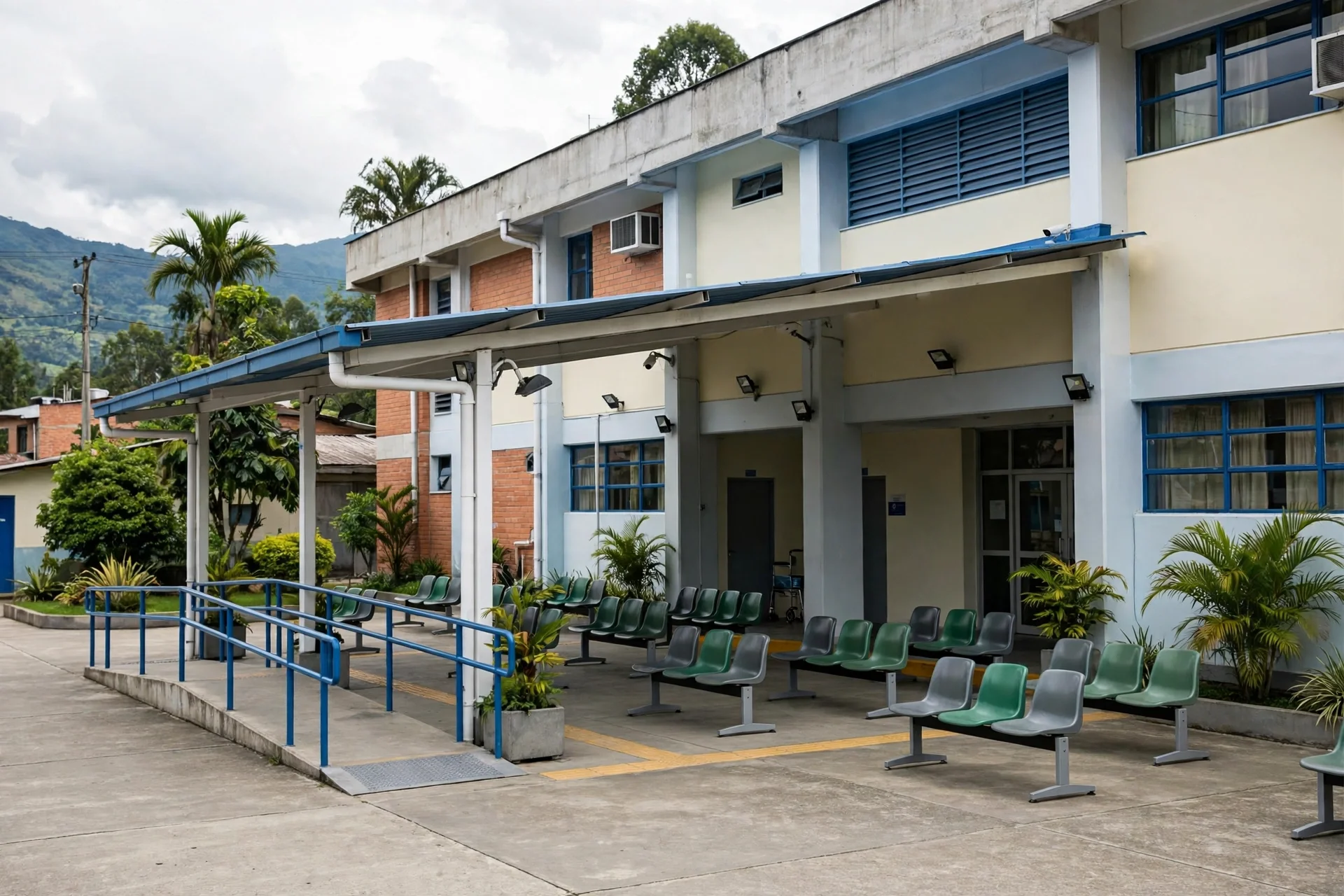
Sala de espera exterior de un centro de salud, imagen alusiva a la reconstrucción del sistema sanitario y al acceso en las regiones. · Erick Prometeo Media
De La Espriella puts patients and evidence at center of health rebuild
President Abelardo De La Espriella set health rebuild priorities at the Health Ministry, centered on patients, technical evidence and objective assessment of…
Health without ideology: data, order and insurers judged by results
At the Health Ministry, President Abelardo De La Espriella announced a shock plan to stabilize system finances, guaranteed a transparent and technically…
--- The context ---
Colombia has coverage described as almost universal, yet effective access remains deeply unequal across its territory. The president framed that gap as central to the rebuild, noting that close to 40% of municipalities have low or very low access to health services while around 90% of supply is concentrated in urban areas, so the place where a person lives still shapes the care that person can actually obtain.
--- The facts ---
President Abelardo De La Espriella visited the Health Ministry headquarters on Tuesday and set out his government's priorities for rebuilding the national health system. He described a double task of recovering what stopped working while building a better system at the same time, preserving the little that still works, correcting what is wrong, rescuing what can be recovered and replacing what is not viable.
Among the urgent backlogs he cited are a million Colombians awaiting delivery of medicines and procedures, although he recalled that hundreds of people who were waiting for such solutions have already been assisted. To keep reducing those waits, he asked Health Minister Ana María Vesga for a weekly verification mechanism tracking progress on medicines, specialist appointments, procedures and surgeries, allowing a week by week measurement of the reduction.
--- The positions ---
On the EPS health insurers, the president said they are not enemies and that his government holds no ideological prejudices against them, while warning that those that do not work are not untouchable either. Assessment will be purely objective, he explained, so viable and well managed insurers will find a serious partner in government, those with correctable problems must present serious recovery plans, and unviable ones may be intervened, reorganized or replaced while protecting affiliates first.
He also stated that intervening an insurer cannot become an instrument of political persecution and should be understood as an exceptional tool to protect patients. He added that his government will not choose between public and private or between one ideology and another, because health has no political color and decisions must be made thinking of patients and grounded in technical evidence rather than dogmas.
--- What remains unknown ---
The timeline and operational detail of the announced shock plan for the financial stabilization of the system remain unknown, beyond starting from a clear definition of the debts owed to each insurer. It is also unclear how stronger primary care, expanded telemedicine and incentives to bring human talent to the areas that need it most would be financed, or what schedule would govern improvements to regional hospitals.
--- Unanswered questions ---
How quickly will the wait facing a million Colombians with pending medicines and procedures begin to fall in a verifiable way? What concrete technical criteria will define whether an insurer complies or not, and what guarantees will affiliates have during an intervention? How will the territorial gap be closed if around 90% of supply remains concentrated in urban areas?
--- EPM analysis ---
Placing territory at the center makes this announcement more than an administrative adjustment, because it focuses on those who today face the greatest barriers to care. Stronger primary care, more doctors and specialists in the regions and broader telemedicine all aim at an access inequality that formal coverage alone has not resolved. At the same time, making each insurer's continuity depend on its real capacity to answer for its affiliates subordinates any institutional debate to a concrete outcome for the patient.
📌 EPM Take: In EPM's view, the central value of these priorities lies in judging the rebuild by real access rather than coverage on paper alone, especially in municipalities with low or very low care. Weekly verification of the backlog and a transparent capitation payment calculation can give that promise public follow through. The challenge will be ensuring that regional presence, human talent and stronger hospitals arrive with timely resources and continuity, so that the right to care no longer depends on where each Colombian lives. That follow through will matter most for patients who live far from major cities and large hospitals.
--- The context ---
The health system inherited by the current administration was described by the president himself as a disaster, attributed to the mistakes and widespread corruption of the previous government. From that assessment, the proposed rebuild does not start from zero, but it requires technical discipline, clear accounts and decisions guided by data, away from ideological experimentation and from the premise that statization by itself solves the sector's problems.
--- The facts ---
During his Tuesday visit to the Health Ministry headquarters, President Abelardo De La Espriella announced that a shock plan for the financial stabilization of the system must be designed and launched as soon as possible, starting from a clear definition of the debts with each EPS insurer. He also guaranteed that the calculation of the Capitation Payment Unit will be transparent, reliable and technically supported, in compliance with what the Constitutional Court has ordered.
That calculation is decisive, he explained, because to a large extent it determines whether resources reach insurers, hospitals, clinics and providers on time. He insisted that the government must know how much caring for one Colombian costs in order to allocate resources, and that every decision on financing, insurance, service delivery, medicines or intervention must answer whether it truly improves the care Colombians receive.
--- The positions ---
On the insurers, the president said they are not enemies and that there will be no ideological or reckless prejudices against them, while making clear that those that do not work are not untouchable either. Viable, well managed insurers able to answer for their affiliates will have the conditions needed to do their work well, while those with correctable problems must present serious recovery plans and unviable ones, those that irresponsibly manage resources or fail to guarantee care, must be intervened without delay, reorganized or replaced.
The head of state also warned that no intervention may be used as political persecution and rejected the practice he attributed to the previous regime at the Superintendency and the Ministry. He added a commitment to institutional neutrality, stating that his government will not choose between public and private and that its working premise is to decide thinking of patients, with technical evidence and without political color in health.
--- What remains unknown ---
The detailed content of the financial shock plan is still missing, along with the amounts and the recognition calendar for debts with each insurer and the indicators that will judge recovery by entities with correctable problems. It also remains to be specified how the backlog of medicines and procedures will be addressed more quickly and what concrete results are expected week by week from the verification mechanism requested from Minister Ana María Vesga.
--- Unanswered questions ---
When will the shock plan be presented with debts defined for each insurer, and with what resources will timely flow toward hospitals and clinics be guaranteed? What deadlines will insurers with correctable problems have to show results before an intervention? What measurable targets will weekly verification set to reduce waits for medicines, appointments, procedures and surgeries?
--- EPM analysis ---
Putting finances in order and making the capitation calculation transparent are preconditions for any care promise to be sustainable, because a system without clear accounts passes its imbalances on to hospitals, providers and patients. Objective assessment of insurers also introduces a simple rule of accountability, under which they comply or they do not, without privileges or persecution. That approach seeks to preserve what works and replace what is unviable without subjecting health management to dogmas or ideological disputes.
📌 EPM Take: In EPM's view, the strength of what was announced lies in placing evidence, capitation transparency and each actor's accountability above ideology, with a clear rule for insurers and priority protection for affiliates. If the shock plan defines debts, ensures timely payments and sustains weekly measurement of the backlog, the rebuild will gain practical credibility. The test will be in financial execution and in whether each decision demonstrably improves the care people receive. Clear deadlines, published debt figures and consistent weekly reporting would turn that framework into accountable delivery for patients, hospitals and providers alike.
De La Espriella prioriza pacientes y regiones para reconstruir la salud
El presidente Abelardo De La Espriella fijó en el Ministerio de Salud las prioridades para reconstruir el sistema, con foco en los pacientes, la evidencia…
Salud sin ideología: datos, orden y EPS evaluadas por resultados
En el Ministerio de Salud, el presidente Abelardo De La Espriella anunció un plan de choque para estabilizar las finanzas del sistema, garantizó una UPC…
--- El contexto ---
Colombia mantiene una cobertura en salud descrita como casi universal, pero el acceso efectivo sigue marcado por profundas desigualdades entre territorios. Esa brecha es el punto de partida del mensaje presidencial: cerca del 40% de los municipios presenta un acceso bajo o muy bajo a los servicios y alrededor del 90% de la oferta se concentra en las zonas urbanas, de modo que vivir lejos de una ciudad continúa condicionando la atención que recibe una persona.
--- Los hechos ---
El presidente Abelardo De La Espriella visitó este martes la sede del Ministerio de Salud y fijó allí las prioridades de su Gobierno para recomponer el sistema. Según planteó, la tarea es doble, porque implica recuperar lo que dejó de funcionar y, al mismo tiempo, construir un sistema mejor, preservando lo poco que aún funciona, corrigiendo lo que está mal, rescatando lo recuperable y reemplazando lo inviable.
Entre las urgencias señaladas figura el represamiento que afecta a un millón de colombianos con entregas pendientes de medicamentos y procedimientos, aunque el mandatario recordó que ya se ha atendido a cientos de personas que esperaban soluciones de ese tipo. Para seguir reduciendo esa espera pidió a la ministra de Salud, Ana María Vesga, un mecanismo de verificación semanal que mida avances en medicamentos, citas con especialistas, procedimientos y cirugías.
--- Las posiciones ---
Frente a las EPS, el jefe del Estado sostuvo que no son enemigas y que en su Gobierno no hay prejuicios ideológicos frente a ellas, aunque advirtió que las que no funcionan tampoco son intocables. La valoración, explicó, será puramente objetiva, de modo que las entidades viables y bien administradas encontrarán un interlocutor serio, mientras las que tengan problemas corregibles deberán presentar planes serios de recuperación y las inviables podrán ser intervenidas, reorganizadas o sustituidas protegiendo primero a los afiliados.
El mandatario también afirmó que la intervención de una EPS no puede convertirse en instrumento de persecución política y que debe entenderse como una herramienta excepcional para proteger a los pacientes. Añadió que no se escogerá entre lo público y lo privado ni entre una ideología y otra, porque la salud no tiene color político y las decisiones deben tomarse pensando en los pacientes y con fundamento en la evidencia técnica, no en dogmas.
--- Lo que falta saber ---
Todavía no se conocen los plazos ni el detalle operativo del plan de choque anunciado para la estabilización financiera del sistema, que partiría de definir con claridad las deudas con cada EPS. Tampoco se ha precisado cómo se financiarán el fortalecimiento de la atención primaria, la expansión de la telemedicina y los incentivos para llevar talento humano a las zonas donde más se necesita, ni qué cronograma tendrán las mejoras en hospitales regionales.
--- Preguntas sin respuesta ---
¿En cuánto tiempo empezará a reducirse de forma verificable la espera del millón de colombianos con medicamentos y procedimientos pendientes? ¿Qué criterios técnicos concretos definirán si una EPS cumple o no cumple y qué garantías tendrán los afiliados durante una intervención? ¿Cómo se cerrará la brecha territorial si alrededor del 90% de la oferta sigue concentrada en las zonas urbanas?
--- Análisis EPM ---
La dimensión territorial convierte este anuncio en algo más que un ajuste administrativo, porque pone el foco en quienes hoy enfrentan mayores barreras para ser atendidos. Fortalecer la atención primaria, acercar médicos y especialistas a las regiones y ampliar la telemedicina apuntan a corregir una desigualdad de acceso que la cobertura formal no ha resuelto. Al mismo tiempo, condicionar la permanencia de cada EPS a su capacidad real de responder por sus afiliados subordina cualquier debate institucional a un resultado concreto para el paciente.
📌 Conclusion EPM: A juicio de EPM, el valor central de estas prioridades está en medir la reconstrucción por el acceso real y no solo por la cobertura en el papel, especialmente en los municipios con atención baja o muy baja. La verificación semanal del represamiento y una UPC transparente pueden dar seguimiento público a esa promesa. El desafío será que la presencia en las regiones, el talento humano y los hospitales fortalecidos lleguen con recursos oportunos y continuidad, para que el derecho a la atención deje de depender del lugar donde vive cada colombiano.
--- El contexto ---
El sistema de salud que recibió la actual administración fue descrito por el propio presidente como un desastre atribuido a las equivocaciones y la corrupción generalizada del Gobierno anterior. Desde esa valoración, la reconstrucción planteada no parte de cero, pero exige disciplina técnica, cuentas claras y decisiones guiadas por datos, alejadas de la experimentación ideológica y de la idea de que la estatización por sí misma resuelve los problemas del sector.
--- Los hechos ---
Durante su visita de este martes a la sede del Ministerio de Salud, el presidente Abelardo De La Espriella anunció que deberá diseñarse y ponerse en marcha cuanto antes un plan de choque para la estabilización financiera del sistema, partiendo de la definición clara de las deudas con cada una de las EPS. También garantizó que el cálculo de la Unidad de Pago por Capitación será transparente, confiable y técnicamente sustentado, en cumplimiento de lo dispuesto por la Corte Constitucional.
Ese cálculo resulta decisivo, según explicó, porque de esa cifra depende en buena medida que los recursos lleguen oportunamente a las EPS, a los hospitales, a las clínicas y a los proveedores. El mandatario insistió en que el Gobierno debe conocer cuánto cuesta la atención de un colombiano para asignar los recursos y en que cada decisión sobre financiación, aseguramiento, prestación, medicamentos o intervención debe responder si mejora realmente la atención que reciben los colombianos.
--- Las posiciones ---
Sobre las EPS, el presidente afirmó que no son enemigas y que no habrá prejuicios ideológicos ni temerarios frente a ellas, pero dejó claro que tampoco son intocables cuando no funcionan. Las entidades viables, bien administradas y capaces de responder por sus afiliados tendrán las condiciones necesarias para hacer bien su trabajo, mientras las que presenten problemas corregibles deberán presentar planes serios de recuperación y las inviables, las que administren irresponsablemente los recursos o no garanticen la atención, deberán ser intervenidas sin dilación, reorganizadas o sustituidas.
El jefe del Estado advirtió además que ninguna intervención puede usarse como persecución política y rechazó la práctica que atribuyó al régimen anterior en la Superintendencia y en el Ministerio. A esa línea sumó un compromiso de neutralidad institucional, al señalar que no se escogerá entre lo público y lo privado y que la premisa de trabajo es tomar decisiones pensando en los pacientes, con evidencia técnica y sin color político en la salud.
--- Lo que falta saber ---
Falta conocer el contenido detallado del plan de choque financiero, el monto y el calendario de reconocimiento de las deudas con cada EPS y los indicadores con los que se juzgará la recuperación de las entidades con problemas corregibles. También queda por precisar cómo se atenderá con mayor rapidez el represamiento de medicamentos y procedimientos y qué resultados concretos se esperan semana a semana del mecanismo de verificación solicitado a la ministra Ana María Vesga.
--- Preguntas sin respuesta ---
¿Cuándo se presentará el plan de choque con las deudas definidas por cada EPS y con qué recursos se garantizará el flujo oportuno hacia hospitales y clínicas? ¿Qué plazos tendrán las EPS con problemas corregibles para demostrar resultados antes de una intervención? ¿Qué metas medibles fijará la verificación semanal para reducir las esperas en medicamentos, citas, procedimientos y cirugías?
--- Análisis EPM ---
Ordenar las finanzas y transparentar la UPC son condiciones previas para que cualquier promesa asistencial sea sostenible, porque un sistema sin cuentas claras traslada sus desajustes a hospitales, proveedores y pacientes. La evaluación objetiva de las EPS introduce además una regla sencilla de responsabilidad, según la cual cumplen o no cumplen, sin privilegios ni persecución. Ese enfoque busca preservar lo que funciona y reemplazar lo inviable sin someter la gestión sanitaria a dogmas ni a disputas ideológicas.
📌 Conclusion EPM: A juicio de EPM, la fortaleza de lo anunciado reside en poner la evidencia, la transparencia de la UPC y la responsabilidad de cada actor por encima de la ideología, con una regla clara para las EPS y protección prioritaria de los afiliados. Si el plan de choque define deudas, asegura pagos oportunos y sostiene la medición semanal del represamiento, la reconstrucción ganará credibilidad práctica. La prueba estará en la ejecución financiera y en que cada decisión mejore de manera comprobable la atención recibida. Esa disciplina, sostenida sin excepciones, es la que puede convertir el anuncio en resultados duraderos para los pacientes.