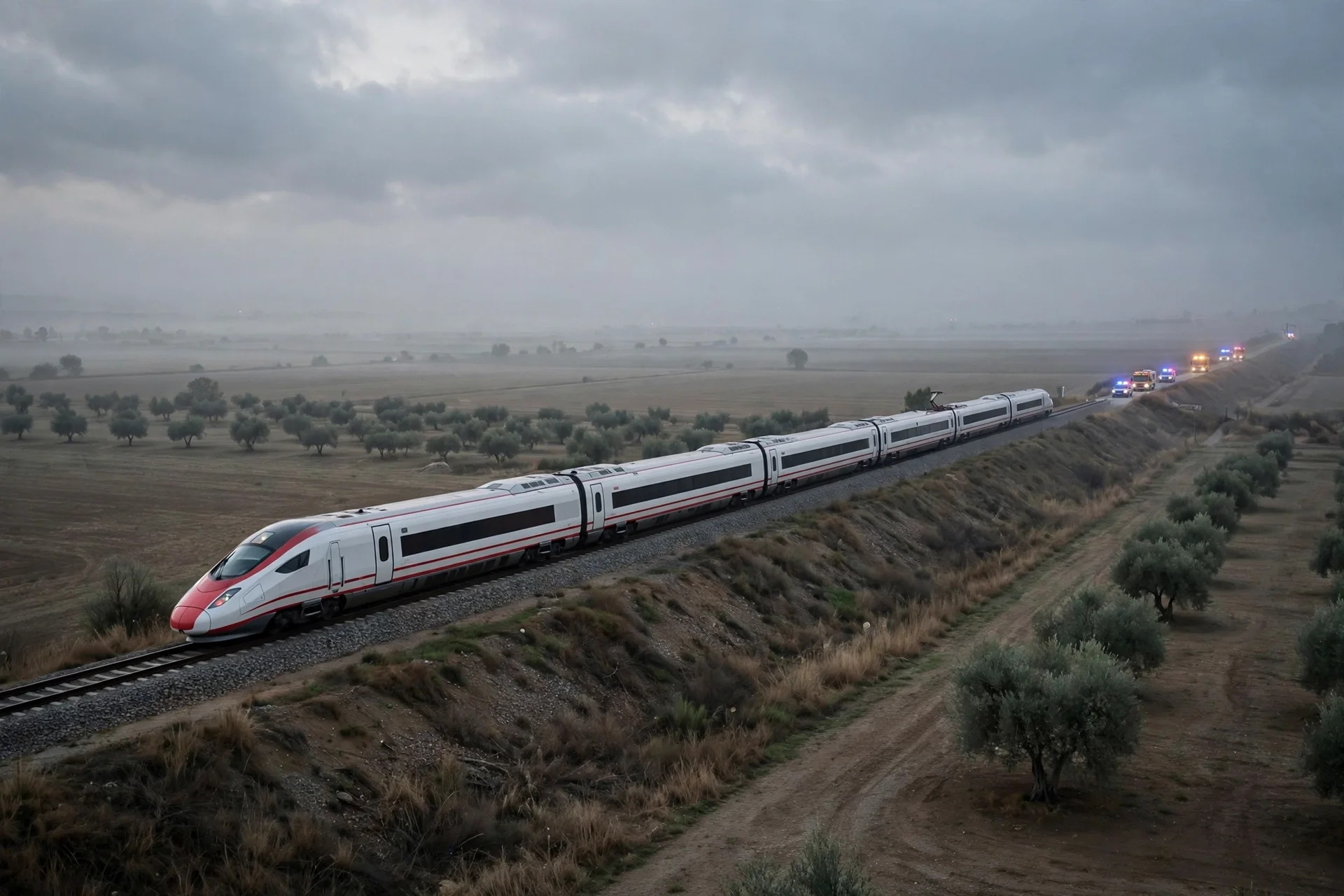
La línea de alta velocidad entre Madrid y Andalucía quedó interrumpida tras el choque en Urda · Imagen generada — Erick Prometeo Media
Train crash in Toledo leaves at least 46 dead in provisional toll
A Renfe AVE and an Iryo train collided near Urda in Toledo, leaving at least 46 dead in a provisional toll attributed to Civil Protection, numerous injured…
Rail crash in Urda leaves at least 46 dead in provisional toll
The collision between a Renfe AVE and an Iryo train near Urda left at least 46 dead in a provisional toll attributed to Civil Protection, numerous injured…
--- The context ---
A Renfe AVE train and an Iryo train collided on Wednesday 28 October near Urda and Los Yébenes, in the province of Toledo, on the high-speed line linking Madrid with Andalusia. The Emergency Service 112 placed the crash at around 8.54, and the collision interrupted that connection while emergency teams worked at the scene.
--- The facts ---
According to the latest toll attributed to Civil Protection sources and released at 10.27, the crash has left at least 46 dead, in a provisional toll, along with numerous injured people. That provisional toll raises the earlier count of at least 39 dead confirmed by Emergency sources of the Government of Castilla-La Mancha. Two Iryo carriages derailed and fell down an embankment.
The Renfe train had left Madrid Puerta de Atocha at 8.00 bound for Sevilla Santa Justa station. Adif and Renfe staff travelled to the scene, and the mayor of Urda placed the crash some eight kilometres from the town, in a flat area.
The Community of Madrid sent eight fire crews and eight Summa 112 resources, and ASEM112 set up a psychosocial care point at Atocha station. Andalusia sent mobile ICU units and a logistical support vehicle from the Andalusian Health Service, and Castilla-La Mancha activated Platecam in Emergency phase, Operational Situation 1, in Toledo.
--- The positions ---
According to sources at the Ministry of Transport, the first hypothesis is that the AVE may have run into the back of the Iryo, and another initial version points to a possible human error linked to a signalling failure, neither yet a conclusion. A passenger on the AVE recounted noticing a sharp deceleration beforehand, and union spokesman Rafael Escudero described the crash as very rare and noted the real-time supervision of that area.
Pedro Sánchez expressed his dismay and his solidarity with the victims and their families, and said he remains in constant contact with Óscar Puente and Emiliano García-Page, while La Moncloa cancelled the agenda of the prime minister and the ministers. The PP cancelled its pre-campaign events for Wednesday, Alberto Núñez Feijóo placed care for the victims as the priority and Juanma Moreno placed Andalusia at the disposal of the authorities.
--- What remains unknown ---
The total number of injured people and the breakdown of their condition by severity remain unspecified. The cause of the crash has not been established, and it is not known when traffic between Madrid and Andalusia may resume.
--- Unanswered questions ---
What is the total number of injured people and what is their condition? Will the investigation confirm the rear-end impact as the sequence of the crash? Did the signalling failure play a part, and was the AVE warned in time? When may traffic between Madrid and Andalusia resume?
--- EPM analysis ---
Read through rail safety, the crash focuses attention on the systems meant to prevent two trains from occupying the same stretch: signalling, real-time supervision and the protocols that apply when a failure occurs. The response brought together resources from three administrations within hours, but prevention is measured before impact, in sustained maintenance.
📌 EPM Take:
In EPM's view, the immediate priority is care for the victims and support for their families, and the obligation that follows is to explain with data how a crash could happen on a line supervised in real time. The provisional toll of at least 46 dead requires a complete investigation, with publication of the signalling sequence and of the communications before the impact. Only that transparency will show whether a machine, a protocol or a human decision failed, and what must be corrected before the line returns to normal activity.
--- The context ---
The high-speed line between Madrid and Andalusia was interrupted on Wednesday 28 October after a collision between a Renfe AVE and an Iryo train near Urda, in the province of Toledo. The Emergency Service 112 placed the crash at around 8.54, and emergency teams deployed at the scene.
--- The facts ---
The latest toll attributed to Civil Protection sources, released at 10.27, raises the dead to at least 46, in a provisional toll that replaces the earlier count of at least 39 dead confirmed by Emergency sources of the Government of Castilla-La Mancha. There are also numerous injured people, with no total figure. Two Iryo carriages derailed and fell down an embankment.
The AVE had left Madrid Puerta de Atocha at 8.00 bound for Sevilla Santa Justa, according to Transport sources. Adif and Renfe staff travelled to the scene, and the mayor of Urda placed the crash some eight kilometres from the town, in a flat area.
The Community of Madrid mobilised eight fire crews and eight Summa 112 resources, and ASEM112 set up a psychosocial care point at Atocha. Andalusia sent mobile ICU units and a logistical support vehicle from the Andalusian Health Service, and Castilla-La Mancha activated Platecam in Emergency phase, Operational Situation 1, in Toledo.
--- The positions ---
According to sources at the Ministry of Transport, the first hypothesis places an impact by the AVE against the rear of the Iryo, and another initial version points to a possible human error linked to a signalling failure, in which a worker may not have alerted the AVE to the other train, still only a hypothesis. Union spokesman Rafael Escudero described the event as very rare and recalled the real-time supervision, while a passenger on the AVE recounted a sharp deceleration beforehand.
Pedro Sánchez expressed his dismay and his solidarity with the victims and their families, assured constant contact with Óscar Puente and Emiliano García-Page, and La Moncloa cancelled the agenda of the prime minister and the ministers while Puente headed to the Atocha control centre. The PP cancelled its pre-campaign events for Wednesday, Alberto Núñez Feijóo placed the priority on the victims and Juanma Moreno placed Andalusia at the disposal of the authorities.
--- What remains unknown ---
The total number of injured people and the breakdown of their condition by severity are not yet known, The cause of the crash is not determined, and no date has been given for reopening the connection.
--- Unanswered questions ---
What failed in the chain of signalling and warnings before the crash? Did the AVE receive any alert about the proximity of the Iryo? What is the total figure for the injured and what is their condition? When will high-speed traffic between Madrid and Andalusia be restored?
--- EPM analysis ---
Read through management responsibility, a rear-end crash on a line supervised in real time requires an audit of the signalling, the intervention on the failure and the warning protocols between trains. The coordination of emergencies worked quickly, but accountability requires reconstructing who knew what and at what moment.
📌 EPM Take:
In EPM's view, alongside care for the victims there must be a complete and public audit of the signalling, of the intervention on the failure and of the warning protocols in force on that stretch. The provisional toll of at least 46 dead admits no generic explanations: each person responsible in the safety chain must show what they did before the impact at 8.54, without exception. That verification, and not the initial hypotheses, is what must set the corrections and any responsibilities that follow in this case.
Choque de trenes en Toledo deja al menos 46 muertos en balance provisional
Un AVE de Renfe y un tren Iryo chocaron cerca de Urda, en Toledo, con un balance provisional de al menos 46 fallecidos según Protección Civil, numerosos…
Accidente ferroviario en Urda: al menos 46 fallecidos en balance provisional
La colisión entre un AVE de Renfe y un tren Iryo cerca de Urda dejó al menos 46 fallecidos en balance provisional atribuido a Protección Civil, numerosos…
--- El contexto ---
Un AVE de Renfe y un tren de Iryo chocaron este miércoles 28 de octubre en el entorno de Urda y Los Yébenes, en Toledo, en la línea de alta velocidad entre Madrid y Andalucía. El siniestro, registrado alrededor de las 8.54 horas según el Servicio de Emergencias 112, interrumpió esa conexión y movilizó a los servicios de emergencia.
--- Los hechos ---
Según el último balance atribuido a fuentes de Protección Civil, difundido a las 10.27 horas, el accidente ha dejado al menos 46 fallecidos, en un balance provisional, y numerosos heridos. Ese balance provisional eleva el recuento anterior de al menos 39 muertos confirmado por fuentes de Emergencias del Gobierno de Castilla-La Mancha. Dos vagones del Iryo descarrilaron y cayeron por un terraplén.
El tren de Renfe había partido de Madrid Puerta de Atocha a las 8.00 horas con destino a Sevilla Santa Justa. Personal de Adif y de Renfe se desplazó al lugar, y el alcalde de Urda situó el choque a unos ocho kilómetros de la localidad, en una zona llana.
La Comunidad de Madrid envió ocho dotaciones de bomberos y ocho recursos del Summa 112, y ASEM112 habilitó un puesto de atención psicosocial en Atocha. Andalucía envió UVI móviles y un vehículo de apoyo logístico del Servicio Andaluz de Salud, y Castilla-La Mancha activó el Platecam en fase de Emergencia, Situación Operativa 1, en Toledo.
--- Las posiciones ---
Según fuentes del Ministerio de Transportes, la primera hipótesis es que el AVE habría alcanzado por detrás al Iryo, y otra versión inicial apunta a un posible error humano ligado a una avería de señalización, sin que ninguna sea todavía una conclusión. Un pasajero del AVE relató haber percibido una fuerte desaceleración previa, y el portavoz sindical Rafael Escudero calificó el accidente de muy raro y señaló la supervisión en tiempo real.
Pedro Sánchez expresó su consternación y su solidaridad con las víctimas y sus familias, y aseguró contacto constante con Óscar Puente y Emiliano García-Page, mientras La Moncloa cancelaba la agenda del presidente y de los ministros. El PP canceló sus actos de precampaña del miércoles, Alberto Núñez Feijóo situó la prioridad en las víctimas y Juanma Moreno puso Andalucía a disposición de las autoridades.
--- Lo que falta saber ---
Falta por concretar el número total de heridos y su distribución por gravedad. Tampoco se ha establecido la causa del choque, y no se conoce cuándo podrá reanudarse la circulación entre Madrid y Andalucía.
--- Preguntas sin respuesta ---
¿Cuál es el número total de heridos y cuál es su estado? ¿Confirmará la investigación el alcance por detrás? ¿Intervino la avería de señalización y se alertó a tiempo al AVE? ¿Cuándo podrá reanudarse la circulación entre Madrid y Andalucía?
--- Análisis EPM ---
Leído desde la seguridad ferroviaria, el suceso pone el foco en los sistemas preventivos: la señalización, la supervisión en tiempo real y los protocolos ante una avería. La respuesta reunió recursos de tres administraciones en pocas horas, pero la prevención se mide antes del impacto, en el mantenimiento sostenido.
📌 Conclusion EPM:
A juicio de EPM, la prioridad inmediata es atender a las víctimas y acompañar a sus familias, y la obligación que sigue es explicar con datos cómo pudo producirse un choque en una línea supervisada en tiempo real. El balance provisional de al menos 46 fallecidos exige una investigación completa, con publicación de la secuencia de señalización y de las comunicaciones previas al impacto. Solo esa transparencia permitirá saber si falló una máquina, un protocolo o una decisión humana, y corregir lo que corresponda antes de que la línea recupere su actividad normal.
--- El contexto ---
La línea de alta velocidad entre Madrid y Andalucía quedó interrumpida este miércoles 28 de octubre tras la colisión entre un AVE de Renfe y un tren de Iryo en Urda y Los Yébenes, en Toledo. El Servicio de Emergencias 112 situó el siniestro alrededor de las 8.54 horas, y los equipos de emergencia se desplegaron en el lugar.
--- Los hechos ---
El último balance atribuido a fuentes de Protección Civil, difundido a las 10.27 horas, eleva a al menos 46 los fallecidos, en un balance provisional que sustituye al recuento anterior de al menos 39 muertos de Emergencias de Castilla-La Mancha. Hay además numerosos heridos sin cifra total. Dos vagones del Iryo descarrilaron y cayeron por un terraplén.
El AVE había salido de Madrid Puerta de Atocha a las 8.00 horas con destino a Sevilla Santa Justa. Personal de Adif y de Renfe se desplazó al lugar, y el alcalde de Urda situó el choque a unos ocho kilómetros de la localidad, en una zona llana.
La Comunidad de Madrid movilizó ocho dotaciones de bomberos y ocho recursos del Summa 112, y ASEM112 habilitó un puesto de atención psicosocial en Atocha. Andalucía envió UVI móviles y un vehículo de apoyo logístico del Servicio Andaluz de Salud, y Castilla-La Mancha activó el Platecam en fase de Emergencia, Situación Operativa 1, en Toledo.
--- Las posiciones ---
Según fuentes del Ministerio de Transportes, la primera hipótesis sitúa un impacto del AVE contra la parte trasera del Iryo, y otra versión inicial apunta a un posible error humano ligado a una avería de señalización y a un posible fallo de alerta al AVE, extremo aún en hipótesis. El portavoz sindical Rafael Escudero calificó el suceso de muy raro y recordó la supervisión en tiempo real, y un pasajero del AVE relató una fuerte desaceleración previa.
Pedro Sánchez expresó su consternación y su solidaridad con las víctimas y sus familias, y aseguró contacto constante con Óscar Puente y Emiliano García-Page, mientras La Moncloa cancelaba la agenda del presidente y de los ministros y Puente se dirigía al centro de control de Atocha. El PP canceló sus actos de precampaña del miércoles, Alberto Núñez Feijóo situó la prioridad en las víctimas y Juanma Moreno puso Andalucía a disposición.
--- Lo que falta saber ---
No se conoce el número total de heridos ni su distribución por gravedad, La causa del choque no está determinada, y no hay fecha para la reapertura de la conexión.
--- Preguntas sin respuesta ---
¿Qué falló en la cadena de señalización y de avisos antes del choque? ¿Recibió el AVE alguna alerta sobre la proximidad del Iryo? ¿Cuál es la cifra total de heridos y su estado? ¿Cuándo se restablecerá la circulación entre Madrid y Andalucía?
--- Análisis EPM ---
Leído desde la responsabilidad de gestión, un choque por alcance en una línea supervisada en tiempo real obliga a auditar la señalización, la intervención sobre la avería y los protocolos de aviso. La coordinación de emergencias funcionó con rapidez, pero la rendición de cuentas exige reconstruir quién sabía qué y en qué momento.
📌 Conclusion EPM:
A juicio de EPM, junto a la atención a las víctimas corresponde una auditoría completa y pública de la señalización, de la intervención sobre la avería y de los protocolos de aviso vigentes en ese tramo. El balance provisional de al menos 46 fallecidos no admite explicaciones genéricas: cada responsable de la cadena de seguridad debe acreditar qué hizo antes del impacto de las 8.54 horas. Esa verificación, y no las hipótesis iniciales, es la que debe fijar las correcciones y las responsabilidades que procedan en este caso.