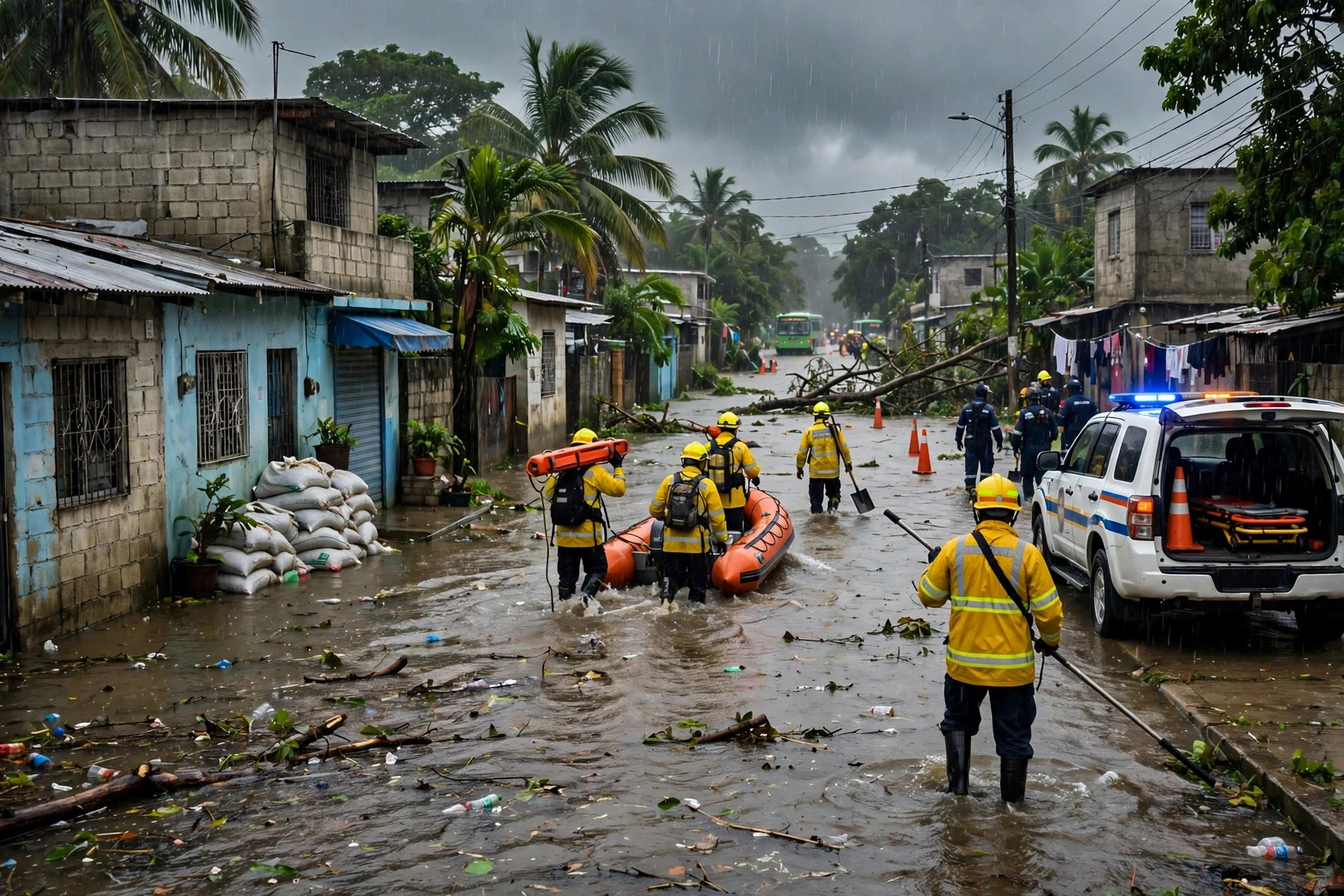
Calle de un barrio con viviendas de bloques anegada tras las lluvias: rescatistas con cascos y chaquetas amarillas cruzan el agua con un bote inflable naranja, sacos de arena protegen una vivienda y un vehículo de emergencia aguarda a la derecha. · Imagen generada para EPM
Dominican COE keeps alerts, warns of floods on saturated ground
The Dominican COE keeps four jurisdictions on yellow alert and 16 on green amid a trough, warns of floods and landslides on saturated soils, restricts the Juan…
No deaths reported as COE holds alerts and restricts a highway
The COE keeps four jurisdictions on yellow alert and 16 on green, restricts the Juan Pablo II highway after two rivers overflowed and confirms the mobilized…
--- The context ---
A trough left the ground saturated across several Dominican jurisdictions, and that saturation changes the risk even as rainfall eases: the soil no longer absorbs water the same way, and fresh rain can quickly become sudden flooding or a landslide.
--- The facts ---
The Emergency Operations Center keeps four jurisdictions under a yellow alert and 16 under a green alert because of the trough.
Its director, Colonel Erdwin Robert Olivares Lucian, warned that saturated soils could trigger new floods and landslides.
--- The positions ---
The yellow alert covers the provinces of Monte Plata and San José de Ocoa, the municipal district of Nisibón in La Altagracia, and the municipality of Ramón Santana in San Pedro de Macorís. The director specified that in these last two provinces the alert is focused on specific areas and the rest of their territories remains under green.
--- What remains unknown ---
A vehicle restriction remains in place on the Juan Pablo II highway, known as the Samaná road, because the waters of the Ozama and Yabacao rivers rose over the roadway in the early morning. Units from the Ministry of Public Works and the General Directorate of Traffic Safety and Land Transport are coordinating measures to keep drivers safe.
--- Unanswered questions ---
How long will the Juan Pablo II highway stay restricted while the rivers remain over the road? What will the surveys show in the homes that flooded? When can the alerts be lifted if the ground is still saturated?
--- EPM analysis ---
The human balance reported is encouraging: the director said no lives had been lost and that about two thousand people mobilized during the emergencies had returned to their homes. Residents preventively moved by the Civil Defense to an official shelter also went back, so no displaced people remained. The Housing Ministry is surveying areas where homes flooded, and response institutions are keeping their contingency plans active.
📌 EPM Take:
In EPM's view, the return home of the mobilized residents should not be read as the end of the emergency, but as a pause conditioned by the state of the ground. With saturated soils, caution protects more than haste: heeding the call not to cross rivers, streams and ravines with high flows, and staying watchful in flooded zones, is today the measure that separates a safe return from a new episode with families once again exposed to the water.
--- The context ---
The Dominican response to the trough is entering a phase of order and verification: the immediate pressure has eased, but authorities are holding alerts because saturated soils can produce floods and landslides even as rainfall decreases.
--- The facts ---
The Emergency Operations Center keeps four jurisdictions under a yellow alert and 16 under a green alert.
Still on yellow are Monte Plata and San José de Ocoa, the municipal district of Nisibón in La Altagracia, and the municipality of Ramón Santana in San Pedro de Macorís, according to its director, Colonel Erdwin Robert Olivares Lucian.
--- The positions ---
The director specified that the yellow alerts in La Altagracia and San Pedro de Macorís are focused and that the rest of their territories remains on green. He urged the public to stay cautious despite the reduction in alerts and to avoid crossing rivers, streams and ravines with elevated flows.
--- What remains unknown ---
The Juan Pablo II highway, known as the Samaná road, remains under a vehicle restriction because the waters of the Ozama and Yabacao rivers rose over the roadway in the early morning. The Ministry of Public Works and the General Directorate of Traffic Safety and Land Transport are coordinating measures for driver safety.
--- Unanswered questions ---
When will the Juan Pablo II highway fully reopen? What concrete damage will the surveys record in the flooded homes? Will contingency plans stay active until the ground loses its saturation?
--- EPM analysis ---
The central fact of the report is the absence of victims: the director said no human losses had been recorded. About two thousand people mobilized during the emergencies returned to their homes, as did residents preventively taken by the Civil Defense to an official shelter, leaving no displaced people. The Housing Ministry is gathering data where homes flooded, and agencies are keeping their contingency plans active, an institutional continuity that underpins the return.
📌 EPM Take:
In EPM's view, the merit of this day lies in what did not happen: no lives were lost and the mobilized population returned home under institutional coordination. That outcome is defended by obeying the road restrictions, respecting the focused alerts and not tempting fate at swollen waterways. Authority has marked the risk clearly; citizen discipline, staying away from the water and waiting for the road's formal reopening, is now the part that completes the response.
El COE mantiene alertas y advierte inundaciones por suelos saturados
El COE mantiene cuatro demarcaciones en alerta amarilla y 16 en verde por una vaguada, advierte inundaciones y deslizamientos por suelos saturados, restringe…
Sin fallecidos: el COE sostiene alertas y restringe una autovía
El COE mantiene cuatro demarcaciones en alerta amarilla y 16 en verde, restringe la autovía Juan Pablo II por el desbordamiento de dos ríos y confirma retorno…
--- El contexto ---
Una vaguada dejó suelos saturados en varias demarcaciones dominicanas, y esa saturación cambia el riesgo aunque las lluvias disminuyan: el terreno ya no absorbe igual y cualquier precipitación nueva puede convertirse en inundación repentina o en deslizamiento.
--- Los hechos ---
El Centro de Operaciones de Emergencias mantiene cuatro demarcaciones en alerta amarilla y 16 en verde por los efectos de la vaguada.
Su director, el coronel Erdwin Robert Olivares Lucian, advirtió que la saturación de los suelos podría provocar nuevas inundaciones y deslizamientos.
--- Las posiciones ---
La alerta amarilla cubre las provincias Monte Plata y San José de Ocoa, el distrito municipal de Nisibón, en La Altagracia, y el municipio de Ramón Santana, en San Pedro de Macorís. El director precisó que en estas dos últimas provincias la alerta está focalizada y que el resto de sus territorios permanece en verde.
--- Lo que falta saber ---
Se mantiene una restricción vehicular en la autovía Juan Pablo II, conocida como carretera de Samaná, porque las aguas de los ríos Ozama y Yabacao sobrepasaron la vía desde la madrugada. Las unidades del Ministerio de Obras Públicas y de la Dirección General de Seguridad de Tránsito y Transporte Terrestre coordinan las medidas para garantizar la seguridad de los conductores.
--- Preguntas sin respuesta ---
¿Cuánto tiempo seguirá restringida la autovía Juan Pablo II mientras los ríos sigan sobre la vía? ¿Qué mostrarán los levantamientos en las viviendas que se inundaron? ¿Cuándo podrán levantarse las alertas si el terreno continúa saturado?
--- Análisis EPM ---
El balance humano comunicado es alentador: el director aseguró que no se habían registrado pérdidas humanas y que cerca de dos mil personas movilizadas durante las emergencias habían retornado a sus hogares. También volvieron los ciudadanos trasladados preventivamente por la Defensa Civil a un albergue oficial, por lo que no quedaban personas desplazadas. El Ministerio de Vivienda realiza levantamientos donde se registraron inundaciones de viviendas y las instituciones de respuesta mantienen activos sus planes de contingencia.
📌 Conclusion EPM:
A juicio de EPM, la vuelta a casa de las personas movilizadas no debe leerse como el final de la emergencia, sino como una tregua condicionada por el estado del terreno. Con suelos saturados, la prudencia protege más que la prisa: atender el llamado a no cruzar ríos, arroyos y cañadas con caudales elevados y mantener la vigilancia en las zonas anegadas es la medida que hoy separa un retorno seguro de un nuevo episodio con familias expuestas otra vez al agua.
--- El contexto ---
La respuesta dominicana ante la vaguada entra en una fase de orden y verificación: bajó la presión inmediata, pero las autoridades mantienen alertas porque los suelos saturados pueden provocar inundaciones y deslizamientos aunque disminuyan las lluvias.
--- Los hechos ---
El Centro de Operaciones de Emergencias mantiene cuatro demarcaciones en alerta amarilla y 16 en verde.
Permanecen en amarilla Monte Plata y San José de Ocoa, el distrito municipal de Nisibón, en La Altagracia, y el municipio de Ramón Santana, en San Pedro de Macorís, según informó su director, el coronel Erdwin Robert Olivares Lucian.
--- Las posiciones ---
El director precisó que las alertas amarillas en La Altagracia y San Pedro de Macorís están focalizadas y que el resto de sus territorios permanece en verde. Llamó a la población a mantener la precaución pese a la reducción de las alertas y exhortó a evitar el cruce de ríos, arroyos y cañadas con elevados caudales.
--- Lo que falta saber ---
La autovía Juan Pablo II, conocida como carretera de Samaná, mantiene una restricción vehicular porque las aguas de los ríos Ozama y Yabacao sobrepasaron la vía desde la madrugada. El Ministerio de Obras Públicas y la Dirección General de Seguridad de Tránsito y Transporte Terrestre coordinan las medidas para la seguridad de los conductores.
--- Preguntas sin respuesta ---
¿Cuándo se reabrirá plenamente la autovía Juan Pablo II? ¿Qué daños concretos registrarán los levantamientos en las viviendas inundadas? ¿Seguirán activos los planes de contingencia hasta que el terreno pierda la saturación?
--- Análisis EPM ---
El dato central del informe es la ausencia de víctimas: el director aseguró que no se habían registrado pérdidas humanas. Cerca de dos mil personas movilizadas durante las emergencias retornaron a sus hogares, igual que los ciudadanos trasladados preventivamente por la Defensa Civil a un albergue oficial, sin personas desplazadas. El Ministerio de Vivienda levanta datos en las zonas de viviendas inundadas y los organismos mantienen sus planes de contingencia, una continuidad institucional que sostiene el retorno.
📌 Conclusion EPM:
A juicio de EPM, el mérito de esta jornada está en lo que no ocurrió: no hubo pérdidas humanas y la población movilizada volvió a sus casas bajo coordinación institucional. Ese resultado se defiende cumpliendo las restricciones viales, respetando las alertas focalizadas y no tentando a la suerte en cauces crecidos. La autoridad ha marcado el riesgo con claridad; la disciplina ciudadana, mantenerse lejos del agua y esperar la reapertura formal de la vía, es ahora la parte que completa la respuesta.