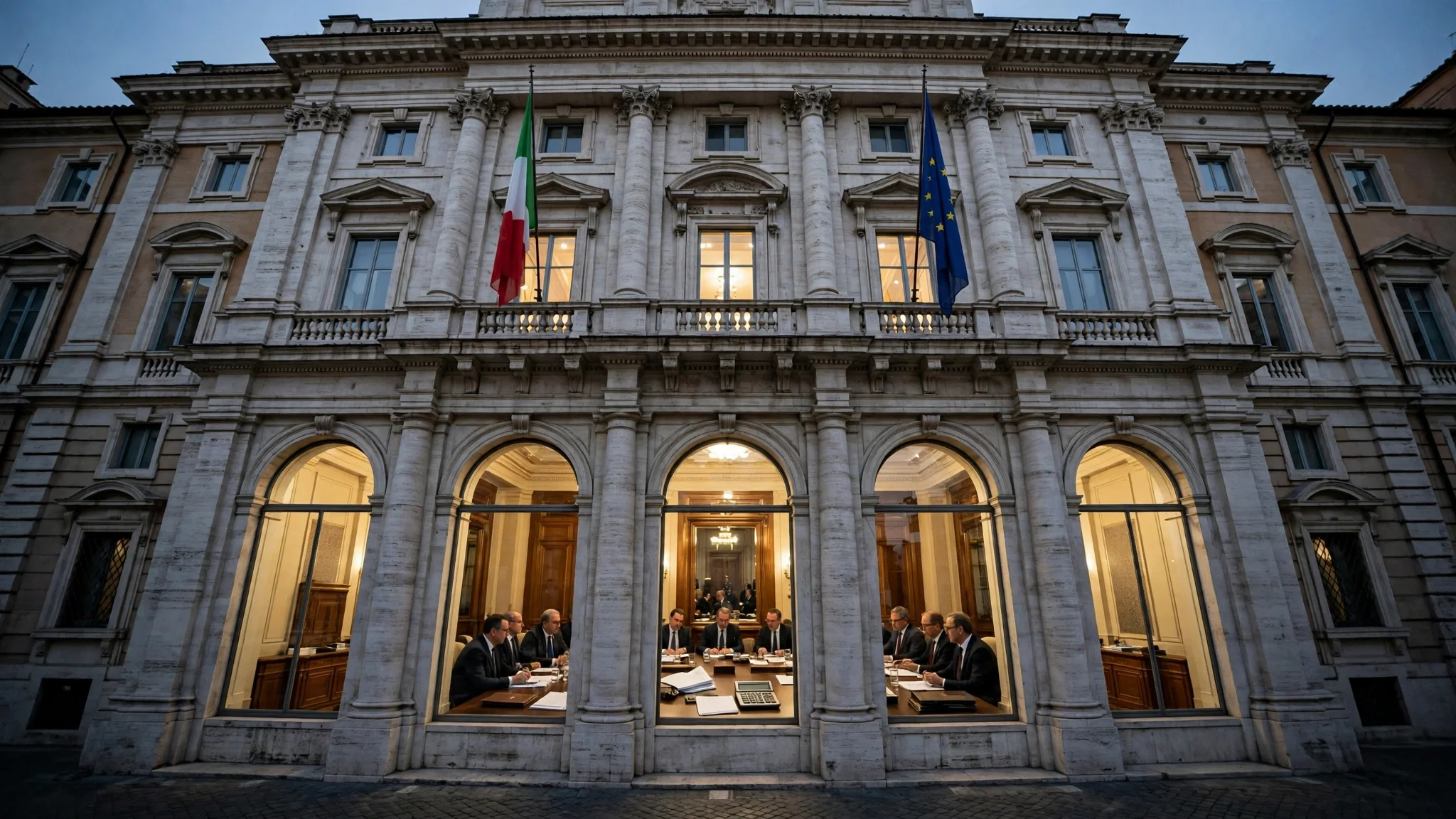
Un palacio institucional italiano al anochecer: tras los ventanales, una reunión de gabinete en torno a una mesa con documentos y una calculadora. · Imagen generada para EPM
Italy approves 2027 budget bill with tax relief and health boost
Italy's Council of Ministers approved the 2027 budget bill, worth 26 billion euros, extending the 33% rate to incomes up to 55,000 euros, raising the health…
Italy 2027 budget: fiscal order, family support and stronger health
Italy's Council of Ministers approved the 2027 budget bill, worth 26 billion euros, with the 33% rate up to 55,000 euros, the health fund at 146.3 thousand…
--- The context ---
The Council of Ministers met on October 28, 2026, at Palazzo Chigi under the chairmanship of Giorgia Meloni, with Alfredo Mantovano as secretary, and approved a broad package built around the draft budget law for 2027 and the multi-year framework for 2027-2029, proposed by Economy and Finance Minister Giancarlo Giorgetti.
As approved, the package concentrates resources on protecting the purchasing power of families and workers, in particular the youngest, on supporting families and birth rates, on health care, on business competitiveness and on investment, with special attention to the south of the country.
--- The facts ---
Overall, the package is worth about 26 billion euros in 2027 and 27 billion euros in 2028. Its funding comes mostly from activating clauses, from higher revenues from the financial, gaming and energy sectors,.
On taxes, the 33% income tax rate is extended to incomes up to 55,000 euros, and the favored 5% substitute tax on pay increases arising from contract renewals in the private sector is confirmed. For young workers, a 1% substitute tax on increases in dependent work income applies in 2027, within specific income and amount limits.
Contribution exemptions for permanent hiring of women, young people and workers in the special economic zones are extended through the end of 2027. The enhanced deduction for new hiring raises the coefficient to 80% for working mothers and to 40% for workers under 36 years of age,.
The flat-rate scheme threshold rises from 85,000 to 100,000 euros, while the value added tax exemption threshold stays at 85,000 euros pending European Union authorization. On housing, the rate on agreed rents falls from 10% to 5%, and to 1% for tenants up to 35 years old, and the tax is also extended to commercial properties.
On health, the National Health Fund rises by 3.4 thousand million euros and reaches 146.3 thousand million in 2027, A 300 euro voucher is created for people over 75 years old with a pension up to 28,000 euros a year, along with an 850 million euro fund for flexible retirement exit under the contributory system.
On family policy, the bonus for mothers with at least two children and work income no higher than 40,000 euros a year is strengthened, made structural and extended to self-employed and fixed-term workers. A birth fund assigns each newborn from 2027 an individual savings position fed by a state contribution of 100 euros a year until adulthood. Parental leave paid at 80% rises from three to four months, to five months with the second child and six from the third,.
For business, the tax credit for investment in the single special economic zone is strengthened with 2.4 thousand million euros in 2027 and 1.25 thousand million in 2028,.
The same Council approved, at preliminary examination, the decree on terraces in cultural spaces and the crafts reform, assessed 21 environmental impact procedures for renewables with a positive judgment for 5 projects in Puglia and a negative one for the rest, extended the Ukraine emergency state by twelve months, adopted the National Plan against trafficking 2026-2028 and granted Italian citizenship to taekwondo athlete Hadi Tiranvalipour.
--- The positions ---
The Government position, as approved, is that the package protects purchasing power and birth rates first, without giving up competitiveness or investment in the south. In the environmental assessment, the opposing position prevailed in most files: protection of landscape and cultural heritage outweighed expanding renewable production, except for the 5 Puglia projects, which received a positive judgment conditioned on the requirements of the competent commissions.
On terraces, the approved line simplifies: installing removable structures in urban open spaces of artistic or historic interest is freed from several prior cultural authorizations, with exceptions for areas strictly adjoining assets of exceptional value.
--- What remains unknown ---
The statement does not detail the parliamentary path the budget bill must still follow, nor how all the announced funding will be distributed in practice. It also does not quantify the individual effect of each cut on a concrete payslip or the effective number of beneficiaries of the family and health measures.
The rejected renewable projects also leave unanswered where the new capacity the country decides to authorize will be located.
--- Unanswered questions ---
Will the budget bill reach final approval without substantial changes to the announced figures? Will the additional 3.4 thousand million be enough for the health fund to sustain tariffs, dementias and emergency care at the same time? What criteria will decide the next renewable projects after a balance of 5 approvals and the rest rejected? When will the lists of exceptional cultural assets that condition outdoor terraces in cultural spaces be published?
--- EPM analysis ---
Read as a whole, the package combines tax relief concentrated on middle incomes and young people with a visible strengthening of health and family policy, The other side is funding: relying on higher revenues from finance, gaming and energy ties the balance of the package to income whose evolution the legislator does not fully control.
The non-budget decisions reinforce that reading: simplifying terraces and crafts cuts administrative friction for small businesses, while the majority brake on renewable projects shows the energy transition still subordinated, case by case, to protection of landscape and heritage.
📌 EPM Take:
In EPM's view, the approved budget portrays a Government seeking immediate relief for middle incomes, working mothers and young people, and reinforcing health care up to 146.3 thousand million as its central social signal. Its strength is breadth: taxation, family, housing, business and the south advance in one coherent package. Its weakness is the same breadth, because each promise competes for funding drawn from financial, gaming and energy revenues. The final judgment will depend on two concrete tests: whether the relief reaches payslips intact and whether the health money translates into services, not only into approved figures.
--- The context ---
The Council of Ministers met on October 28, 2026, at Palazzo Chigi under the chairmanship of Giorgia Meloni, with Alfredo Mantovano as secretary. Proposed by Economy and Finance Minister Giancarlo Giorgetti, it approved the draft budget law for 2027 and the multi-year framework for 2027-2029, together with sector reforms.
As approved, the package concentrates resources on safeguarding the purchasing power of families and workers, in particular the youngest, on supporting families and birth rates, on health care, on business competitiveness and on investment, with particular attention to the south of the country.
--- The facts ---
The package is worth overall about 26 billion euros in 2027 and 27 billion euros in 2028. Its funding was obtained mostly by activating clauses, through higher revenues from the financial, gaming and energy sectors, and through contributions also requested from ministries and the Presidency.
On the tax front, the 33% income tax rate is extended to incomes up to 55,000 euros and the favored 5% substitute tax on pay increases from contract renewals in the private sector is confirmed. For 2027, a 1% substitute tax is introduced on increases in the income of young dependent workers, within specific income and amount limits.
Contribution exemptions for permanent hiring of women, young people and workers in the special economic zones are extended through the end of 2027. The enhanced deduction for new hiring raises the coefficient to 80% for working mothers and to 40% for young people under 36 years of age,.
Housing receives a clear tax signal: the rate on agreed rents falls from 10% to 5%, and to 1% for contracts with tenants up to 35 years old, and the tax is also extended to commercial properties. The flat-rate threshold moves from 85,000 to 100,000 euros, while the value added tax exemption stays at 85,000 euros pending European Union authorization.
The National Health Fund grows by 3.4 thousand million euros and reaches 146.3 thousand million in 2027. A 300 euro voucher is introduced for people over 75 years old with a pension up to 28,000 euros a year, and an 850 million euro fund supports flexible exit under the contributory system.
On family and births, the bonus for mothers with at least two children and work income no higher than 40,000 euros a year is strengthened, made structural and extended to self-employed and fixed-term workers. A birth fund assigns newborns from 2027 an individual savings position fed by a yearly state contribution of 100 euros until adulthood. Parental leave paid at 80% rises from three to four months, to five months with the second child and six from the third,.
For business and the south, the tax credit for investment in the single special economic zone is strengthened with 2.4 thousand million euros in 2027 and 1.25 thousand million in 2028.
The Council also approved, at preliminary examination, the decree on terraces in cultural spaces and the crafts reform, examined 21 environmental impact procedures for renewables with a positive judgment for 5 projects in Puglia and a negative one for the rest on landscape grounds, extended the Ukraine emergency state by twelve months, adopted the National Plan against trafficking 2026-2028 and granted Italian citizenship to taekwondo athlete Hadi Tiranvalipour.
--- The positions ---
The position ordering the package is that of a budget rewarding work and hiring: a lower burden on incomes up to 55,000 euros, higher incentives to hire mothers and young people, and a wider flat-rate scheme for self-employed work. On the environmental front, the prevailing position was defense of landscape and cultural heritage against most of the renewable projects examined, with the sole favorable exception of the 5 Puglia projects conditioned on requirements.
On terraces, the approved reform orders and coordinates concessions of public spaces of cultural or landscape interest for removable structures, distinguishing closable spaces from mobile elements such as tables, umbrellas and platforms, while keeping the public land occupation title.
--- What remains unknown ---
The statement does not specify the parliamentary timetable for the bill or the detail of how funding will be divided between clauses and sector revenues. It also offers no estimate of the average effect of the relief on each taxpayer or of the final number of beneficiaries of the family and health measures.
--- Unanswered questions ---
Will Parliament keep the central figures of the package intact during its passage? Can the 146.3 thousand million health fund sustain hospital tariffs, dementias and emergency care at once? How will the country offset the renewable capacity not authorized after rejecting most of the 21 procedures? What effect will the structural car tax exemption for vehicles up to 80 kW have?
--- EPM analysis ---
The architecture of the package favors incentives over generalized subsidies: concrete rates fall, deductions linked to hiring rise and agreed renting is rewarded, while health and births receive identifiable allocations.
The risk lies in the funding: depending mostly on clauses and on higher revenues from finance, gaming and energy demands discipline in execution so that the promised relief is not paid for with later deviations. The brake on most renewables completes a portrait of regulatory prudence.
📌 EPM Take:
In EPM's view, the central value of this budget lies in its order: it rewards work, protects the family with permanent instruments and strengthens health care without promising spending with no identified funding. Extending the 33% rate and the incentives to hire mothers and young people point to the same goal, that producing and raising a family should stop being penalized. Its test will come in execution: if sector funding yields what is expected and hiring responds, the package will stand as a model of effective prudence; if not, the announced relief will remain a half-kept promise.
Italia aprueba el presupuesto 2027 con rebaja fiscal y más sanidad
El Consejo de Ministros aprobó el proyecto de presupuesto 2027, de 26 mil millones de euros, con la tarifa del 33 extendida hasta 55.000 euros, el fondo…
Presupuesto 2027 en Italia: orden fiscal, familia y sanidad reforzada
El Consejo de Ministros aprobó el proyecto de presupuesto 2027, de 26 mil millones de euros, con la tarifa del 33 hasta 55.000 euros, el fondo sanitario en…
--- El contexto ---
El Consejo de Ministros se reunió el 28 de octubre de 2026 en el Palacio Chigi bajo la presidencia de Giorgia Meloni, con Alfredo Mantovano como secretario, y aprobó el proyecto de ley de presupuesto para 2027 y el marco plurianual 2027-2029, a propuesta del ministro de Economía y Finanzas Giancarlo Giorgetti.
Según lo aprobado, la maniobra concentra los recursos en proteger el poder adquisitivo de familias y trabajadores, en particular de los más jóvenes, apoyar la familia y la natalidad, reforzar la sanidad, elevar la competitividad de las empresas y sostener la inversión, con atención especial al sur del país.
--- Los hechos ---
En conjunto, la maniobra vale unos 26 mil millones de euros en 2027 y 27 mil millones de euros en 2028. Las coberturas proceden sobre todo de la activación de cláusulas, de mayores ingresos de los sectores financiero, de juegos y de energía,.
En materia fiscal, la tarifa del impuesto sobre la renta del 33% se extiende a las rentas de hasta 55.000 euros y se confirma el impuesto sustitutivo favorecido del 5% sobre los aumentos salariales derivados de renovaciones contractuales en el sector privado. Para los jóvenes se introduce en 2027 un impuesto sustitutivo del 1% sobre los aumentos del ingreso laboral dependiente, dentro de límites específicos de renta e importe.
Se prorrogan hasta finales de 2027 las exenciones contributivas para contrataciones indefinidas de mujeres, jóvenes y trabajadores en las zonas económicas especiales. La mayor deducción por nuevas contrataciones eleva el coeficiente al 80% para las madres trabajadoras y al 40% para los menores de 36 años,.
El umbral del régimen forfetario sube de 85.000 a 100.000 euros, mientras el umbral de exención del impuesto sobre el valor añadido se mantiene en 85.000 euros a la espera de la autorización de la Unión Europea. En vivienda, la tarifa sobre alquileres pactados baja del 10% al 5%, y al 1% para inquilinos de hasta 35 años,.
En sanidad, el Fondo sanitario nacional aumenta en 3,4 mil millones de euros y alcanza 146,3 mil millones en 2027, Se crea un vale de 300 euros para mayores de 75 años con pensión de hasta 28.000 euros anuales y un fondo de 850 millones para la flexibilidad de salida laboral en el sistema contributivo.
En familia, se refuerza y se vuelve estructural el bono para madres con al menos dos hijos e ingreso laboral no superior a 40.000 euros anuales, ampliado a autónomas y temporales. Se crea un fondo de natalidad que asigna a cada recién nacido desde 2027 una posición de ahorro alimentada con 100 euros estatales al año hasta la mayoría de edad. El permiso parental pagado al 80% pasa de tres a cuatro meses, a cinco con el segundo hijo y a seis desde el tercero,.
Para las empresas, se refuerza el crédito fiscal por inversiones en la zona económica especial única, con 2,4 mil millones de euros en 2027 y 1,25 mil millones en 2028.
El mismo Consejo aprobó en examen preliminar el decreto de terrazas en espacios culturales y la reforma del artesanado, evaluó 21 procedimientos de impacto ambiental de renovables con juicio positivo para 5 proyectos en Puglia y negativo para el resto, prorrogó por doce meses el estado de emergencia por Ucrania, adoptó el Plan nacional contra la trata 2026-2028 y confirió la ciudadanía italiana al atleta de taekwondo Hadi Tiranvalipour.
--- Las posiciones ---
La posición del Gobierno, según el comunicado aprobado, es que la maniobra protege primero el poder adquisitivo y la natalidad sin renunciar a la competitividad ni a la inversión en el sur. En la evaluación ambiental prevaleció la posición contraria en la mayoría de los expedientes: la tutela del paisaje y del patrimonio cultural resultó prevalente frente al aumento de la producción renovable, salvo en los 5 proyectos de Puglia.
En las terrazas, la línea aprobada simplifica: la instalación de estructuras desmontables en espacios urbanos de interés artístico o histórico queda fuera de varias autorizaciones culturales previas, con excepciones para las áreas estrictamente próximas a bienes de valor excepcional.
--- Lo que falta saber ---
El comunicado no detalla el recorrido parlamentario que aún debe seguir el proyecto de presupuesto ni precisa cómo se repartirán en la práctica todas las coberturas anunciadas. Tampoco cuantifica el efecto individual de cada rebaja sobre una nómina concreta ni el número de beneficiarios efectivos de las ayudas familiares y sanitarias.
--- Preguntas sin respuesta ---
¿Llegará el proyecto de presupuesto a su aprobación definitiva sin cambios sustanciales en las cifras anunciadas? ¿Bastarán los 3,4 mil millones adicionales para sostener tarifas, demencias y urgencias al mismo tiempo? ¿Qué criterios decidirán los próximos proyectos renovables tras un balance de 5 aprobados y el resto rechazados? ¿Cuándo se publicarán las listas de bienes de valor excepcional que condicionan las terrazas en espacios culturales?
--- Análisis EPM ---
Leído en conjunto, el paquete combina un alivio fiscal concentrado en rentas medias y jóvenes con un refuerzo visible de sanidad y familia, La otra cara es la financiación: apoyarse en mayores ingresos de finanzas, juegos y energía deja el equilibrio de la maniobra atado a ingresos cuya evolución no controla por completo el legislador.
Simplificar terrazas y artesanado reduce fricción para pequeños negocios, mientras el freno mayoritario a los renovables muestra la transición energética subordinada a la protección del paisaje.
📌 Conclusion EPM:
A juicio de EPM, el presupuesto aprobado dibuja un Gobierno que busca alivio inmediato para rentas medias, madres trabajadoras y jóvenes, y que refuerza la sanidad hasta 146,3 mil millones como señal social central. Su fortaleza es la amplitud: fiscalidad, familia, vivienda, empresas y sur avanzan en un mismo paquete coherente. Su debilidad es la misma amplitud, porque cada promesa compite por coberturas apoyadas en ingresos financieros, del juego y de la energía. El juicio definitivo dependerá de dos pruebas concretas: que la rebaja llegue intacta a las nóminas y que el dinero sanitario se traduzca en servicios, no solo en cifras aprobadas.
--- El contexto ---
El Consejo de Ministros se reunió el 28 de octubre de 2026 en el Palacio Chigi bajo la presidencia de Giorgia Meloni, con Alfredo Mantovano como secretario. A propuesta del ministro de Economía y Finanzas Giancarlo Giorgetti, aprobó el proyecto de ley de presupuesto para 2027 y el marco plurianual 2027-2029, junto con reformas sectoriales.
La maniobra, según lo aprobado, concentra los recursos en la tutela del poder adquisitivo de familias y trabajadores, en particular de los más jóvenes, en el sostén de la familia y de la natalidad, en la sanidad, en la competitividad de las empresas y en las inversiones, con atención particular al sur del país.
--- Los hechos ---
La maniobra vale en conjunto unos 26 mil millones de euros en 2027 y 27 mil millones de euros en 2028. Las coberturas se obtuvieron en prevalencia mediante la activación de cláusulas, mayores entradas de los sectores financiero, de juegos y de energía, y la contribución pedida también a los ministerios y a la Presidencia.
En el frente fiscal, se extiende la tarifa del impuesto sobre la renta del 33% a las rentas de hasta 55.000 euros y se confirma el impuesto sustitutivo favorecido del 5% sobre los aumentos retributivos derivados de renovaciones contractuales en el sector privado.
Se prorrogan hasta finales de 2027 las exenciones contributivas para las contrataciones indefinidas de mujeres, jóvenes y trabajadores en las zonas económicas especiales. La mayor deducción por nuevas contrataciones eleva el coeficiente al 80% para las madres trabajadoras y al 40% para los jóvenes menores de 36 años,.
La casa recibe una señal tributaria clara: la tarifa sobre alquileres pactados desciende del 10% al 5%, y al 1% para contratos con inquilinos de hasta 35 años, y el tributo se extiende además a los inmuebles comerciales. El umbral del régimen forfetario pasa de 85.000 a 100.000 euros,.
El Fondo sanitario nacional crece en 3,4 mil millones de euros y alcanza 146,3 mil millones en 2027. Se introduce un vale de 300 euros para personas de más de 75 años con pensión de hasta 28.000 euros anuales, y un fondo de 850 millones para la flexibilidad de salida en el sistema contributivo.
En familia y natalidad, se potencia y se vuelve estructural el bono para madres con al menos dos hijos e ingreso laboral no superior a 40.000 euros anuales, ampliado también a autónomas y temporales. Nace el fondo para la natalidad, que asigna a los recién nacidos desde 2027 una posición individual de ahorro alimentada con un aporte estatal anual de 100 euros hasta la mayoría de edad. El permiso parental retribuido al 80% pasa de tres a cuatro meses, a cinco con el segundo hijo y a seis desde el tercero.
Para las empresas y el sur, se refuerza el crédito fiscal por inversiones en la zona económica especial única, con 2,4 mil millones de euros en 2027 y 1,25 mil millones en 2028.
El Consejo aprobó además, en examen preliminar, el decreto de terrazas en espacios culturales y la reforma del artesanado, examinó 21 procedimientos de impacto ambiental de renovables con juicio positivo para 5 proyectos en Puglia y negativo para el resto por prevalencia del paisaje, prorrogó por doce meses el estado de emergencia por Ucrania, adoptó el Plan nacional contra la trata 2026-2028 y confirió la ciudadanía italiana al atleta de taekwondo Hadi Tiranvalipour.
--- Las posiciones ---
La posición que ordena el paquete es la de un presupuesto que premia el trabajo y la contratación: menos carga sobre rentas de hasta 55.000 euros, incentivos más altos para contratar madres y jóvenes, y un régimen forfetario más amplio para el trabajo autónomo. En el frente ambiental, la posición que prevaleció fue la defensa del paisaje y del patrimonio cultural frente a la mayoría de los proyectos renovables examinados, con la única excepción favorable de los 5 proyectos de Puglia condicionados a prescripciones.
En terrazas, la reforma aprobada ordena y coordina las concesiones de espacios públicos de interés cultural o paisajístico para estructuras desmontables, distinguiendo entre espacios que pueden cerrarse y elementos móviles como mesas, sombrillas y plataformas, y manteniendo el título de ocupación de suelo público.
--- Lo que falta saber ---
El comunicado no precisa el calendario parlamentario del proyecto ni el detalle de cómo se distribuirán las coberturas entre cláusulas e ingresos sectoriales. Tampoco ofrece una estimación del efecto medio de la rebaja sobre cada contribuyente ni del número final de beneficiarios de las medidas de familia y sanidad.
--- Preguntas sin respuesta ---
¿Mantendrá el Parlamento intactas las cifras centrales de la maniobra durante su tramitación? ¿Podrá el fondo sanitario de 146,3 mil millones sostener a la vez tarifas hospitalarias, demencias y urgencias? ¿Cómo compensará el país la capacidad renovable no autorizada tras rechazar la mayoría de los 21 procedimientos? ¿Qué efecto tendrá la exención estructural de la tasa de automóviles para vehículos de hasta 80 kW?
--- Análisis EPM ---
La arquitectura del paquete es de incentivos antes que de subsidios generalizados: bajan tarifas concretas, suben deducciones ligadas a contratar y se premia el alquiler pactado, mientras la sanidad y la natalidad reciben partidas identificables.
El riesgo está en las coberturas: depender en prevalencia de cláusulas y de mayores ingresos de finanzas, juegos y energía exige disciplina en la ejecución para que el alivio prometido no se pague con desvíos posteriores. El freno a la mayoría de renovables completa un retrato de prudencia regulatoria.
📌 Conclusion EPM:
A juicio de EPM, el valor central de este presupuesto está en su orden: premia el trabajo, protege a la familia con instrumentos permanentes y refuerza la sanidad sin prometer gasto sin cobertura identificada. La extensión de la tarifa del 33 y los incentivos a contratar madres y jóvenes apuntan al mismo objetivo, que producir y formar familia deje de penalizar. Su examen llegará en la ejecución: si las coberturas sectoriales rinden lo previsto y las contrataciones responden, la maniobra será un modelo de prudencia eficaz; si no, el alivio anunciado quedará como una promesa a medio cumplir.