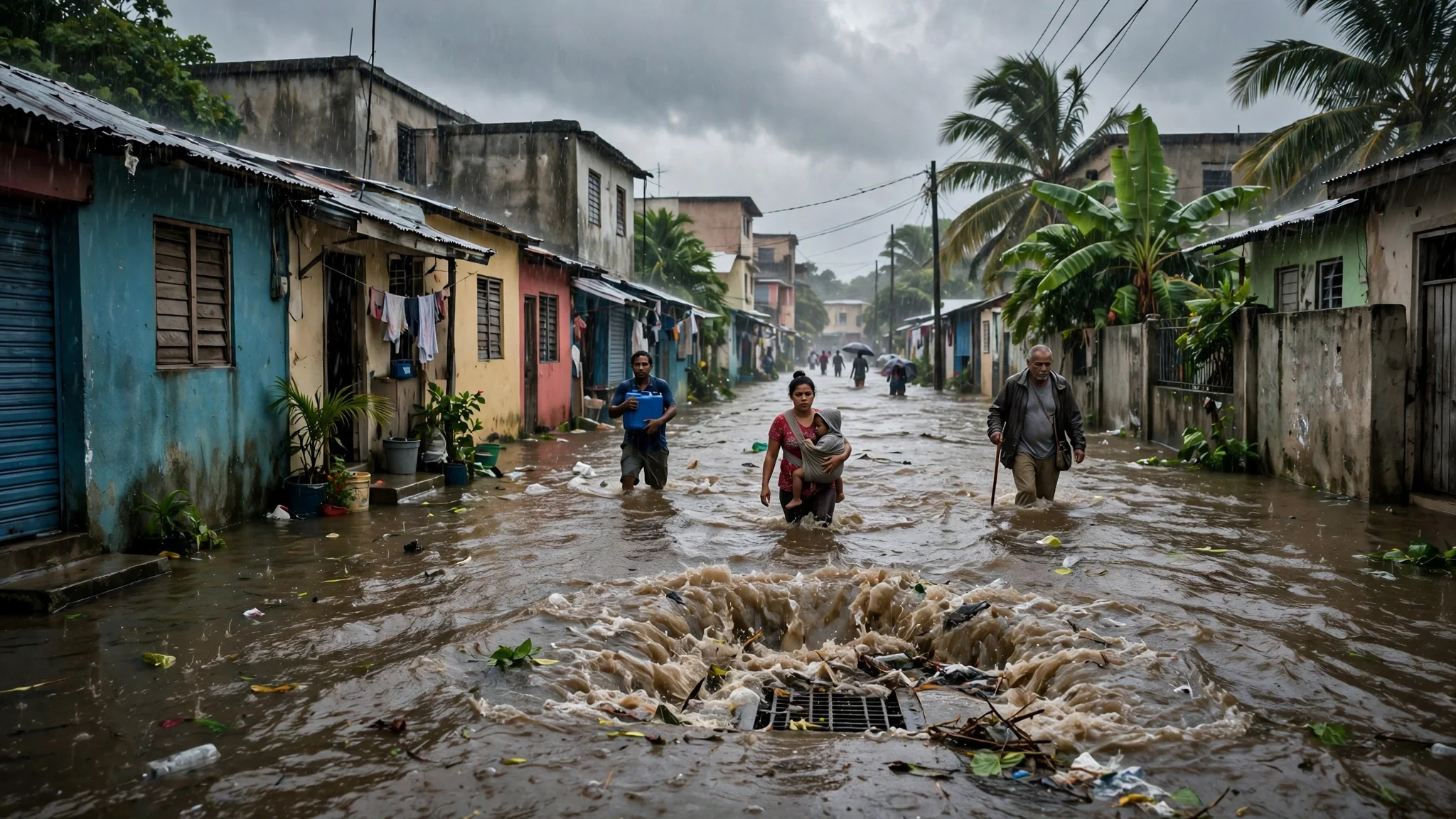
Una calle de un barrio caribeño anegada tras las lluvias: vecinos cruzan el agua mientras un drenaje desbordado y restos arrastrados muestran la obstrucción de los desagües. · Imagen generada para EPM
O'Neal demands a lasting flood plan for Santo Domingo Este
Lawmaker Juliana O'Neal asked the Santo Domingo Este city government for a sustainable plan against Tuesday's flooding in Alma Rosa and Maquiteria, while…
Santo Domingo Este needs drainage, cleaning and continuity
After Tuesday's flooding, Juliana O'Neal demanded that Santo Domingo Este present a lasting plan with identified critical points, clean storm drains…
--- The context ---
Flooding on Tuesday again inundated different sectors of Santo Domingo Este and reopened a demand that returns with every season of intense rain. Against that backdrop, lawmaker Juliana O'Neal called for sustainable solutions and asked the city government to explain what actions it is carrying out to keep the rains from paralyzing the municipality.
She made the demand during statements to the press at the Chamber of Deputies, with the focus placed on prevention and on the continuity of interventions over time.
--- The facts ---
O'Neal mentioned the flooding recorded in Alma Rosa and on Costa Rica and San Vicente de Paúl avenues, as well as the drainage problems affecting Maquiteria. In La Isabelita and Villa Faro, residents and merchants asked for definitive solutions to storm drainage.
The lawmaker considered it necessary to identify the critical points and strengthen the cleaning of storm drains, the maintenance of drainage systems and garbage collection as part of a preventive strategy, and warned that these situations affect productive activity, school attendance and public transportation.
The Dominican Institute of Meteorology reported that rain will continue this Wednesday, although with less intensity, due to a trough combined with southeasterly wind, with downpours, thunderstorms and gusts of wind in different regions, including the southeast.
--- The positions ---
O'Neal argued that solutions and a plan are needed and that the public must know what the city government is doing about this situation. She also maintained that a state plan is required rather than only a government plan, with interventions sustained over time regardless of changes in authorities.
Residents and merchants in La Isabelita and Villa Faro agreed in asking for works that keep water from entering their homes and businesses again, and called for better management of solid waste to reduce the obstruction of drains.
--- What remains unknown ---
It is still not known what concrete actions the city government is carrying out, nor an intervention schedule for the sectors and avenues identified, nor how cleaning, maintenance and collection are organized at the critical points.
--- Unanswered questions ---
What critical points have been identified so far in Santo Domingo Este? What storm drain cleaning and drainage maintenance work is currently under way? How will garbage collection be strengthened to prevent drains from becoming obstructed? What measures will be adopted before the intense rains that are often recorded in November?
--- EPM analysis ---
The demand connects three levels that are often treated separately: drainage infrastructure, solid waste management and the continuity of public policy. When they do not advance together, each rain episode again interrupts production, classes and transportation.
The weather warning adds immediate urgency, but the core is structural: without sustained maintenance and verifiable prevention, a partial improvement in how quickly the water recedes is not a definitive solution.
📌 EPM Take:
In EPM's view, the value of O'Neal's demand lies in requiring continuity and verifiable prevention, not improvised responses after each flood. Identifying critical points, cleaning storm drains, maintaining drainage systems and collecting garbage on time are basic tasks whose fulfillment should be checkable street by street. If the city government presents that plan with clear responsibility and public follow-up, Santo Domingo Este will gain real resilience; if everything remains announcements after Tuesday's rain, the next episode will again paralyze schools, transportation and productive activity.
--- The context ---
Santo Domingo Este was exposed again on Tuesday, when rains flooded different sectors and forced residents and merchants to protect homes and businesses. After that episode, lawmaker Juliana O'Neal called for sustainable solutions and asked the city government to explain what actions it is carrying out to keep the rains from paralyzing the municipality.
She made the demand during statements to the press at the Chamber of Deputies, pointing to a basic management question: drainage that works, clean storm drains and constant garbage collection.
--- The facts ---
The lawmaker mentioned the flooding recorded in Alma Rosa and on Costa Rica and San Vicente de Paúl avenues, as well as the drainage problems affecting Maquiteria. In La Isabelita and Villa Faro, residents and merchants asked for definitive solutions to storm drainage and for works that keep water from entering their homes and businesses again.
O'Neal considered it necessary to identify the critical points and strengthen the cleaning of storm drains, the maintenance of drainage systems and garbage collection as part of a preventive strategy. She warned that these situations affect productive activity, school attendance and public transportation, and recalled the consequences of the intense rains recorded in November in recent years.
The Dominican Institute of Meteorology reported that rain will continue this Wednesday, although with less intensity, due to a trough combined with southeasterly wind, with downpours, thunderstorms and gusts of wind in different regions, including the southeast.
--- The positions ---
O'Neal expressed that solutions and a plan are needed and that it must be known what the city government is doing about this situation. She also maintained that a state plan is needed and not only a government plan, insisting that interventions must be sustained over time regardless of changes in authorities.
Those affected acknowledged that some interventions have allowed the water to recede more quickly, but pointed out that they have not prevented the flooding, and they called for better management of solid waste to reduce the obstruction of drains.
--- What remains unknown ---
It has not been reported what concrete actions the city government is carrying out at the critical points, nor how often storm drains are cleaned and drainage systems maintained, nor a calendar for the sectors and avenues identified.
--- Unanswered questions ---
What concrete plan will the city government present to prevent new flooding in Santo Domingo Este? What critical points will be addressed first and with what verifiable work? How will it be guaranteed that cleaning and maintenance continue even when authorities change? What responsibility will the municipality and residents assume in managing solid waste?
--- EPM analysis ---
The discussion is not only meteorological: it is about order and maintenance. A city can withstand intense rain if its drainage is clean, its storm drains are clear and its garbage is collected on time; when those tasks fail, the damage to homes and businesses multiplies.
The continuity demanded also has a practical sense: drainage works and cleaning programs lose effect if they are interrupted with each change of administration, so sustained prevention costs less than repeated repairs.
📌 EPM Take:
In EPM's view, Santo Domingo Este does not need another diagnosis after the rain, but constant and verifiable management: critical points identified, storm drains cleaned, drainage systems maintained and garbage collected without interruptions. The demand for a plan that transcends governments is right because prevention allows no pauses between administrations. The city government must respond with concrete actions and visible follow-up, and the community must help with responsible waste management. Only that shared discipline will keep each trough from again paralyzing schools, transportation and productive activity.
O'Neal reclama un plan duradero contra las inundaciones en Santo Domingo Este
La diputada Juliana O'Neal pidió a la alcaldía de Santo Domingo Este un plan sostenible contra las inundaciones del martes en Alma Rosa y Maquiteria —mientras…
Santo Domingo Este necesita drenaje, limpieza y un plan que perdure
Tras las inundaciones del martes, Juliana O'Neal exigió a Santo Domingo Este un plan duradero con puntos críticos identificados, imbornales limpios, drenajes…
--- El contexto ---
Las inundaciones del martes volvieron a anegar distintos sectores de Santo Domingo Este. En ese escenario, la diputada Juliana O'Neal reclamó soluciones sostenibles y pidió a la alcaldía explicar qué acciones ejecuta para evitar que las lluvias paralicen el municipio.
La legisladora formuló el reclamo durante declaraciones a la prensa en la Cámara de Diputados, con el foco puesto en la prevención y en la continuidad de las intervenciones en el tiempo.
--- Los hechos ---
O'Neal mencionó las inundaciones registradas en Alma Rosa y en las avenidas Costa Rica y San Vicente de Paúl, así como los problemas de drenaje que afectan a Maquiteria. En La Isabelita y Villa Faro, residentes y comerciantes pidieron soluciones definitivas al drenaje pluvial.
La diputada consideró necesario identificar los puntos críticos y reforzar la limpieza de imbornales, el mantenimiento de los drenajes y la recogida de basura como parte de una estrategia preventiva, y advirtió que estas situaciones afectan la actividad productiva, la asistencia a las escuelas y el transporte público.
El Instituto Dominicano de Meteorología informó que este miércoles continuarán las lluvias, aunque con menor intensidad, debido a una vaguada combinada con el viento del sureste, con aguaceros, tormentas eléctricas y ráfagas de viento en distintas regiones, incluido el sureste.
--- Las posiciones ---
O'Neal sostuvo que se necesitan soluciones y un plan, y que la población debe saber qué está haciendo la alcaldía frente a esta situación. También defendió que se requiere un plan de Estado y no solo un plan de gobierno, con intervenciones sostenidas en el tiempo independientemente de los cambios de autoridades.
Los residentes y comerciantes de La Isabelita y Villa Faro coincidieron en pedir obras que impidan que el agua vuelva a penetrar en sus viviendas y negocios, y llamaron a mejorar el manejo de los desechos sólidos para reducir la obstrucción de los desagües.
--- Lo que falta saber ---
Todavía no se conoce qué acciones concretas ejecuta la alcaldía ni un calendario de intervención para los sectores y avenidas señalados, ni cómo se ordenan la limpieza, el mantenimiento y la recogida en los puntos críticos.
--- Preguntas sin respuesta ---
¿Qué puntos críticos han sido identificados hasta ahora en Santo Domingo Este? ¿Qué trabajos de limpieza de imbornales y mantenimiento de drenajes están en curso? ¿Cómo se reforzará la recogida de basura para evitar la obstrucción de los desagües? ¿Qué medidas se adoptarán antes de las lluvias intensas que suelen registrarse en noviembre?
--- Análisis EPM ---
El reclamo conecta tres planos que suelen tratarse por separado: la infraestructura de drenaje, la gestión de los desechos sólidos y la continuidad de las políticas públicas. Cuando no avanzan juntos, cada episodio de lluvia vuelve a interrumpir la producción, las clases y el transporte.
La advertencia meteorológica añade urgencia inmediata, pero el fondo del planteamiento es estructural: sin mantenimiento sostenido y sin prevención verificable, la mejora parcial en la velocidad con que baja el agua no equivale a una solución definitiva.
📌 Conclusion EPM:
A juicio de EPM, el valor del reclamo de O'Neal está en exigir continuidad y prevención verificable, no respuestas improvisadas tras cada inundación. Identificar puntos críticos, limpiar imbornales, mantener drenajes y recoger la basura a tiempo son tareas básicas cuyo cumplimiento debería poder comprobarse calle por calle. Si la alcaldía presenta ese plan con responsables y seguimiento público, Santo Domingo Este ganará resiliencia real; si todo queda en anuncios tras la lluvia del martes, el próximo episodio volverá a paralizar escuelas, transporte y actividad productiva.
--- El contexto ---
Santo Domingo Este volvió a quedar expuesto el martes, cuando las lluvias inundaron distintos sectores y obligaron a vecinos y comerciantes a proteger viviendas y negocios. Tras ese episodio, la diputada Juliana O'Neal reclamó soluciones sostenibles y pidió a la alcaldía explicar qué acciones ejecuta para evitar que las lluvias paralicen el municipio.
El reclamo, formulado en la Cámara de Diputados, apuntó a una gestión básica: drenajes que funcionen, imbornales limpios y recogida constante.
--- Los hechos ---
La legisladora mencionó las inundaciones registradas en Alma Rosa y en las avenidas Costa Rica y San Vicente de Paúl, así como los problemas de drenaje que afectan a Maquiteria. En La Isabelita y Villa Faro, residentes y comerciantes pidieron soluciones definitivas al drenaje pluvial y obras que impidan que el agua vuelva a penetrar en sus viviendas y negocios.
O'Neal consideró necesario identificar los puntos críticos y reforzar la limpieza de imbornales, el mantenimiento de los drenajes y la recogida de basura como parte de una estrategia preventiva. Advirtió que estas situaciones afectan la actividad productiva, la asistencia a las escuelas y el transporte público, y recordó las consecuencias de las lluvias intensas registradas en noviembre durante los últimos años.
El Instituto Dominicano de Meteorología informó que este miércoles continuarán las lluvias, aunque con menor intensidad, debido a una vaguada combinada con el viento del sureste, con aguaceros, tormentas eléctricas y ráfagas de viento en distintas regiones, incluido el sureste.
--- Las posiciones ---
O'Neal expresó que se necesitan soluciones y un plan, y que debe saberse qué está haciendo la alcaldía con esta situación. También sostuvo que hace falta un plan de Estado y no solo un plan de gobierno, al insistir en que las intervenciones deben mantenerse en el tiempo independientemente de los cambios de autoridades.
Los afectados reconocieron que algunas intervenciones han permitido que el agua descienda con mayor rapidez, pero señalaron que no han evitado las inundaciones, y llamaron a mejorar el manejo de los desechos sólidos para reducir la obstrucción de los desagües.
--- Lo que falta saber ---
No se ha informado qué acciones concretas ejecuta la alcaldía en los puntos críticos ni la frecuencia de limpieza y mantenimiento, ni un calendario para los sectores y las avenidas señalados.
--- Preguntas sin respuesta ---
¿Qué plan concreto presentará la alcaldía para evitar nuevas inundaciones en Santo Domingo Este? ¿Qué puntos críticos serán intervenidos primero y con qué trabajos verificables? ¿Cómo se garantizará que la limpieza y el mantenimiento continúen aunque cambien las autoridades? ¿Qué responsabilidad asumirán municipio y vecinos en el manejo de los desechos sólidos?
--- Análisis EPM ---
La discusión no es solo meteorológica: es de orden y mantenimiento. Una ciudad puede soportar lluvias intensas si sus drenajes están limpios, sus imbornales despejados y su basura recogida a tiempo; cuando esas tareas fallan, el daño sobre hogares y comercios se multiplica.
La continuidad que reclama la diputada tiene además un sentido práctico: las obras de drenaje y los programas de limpieza pierden efecto si se interrumpen con cada cambio de gestión.
📌 Conclusion EPM:
A juicio de EPM, Santo Domingo Este no necesita otro diagnóstico tras la lluvia, sino gestión constante y comprobable: puntos críticos identificados, imbornales limpios, drenajes mantenidos y basura recogida sin interrupciones. La exigencia de un plan que trascienda gobiernos acierta porque la prevención no admite pausas entre administraciones. La alcaldía debe responder con acciones concretas y seguimiento visible, y la comunidad debe acompañar con un manejo responsable de los desechos. Solo esa disciplina compartida evitará que cada vaguada paralice de nuevo escuelas, transporte y actividad productiva.