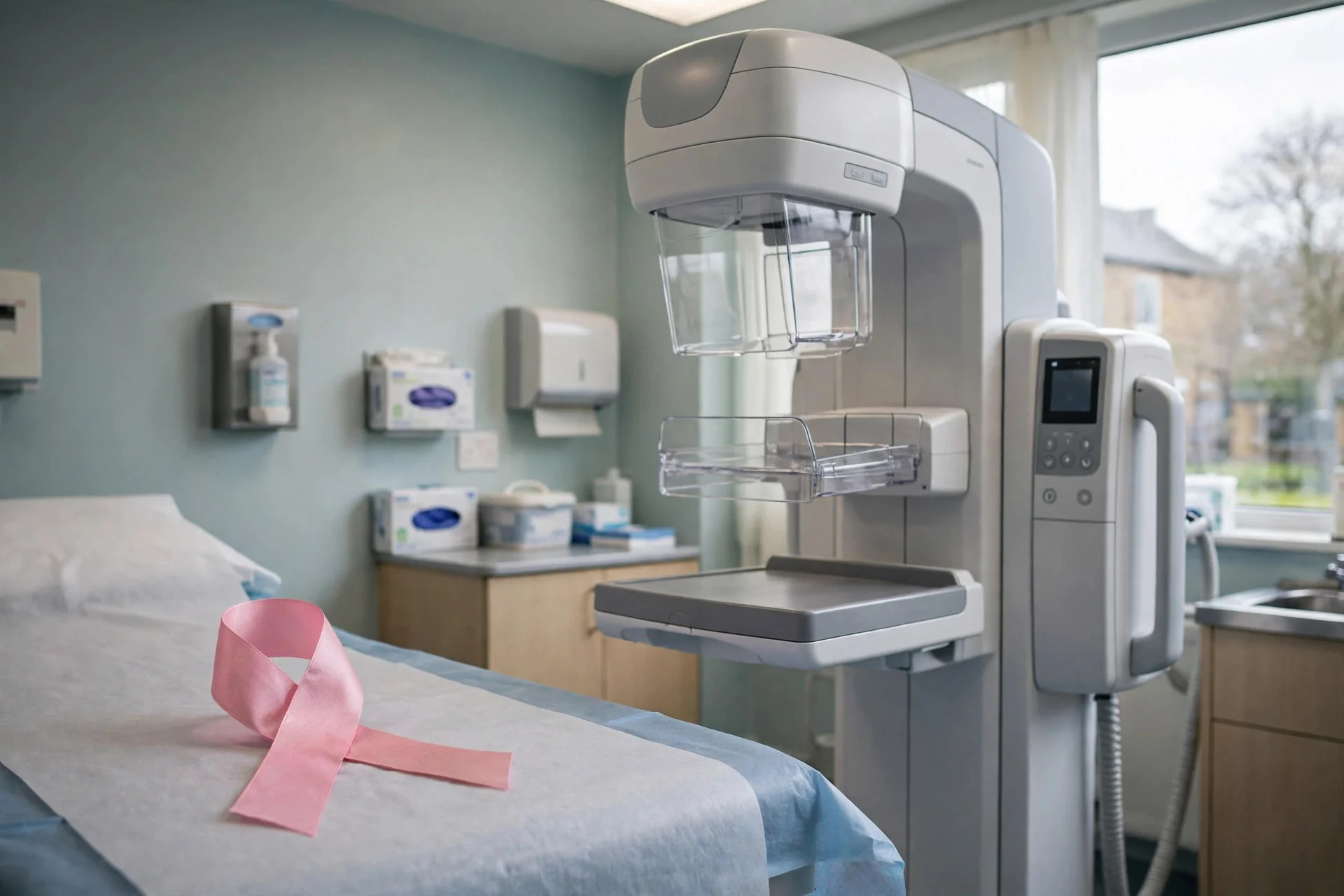
Imagen alusiva a la detección temprana del cáncer de mama y a los ensayos de radioterapia. · Imagen generada para EPM
United Kingdom shortens radiotherapy for breast cancer care
More than 1,000 people have joined a British trial testing whether breast cancer radiotherapy can be cut from three weeks to five days, with a targeted boost…
Fewer hospital visits in a new breast cancer treatment trial
A trial at 39 British hospitals is testing a five-day course of radiotherapy against three weeks, aiming to recruit 4,830 people by 2028 and to report its…
--- The context ---
The British government has set out a package against breast cancer that combines clinical research, a push on screening and a direct patient voice inside the delivery of the National Cancer Plan. The announcement comes as Breast Cancer Awareness Month draws to a close.
Uptake of a first screening invitation has reached its highest level in a decade. Even so, many women invited for the first time still do not attend.
--- The facts ---
More than 1,000 people have joined the FAST-Forward Boost trial, running at 39 hospitals across the United Kingdom. The study tests whether radiotherapy can be safely cut from three weeks to just five days, with an additional targeted dose, known as a boost, against the cancer returning. If it works, each patient could be spared 10 hospital visits.
The trial is led by The Institute of Cancer Research and funded through the National Institute for Health and Care Research. It aims to recruit 4,830 people by 2028, with five years of follow-up and results expected in 2033. In parallel, there are trials of AI for mammograms and work with the charity Breast Cancer Now over three years.
--- The positions ---
Health and Social Care Secretary Yvette Cooper argued, in attributed remarks, that the trial shows how the country is using its research capabilities to pursue major improvements in cancer treatment. She also urged women who receive a screening invitation to take up what she described as a potentially life-saving offer.
Ashley Dalton, a member of parliament living with metastatic breast cancer, has been appointed as an adviser on delivery of the National Cancer Plan. Dalton stepped down as Parliamentary Under-Secretary of State for Public Health and Prevention on March 2, 2026, to manage her health. In her attributed remarks, Dalton said her personal experience should help ensure the plan reflects the realities of people living with cancer.
--- What remains unknown ---
The trial is still under way and its results are not expected until 2033, so the shorter course still has to prove that it is safe and effective. It is also unknown whether the saving in visits would lead to a general change in clinical practice.
Uptake of the first invitation reached 63.6%, but around four in 10 women invited for the first time do not attend, according to the figures released alongside the announcement.
--- Unanswered questions ---
Will the trial show that five days of radiotherapy with a targeted boost protects patients as well as three weeks of treatment? Will the system persuade more women to accept their first screening invitation? Could the saving of 10 visits be applied generally to eligible patients?
--- EPM analysis ---
In England, around 30% of female breast cancers are diagnosed via screening, most at an early stage. At stage 1, almost 100% of people survive for five years or more, compared with just 32% at stage 4. The plan also sets a goal for 2035 under which 3 out of 4 people diagnosed will be cancer free or living well after 5 years.
📌 EPM Take:
In EPM's view, the strength of this package lies in joining three fronts that often move separately: finding cancer earlier, treating it in less time and listening to someone who lives with the disease. The trial could ease the burden on thousands of patients and free up hospital capacity, but its promise depends on results that are years away. Meanwhile, the immediate fact is screening: every accepted invitation moves diagnosis closer to the stage at which survival is almost the norm.
--- The context ---
The British government has stepped up action on breast cancer with steps on earlier diagnosis, better treatment and patient support under the National Cancer Plan. The practical centre is a trial that seeks to compress weeks of radiotherapy into a few days and reduce travel and pressure on hospitals.
Any safe reduction in sessions frees up capacity to treat more people. That logic also runs through the push on screening and the trials of AI for mammograms.
--- The facts ---
The FAST-Forward Boost trial has passed 1,000 participants and is running at 39 hospitals across the United Kingdom. It tests a course of just five days of radiotherapy, with an additional targeted dose known as a boost, against the usual three weeks, in order to help prevent breast cancer returning. The potential saving for each patient is 10 hospital visits.
The study is led by The Institute of Cancer Research and funded through the National Institute for Health and Care Research. It aims to recruit 4,830 people by 2028, follow participants for five years and report results in 2033. If successful, according to the official announcement, it could reduce travel costs and time away from work, while freeing up NHS capacity.
--- The positions ---
Health and Social Care Secretary Yvette Cooper said, in attributed remarks, that the programme is aiming to radically shorten treatment times in order to support patients and save more lives. She also highlighted the appointment of Ashley Dalton as adviser on the National Cancer Plan, citing her personal experience of cancer and her previous experience at the Department of Health and Social Care.
Dalton, a Labour member of parliament living with incurable metastatic breast cancer, stepped down as Parliamentary Under-Secretary of State for Public Health and Prevention on March 2, 2026, to manage her health. In attributed remarks, she said it was a real honour to take on the advisory role and that she wanted to use what she had learned as a minister and as a patient to drive forward the commitments in the plan.
--- What remains unknown ---
The effectiveness of the shorter course is not yet proven. The trial will keep recruiting until 2028 and its results are expected in 2033, so any general change in practice will have to wait for that evidence and its full clinical assessment.
It is also unknown how much freed capacity could be reinvested in cutting waits, without official savings figures per centre.
--- Unanswered questions ---
Will the results in 2033 confirm that the five-day course is as safe as the three-week course? How much real hospital capacity would be freed if the approach is adopted generally? Will the plan reach its goal of 3 out of 4 people diagnosed being cancer free or living well after 5 years by 2035?
--- EPM analysis ---
In England, around 30% of female breast cancers are diagnosed via screening, and five-year survival is almost 100% at stage 1 compared with 32% at stage 4. Uptake of the first invitation rose to 63.6%, although around four in 10 women invited for the first time do not attend.
📌 EPM Take:
In EPM's view, the British bet will be judged by measurable results rather than announcements: completed recruitment, safety evidence in 2033 and more diagnoses at an early stage. Compressing radiotherapy from three weeks to five days would be a tangible gain in time, costs and capacity if the targeted dose keeps patients protected. Until the data arrive, the verifiable advance is a trial under way at 39 hospitals and a screening goal that still leaves too many women outside the system.
Reino Unido acorta la radioterapia contra el cáncer de mama
Más de 1,000 personas participan en un ensayo británico que prueba reducir la radioterapia del cáncer de mama de tres semanas a cinco días, con una dosis…
Menos visitas al hospital para tratar el cáncer de mama
Un ensayo en 39 hospitales británicos prueba un curso de radioterapia de cinco días frente a tres semanas, con la meta de reclutar a 4,830 personas para 2028 y…
--- El contexto ---
El Gobierno británico presentó un paquete contra el cáncer de mama que combina investigación clínica, impulso al cribado y una voz con experiencia directa de la enfermedad dentro del National Cancer Plan. El anuncio llega cuando cierra el mes de sensibilización sobre este cáncer.
La asistencia a la primera invitación de cribado alcanza su nivel más alto en una década. Aun así, muchas mujeres invitadas por primera vez siguen sin acudir a la cita.
--- Los hechos ---
Más de 1,000 personas ya participan en el ensayo FAST-Forward Boost, activo en 39 hospitales del Reino Unido. El estudio prueba si la radioterapia puede recortarse de tres semanas a solo cinco días, con una dosis adicional dirigida, conocida como boost, contra el regreso del cáncer. Si funciona, cada paciente podría ahorrarse 10 visitas al hospital.
El ensayo lo lidera el Institute of Cancer Research y lo financia el National Institute for Health and Care Research. Su meta es reclutar a 4,830 personas para 2028, con seguimiento de cinco años y resultados previstos en 2033. En paralelo, hay ensayos de inteligencia artificial para mamografías y trabajo con Breast Cancer Now durante tres años.
--- Las posiciones ---
La secretaria de Salud y Asistencia Social, Yvette Cooper, defendió en términos atribuidos que el ensayo muestra la capacidad investigadora del país para transformar el tratamiento y acortar los tiempos. También instó a las mujeres que reciban una invitación de cribado a aceptarla, por su potencial para salvar vidas.
Ashley Dalton, diputada que vive con cáncer de mama metastásico, fue nombrada asesora para la entrega del National Cancer Plan. Dalton dejó su cargo de subsecretaria de Estado de Salud Pública y Prevención el 2 de marzo de 2026 para atender su salud. Según lo expresado por la propia Dalton, su experiencia personal debe ayudar a que el plan refleje la realidad de quienes viven con cáncer.
--- Lo que falta saber ---
El ensayo sigue en curso y sus resultados no se esperan hasta 2033, de modo que el recorte aún debe demostrar seguridad y eficacia. Tampoco se sabe si el ahorro de visitas llevará a un cambio general de práctica clínica.
La aceptación de la primera invitación de cribado llegó al 63,6 %, pero alrededor de 4 de cada 10 mujeres invitadas por primera vez no asisten, según las cifras difundidas junto al anuncio.
--- Preguntas sin respuesta ---
¿Demostrará el ensayo que cinco días de radioterapia con dosis dirigida protegen igual que tres semanas de tratamiento? ¿Logrará el sistema que más mujeres acepten su primera invitación de cribado? ¿Podrá aplicarse el ahorro de 10 visitas de forma general a las pacientes elegibles?
--- Análisis EPM ---
En Inglaterra, alrededor del 30 % de los cánceres de mama femeninos se detectan mediante el cribado, la mayoría en etapa temprana. En estadio 1, casi el 100 % de las personas sobrevive cinco años o más, frente a solo el 32 % en estadio 4. El plan fija una meta para 2035: que 3 de cada 4 diagnosticados estén libres de cáncer o vivan bien a los cinco años.
📌 Conclusion EPM:
A juicio de EPM, el valor de este paquete está en unir tres frentes que suelen avanzar por separado: detectar antes, tratar en menos tiempo y escuchar a quien vive la enfermedad. El ensayo puede aliviar la carga de miles de pacientes y liberar capacidad hospitalaria, pero su promesa depende de resultados que tardarán años. Mientras tanto, el dato inmediato es el cribado: cada invitación aceptada acerca el diagnóstico a la etapa en la que sobrevivir es casi la norma.
--- El contexto ---
El Gobierno británico reforzó su acción contra el cáncer de mama con medidas de diagnóstico temprano, tratamiento y apoyo a las pacientes, dentro del National Cancer Plan. El eje práctico es un ensayo que busca comprimir semanas de radioterapia en pocos días y reducir desplazamientos y presión sobre los hospitales.
Toda reducción segura de sesiones libera capacidad para tratar a más personas. Esa lógica acompaña el impulso al cribado y la inteligencia artificial en mamografías.
--- Los hechos ---
El ensayo FAST-Forward Boost superó los 1,000 participantes y funciona en 39 hospitales del Reino Unido. Compara el curso habitual de tres semanas de radioterapia con un curso de solo cinco días que añade una dosis dirigida, llamada boost, para ayudar a prevenir el regreso del cáncer. El ahorro potencial por paciente es de 10 visitas al hospital.
El estudio lo lidera el Institute of Cancer Research y lo financia el National Institute for Health and Care Research. El objetivo es reclutar a 4,830 personas para 2028, seguirlas durante cinco años y publicar los resultados en 2033. Si tiene éxito, según el anuncio oficial, podría reducir costes de viaje y tiempo fuera del trabajo, además de liberar capacidad.
--- Las posiciones ---
La secretaria de Salud y Asistencia Social, Yvette Cooper, sostuvo en declaraciones atribuidas que el programa busca acortar radicalmente los tiempos de tratamiento para apoyar a las pacientes y salvar más vidas. También destacó el nombramiento de Ashley Dalton como asesora del plan, por su experiencia personal y su trayectoria previa en el departamento de salud.
Dalton, diputada laborista que vive con cáncer de mama metastásico incurable, dejó el cargo de subsecretaria de Estado de Salud Pública y Prevención el 2 de marzo de 2026 para gestionar su salud. En sus declaraciones atribuidas, afirmó que es un honor asumir el papel asesor y que quiere usar lo aprendido como ministra y como paciente para impulsar los compromisos del plan.
--- Lo que falta saber ---
La eficacia del curso corto aún no está probada. El ensayo seguirá reclutando hasta 2028 y sus resultados se esperan en 2033, por lo que cualquier cambio general de práctica deberá esperar esa evidencia completa.
Falta saber cuánta capacidad liberada podrá reinvertirse en reducir esperas, sin cifras oficiales de ahorro por centro.
--- Preguntas sin respuesta ---
¿Confirmarán los resultados de 2033 que el curso de cinco días es tan seguro como el de tres semanas? ¿Cuánta capacidad hospitalaria real se liberaría si el enfoque se adopta de forma general? ¿Alcanzará el plan su meta de que 3 de cada 4 diagnosticados vivan bien o sin cáncer a los cinco años en 2035?
--- Análisis EPM ---
En Inglaterra, cerca del 30 % de los cánceres de mama femeninos se diagnostican mediante el cribado, y la supervivencia a cinco años es de casi el 100 % en estadio 1 frente al 32 % en estadio 4. La aceptación de la primera invitación subió al 63,6 %, aunque alrededor de 4 de cada 10 invitadas por primera vez no acuden.
📌 Conclusion EPM:
A juicio de EPM, la apuesta británica se juzgará por resultados medibles y no por anuncios: reclutamiento completo, evidencia de seguridad en 2033 y más diagnósticos en estadio temprano. Comprimir la radioterapia de tres semanas a cinco días sería una ganancia tangible en tiempo, costes y capacidad si la dosis dirigida mantiene la protección. Hasta que lleguen los datos, el avance verificable es el ensayo en marcha en 39 hospitales y una meta de cribado que todavía deja fuera a demasiadas mujeres.