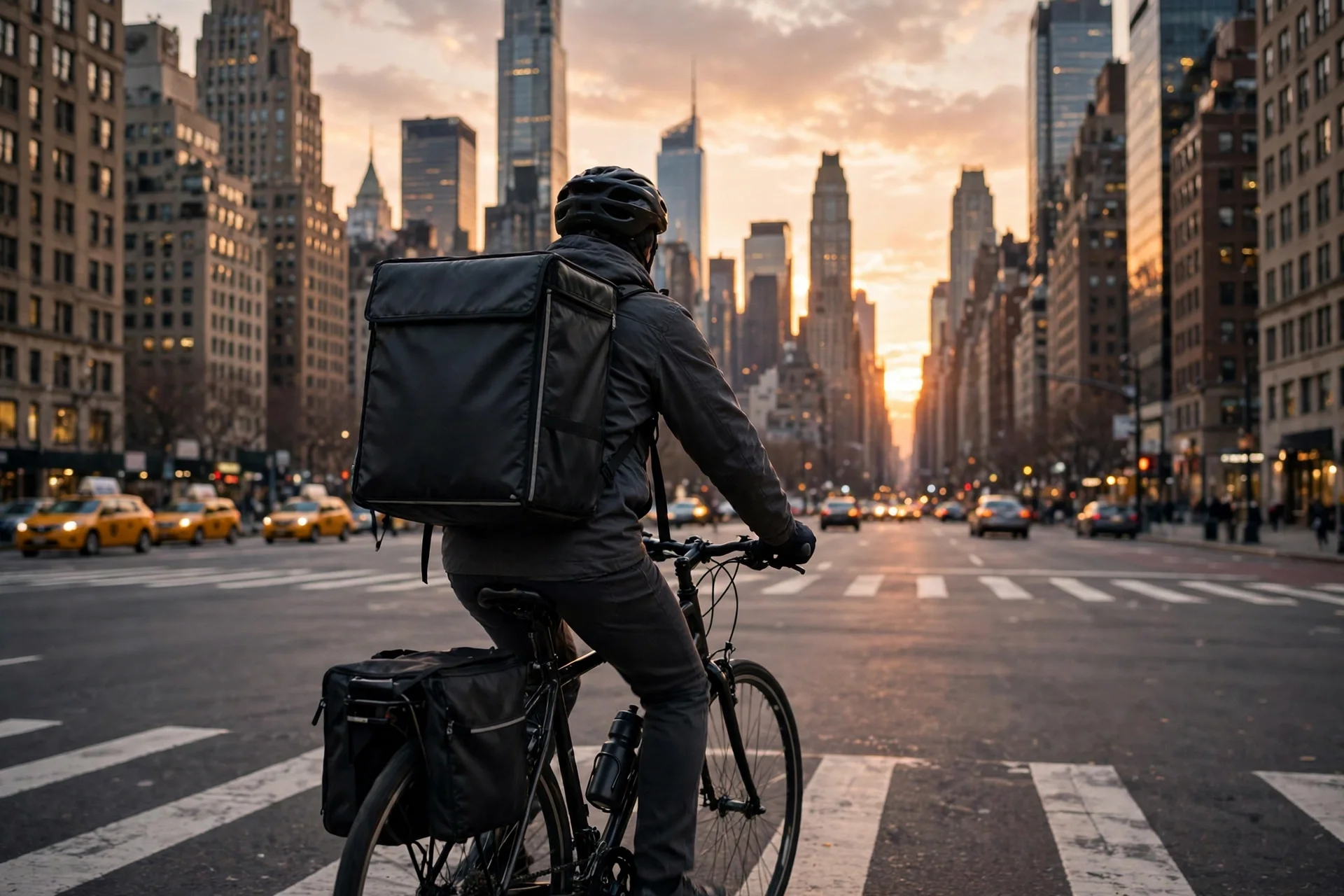
Un repartidor en bicicleta espera en un cruce de Manhattan al atardecer, con rascacielos y taxis al fondo. · Imagen generada para EPM
Uber, Amazon and Instacart Sue New York Over Local Law 34
Uber, Amazon and Instacart filed a federal lawsuit in Manhattan to block Local Law 34, which prevents deactivating couriers without justified cause or a…
New York Delivery Law Faces a Federal Court Challenge
Uber, Amazon and Instacart brought their lawsuit against Local Law 34 before a federal court in the Southern District of New York, with First and Fourteenth…
--- The context ---
In New York, delivery platforms can deactivate a courier account and cut off access to work, and the city chose to regulate that power. Local Law 34 bars deactivating a contracted worker without demonstrated justified cause, such as misconduct, or a genuine economic reason, and requires prior notice.
The law takes effect in January, so the window to dispute its reach is short and the conflict moved immediately to a federal court.
--- The facts ---
Uber, Amazon and Instacart sued the city of New York to block the law. The lawsuit was filed on October 28, 2026, in the federal court of the Southern District of New York, in Manhattan, under number 1:26-cv-09455, represented by Sidley Austin and Gibson Dunn & Crutcher.
The filing runs 94 pages and seven counts. According to the lawsuit, the companies plan to seek a preliminary injunction, a court order that would suspend the law while the case advances.
--- The positions ---
The companies hold that the law violates the First and Fourteenth Amendments of the United States Constitution, which protect freedom of expression and due process, plus the contracts clause. They argue the city rewrites their agreements with couriers and that some obligations reach decisions taken since 2021.
The companies state that deactivations are relatively rare and almost always linked to safety or fraud, and that the law would force them to reopen cases removed for those reasons. Instacart said the rule will delay removing accounts that pose safety risks, could force it to disclose sensitive information about how it detects fraud, and that it sent more than 50 questions to the city Department of Consumer and Worker Protection without a response.
Instacart also assured that its shoppers receive an explanation for a removal, an avenue of appeal and a human review. City representatives did not respond immediately.
--- What remains unknown ---
It remains unknown whether the court will grant the preliminary injunction and suspend Local Law 34 before it takes effect in January, or how the city will answer the constitutional arguments.
As a precedent, Local Law 52, on Uber and Lyft driver deactivations, was blocked on July 21 by federal judge Gregory Woods through a preliminary injunction, in litigation that remains open. Instacart calls Local Law 34 substantially similar.
--- Unanswered questions ---
Will the court grant the preliminary injunction and suspend Local Law 34 before January? Will the city answer the arguments on the First and Fourteenth Amendments and the contracts clause? How will the justified cause requirement apply to safety or fraud cases?
--- EPM analysis ---
The case pits courier protection against a removal without a demonstrated cause against the capacity of platforms to remove accounts over safety or fraud. The Local Law 52 precedent weighs heavily, because a federal judge already blocked a similar law after considering it likely to gravely affect contracts.
📌 EPM Take: In EPM's view, the lawsuit places the court before a delicate balancing decision, because Local Law 34 protects couriers who can lose their income through a deactivation, but its application cannot leave platforms without a response to safety and fraud. The justified cause standard, prior notice and human review offer a reasonable ground of accountability. The injunction will say whether that balance is debated with the law in force or suspended.
--- The context ---
Local Law 34 requires justified cause or a genuine economic reason to deactivate a courier, plus prior notice. It takes effect in January and, the lawsuit challenges, some obligations reach decisions taken since 2021.
For the plaintiff companies, that reach intervenes in contracts already signed and safety decisions already executed, so the response was judicial rather than administrative.
--- The facts ---
Uber, Amazon and Instacart sued the city of New York in the federal court of the Southern District of New York, in Manhattan, to stop the law limiting courier dismissals. The lawsuit was filed on October 28, 2026, under number 1:26-cv-09455, represented by Sidley Austin and Gibson Dunn & Crutcher.
The filing runs 94 pages and seven counts, and holds that the city rewrites the agreements in force with couriers. The companies plan to seek an injunction suspending the law.
--- The positions ---
According to the filing, the law violates the First and Fourteenth Amendments of the United States Constitution, which protect freedom of expression and due process, plus the contracts clause. Deactivations, the companies state, are relatively rare and almost always linked to safety or fraud, so the rule would force them to reopen cases closed for those reasons.
Instacart stated that the law will make it harder to apply standards against unsafe conduct, harassment, theft and fraud, will delay removing accounts that pose safety risks, and could force it to disclose sensitive information about how it detects fraud.
The company assured that it sent more than 50 questions to the city Department of Consumer and Worker Protection without a response, and that its shoppers already receive an explanation for a removal, an avenue of appeal and a human review. City representatives did not respond immediately.
--- What remains unknown ---
It is not yet known whether the court will suspend the law or what will happen to decisions taken since 2021 if the rule stands. The city has not publicly answered the constitutional counts.
The precedent is adverse for local regulation: on July 21 federal judge Gregory Woods blocked Local Law 52, on Uber and Lyft driver deactivations, through a preliminary injunction, a law due to take effect on July 28, without annulling it definitively.
--- Unanswered questions ---
Will the court follow the criterion of Local Law 52 and also suspend Local Law 34? How far can a local law rewrite agreements already signed between platforms and couriers? What margin will companies keep to deactivate accounts over safety or fraud without revealing their methods?
--- EPM analysis ---
The core of the litigation is contractual and constitutional, because the lawsuit holds that the city alters agreements in force and past decisions. The point on safety and fraud also touches an operational issue, because reopening removals for those causes and disclosing detection methods carries costs that the judicial filing details.
📌 EPM Take: In EPM's view, the lawsuit has a serious foundation in the immediate precedent, because a federal judge already suspended a substantially similar law after deeming a grave effect on contracts likely. That does not resolve the merits, but it does mark the starting point of case 1:26-cv-09455. The decisive discussion will be whether courier protection can be imposed without rewriting agreements in force or weakening the response to fraud. Until the court rules, the injunction is the true first judgment.
Uber, Amazon e Instacart demandan a Nueva York por la Ley Local 34
Uber, Amazon e Instacart presentaron una demanda federal en Manhattan para bloquear la Ley Local 34, que impide desactivar repartidores sin causa justificada o…
La Ley Local 34 de Nueva York llega a un tribunal federal
Uber, Amazon e Instacart llevaron a un tribunal federal del Distrito Sur de Nueva York su demanda contra la Ley Local 34, con argumentos de Primera y…
--- El contexto ---
En Nueva York, las plataformas pueden desactivar la cuenta de un repartidor y dejarlo sin trabajo, y la ciudad decidió regular esa facultad. La Ley Local 34 impide desactivar a un trabajador contratado salvo causa justificada, como una falta de conducta, o un motivo económico genuino, y obliga a avisar antes de la baja.
La norma entra en vigor en enero y el conflicto pasó de inmediato a un tribunal federal.
--- Los hechos ---
Uber, Amazon e Instacart demandaron a la ciudad de Nueva York para bloquear la ley. La demanda se presentó el 28 de octubre de 2026 en el tribunal federal del Distrito Sur de Nueva York, en Manhattan, con el número 1:26-cv-09455, representada por Sidley Austin y Gibson Dunn & Crutcher.
El texto tiene 94 páginas y siete cargos. Las compañías planean pedir una medida cautelar que suspenda la ley mientras avanza el caso.
--- Las posiciones ---
Las empresas sostienen que la ley viola la Primera y la Decimocuarta Enmienda de la Constitución de Estados Unidos, que protegen la libertad de expresión y el debido proceso, además de la cláusula de contratos. Argumentan que la ciudad reescribe sus acuerdos con los repartidores y que algunas obligaciones alcanzan decisiones tomadas desde 2021.
Las compañías afirman que las desactivaciones son relativamente raras y casi siempre se vinculan con seguridad o fraude, y que la ley obligaría a reabrir casos dados de baja por esas razones. Instacart afirmó que la norma demorará la eliminación de cuentas con riesgos de seguridad, podría obligarla a divulgar información sensible sobre cómo detecta el fraude y que envió más de 50 preguntas al Departamento de Protección del Consumidor y el Trabajador sin respuesta.
Instacart aseguró que sus compradores reciben explicación de la baja, vía de apelación y revisión humana. La ciudad no respondió de inmediato a la consulta sobre la demanda.
--- Lo que falta saber ---
Falta saber si el tribunal concederá la cautelar y suspenderá la ley antes de enero. Tampoco consta una respuesta de fondo de la ciudad.
Como antecedente, la Ley Local 52, sobre conductores de Uber y Lyft, fue bloqueada el 21 de julio por el juez federal Gregory Woods con una cautelar, en un litigio abierto. Instacart describe la Ley Local 34 como sustancialmente similar.
--- Preguntas sin respuesta ---
¿Concederá el tribunal la medida cautelar y suspenderá la Ley Local 34 antes de enero? ¿Responderá la ciudad a los argumentos sobre la Primera y la Decimocuarta Enmienda y la cláusula de contratos? ¿Cómo se aplicará la causa justificada a los casos de seguridad o fraude?
--- Análisis EPM ---
El caso enfrenta la protección del repartidor frente a una baja sin causa y la capacidad de las plataformas de apartar cuentas por seguridad o fraude. Pesa el antecedente de la Ley Local 52, bloqueada al estimarse probable una afectación grave de los contratos.
📌 Conclusion EPM: A juicio de EPM, la demanda coloca al tribunal ante un equilibrio delicado, porque la Ley Local 34 protege a repartidores que pueden perder su ingreso con una desactivación, pero su aplicación no puede dejar a las plataformas sin respuesta frente a la seguridad y el fraude. El estándar de causa justificada, el aviso previo y la revisión humana ofrecen un terreno razonable de exigencia. La cautelar dirá si ese equilibrio se discute con la ley vigente o suspendida.
--- El contexto ---
La Ley Local 34 exige causa justificada o un motivo económico genuino para desactivar a un repartidor, además de aviso previo. Entra en vigor en enero y, según la demanda, algunas obligaciones alcanzan decisiones tomadas desde 2021.
Para las empresas demandantes, ese alcance interviene contratos ya firmados y decisiones de seguridad ya ejecutadas, por lo que la respuesta fue judicial y no administrativa.
--- Los hechos ---
Uber, Amazon e Instacart demandaron a la ciudad de Nueva York en el tribunal federal del Distrito Sur de Nueva York, en Manhattan, para frenar la ley. La demanda se presentó el 28 de octubre de 2026, con el número 1:26-cv-09455, representada por Sidley Austin y Gibson Dunn & Crutcher.
El texto tiene 94 páginas y siete cargos, y sostiene que la ciudad reescribe los acuerdos vigentes. Las empresas planean pedir una cautelar que suspenda la ley.
--- Las posiciones ---
La demanda sostiene que la ley viola la Primera y la Decimocuarta Enmienda de la Constitución de Estados Unidos, que protegen la libertad de expresión y el debido proceso, además de la cláusula de contratos. Las desactivaciones, afirman las empresas, son relativamente raras y casi siempre se vinculan con seguridad o fraude, por lo que la norma obligaría a reabrir casos cerrados por esas razones.
Instacart afirmó que la ley dificultará aplicar estándares contra conductas inseguras, acoso, robo y fraude, demorará la eliminación de cuentas con riesgos de seguridad y podría obligarla a divulgar información sensible sobre cómo detecta el fraude.
La empresa aseguró que envió más de 50 preguntas al Departamento de Protección del Consumidor y el Trabajador sin respuesta, y que sus compradores ya reciben explicación de la baja, vía de apelación y revisión humana. La ciudad no respondió de inmediato.
--- Lo que falta saber ---
No se sabe si el tribunal suspenderá la ley con la medida cautelar ni qué ocurrirá con las decisiones tomadas desde 2021 si la norma se mantiene. Tampoco consta una respuesta pública de la ciudad a los cargos constitucionales.
El antecedente es adverso: el 21 de julio el juez federal Gregory Woods bloqueó con una cautelar la Ley Local 52, sobre conductores de Uber y Lyft, que debía entrar en vigor el 28 de julio, sin anularla.
--- Preguntas sin respuesta ---
¿Seguirá el tribunal el criterio de la Ley Local 52 y suspenderá también la Ley Local 34? ¿Hasta dónde puede una ley local reescribir acuerdos ya firmados entre plataformas y repartidores? ¿Qué margen conservarán las empresas para desactivar cuentas por seguridad o fraude sin revelar sus métodos?
--- Análisis EPM ---
El núcleo del litigio es contractual y constitucional, porque la demanda sostiene que la ciudad altera acuerdos vigentes y decisiones pasadas. Reabrir bajas por seguridad o fraude y divulgar métodos de detección tiene además costos que el texto judicial detalla.
📌 Conclusion EPM: A juicio de EPM, la demanda tiene un fundamento serio en el antecedente inmediato, porque un juez federal ya suspendió una ley sustancialmente similar al estimar probable una afectación grave de los contratos. Eso no resuelve el fondo, pero marca el punto de partida del caso 1:26-cv-09455. La discusión decisiva será si la protección al repartidor puede imponerse sin reescribir acuerdos vigentes ni debilitar la respuesta ante el fraude. Hasta que el tribunal se pronuncie, la cautelar es la verdadera primera sentencia.