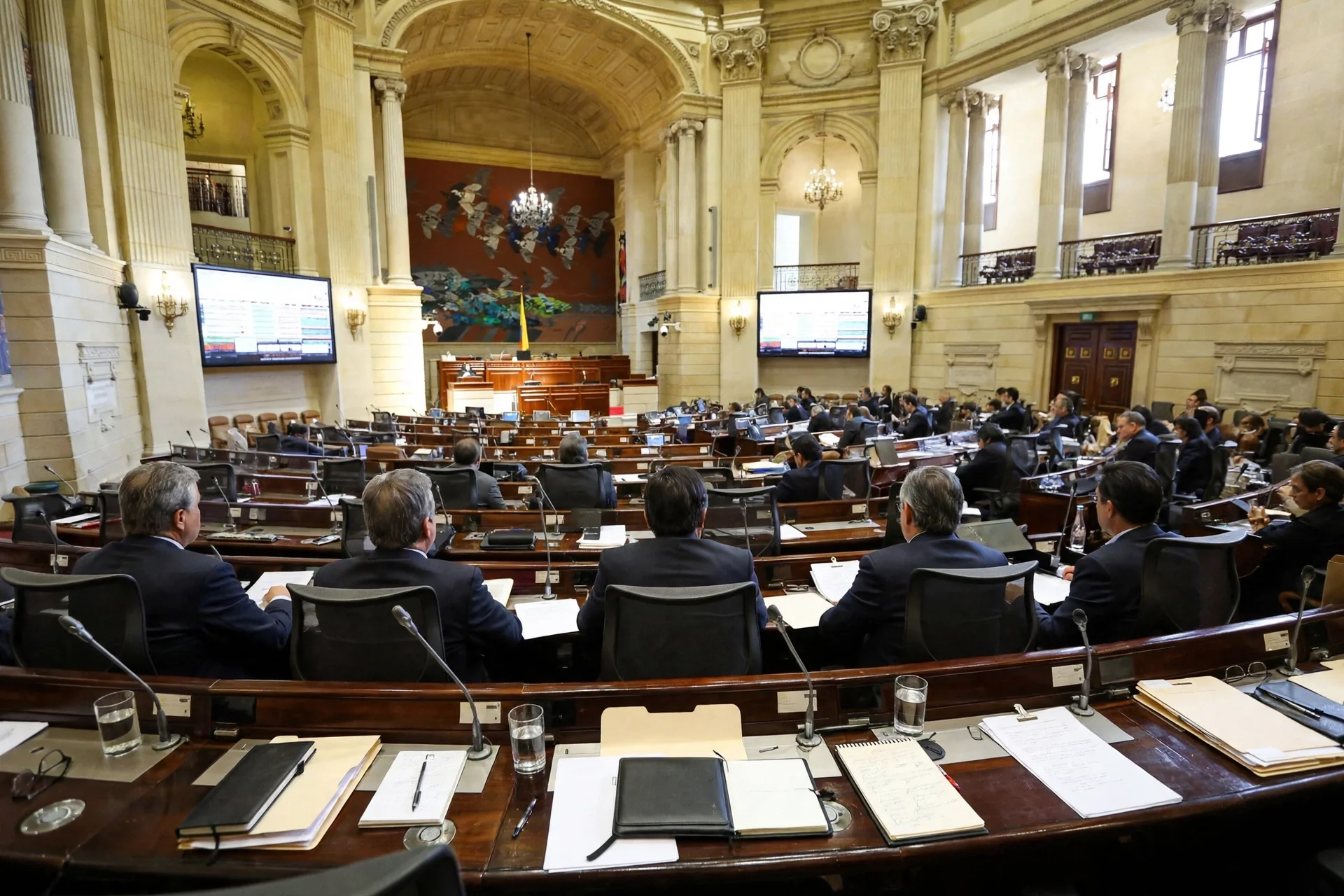
Debate en el Senado sobre el plazo de cierre de la JEP. · Imagen generada para EPM
Senate opens debate on ending the JEP in March 2028
The Senate First Committee approved in a first debate Enrique Gómez's reform to limit the Special Jurisdiction for Peace (JEP) to ten years and move pending…
Reform would end the JEP in 2028 and move cases to ordinary courts
With 11 votes in favor and none against, the First Committee approved in a first debate a maximum non-extendable limit of ten years for the Special…
--- The context ---
The Special Jurisdiction for Peace, known as the JEP, is the judicial component created to try the most serious crimes of the Colombian armed conflict. Its work is tied to victims' rights to truth, justice, reparation and guarantees of non-repetition, and to legal certainty for those who appear before its chambers and sections.
--- The facts ---
The Senate First Committee approved, in the first debate on October 28, the constitutional reform promoted by Senator Enrique Gómez. The vote recorded 11 votes in favor and none against, with opposition lawmakers absent. It is only the first of the eight debates required, so the proposal is still in process and has not been approved.
The text proposes a maximum, non-extendable period of ten years, counted from the start of operations of all its chambers and sections. Under that limit, the JEP would end its functions in March 2028 and pending cases would move to the ordinary courts. The current framework also provides a later stage of five years, extendable under certain conditions.
--- The positions ---
Gómez, of the National Salvation Movement, argues that transitional justice should be preserved, but with pending matters handled by the ordinary courts. During the discussion he questioned the jurisdiction's spending, contracting and resolution times, and centered his defense on setting a limit to its duration.
The JEP warned that a closure in March 2028 could leave investigations and trials unfinished and put victims' rights at risk. It also questioned eliminating the trial stage and pointed to a possible impact on the guarantee of the natural judge. Senator Carolina Corcho raised concerns about constitutional guarantees and the legal certainty of those who appear before the jurisdiction.
--- What remains unknown ---
The project provides that final decisions and evidence already produced would keep their effects if cases are transferred, and that the change alone would not impose harsher conditions. Even so, it is unclear how continuity would be preserved in the most complex proceedings or what would happen with Colombia's international commitments.
--- Unanswered questions ---
How many proceedings would still be pending in March 2028 if the limit advances? Could the ordinary courts take them on without delays or loss of continuity? What concrete guarantees would victims and those appearing before the jurisdiction have during the transfer of the case files?
--- EPM analysis ---
The discussion will continue on November 4 at a forum with victims, magistrates of the high courts, signatories of the Peace Agreement and other participants. That exchange may provide elements the first debate did not resolve, because the initial vote moved the process forward but did not clear up the practical effects of closing the jurisdiction on a fixed date.
📌 EPM Take:
In EPM's view, no closure of the JEP should be measured by the calendar alone. If Congress advances through the remaining debates, the central discussion will have to be the effective protection of victims, the continuity of the most serious proceedings and legal certainty for those who appear before the jurisdiction. A deadline can be legitimate, but its value will depend on the transfer to the ordinary courts not turning the end of the jurisdiction into the start of new delays and postponed rights.
--- The context ---
The Special Jurisdiction for Peace, known as the JEP, was created as a transitional jurisdiction to hear the most serious crimes of the Colombian armed conflict. Because of its exceptional character, its duration is part of the constitutional debate: the current framework sets a later stage of five years to conclude its judicial work, extendable under certain conditions and at the request of its magistrates.
--- The facts ---
The Senate First Committee approved, in the first debate on October 28, the constitutional reform promoted by Senator Enrique Gómez, with 11 votes in favor and none against. Opposition lawmakers were absent from the vote. It is the first of the eight debates required, so the initiative is still in process and has not yet been approved.
The proposal establishes a maximum, non-extendable period of ten years, counted from the start of operations of all its chambers and sections. Under that cap, the JEP would end its functions in March 2028, the possibility of extending its activity would be removed, and pending cases would move to the ordinary courts for their continuation.
--- The positions ---
Gómez, of the National Salvation Movement, argues that transitional justice should be preserved, but with pending matters handled by the ordinary courts. In the discussion he questioned the JEP's spending, contracting and resolution times, and defended setting a clear time limit that orders the closure of the jurisdiction.
The JEP warned of risks if the closure leaves investigations and trials unfinished, and pointed to possible effects on the guarantee of the natural judge and on international commitments. Senator Carolina Corcho raised concerns about constitutional guarantees and the legal certainty of those who appear. The text responds that final decisions and evidence would keep their effects after the transfer.
--- What remains unknown ---
It still must be specified how the transfer of complex case files would be organized, what capacity the ordinary courts would have to receive them, and whether the change would trigger new international scrutiny. The proposal also states that the change of jurisdiction, by itself, would not impose harsher procedural conditions on those who appear, a point that will remain under discussion.
--- Unanswered questions ---
What volume of proceedings would remain pending when the ten-year period expires? How would it be guaranteed that the transfer does not interrupt trials already under way? What adjustments would the ordinary courts need to take on the most serious cases of the conflict?
--- EPM analysis ---
The discussion will continue on November 4 at a forum with victims, magistrates of the high courts, signatories of the Peace Agreement and other participants. Two demands that need not exclude each other will be weighed there: giving a transitional jurisdiction a certain end, and doing so without sacrificing the continuity of proceedings or the rights recognized within them.
📌 EPM Take:
In EPM's view, a transitional justice system without a closing date runs the risk of becoming permanent and losing its original meaning. The reform approved in the first debate proposes an orderly exit: ten years as a limit, transfer to the ordinary courts and preservation of decisions and evidence. For that exit to be solid, the remaining debates must show with data that the transfer protects victims, respects those who appear and leaves no serious proceeding without a judge or without continuity.
Senado abre el debate para fijar el fin de la JEP en 2028
La Comisión Primera del Senado aprobó en primer debate la reforma de Enrique Gómez que limitaría la JEP a diez años y trasladaría los procesos pendientes a la…
Reforma busca cerrar la JEP en 2028 y pasar casos a la justicia ordinaria
Con 11 votos a favor y ninguno en contra, la Comisión Primera aprobó en primer debate limitar la JEP a un máximo improrrogable de diez años.
--- El contexto ---
La Jurisdicción Especial para la Paz, la JEP, es el componente judicial creado para juzgar los crímenes más graves del conflicto armado colombiano. Su labor se vincula con los derechos de las víctimas a la verdad, la justicia, la reparación y las garantías de no repetición, y con la seguridad jurídica de quienes comparecen ante ella.
--- Los hechos ---
La Comisión Primera del Senado aprobó en primer debate, el 28 de octubre, la reforma constitucional impulsada por el senador Enrique Gómez. La votación registró 11 votos a favor y ninguno en contra, con los congresistas de oposición ausentes. Es el primero de los ocho debates requeridos, por lo que la propuesta sigue en trámite y no está aprobada.
El texto propone un periodo máximo e improrrogable de diez años, contado desde la entrada en operación de la totalidad de sus salas y secciones. Con ese límite, la JEP terminaría sus funciones en marzo de 2028 y los procesos pendientes pasarían a la justicia ordinaria. El marco vigente contempla una etapa posterior de cinco años, prorrogable bajo determinadas condiciones.
--- Las posiciones ---
Gómez, del Movimiento de Salvación Nacional, sostiene que la justicia transicional debe conservarse, pero con los asuntos pendientes a cargo de la justicia ordinaria. Durante la discusión cuestionó los gastos, la contratación y los tiempos de resolución de la jurisdicción, y centró su defensa en fijar un límite a su duración.
La JEP advirtió que un cierre en marzo de 2028 podría dejar investigaciones y juicios sin concluir y poner en riesgo los derechos de las víctimas. También cuestionó la eliminación de la fase de juzgamiento y señaló una posible afectación de la garantía del juez natural. La senadora Carolina Corcho planteó reparos sobre las garantías constitucionales y la seguridad jurídica de los comparecientes.
--- Lo que falta saber ---
El proyecto prevé que las decisiones en firme y las pruebas practicadas conserven sus efectos si los procesos son trasladados, y que el cambio no imponga por sí solo condiciones más gravosas. Aun así, no está claro cómo se mantendría la continuidad de los procesos más complejos ni qué ocurriría con los compromisos internacionales de Colombia.
--- Preguntas sin respuesta ---
¿Cuántos procesos seguirían pendientes en marzo de 2028 si el límite prospera? ¿Podría la justicia ordinaria asumirlos sin retrasos ni pérdida de continuidad? ¿Qué garantías concretas tendrían las víctimas y los comparecientes durante el traslado de los expedientes?
--- Análisis EPM ---
La discusión continuará el 4 de noviembre en un foro con víctimas, magistrados de las altas cortes, firmantes del Acuerdo de Paz y otros participantes. Ese intercambio puede aportar elementos que el primer debate no resolvió, porque la votación inicial ordenó el trámite, pero no despejó los efectos prácticos de cerrar la jurisdicción en una fecha fija.
📌 Conclusion EPM:
A juicio de EPM, ningún cierre de la JEP debería medirse solo por el calendario. Si el Congreso avanza en los debates restantes, la discusión central tendrá que ser la protección efectiva de las víctimas, la continuidad de los procesos más graves y la seguridad jurídica de los comparecientes. Un plazo puede ser legítimo, pero su valor dependerá de que el traslado a la justicia ordinaria no convierta el final de la jurisdicción en el comienzo de nuevas demoras, incertidumbres y derechos postergados para quienes esperan verdad y reparación.
--- El contexto ---
La Jurisdicción Especial para la Paz, la JEP, fue creada como una jurisdicción transicional para conocer los crímenes más graves del conflicto armado colombiano. Por su carácter excepcional, su duración forma parte del debate constitucional: el marco vigente fija una etapa posterior de cinco años para concluir su labor judicial, prorrogable bajo determinadas condiciones y a solicitud de sus magistrados.
--- Los hechos ---
La Comisión Primera del Senado aprobó en primer debate, el 28 de octubre, la reforma constitucional impulsada por el senador Enrique Gómez, con 11 votos a favor y ninguno en contra. Los congresistas de oposición se ausentaron de la votación. Se trata del primero de los ocho debates exigidos, de modo que la iniciativa sigue en trámite y todavía no está aprobada.
La propuesta establece un periodo máximo e improrrogable de diez años, contado desde la entrada en operación de la totalidad de sus salas y secciones. Con ese tope, la JEP terminaría sus funciones en marzo de 2028, se eliminaría la posibilidad de extender su actividad y los procesos pendientes pasarían a la justicia ordinaria para su continuidad.
--- Las posiciones ---
Gómez, del Movimiento de Salvación Nacional, sostiene que la justicia transicional debe conservarse, pero con los asuntos pendientes a cargo de la justicia ordinaria. En la discusión cuestionó los gastos, la contratación y los tiempos de resolución de la JEP, y defendió fijar un límite temporal claro que ordene el cierre de la jurisdicción.
La JEP advirtió riesgos si el cierre deja investigaciones y juicios sin concluir, y señaló posibles efectos sobre la garantía del juez natural y los compromisos internacionales. La senadora Carolina Corcho expresó reparos sobre las garantías constitucionales y la seguridad jurídica de los comparecientes. El texto responde que las decisiones en firme y las pruebas conservarían sus efectos tras el traslado.
--- Lo que falta saber ---
Aún debe precisarse cómo se organizaría el traslado de expedientes complejos, qué capacidad tendría la justicia ordinaria para recibirlos y si el cambio activaría un nuevo escrutinio internacional. La propuesta también plantea que el cambio de jurisdicción, por sí solo, no imponga condiciones procesales más gravosas a los comparecientes, punto que seguirá en discusión.
--- Preguntas sin respuesta ---
¿Qué volumen de procesos quedaría pendiente al cumplirse el plazo de diez años? ¿Cómo se garantizaría que el traslado no interrumpa los juicios en curso? ¿Qué ajustes necesitaría la justicia ordinaria para asumir los casos más graves del conflicto?
--- Análisis EPM ---
La discusión seguirá el 4 de noviembre en un foro con víctimas, magistrados de las altas cortes, firmantes del Acuerdo de Paz y otros participantes. Allí se medirán dos exigencias que no tienen por qué excluirse: poner un final cierto a una jurisdicción transicional y hacerlo sin sacrificar la continuidad de los procesos ni los derechos reconocidos en ellos.
📌 Conclusion EPM:
A juicio de EPM, una justicia transicional sin fecha de cierre corre el riesgo de volverse permanente y perder su sentido original. La reforma aprobada en primer debate plantea una salida ordenada: diez años como límite, traslado a la justicia ordinaria y conservación de las decisiones y las pruebas. Para que esa salida sea sólida, los debates restantes deben demostrar con datos que el traslado protege a las víctimas, respeta a los comparecientes y no deja ningún proceso grave sin juez ni sin continuidad.