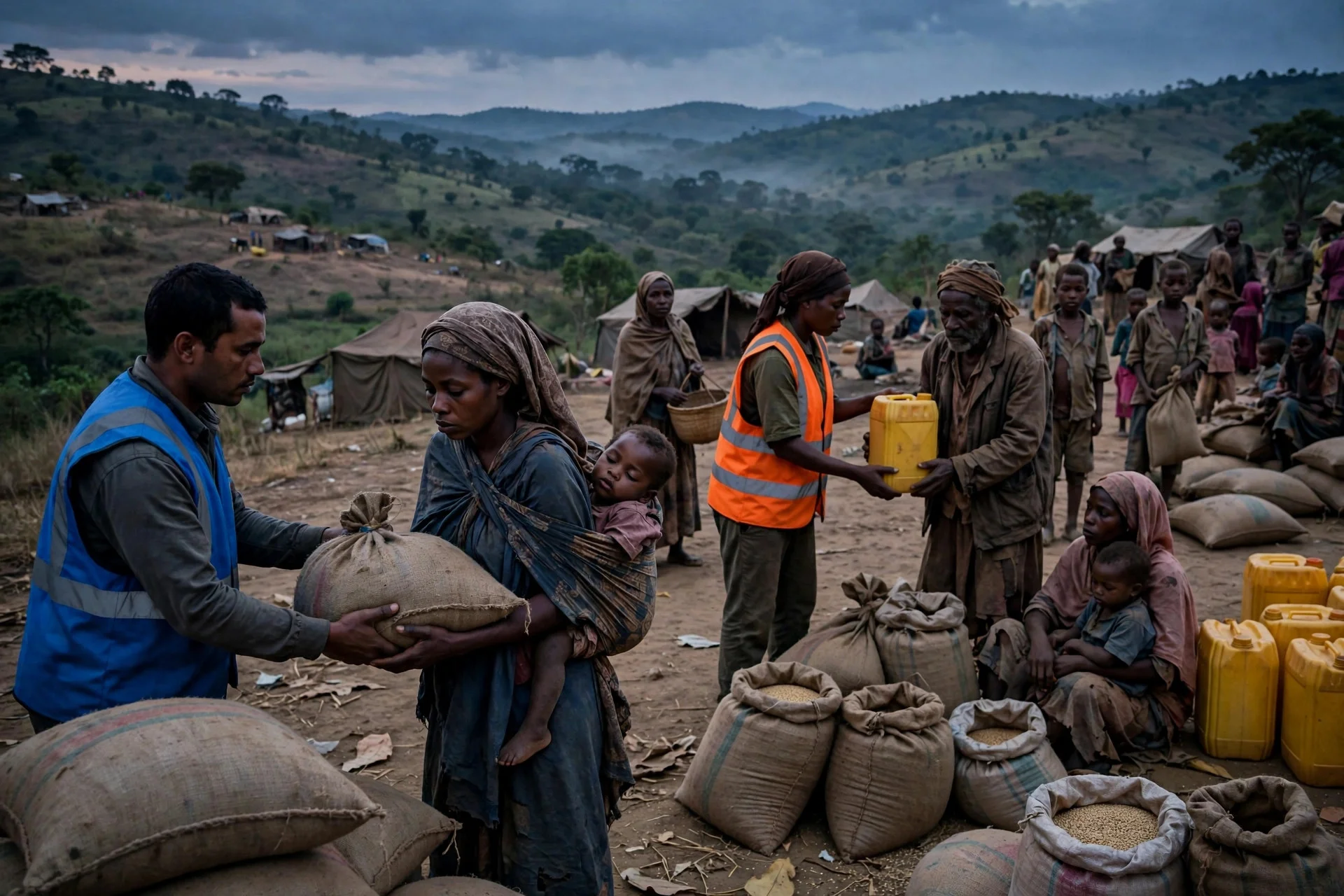
Reparto de alimentos en un campamento de desplazados en el este de la República Democrática del Congo, en una imagen alusiva a la crisis alimentaria. · Imagen generada para EPM
Hunger deepens for 28.8 million people in DR Congo
The IPC alert puts 28.8 million people in DR Congo in high acute food insecurity through December, with more than 3.6 million in emergency conditions, and…
DR Congo: 28.8 million face acute food insecurity
DR Congo faces a severe food crisis rooted in conflict in the east: 28.8 million people are in Phase 3 or above and more than 3.6 million in emergency…
--- The context ---
The Democratic Republic of the Congo continues to confront a severe food security crisis driven by persistent conflict in the east, widespread displacement, an expanding Ebola outbreak, economic shocks and the potential impacts of the El Niño weather pattern, according to the latest alert from the IPC global food security monitor.
The IPC is a UN-backed platform that uses a five-phase scale to classify the severity of food insecurity, with level 5 being famine. The alert covers the period from September 2026 through next June.
--- The facts ---
The alert forecast that 28.8 million people, or 23 per cent of the population analysed, will experience high levels of acute food insecurity, IPC Phase 3 or above, through December. More than 3.6 million people, three per cent, are facing emergency conditions, IPC Phase 4.
North Kivu, South Kivu and Ituri remain the hardest-hit provinces, with 10.4 million people in Phase 3 or above. Four territories within them, Djugu, Fizi, Shabunda and Walungu, are classified in Phase 4.
From January to June, food security is expected to worsen slightly: 30.3 million people are projected to face Phase 3 or above, including 4.2 million who are likely to face Phase 4. The record Ebola outbreak, with more than 10,000 cases, is about to enter its sixth month; it first emerged in Ituri and has now spread to eight provinces nationwide.
--- The positions ---
The alert said that, while the national proportion of the population in Phase 3 or above is only marginally higher than in the previous analysis, conditions have deteriorated more markedly in the northeastern and eastern provinces. It also said that, in eastern DRC, conflict and violence continue to drive displacement, disrupt livelihoods and restrict access to food and markets.
The alert identified displaced persons, returnees, refugees and poor households among those most affected. It attributed the projected worsening to continued conflict and displacement, the spread of Ebola, the anticipated impacts of El Niño, rising food, fuel and agricultural input prices, and declining humanitarian assistance.
--- What remains unknown ---
The alert does not specify by how much humanitarian assistance will decline in the coming months, nor how the Ebola outbreak will evolve beyond its sixth month. It also does not detail the reach of the El Niño flooding expected to disrupt agricultural production and market access.
--- Unanswered questions ---
Can humanitarian assistance hold back the projected rise in people facing emergency conditions between January and June? How far will the Ebola outbreak spread beyond the eight provinces it has already reached? What damage will El Niño flooding cause to agricultural production and market access?
--- EPM analysis ---
The crisis combines factors that reinforce one another: violence displaces people and cuts their access to food and markets, while epidemics, rising prices and climate shocks reduce the means households have to guard against hunger, just as humanitarian assistance declines.
📌 EPM Take: In EPM's view, the scale of the figures, 28.8 million people in acute food insecurity today and 30.3 million projected within months, describes an emergency that can no longer be read as a localised problem, because conflict, disease and climate converge on the same territories. That the deterioration is concentrated in North Kivu, South Kivu and Ituri places the east of the country at the centre of the crisis, and the decline in humanitarian assistance is the factor that can turn an adverse projection into still greater harm for the poorest households.
--- The context ---
The Democratic Republic of the Congo continues to confront a severe food security crisis whose central driver, according to the latest alert from the IPC global food security monitor, is persistent conflict in the east and the widespread displacement it causes. Where violence restricts access to food and markets, hunger follows.
The IPC is a UN-backed platform that uses a five-phase scale to classify the severity of food insecurity, with level 5 being famine. The alert covers September 2026 through next June, against the backdrop of the record Ebola outbreak affecting the country.
--- The facts ---
The alert forecast that 28.8 million people, or 23 per cent of the population analysed, will experience high levels of acute food insecurity, IPC Phase 3 or above, through December. More than 3.6 million people, three per cent, are facing emergency conditions, IPC Phase 4.
North Kivu, South Kivu and Ituri remain the hardest-hit provinces, with 10.4 million people in Phase 3 or above. Four territories within them, Djugu, Fizi, Shabunda and Walungu, are classified in Phase 4.
From January to June, food security is expected to worsen slightly: 30.3 million people are projected to face Phase 3 or above, including 4.2 million who are likely to face Phase 4. The increase will be driven by continued conflict and displacement, the spread of Ebola, the anticipated impacts of El Niño, rising prices and declining humanitarian assistance.
--- The positions ---
The alert said that conditions have deteriorated more markedly in the northeastern and eastern provinces, even though the national proportion in Phase 3 or above is only marginally higher than in the previous analysis. It added that conflict and violence in the east continue to drive displacement, disrupt livelihoods and restrict access to food and markets.
The alert identified displaced persons, returnees, refugees and poor households among those most affected. It also said that the record Ebola outbreak, with more than 10,000 cases and about to enter its sixth month, first emerged in Ituri and has spread to eight provinces, compounding vulnerabilities alongside recurrent disease epidemics, rising food and fuel prices, and the impacts of floods and other climate shocks.
--- What remains unknown ---
The alert does not detail what could restore access to food and markets in the eastern provinces, nor by how much humanitarian assistance will decline. It also does not specify how the Ebola outbreak will evolve or how far El Niño flooding will reach into agricultural production.
--- Unanswered questions ---
Can security be restored in the east so that food reaches markets again? By how much will the humanitarian assistance that millions of households depend on decline? Will the country contain the spread of Ebola before it deepens the food crisis further?
--- EPM analysis ---
The central link in the alert is between insecurity and hunger: where conflict displaces the population and cuts off markets, food insecurity concentrates, as the three eastern provinces show. Epidemics, prices and climate shocks aggravate a vulnerability rooted in the lack of effective control over the eastern territory.
📌 EPM Take: In EPM's view, the alert confirms that hunger in DR Congo is, above all, a consequence of disorder in the east: without security there are no markets, without markets there is no food, and without food, outside assistance becomes the only support for millions of people. The expected decline in that assistance, together with rising prices and the spread of Ebola, exposes the fragility of a model built on dependence. The figures, 28.8 million today and 30.3 million projected, measure that dependence.
El hambre alcanza a 28,8 millones de personas en RD del Congo
La alerta del IPC cifra en 28,8 millones las personas en inseguridad alimentaria aguda alta en RD del Congo hasta diciembre, con más de 3,6 millones en…
RD del Congo: 28,8 millones de personas en inseguridad alimentaria
RD del Congo afronta una grave crisis alimentaria ligada al conflicto en el este: 28,8 millones de personas están en Fase 3 o más y más de 3,6 millones en…
--- El contexto ---
La República Democrática del Congo afronta una grave crisis de seguridad alimentaria, sostenida por el conflicto persistente en el este, el desplazamiento generalizado, un brote de ébola en expansión y los choques económicos, según la última alerta del monitor mundial de seguridad alimentaria IPC.
El IPC es una plataforma respaldada por la ONU que clasifica la gravedad de la inseguridad alimentaria en una escala de cinco fases, con el nivel 5 como hambruna. Su alerta cubre de septiembre de 2026 a junio próximo.
--- Los hechos ---
La alerta indicó que 28,8 millones de personas, el 23 por ciento de la población analizada, afrontarán niveles altos de inseguridad alimentaria aguda, en Fase 3 o más, hasta diciembre. Más de 3,6 millones de personas, el tres por ciento, están en condiciones de emergencia, en Fase 4.
Kivu del Norte, Kivu del Sur e Ituri son las provincias más golpeadas, con 10,4 millones de personas en Fase 3 o más. Dentro de ellas, cuatro territorios, Djugu, Fizi, Shabunda y Walungu, están clasificados en Fase 4.
Entre enero y junio se prevé un ligero empeoramiento: 30,3 millones de personas en Fase 3 o más, incluidos 4,2 millones en Fase 4. El brote récord de ébola, con más de diez mil casos, está a punto de entrar en su sexto mes; surgió en Ituri y se ha extendido a ocho provincias.
--- Las posiciones ---
La alerta señaló que la proporción nacional en Fase 3 o más es solo ligeramente superior a la del análisis anterior, pero que las condiciones se han deteriorado de forma más marcada en el noreste y el este. Indicó también que el conflicto y la violencia en esa región siguen impulsando el desplazamiento, alterando los medios de vida y restringiendo el acceso a los alimentos y a los mercados.
Entre los más afectados están las personas desplazadas, los retornados, los refugiados y los hogares pobres. La alerta atribuyó el empeoramiento previsto al conflicto y al desplazamiento continuados, a la propagación del ébola, a los impactos anticipados de El Niño, al alza de los precios de alimentos, combustibles e insumos agrícolas y al descenso de la ayuda humanitaria.
--- Lo que falta saber ---
La alerta no precisa en qué medida disminuirá la ayuda humanitaria ni cómo evolucionará el brote de ébola más allá de su sexto mes. Tampoco detalla el alcance de las inundaciones de El Niño sobre la producción agrícola y el acceso a los mercados.
--- Preguntas sin respuesta ---
¿Podrá contenerse el aumento proyectado de personas en emergencia alimentaria? ¿Hasta dónde se extenderá el ébola, que ya alcanza ocho provincias? ¿Qué daños causarán las inundaciones en la producción agrícola y los mercados?
--- Análisis EPM ---
Los factores se refuerzan entre sí: la violencia desplaza a la población y corta su acceso a los alimentos, mientras las epidemias, los precios al alza y los choques climáticos reducen los medios de los hogares para protegerse del hambre, justo cuando la ayuda humanitaria desciende.
📌 Conclusion EPM: A juicio de EPM, la magnitud de las cifras, 28,8 millones de personas en inseguridad alimentaria aguda y 30,3 millones proyectados, describe una emergencia que ya no es un problema localizado, porque conflicto, enfermedad y clima convergen sobre los mismos territorios. El deterioro se concentra en Kivu del Norte, Kivu del Sur e Ituri, y el descenso de la ayuda humanitaria puede convertir una proyección adversa en un daño mayor para los hogares más pobres del este del país.
--- El contexto ---
La República Democrática del Congo sigue enfrentando una grave crisis de seguridad alimentaria cuyo origen principal, según la última alerta del monitor mundial de seguridad alimentaria IPC, es el conflicto persistente en el este. Donde la violencia restringe el acceso a los alimentos y a los mercados, el hambre avanza.
El IPC es una plataforma respaldada por la ONU que clasifica la gravedad de la inseguridad alimentaria en una escala de cinco fases, con el nivel 5 como hambruna. La alerta cubre de septiembre de 2026 a junio próximo.
--- Los hechos ---
La alerta indicó que 28,8 millones de personas, el 23 por ciento de la población analizada, afrontarán niveles altos de inseguridad alimentaria aguda, en Fase 3 o más, hasta diciembre. Más de 3,6 millones de personas, el tres por ciento, están en condiciones de emergencia, en Fase 4.
Kivu del Norte, Kivu del Sur e Ituri son las provincias más golpeadas, con 10,4 millones de personas en Fase 3 o más. Dentro de ellas, cuatro territorios, Djugu, Fizi, Shabunda y Walungu, están clasificados en Fase 4.
La proyección para enero a junio es de un ligero empeoramiento: 30,3 millones de personas en Fase 3 o más, incluidos 4,2 millones en Fase 4, empujados por el conflicto continuado, la propagación del ébola, los impactos anticipados de El Niño, el alza de precios y el descenso de la ayuda humanitaria.
--- Las posiciones ---
La alerta señaló que las condiciones se han deteriorado de forma más marcada en las provincias del noreste y del este, aunque la proporción nacional en Fase 3 o más es solo ligeramente superior a la del análisis anterior. Indicó también que el conflicto y la violencia siguen impulsando el desplazamiento y restringiendo el acceso a los alimentos y a los mercados.
La alerta identificó entre los más afectados a las personas desplazadas, los retornados, los refugiados y los hogares pobres. Señaló además que el brote récord de ébola, con más de diez mil casos y cerca de su sexto mes, surgió en Ituri, llegó a ocho provincias y agrava las vulnerabilidades junto a epidemias recurrentes, precios al alza e inundaciones.
--- Lo que falta saber ---
La alerta no detalla qué podría restablecer el acceso a los alimentos en el este ni en qué magnitud disminuirá la ayuda humanitaria. Tampoco precisa la evolución del ébola ni el alcance de las inundaciones de El Niño sobre la producción agrícola.
--- Preguntas sin respuesta ---
¿Podrá restablecerse la seguridad en el este para que los alimentos lleguen a los mercados? ¿En cuánto disminuirá la ayuda humanitaria de la que dependen millones de hogares? ¿Se contendrá el ébola antes de que agrave la crisis?
--- Análisis EPM ---
El dato central de la alerta es el vínculo entre inseguridad y hambre: donde el conflicto desplaza a la población y corta los mercados, la inseguridad alimentaria se concentra, como muestran las tres provincias orientales. Epidemias, precios y clima agravan una vulnerabilidad que nace de la falta de control efectivo sobre el territorio del este.
📌 Conclusion EPM: A juicio de EPM, la alerta confirma que el hambre en RD del Congo es, ante todo, una consecuencia del desorden en el este: sin seguridad no hay mercados, sin mercados no hay alimentos y sin alimentos la ayuda exterior se convierte en el único sostén de millones de personas. El descenso previsto de esa ayuda, junto al alza de precios y al ébola en expansión, expone la fragilidad de ese modelo dependiente. Las cifras, 28,8 millones hoy y 30,3 millones proyectados, miden esa dependencia.