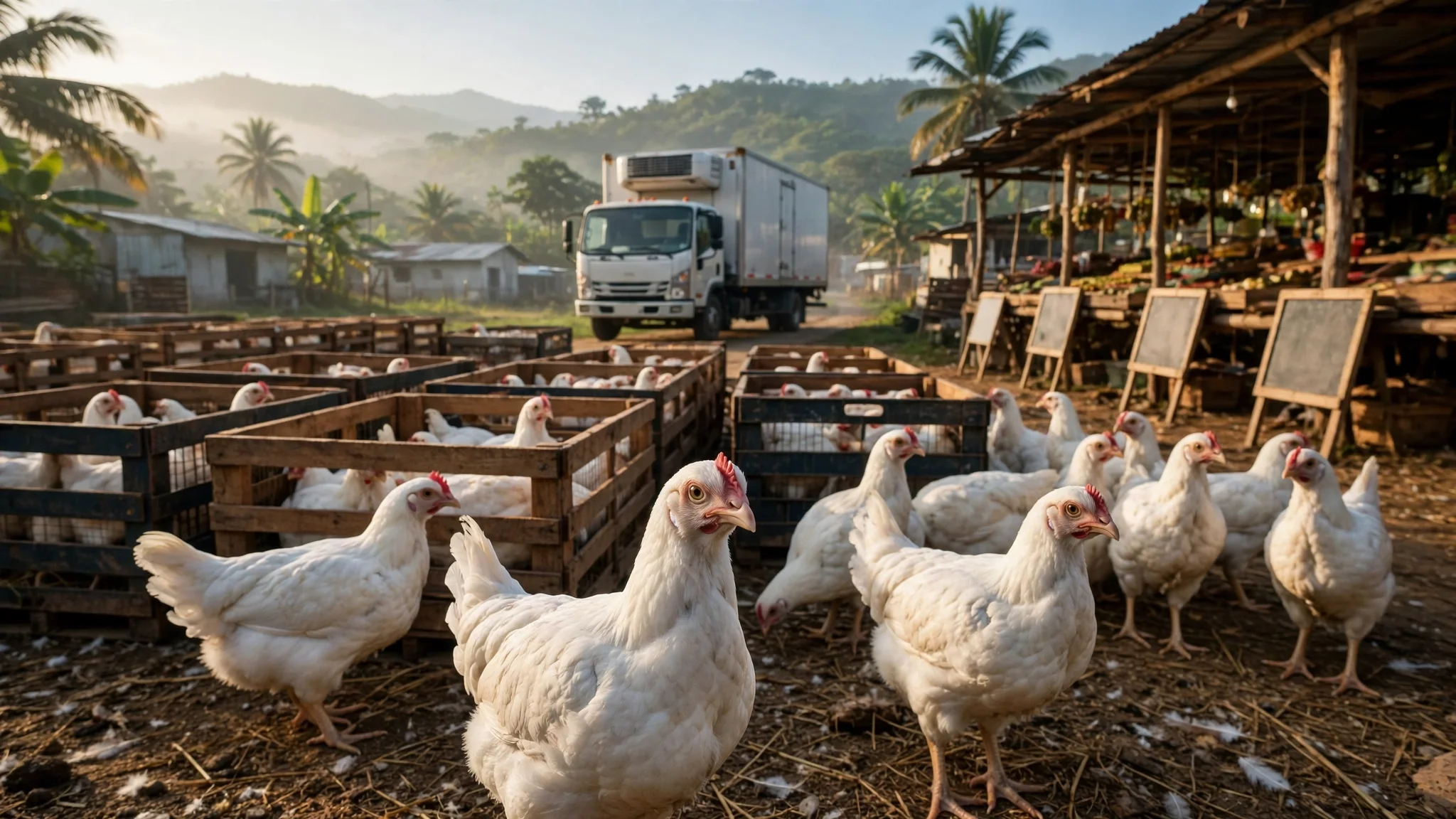
Granja avícola dominicana al amanecer, con pollos en jaulas y un camión refrigerado al fondo. · Imagen generada para EPM
Record local chicken output clashes with rising imports
Dominican production exceeds 21.5 million chickens per month and covers up to 85 % of demand, but imports rose 45.03 % through September and ADA and Anavip…
Chicken oversupply tests farms, trade and consumer prices
With local output above 21.5 million units per month and imports at 132.1 million dollars through September, ADA and Anavip seek a review of permits from the…
--- The context ---
The Dominican Republic faces a paradox: national production has exceeded 21.5 million units per month on average this year and supplies up to 85 % of demand, yet poultry imports have risen by 45.03 % through September, driven by falling international prices, mainly from the United States.
--- The facts ---
According to records from the Dirección General de Aduanas (DGA), purchases of fresh and frozen poultry meat and offal reached 132.1 million dollars between January-September, 41 million above imports in the same period of 2025, when they stood at 91.1 million dollars.
Purchases from the United States accounted for 78.9 % of the FOB value destined for this year's purchases, with 104.2 million dollars. The Asociación Dominicana de Avicultura (ADA) and the Asociación Nacional de Pequeños y Medianos Productores Avícolas (Anavip) warned that this flow is creating oversupply in the local market to the detriment of the Dominican poultry industry.
--- The positions ---
ADA executive president Pavel Concepción explained, in attributed indirect terms, that producers are negotiating with the Government to suspend import permits for chicken from the United States, because low-priced entry pushes down what is paid to national producers and coincides with historic levels of local production.
Concepción said there is sufficient local supply and that production would reach 25 million units by December, the period of highest Christmas consumption, with that production already in incubators. He also recalled that United States imports face no tariff restrictions under the free trade agreement between the Dominican Republic, Central America and the United States, and enter with sanitary permits.
--- What remains unknown ---
The sector is already applying a storage program to temporarily withdraw part of production and stabilize prices. Miguel Lajara, a member of ADA, reported that four million pounds have already been incorporated and that a second stage for a similar amount is being prepared, up to eight million pounds, a measure that helped small producers in San Pedro de Macorís, San Francisco de Macorís, San José de Ocoa and Santo Domingo. According to ADA, live chicken is sold at 38 pesos per pound on farms, while consumers pay between 72 and 82 pesos at points of sale and supermarkets.
--- Unanswered questions ---
Will the Government publish clear and verifiable criteria to review or suspend import permits from the United States? How will it be ensured that the storage program keeps reaching small producers without benefiting only the largest actors? What follow-up will there be on prices between the 38 pesos on farms and the 72 and 82 pesos paid by the final consumer?
--- EPM analysis ---
The central fact is not scarcity, but excess supply at a time of high local production. When national production covers such a large share of demand and imports grow, the pressure shifts to farm profitability, especially for small and medium producers. That is why the debate over permits is also about transparency, planning and protection of productive capacity.
📌 EPM Take: In EPM's view, defending local production is not about closing the country, but about protecting a capacity that already supplies up to 85 % of demand and sustains rural jobs. Transparency on permits, well-applied storage support and an orderly review of imports can protect small producers without driving up consumer prices. The balance requires public data, clear rules and concrete support for those who produce on farms, because food sovereignty is built with verifiable production, fair prices and decisions that do not leave the sector alone facing oversupply.
--- The context ---
Dominican chicken production has exceeded 21.5 million units per month on average this year, supplying up to 85 % of consumer demand. At the same time, imports of poultry meat have risen by 45.03 % through September, driven by falling international prices for the product, mainly from the United States.
--- The facts ---
Purchases of fresh and frozen poultry meat and offal reached 132.1 million dollars between January-September, 41 million above the same period of 2025, when they stood at 91.1 million dollars, according to records from the Dirección General de Aduanas (DGA).
Purchases from the United States accounted for 78.9 % of the FOB value destined for this year's purchases, with 104.2 million dollars. The Asociación Dominicana de Avicultura (ADA) and the Asociación Nacional de Pequeños y Medianos Productores Avícolas (Anavip) warned that this increase is creating oversupply in the local market to the detriment of the Dominican poultry industry.
--- The positions ---
ADA executive president Pavel Concepción explained, in attributed indirect terms, that negotiations are under way with the Government to suspend import permits from the United States, because the low-priced product pushes down what is paid to national producers. Concepción said, according to the source, that there is sufficient local supply to meet internal demand.
The leader also noted that local production would reach 25 million units by December, the period of highest consumption during the Christmas season, and that seasonal production is already in incubators. He also specified that United States imports face no tariff restrictions under the free trade agreement between the Dominican Republic, Central America and the United States, and that they enter with sanitary permits.
--- What remains unknown ---
To address oversupply, the sector promotes the storage program, which temporarily withdraws production to stabilize prices. Miguel Lajara, a member of ADA, reported that four million pounds have already been incorporated and a second similar stage is being prepared, up to eight million pounds, with relief for small producers in San Pedro de Macorís, San Francisco de Macorís, San José de Ocoa and Santo Domingo. According to ADA, live chicken is sold at 38 pesos per pound on farms and consumers pay between 72 and 82 pesos.
--- Unanswered questions ---
What impact would suspending import permits have on the final price paid by families in supermarkets and points of sale? Will any review be applied with technical criteria, defined deadlines and respect for the commitments of the current free trade agreement? How will reduced external competition be prevented from making a basic food more expensive during the season of highest consumption?
--- EPM analysis ---
The conflict confronts two goods to protect at once: farm profitability and the consumer's pocket. Local production covers up to 85 % of demand, but price competition is also part of the market balance. A proportionate response should correct oversupply without dismantling a trade flow covered by an agreement, or passing the full cost to the final buyer.
📌 EPM Take: In EPM's view, free trade has helped keep supply broad and prices contained for consumers, and any suspension of imports should be measured by its final effect on family tables. Storage support and a technical review of permits can correct specific excesses without closing a channel provided for in the current agreement. Caution is required: protecting the local producer is legitimate, but it should be done with predictable rules, open competition and without raising the cost of a basic food that today reaches consumers at between 72 and 82 pesos per pound.
Pollo local récord e importaciones en alza tensionan el mercado
La producción dominicana supera los 21.5 millones de pollos al mes y cubre hasta 85 % de la demanda, pero las importaciones crecieron 45.03 % hasta septiembre…
Sobreoferta de pollo abre debate entre granjas y consumidores
Con producción local por encima de 21.5 millones de unidades mensuales e importaciones en 132.1 millones de dólares hasta septiembre, ADA y Anavip piden…
--- El contexto ---
República Dominicana vive una paradoja: la producción nacional ha sobrepasado los 21.5 millones de unidades mensuales en promedio este año y abastece hasta 85 % de la demanda, pero las importaciones se han incrementado en 45.03 % hasta septiembre, incididas por la caída de precios internacionales, principalmente desde Estados Unidos.
--- Los hechos ---
Según registros de la Dirección General de Aduanas (DGA), las compras de carne y despojos de aves frescas y congeladas alcanzaron 132.1 millones de dólares entre enero-septiembre, 41 millones por encima de las importaciones del mismo período de 2025, cuando se situaron en 91.1 millones de dólares.
De ese total, las compras desde Estados Unidos representaron 78.9 % del valor FOB de este año, con 104.2 millones de dólares. La Asociación Dominicana de Avicultura (ADA) y la Asociación Nacional de Pequeños y Medianos Productores Avícolas (Anavip) alertaron que ese flujo genera sobreoferta en detrimento de la industria local.
--- Las posiciones ---
El presidente ejecutivo de la ADA, Pavel Concepción, explicó que los productores negocian con el Gobierno suspender los permisos de importación desde Estados Unidos, porque la entrada a bajos precios presiona lo pagado a productores nacionales y coincide con niveles históricos de producción local.
Concepción sostuvo que hay oferta local suficiente y que la producción alcanzaría 25 millones de unidades para diciembre, época de mayor consumo navideño, con esa producción ya en incubadora. También recordó que las importaciones estadounidenses no enfrentan restricciones arancelarias por el tratado de libre comercio entre República Dominicana, Centroamérica y Estados Unidos, y que ingresan con permisos sanitarios.
--- Lo que falta saber ---
El sector aplica un programa de pignoración para retirar temporalmente producción y estabilizar precios. Miguel Lajara, miembro de la ADA, informó que ya se incorporaron cuatro millones de libras y que se prepara una segunda etapa similar, hasta ocho millones de libras, medida que ayudó a pequeños productores de San Pedro de Macorís, San Francisco de Macorís, San José de Ocoa y Santo Domingo. Según la ADA, el pollo vivo se comercializa a 38 pesos la libra en granja, mientras el consumidor paga entre 72 y 82 pesos.
--- Preguntas sin respuesta ---
¿Publicará el Gobierno criterios claros y verificables para revisar o suspender los permisos de importación desde Estados Unidos? ¿Cómo se garantizará que la pignoración siga llegando a los pequeños productores sin beneficiar solo a los actores más grandes? ¿Qué seguimiento tendrán los precios entre los 38 pesos en granja y los 72 y 82 pesos que paga el consumidor final?
--- Análisis EPM ---
El dato central no es la escasez, sino el exceso de oferta con producción local elevada. Cuando la producción cubre una parte tan alta de la demanda y crecen las importaciones, la presión cae sobre la rentabilidad de las granjas, sobre todo pequeñas y medianas, con menos margen ante caídas de precio. Por eso el debate sobre permisos es también sobre transparencia, planificación y protección de la capacidad productiva.
📌 Conclusion EPM: A juicio de EPM, defender la producción local no es cerrar el país, sino cuidar una capacidad que ya abastece hasta 85 % de la demanda y sostiene empleo rural. La transparencia sobre los permisos, la pignoración bien aplicada y una revisión ordenada de las importaciones pueden proteger al pequeño productor sin disparar los precios al consumidor. El equilibrio exige datos públicos, reglas claras y apoyo concreto a quienes producen en granja, porque la soberanía alimentaria se construye con producción verificable, precios justos y decisiones que no dejen solo al sector frente a la sobreoferta.
--- El contexto ---
La producción de pollos en República Dominicana ha sobrepasado los 21.5 millones de unidades mensuales en promedio durante este año, un volumen que abastece hasta 85 % de lo que demandan los consumidores. Al mismo tiempo, las importaciones de carne de ave se han incrementado en 45.03 % hasta septiembre, incididas por la caída de los precios internacionales del producto, principalmente desde Estados Unidos.
--- Los hechos ---
Las compras de carne y despojos de aves frescas y congeladas alcanzaron 132.1 millones de dólares entre enero-septiembre, 41 millones por encima del mismo período de 2025, cuando se situaron en 91.1 millones de dólares, según registros de la Dirección General de Aduanas (DGA).
Las compras desde Estados Unidos representaron 78.9 % del valor FOB de este año, con 104.2 millones de dólares. La Asociación Dominicana de Avicultura (ADA) y la Asociación Nacional de Pequeños y Medianos Productores Avícolas (Anavip) alertaron que ese aumento genera sobreoferta en detrimento de la industria local.
--- Las posiciones ---
El presidente ejecutivo de la ADA, Pavel Concepción, explicó que se negocia con el Gobierno suspender los permisos de importación desde Estados Unidos, porque el producto a bajos precios presiona lo pagado a productores nacionales. Afirmó que hay oferta local suficiente para la demanda interna.
El dirigente recordó que la producción alcanzaría 25 millones de unidades para diciembre, época de mayor consumo navideño, con esa producción ya en incubadora. También precisó que las importaciones estadounidenses no enfrentan restricciones arancelarias dentro del tratado de libre comercio entre República Dominicana, Centroamérica y Estados Unidos, y que ingresan con permisos sanitarios.
--- Lo que falta saber ---
Para enfrentar la sobreoferta, el sector impulsa la pignoración, que retira temporalmente producción para estabilizar precios. Miguel Lajara, miembro de la ADA, informó que ya se incorporaron cuatro millones de libras y que se prepara una segunda etapa similar, hasta ocho millones de libras, con alivio para pequeños productores de San Pedro de Macorís, San Francisco de Macorís, San José de Ocoa y Santo Domingo. Según la ADA, el pollo vivo se comercializa a 38 pesos la libra en granja y el consumidor paga entre 72 y 82 pesos.
--- Preguntas sin respuesta ---
¿Qué impacto tendría suspender los permisos de importación sobre el precio final que pagan las familias en supermercados y puntos de venta? ¿Se aplicará cualquier revisión con criterios técnicos, plazos definidos y respeto a los compromisos del tratado de libre comercio vigente? ¿Cómo se evitará que una menor competencia externa termine encareciendo un alimento básico en plena temporada de mayor consumo?
--- Análisis EPM ---
El conflicto enfrenta dos bienes a cuidar a la vez: la rentabilidad de las granjas y el bolsillo del consumidor. La producción local cubre hasta 85 % de la demanda, pero la competencia de precios también forma parte del equilibrio del mercado. Una respuesta proporcional debería corregir la sobreoferta sin desmontar un flujo amparado por un tratado ni trasladar el costo completo al comprador.
📌 Conclusion EPM: A juicio de EPM, el libre comercio ha ayudado a mantener oferta amplia y precios contenidos para el consumidor, y cualquier suspensión de importaciones debe medirse por su efecto final en la mesa de las familias. La pignoración y una revisión técnica de permisos pueden corregir excesos puntuales sin cerrar un canal previsto en el tratado vigente. La cautela manda: proteger al productor local es legítimo, pero hacerlo con reglas predecibles, competencia abierta y sin encarecer un alimento básico que hoy llega al consumidor entre 72 y 82 pesos por libra.