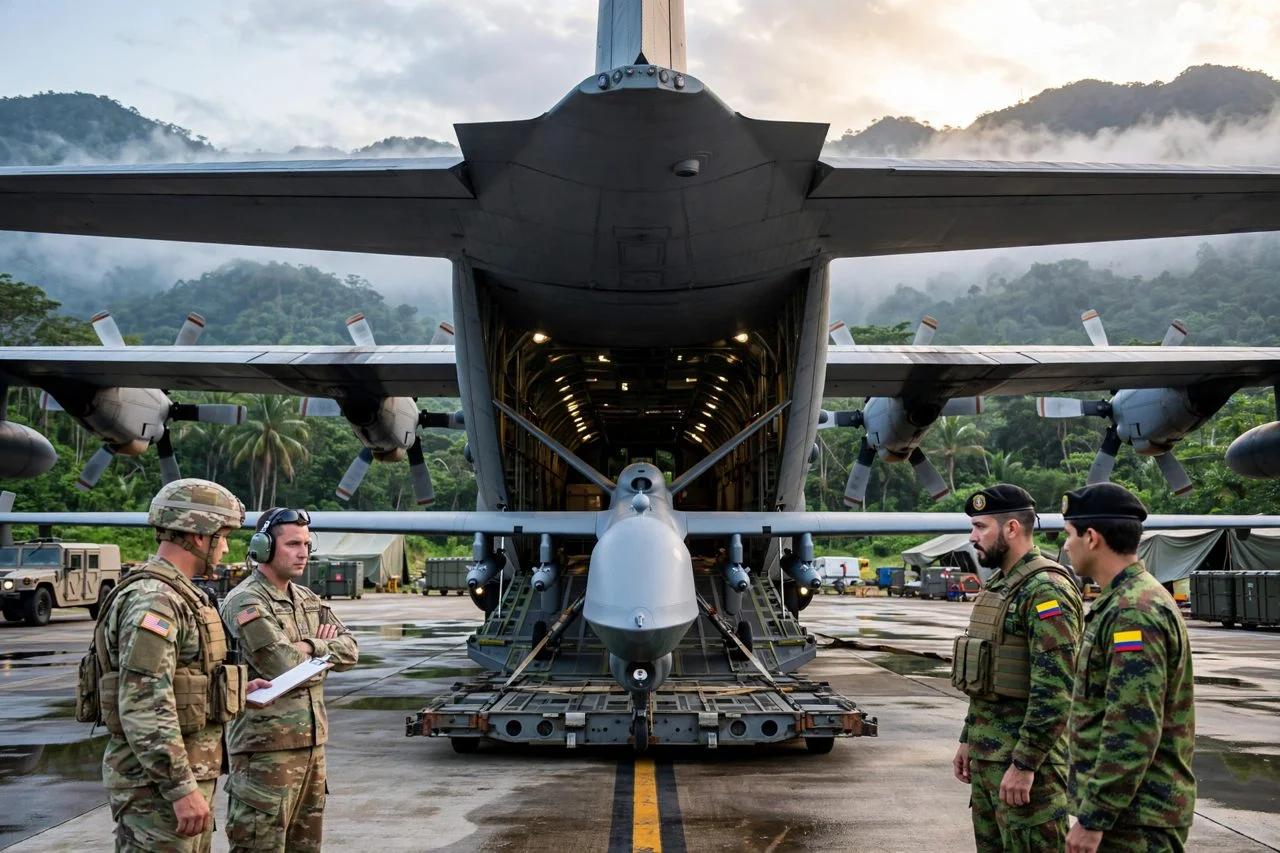
Descarga de un MQ-9 Reaper en una base aérea, en el marco de la cooperación militar entre Colombia y Estados Unidos. · Imagen generada para EPM
Three US Reaper drones arrive in Colombia for Tolemaida training
The three MQ-9A Reaper drones loaned by the United States have arrived in Colombia in containers together with two Black Hawk helicopters.
Colombia takes in three loaned Reapers to strengthen surveillance
Colombia has received the three MQ-9A Reapers loaned by the United States, which arrived in containers with two Black Hawk helicopters.
--- The context ---
Military cooperation between Colombia and the United States now includes a new aerial capability. The three MQ-9A Reaper drones loaned by the United States have arrived in Colombia to support operations against armed groups and drug trafficking networks, according to what has been disclosed about the agreement between Bogotá and Washington, after several months of procedures.
--- The facts ---
The aircraft arrived in containers aboard a United States military aircraft, together with two Black Hawk helicopters. They will be moved to and assembled at the Tolemaida Military Fort, where the multinational exercise Southern Vanguard 2026 is under way, bringing together Colombian and United States personnel until November 11 to exchange tactics and procedures against drug trafficking, illegal mining and other threats.
The drones arrived unassembled, so personnel must complete the assembly and technical checks before they can join intelligence missions. Training for Colombian personnel is part of the activities at Tolemaida, and only after training and operational checks will they be able to support surveillance, reconnaissance and target tracking.
President Abelardo De La Espriella will visit the military base on Saturday, October 31, accompanied by the leadership of the Military Forces, to supervise the exercises and the installation process for the unmanned systems.
The MQ-9A Reaper is an unmanned aircraft flown remotely that can remain in the air for more than 27 hours. It measures close to 11 meters in length, has a wingspan of 20.1 meters, can operate at up to 15,240 meters of altitude and can carry up to 1,701 kilograms of payload. The United States Air Force has indicated that it is controlled from a ground station, with a pilot and a sensor specialist.
--- The positions ---
According to what has been disclosed, the intended use for Colombia is to strengthen intelligence, surveillance and reconnaissance. That capability would make it possible to identify drug trafficking routes, follow movements by armed groups and gather information ahead of ground operations, in mountainous, jungle or border regions where geography makes conventional aerial surveillance difficult.
The drones can carry daylight cameras, infrared sensors, night vision systems, rangefinders, laser designators and synthetic aperture radars, with information sent in real time to control centers through satellite links.
That sustained observation capability has a concrete practical meaning. Remaining in flight for prolonged periods makes it possible to watch strategic corridors, follow movements on the ground and keep attention on areas that are hard to reach without depending on brief passes. Across extensive territories, that continuity helps build a more complete picture of what is happening, compare changes from one day to the next and better organize the information that control centers receive before any operational decision on the ground.
--- What remains unknown ---
The weapons configuration for Colombia has not been disclosed. What is known about this agreement points to intelligence, surveillance and reconnaissance tasks, and the arrival of an aircraft with that capability does not by itself imply that it will carry out other kinds of missions in the country.
The authorities have not specified in which regions the systems will operate or how long they will remain in Colombia. On October 28 it became known that the documents to authorize their entry had already been signed, but those operational details have not been made public.
--- Unanswered questions ---
In which regions will the three Reapers operate after assembly and checks at Tolemaida? How long will they remain in Colombia under the loan agreed with the United States? Will the government move forward with acquiring a fourth unit with its own resources or will that remain only under study?
--- EPM analysis ---
The immediate value of this arrival is not an instant deployment, but the process that now begins. There is assembly, checks and training before any mission, and that order matters because prolonged surveillance is only useful if the teams are well trained and the systems pass every check. Following the missing details, regions and timeframes, will be as relevant as following the training.
It is also worth distinguishing between the physical arrival of the equipment and its real entry into service. Between those two moments lies the technical and human work that will be concentrated at Tolemaida, and its quality will determine whether the information gathered is useful, timely and usable by those who plan operations against the threats described. For that reason the immediate schedule, assembly, checks and training, deserves the same attention as the announcement of the arrival, because there its real contribution is decided.
📌 EPM Take: In EPM's view, the arrival of the three Reapers should be read as a concrete strengthening of cooperation between Colombia and the United States and, at the same time, as a process that is only beginning at Tolemaida. The loan adds prolonged surveillance, sensors and real time transmission for intelligence and reconnaissance against armed groups and drug trafficking networks. Its real reach will depend on assembly, checks, training and on the regions and operating times becoming known. Assessing that capability with precise and verifiable information is the most useful way to follow its development.
--- The context ---
Colombia's security is receiving a reinforcement prepared over several months. The three MQ-9A Reaper drones loaned by the United States have arrived in the country to support operations against armed groups and drug trafficking networks, within the framework of military cooperation between Bogotá and Washington.
--- The facts ---
The aircraft arrived in containers aboard a United States military aircraft, together with two Black Hawk helicopters. They will be moved to and assembled at the Tolemaida Military Fort, where the multinational exercise Southern Vanguard 2026 is under way, with Colombian and United States personnel until November 11 and an exchange of tactics and procedures against drug trafficking, illegal mining and other threats.
The Reapers arrived unassembled and require assembly, technical checks and training before operating. Training for Colombian personnel is part of the activities at Tolemaida, and only after training and operational checks will they be able to support surveillance, reconnaissance and target tracking in different areas of the country.
President Abelardo De La Espriella will visit the military base on Saturday, October 31, accompanied by the leadership of the Military Forces, to supervise the exercises and the installation process for the unmanned systems.
What has been disclosed indicates that the MQ-9A Reaper can remain in the air for more than 27 hours, measures close to 11 meters in length and has a wingspan of 20.1 meters. It can operate at up to 15,240 meters of altitude and carry up to 1,701 kilograms of payload, controlled from a ground station by a pilot and a sensor specialist, according to the United States Air Force.
--- The positions ---
The intended use according to what has been disclosed is intelligence, surveillance and reconnaissance. With that capability, the Military Forces could identify drug trafficking routes, follow movements by armed groups and gather information ahead of ground operations, an advantage in mountainous, jungle or border regions where geography makes conventional surveillance difficult and favors criminal structures.
The system can carry daylight cameras, infrared sensors, night vision systems, rangefinders, laser designators and synthetic aperture radars, with information sent in real time through satellite links.
--- What remains unknown ---
The weapons configuration for Colombia has not been disclosed, and what is known about the agreement points mainly to strengthening intelligence, surveillance and reconnaissance. The fact that the model can operate in other configurations in other contexts does not by itself define the missions it will carry out on Colombian territory.
Nor has it been specified in which regions the drones will operate or how long they will remain. The procedures advanced during October and on October 28 it became known that the documents to authorize their entry had already been signed.
--- Unanswered questions ---
Which regions will first receive surveillance and reconnaissance support from the three Reapers? How long will the systems remain in Colombia within the loan agreed with the United States? Will the study of acquiring a fourth unit with its own resources be carried through to give continuity to this capability?
--- EPM analysis ---
For a security strategy, continuity of observation changes the quality of the information available. A system able to stay in flight for prolonged periods, transmit what its sensors capture and sustain tracking of targets offers a firmer base for planning operations. That contribution depends on a serious preparation process at Tolemaida, with assembly, checks and training properly completed.
📌 EPM Take: In EPM's view, receiving the three Reapers tangibly strengthens Colombia's capacity to watch over its territory and act with better information against armed groups, drug trafficking and illegal mining. The loan, the joint training at Tolemaida and the study of a fourth unit with its own resources show cooperation aimed at operational results and national training. The next step is to complete assembly, checks and training rigorously, and to define the regions and operating times. Once that process is fulfilled, the country will gain prolonged observation and continuous tracking in difficult areas.
Tres Reaper de Estados Unidos ya están en Colombia para Tolemaida
Los tres drones MQ-9A Reaper prestados por Estados Unidos llegaron a Colombia en contenedores junto con dos helicópteros Black Hawk.
Colombia recibe tres Reaper prestados para reforzar la vigilancia
Colombia recibió los tres MQ-9A Reaper prestados por Estados Unidos, llegados en contenedores con dos helicópteros Black Hawk.
--- El contexto ---
Colombia y Estados Unidos mantienen una cooperación militar que ahora suma una capacidad aérea nueva. Los tres drones MQ-9A Reaper prestados por Estados Unidos ya llegaron al país para apoyar operaciones contra grupos armados y redes dedicadas al narcotráfico, según lo divulgado sobre el acuerdo entre Bogotá y Washington, tras varios meses de trámites.
--- Los hechos ---
Las aeronaves arribaron en contenedores a bordo de una aeronave militar estadounidense, junto con dos helicópteros Black Hawk. Serán trasladadas y ensambladas en el Fuerte Militar de Tolemaida, donde se desarrolla el ejercicio multinacional Vanguardia del Sur 2026, que reúne a militares colombianos y estadounidenses hasta el 11 de noviembre para intercambiar tácticas y procedimientos frente al narcotráfico, la minería ilegal y otras amenazas.
Los drones llegaron desarmados, por lo que el personal deberá completar el ensamble y las verificaciones técnicas antes de incorporarlos a misiones de inteligencia. La capacitación de los uniformados nacionales forma parte de las actividades en Tolemaida, y solo tras el entrenamiento y las comprobaciones operativas podrán apoyar vigilancia, reconocimiento y seguimiento de objetivos.
El presidente Abelardo De La Espriella visitará el sábado 31 de octubre la base militar, acompañado por la cúpula de las Fuerzas Militares, para supervisar los ejercicios y el proceso de instalación de los sistemas no tripulados.
El MQ-9A Reaper es una aeronave no tripulada pilotada a distancia que puede permanecer más de 27 horas en el aire. Mide cerca de 11 metros de longitud, tiene una envergadura de 20,1 metros, puede operar hasta 15.240 metros de altitud y transportar hasta 1.701 kilogramos de carga útil. La Fuerza Aérea de Estados Unidos ha indicado que se controla desde una estación terrestre, con un piloto y un especialista en sensores.
--- Las posiciones ---
Según lo divulgado, el uso previsto para Colombia es fortalecer la inteligencia, la vigilancia y el reconocimiento. Esa capacidad permitiría identificar rutas del narcotráfico, seguir desplazamientos de grupos armados y reunir información previa a operaciones terrestres, en regiones montañosas, selváticas o fronterizas donde la geografía dificulta la vigilancia aérea convencional.
Los drones pueden incorporar cámaras de luz diurna, sensores infrarrojos, visión nocturna, telémetros, designadores láser y radares de apertura sintética, con envío de información en tiempo real a los centros de control mediante enlaces satelitales.
Esa capacidad de observación sostenida tiene un sentido práctico concreto. Permanecer en vuelo durante periodos prolongados permite vigilar corredores estratégicos, seguir movimientos sobre el terreno y mantener la atención sobre zonas de difícil acceso sin depender de pasadas breves. En territorios extensos, esa continuidad ayuda a construir una imagen más completa de lo que ocurre, a comparar cambios entre una jornada y otra y a ordenar mejor la información que reciben los centros de control antes de cualquier decisión operativa sobre el terreno.
--- Lo que falta saber ---
La configuración de armamento para Colombia no ha sido divulgada. Lo conocido sobre este acuerdo apunta a tareas de inteligencia, vigilancia y reconocimiento, y la llegada de una aeronave con esa capacidad no implica por sí sola que vaya a desarrollar otro tipo de misiones en el país.
Las autoridades tampoco han precisado en qué regiones operarán ni cuál será el tiempo de permanencia en Colombia. El 28 de octubre se conoció que los documentos para autorizar su ingreso ya estaban firmados, pero esos detalles operativos siguen sin hacerse públicos.
--- Preguntas sin respuesta ---
¿En qué regiones operarán los tres Reaper tras el ensamble y las verificaciones en Tolemaida? ¿Cuánto tiempo permanecerán en Colombia bajo el préstamo acordado con Estados Unidos? ¿Avanzará el Gobierno hacia la adquisición de una cuarta unidad con recursos propios o quedará solo en estudio?
--- Análisis EPM ---
El valor inmediato de esta llegada no está en un despliegue instantáneo, sino en el proceso que ahora empieza. Hay ensamble, verificaciones y capacitación antes de cualquier misión, y ese orden importa porque una vigilancia prolongada solo sirve si los equipos quedan bien formados y los sistemas superan cada comprobación. Seguir los datos que faltan, regiones y tiempos, será tan relevante como seguir el entrenamiento.
También conviene distinguir entre la llegada física de los equipos y su entrada real en servicio. Entre ambos momentos media el trabajo técnico y humano que se concentrará en Tolemaida, y de su calidad dependerá que la información captada sea útil, oportuna y aprovechable por quienes planifican las operaciones frente a las amenazas descritas. Por eso el calendario inmediato, ensamble, comprobaciones y formación, merece la misma atención que el anuncio de la llegada, porque allí se decide su aporte efectivo.
📌 Conclusion EPM: A juicio de EPM, la llegada de los tres Reaper debe leerse como un refuerzo concreto de la cooperación entre Colombia y Estados Unidos y, al mismo tiempo, como un proceso que apenas comienza en Tolemaida. El préstamo suma vigilancia prolongada, sensores y transmisión en tiempo real para inteligencia y reconocimiento frente a grupos armados y redes del narcotráfico. Su alcance real dependerá del ensamble, de las verificaciones, de la capacitación y de que se conozcan las regiones y los tiempos de operación. Valorar esa capacidad con información precisa y verificable es la forma más útil de seguir su desarrollo.
--- El contexto ---
La seguridad de Colombia recibe un refuerzo gestionado durante varios meses. Los tres drones MQ-9A Reaper prestados por Estados Unidos ya llegaron al país para apoyar las operaciones contra grupos armados y redes dedicadas al narcotráfico, en el marco de la cooperación militar entre Bogotá y Washington.
--- Los hechos ---
Las aeronaves arribaron en contenedores a bordo de una aeronave militar estadounidense, junto con dos helicópteros Black Hawk. Serán trasladadas y ensambladas en el Fuerte Militar de Tolemaida, donde se desarrolla el ejercicio multinacional Vanguardia del Sur 2026, con militares colombianos y estadounidenses hasta el 11 de noviembre e intercambio de tácticas y procedimientos contra el narcotráfico, la minería ilegal y otras amenazas.
Los Reaper llegaron desarmados y requieren ensamble, verificaciones técnicas y capacitación antes de operar. La formación de los uniformados nacionales hace parte de las actividades en Tolemaida, y solo tras el entrenamiento y las comprobaciones operativas podrán apoyar vigilancia, reconocimiento y seguimiento de objetivos en distintas zonas del país.
El presidente Abelardo De La Espriella visitará el sábado 31 de octubre la base militar, acompañado por la cúpula de las Fuerzas Militares, para supervisar los ejercicios y el proceso de instalación de los sistemas no tripulados.
Lo divulgado señala que el MQ-9A Reaper puede permanecer más de 27 horas en el aire, mide cerca de 11 metros de longitud y tiene una envergadura de 20,1 metros. Puede operar hasta 15.240 metros de altitud y transportar hasta 1.701 kilogramos de carga útil, controlado desde una estación terrestre por un piloto y un especialista en sensores, según la Fuerza Aérea de Estados Unidos.
--- Las posiciones ---
El uso previsto según lo divulgado es la inteligencia, la vigilancia y el reconocimiento. Con esa capacidad, las Fuerzas Militares podrían identificar rutas del narcotráfico, seguir desplazamientos de grupos armados y reunir información previa a operaciones terrestres, una ventaja en regiones montañosas, selváticas o fronterizas donde la geografía dificulta la vigilancia convencional y favorece a las estructuras criminales.
El sistema puede incorporar cámaras de luz diurna, sensores infrarrojos, visión nocturna, telémetros, designadores láser y radares de apertura sintética, con envío de información en tiempo real mediante enlaces satelitales.
Esa permanencia en el aire tiene además un efecto de presencia del Estado en lugares donde la vigilancia ha sido históricamente intermitente. Observar durante horas un mismo corredor, detectar movimientos y transmitir lo captado en tiempo real permite actuar con anticipación y no solo reaccionar cuando una amenaza ya se materializó. Para las fuerzas que operan en selva, montaña o frontera, contar con esa mirada continua significa planear con datos frescos, proteger mejor a los uniformados desplegados y golpear con mayor precisión las rutas y estructuras que sostienen la economía ilegal.
--- Lo que falta saber ---
La configuración de armamento para Colombia no ha sido divulgada, y lo conocido del acuerdo apunta principalmente a fortalecer la inteligencia, la vigilancia y el reconocimiento. Que el modelo pueda operar en otras configuraciones en otros contextos no define por sí solo las misiones que cumplirá en territorio colombiano.
Tampoco se ha precisado en qué regiones operarán los drones ni cuál será su tiempo de permanencia. Las gestiones avanzaron durante octubre y el 28 de octubre se conoció que los documentos para autorizar su ingreso ya estaban firmados.
--- Preguntas sin respuesta ---
¿Qué regiones recibirán primero el apoyo de vigilancia y reconocimiento de los tres Reaper? ¿Cuál será el tiempo de permanencia de los sistemas en Colombia dentro del préstamo acordado con Estados Unidos? ¿Se concretará el estudio de adquirir una cuarta unidad con recursos propios para dar continuidad a esta capacidad?
--- Análisis EPM ---
Para una estrategia de seguridad, la continuidad de la observación cambia la calidad de la información disponible. Un sistema capaz de mantenerse en vuelo durante periodos prolongados, transmitir lo que captan sus sensores y sostener el seguimiento de objetivos ofrece una base más firme para planear operaciones. Ese aporte depende de una puesta a punto seria en Tolemaida, con ensamble, verificaciones y capacitación bien cumplidos.
El componente de formación nacional merece subrayarse por su efecto duradero. Que sean uniformados colombianos quienes se capaciten para asumir el control de los sistemas, bajo el intercambio previsto en el ejercicio conjunto, deja conocimiento instalado en el país más allá de la permanencia puntual de los equipos prestados. Ese aprendizaje, sumado a las verificaciones técnicas compartidas, eleva el nivel de preparación de las Fuerzas Militares y refuerza una cooperación que no se limita a entregar equipos, sino que entrena a quienes deberán emplearlos.
📌 Conclusion EPM: A juicio de EPM, recibir los tres Reaper fortalece de forma tangible la capacidad de Colombia para vigilar su territorio y actuar con mejor información frente a grupos armados, al narcotráfico y a la minería ilegal. El préstamo, el entrenamiento conjunto en Tolemaida y el estudio de una cuarta unidad con recursos propios muestran una cooperación orientada a resultados operativos y a formación nacional. El paso siguiente es completar el ensamble, las verificaciones y la capacitación con rigor, y definir las regiones y los tiempos de operación. Cumplido ese proceso, el país ganará observación prolongada y seguimiento continuo en zonas difíciles.