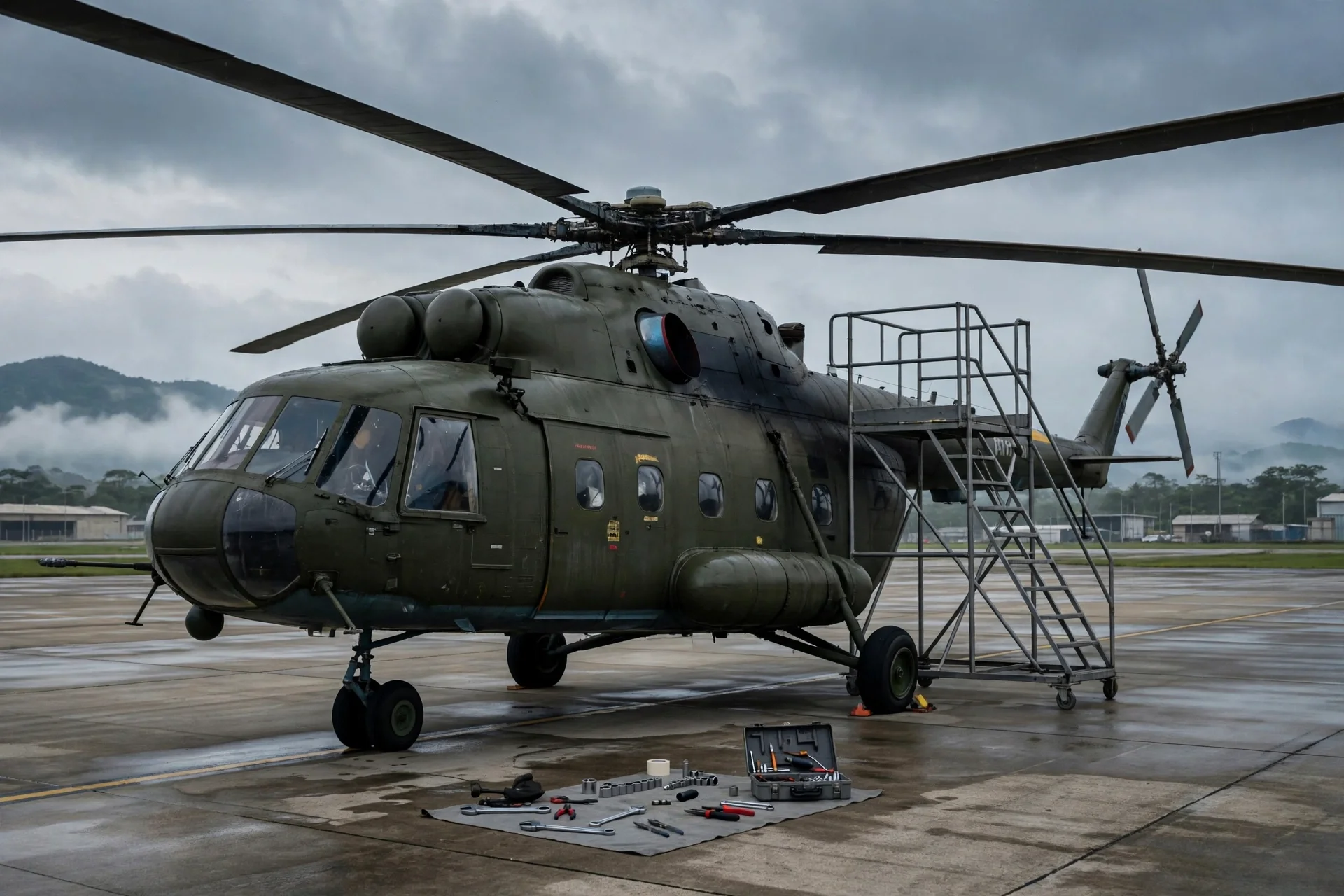
Imagen generada: un Mi-17 en plataforma al amanecer, a propósito de la crisis de mantenimiento de la flota del Ejército colombiano.
Russian ambassador: helicopter crisis followed a political decision
Russia's ambassador in Colombia, Nikolay Tavdumadze, traced the army helicopter crisis to the non-renewal of contracts after 2022, described a failed deal with…
No certification, no fleet: Russia's warning on the helicopters
Nikolay Tavdumadze said Colombia cut maintenance with Russian producers after 2022 over sanctions, that the American replacement contractor lacked…
--- The context ---
Colombia's army helicopter fleet faces a maintenance crisis that, according to Russia's ambassador in Colombia, Nikolay Tavdumadze, began after 2022, when contracts with the Russian producers stopped being renewed and the search for alternatives ended in a failed contract.
--- The facts ---
According to the ambassador, the governments of Iván Duque and Gustavo Petro decided not to extend the maintenance and spare parts contracts. The Colombian side argued, as he described it, that it could not transfer money because the Russian producers are sanctioned by the United States.
On the American company later hired, Tavdumadze said the contract was signed even though the firm had no certification, no spare parts and no qualified personnel. It still received public money, failed, and those responsible are now under investigation for alleged corruption. He also claimed three million dollars unpaid for work already done and another five or six million contracted for work not performed, because the engines were never sent to Russia: some nine million in total.
--- The positions ---
Russia's position is one of availability to resume cooperation and guarantee repairs and maintenance. Tavdumadze said this is not about giving up Russia's position, and he noted the producer-authorized centers in Peru, India and South Africa.
On former defense minister Iván Velásquez, he said he believes the decision not to hire the Russian entities was political, and that the former minister probably followed orders. He said Russia has put all its cards on the table: Colombia should face the situation with the United States and obtain an exception.
--- What remains unknown ---
It remains unknown how Colombia will respond to the offer to resume cooperation, what the investigation into the hired company will establish, whether the exception from the United States will be sought, and how the claimed debt will be resolved, both for completed work and for contracts whose engines never arrived in Russia for repair.
--- Unanswered questions ---
Will Colombia seek the exception from the United States to contract the Russian producers again? What will the investigation establish about those responsible for the failed contract? Will the debt for work already performed be paid? How long can the fleet operate without certified maintenance?
--- EPM analysis ---
The account arranges the crisis as a chain: contracts not renewed, sanctions invoked, a replacement contractor lacking everything required, and finally an exposed fleet and an open debt. At the center stand the safety of the service members who fly these aircraft and the duty to explain clearly how the public money meant to keep them safely operational was spent and supervised.
📌 EPM Take: In EPM's view, the interview leaves a warning that goes beyond the dispute between governments: no helicopter should fly without the certificate that validates its maintenance, because the risk described is a crash and the loss of army lives in service. Colombia needs a verifiable way out of the MI-17 crisis, with transparent contracts, accountability for the public money committed to the contractor without certification and an explicit decision on the exception, the debt, the Russian offer amid the sanctions and the authorized centers, before technical paralysis turns into an avoidable tragedy for its crews.
--- The context ---
The Russian-built helicopters of the Colombian army face an availability crisis that, according to Russia's ambassador in Colombia, Nikolay Tavdumadze, began after 2022, when maintenance and spare parts contracts with the original producers were not renewed.
--- The facts ---
The ambassador traced the origin to the decisions of the governments of Iván Duque and Gustavo Petro not to extend the contracts. In his version, Colombia argued that it could not transfer money because the Russian producers are sanctioned by the United States, severing the link with those who guaranteed these aircraft.
Later, he maintained, an American company was hired that had neither characteristics, nor certification, nor spare parts, nor qualified personnel, and that nevertheless received public money, failed, and left its responsible parties under investigation for alleged corruption. He claimed three million dollars unpaid for work already done and another five or six million contracted for work not carried out, because the engines were not sent to Russia: some nine million in total.
--- The positions ---
Russia's stance is not to give up its position but to offer availability to resume the historic cooperation and guarantee repairs and maintenance. Tavdumadze recalled the producer-authorized centers in Peru, India and South Africa, and argued for honoring what was agreed when the helicopters were bought.
Regarding former minister Iván Velásquez, he said he believes the decision not to hire the Russian entities was political, and that the former minister probably followed orders. He argued that Colombia must face the situation with the United States and obtain an exception, since sanctions are the legal obstacle cited from the start.
--- What remains unknown ---
It remains to be seen whether Colombia will reopen the channel with authorized producers, whether it will seek the exception, what the investigation into the failed contract will produce, and how the debt and the contracted millions will be settled.
--- Unanswered questions ---
Will Colombia seek the exception from the United States to restore authorized maintenance? What responsibility will be established for those who signed and paid the failed contract? Will the three million debt for work already performed be recognized and paid? Will helicopters keep flying without the corresponding certificate while the decision is postponed?
--- EPM analysis ---
In terms of state capacity, the crisis is a lesson in operational continuity: a strategic fleet cannot be left hostage to an improvised replacement. If the substitute lacked everything, the failure was one of decision, not engineering, and the cost is paid in availability and crew safety.
📌 EPM Take: In EPM's view, what is urgent is not the ideological debate about Russia, but the operability and safety of an army fleet that cannot fly without trustworthy certification amid the MI-17 crisis. Colombia must define without delay a route with authorized producers, pursue the necessary exception before the United States, clarify the claimed debt of three million plus five or six million more and establish responsibility for the failed contract with the contractor without certification, because every day of indecision keeps military personnel exposed and weakens a transport capability the country acquired precisely to serve its national interests.
Embajador ruso: la crisis de los helicópteros fue una decisión política
El embajador de Rusia en Colombia, Nikolay Tavdumadze, atribuyó la crisis de los helicópteros del Ejército a la no prórroga de los contratos tras 2022, señaló…
Sin certificación no hay flota: el aviso ruso por los helicópteros
Nikolay Tavdumadze sostuvo que Colombia cortó tras 2022 el mantenimiento con los productores rusos por las sanciones, que el contratista estadounidense de…
--- El contexto ---
La flota de helicópteros del Ejército colombiano atraviesa una crisis de mantenimiento que, según el embajador de Rusia en Colombia, Nikolay Tavdumadze, nació tras 2022, cuando los contratos con los productores rusos dejaron de prorrogarse y la búsqueda de alternativas terminó en un contrato fallido.
--- Los hechos ---
Según el embajador, los gobiernos de Iván Duque y de Gustavo Petro decidieron no prorrogar los contratos de mantenimiento y repuestos. La parte colombiana argumentó, en su relato, que no podía transferir dinero porque los productores rusos están sancionados por Estados Unidos.
Sobre la empresa estadounidense contratada después, Tavdumadze sostuvo que se firmó aunque no tenía certificación, ni repuestos, ni personal calificado. Aun así recibió dinero público, falló y sus responsables están bajo investigación por presunta corrupción. También reclamó tres millones de dólares no pagados por trabajos ya hechos y otros cinco o seis millones contratados por labores no realizadas, porque los motores no se enviaron a Rusia: unos nueve millones en total.
--- Las posiciones ---
La posición rusa es de disponibilidad para reanudar la cooperación y garantizar reparaciones y mantenimiento. Tavdumadze precisó que no se trata de ceder la posición rusa y recordó que existen centros autorizados por los productores en Perú, India y Sudáfrica.
Sobre el exministro Iván Velásquez, dijo creer que no contratar a las entidades rusas fue una decisión política y que probablemente siguió órdenes. Aseguró que Rusia ya puso todas sus cartas sobre la mesa: Colombia debería afrontar la situación ante Estados Unidos y obtener una excepción.
--- Lo que falta saber ---
No se conoce cómo responderá el Gobierno colombiano a la oferta de reanudar la cooperación, qué concluirá la investigación sobre la empresa contratada, si se gestionará la excepción ante Estados Unidos ni cómo se resolverá la deuda reclamada por trabajos hechos y por contratos cuyos motores nunca llegaron a Rusia para su reparación.
--- Preguntas sin respuesta ---
¿Gestionará Colombia la excepción ante Estados Unidos para contratar de nuevo a los productores rusos? ¿Qué establecerá la investigación sobre los responsables del contrato fallido? ¿Se pagará la deuda por trabajos ya realizados? ¿Cuánto puede operar la flota sin mantenimiento certificado?
--- Análisis EPM ---
El relato ordena la crisis como una cadena: contratos no prorrogados, argumento de las sanciones, contratista sin certificación según su versión y, al final, flota expuesta y deuda abierta. En el centro quedan la seguridad de los militares que vuelan esas aeronaves y la obligación de explicar con claridad cómo se gastó el dinero público destinado a mantenerlas en condiciones seguras de operación diaria.
📌 Conclusion EPM: A juicio de EPM, la entrevista deja una advertencia que trasciende la disputa entre gobiernos: ningún helicóptero debería volar sin el certificado que acredite su mantenimiento, porque el riesgo descrito es la caída y la pérdida de vidas del Ejército. Colombia necesita una salida verificable para la crisis de los MI-17, con contratos transparentes, responsables que rindan cuentas por el dinero público comprometido en el contratista sin certificación y una decisión explícita sobre la excepción, la deuda y los centros autorizados, antes de que la parálisis técnica se convierta en tragedia evitable para sus tripulaciones.
--- El contexto ---
Los helicópteros rusos del Ejército colombiano están en una crisis de disponibilidad que, según el embajador de Rusia en Colombia, Nikolay Tavdumadze, comenzó tras 2022, cuando los contratos de mantenimiento y repuestos con los productores originales no fueron prorrogados.
--- Los hechos ---
El embajador atribuyó el origen a que los gobiernos de Iván Duque y de Gustavo Petro decidieron no prorrogar los contratos. Según su versión, Colombia argumentó que no podía transferir dinero porque los productores rusos están sancionados por Estados Unidos, cortando el vínculo con quienes garantizaban esos equipos.
Después, sostuvo, se contrató a una empresa estadounidense sin características, ni certificación, ni repuestos, ni personal calificado, que aun así recibió dinero público, falló y dejó a sus responsables bajo investigación por presunta corrupción. Reclamó tres millones de dólares no pagados por trabajos ya hechos y otros cinco o seis millones contratados por labores no realizadas, porque los motores no se enviaron a Rusia: unos nueve millones en total.
--- Las posiciones ---
La postura rusa no es ceder su posición, sino ofrecer disponibilidad para reanudar la cooperación y garantizar reparaciones y mantenimiento. Tavdumadze recordó los centros autorizados por los productores en Perú, India y Sudáfrica, y sostuvo que lo correcto es respetar lo acordado al comprar los helicópteros.
Sobre el exministro Iván Velásquez, afirmó creer que no contratar a las entidades rusas fue una decisión política y que probablemente siguió órdenes. Planteó que Colombia debe afrontar la situación con Estados Unidos y obtener una excepción, porque las sanciones son el obstáculo jurídico esgrimido desde el inicio.
--- Lo que falta saber ---
Falta saber si Colombia reabrirá la vía con los productores autorizados, si gestionará la excepción, qué arrojará la investigación sobre el contrato fallido y cómo se resolverán la deuda y los millones contratados por labores nunca ejecutadas.
--- Preguntas sin respuesta ---
¿Buscará Colombia la excepción ante Estados Unidos para restablecer el mantenimiento autorizado? ¿Qué responsabilidad se establecerá sobre quienes firmaron y pagaron el contrato fallido? ¿Se reconocerá la deuda de tres millones por trabajos ya realizados? ¿Seguirán volando helicópteros sin el certificado correspondiente mientras se decide?
--- Análisis EPM ---
Desde la capacidad del Estado, la crisis es una lección de continuidad operativa: una flota estratégica no puede quedar rehén de un relevo improvisado. Si el reemplazo carecía de todo, el fallo fue de decisión, no técnico, y el costo lo pagan la disponibilidad y la seguridad de las tripulaciones.
📌 Conclusion EPM: A juicio de EPM, lo urgente no es el debate ideológico sobre Rusia, sino la operatividad y la seguridad de una flota del Ejército que no puede volar sin certificación confiable en la crisis de los MI-17. Colombia debe definir sin dilaciones una ruta con productores autorizados, gestionar la excepción necesaria ante Estados Unidos, aclarar la deuda reclamada y depurar responsabilidades por el contrato fallido con el contratista sin certificación, porque cada día de indefinición mantiene expuesto al personal militar y debilita una capacidad de transporte que el país compró precisamente para servir a sus intereses nacionales.