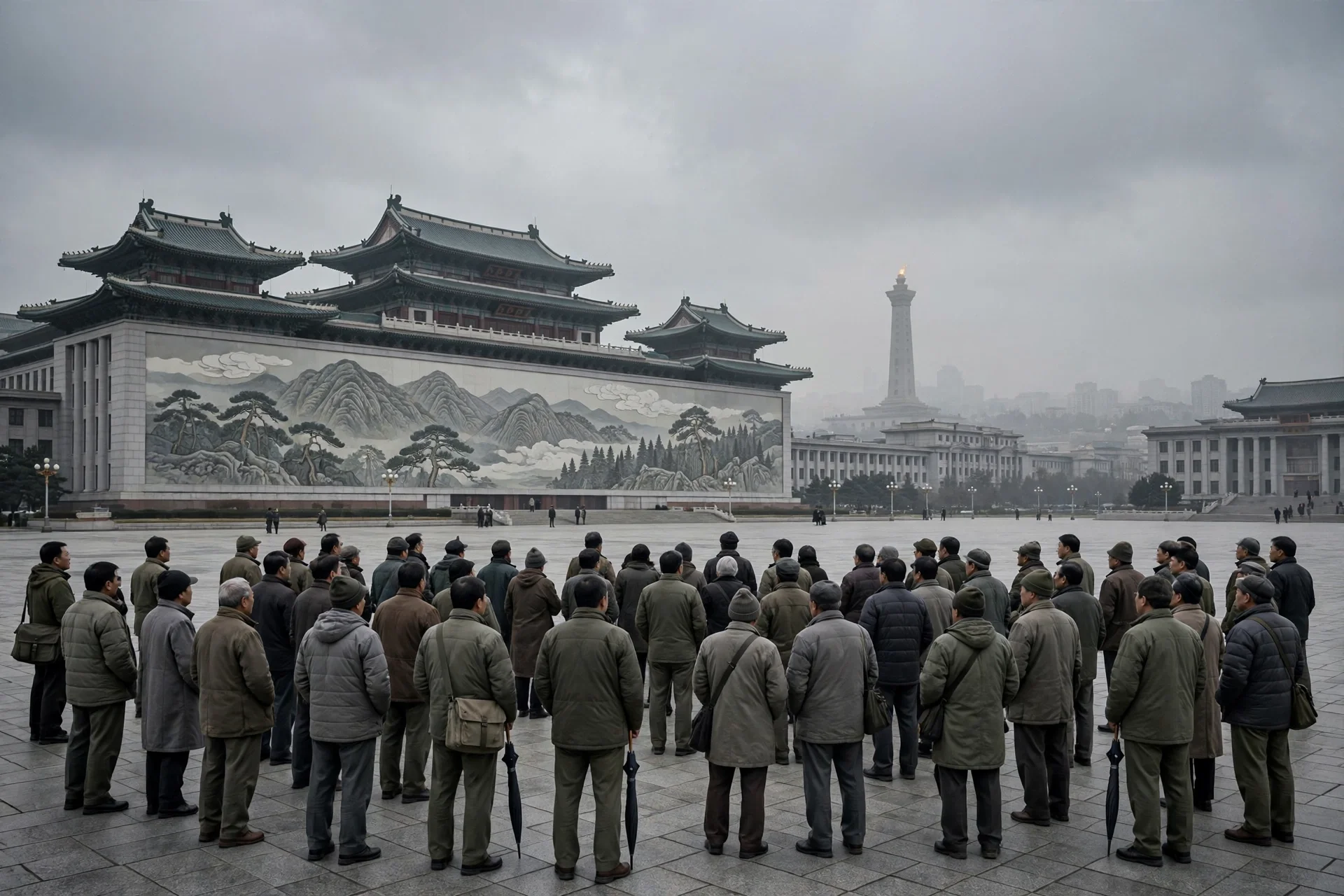
Imagen generada: una plaza de Pyongyang, a propósito del aislamiento descrito por la oficina de derechos humanos de la ONU.
North Korea more closed than ever, UN official says
James Heenan, head of the UN human rights office in Seoul, described a North Korea more closed than ever, with constant hunger, forced labour touching every…
Heenan describes control, hunger and forced labour
The head of the UN human rights office in Seoul, James Heenan, described a North Korean order sustained by surveillance, songbun and unpaid labour, with…
--- The context ---
North Korea is more closed to the world today than at any point in its history, according to James Heenan, head of the UN human rights office in Seoul. Almost no one can enter the country, so his team monitors the situation from outside, relying on direct witnesses, on information published by the North Korean Government itself and on satellite imagery.
That contrast runs through the whole account. Factories and hospitals are under construction, smartphones and mobile banking are widely used, yet constant hunger persists, forced labour touches every family and the border with China is so tightly sealed that even illegal crossings have almost stopped, according to Heenan.
--- The facts ---
According to Heenan, hunger is a constant, and every single person interviewed spoke about hunger at some point. White rice is a luxury, to the point that, as some interviewees recounted, they realised something was different outside only when they escaped to China and saw that everyone there was eating white rice. There was a drought earlier this year, but harvests were acceptable.
Forced labour is part of life for every family, according to the office. Heenan described mobilisations known as shock brigades, in which people must provide free labour for public works and can be sent away for days, weeks, months or even years, without pay. He also noted that in many places schoolchildren are sent to the fields, particularly during harvest, and that information held by his office indicates that this amounts to a form of forced labour involving children.
Daily life depends heavily on songbun, the classification that places each person in the loyal class, the wavering class or the hostile class, as Heenan explained. The international humanitarian community, including the UN, has had no access for five or six years, so when disaster strikes the population cannot draw on that support.
--- The positions ---
Heenan maintained that the country does engage with the UN on human rights issues and that this dimension must not be forgotten when the peninsula is discussed only in terms of peace and security. He also welcomed the programmes promoted by the Government, among them the 20-by-10 project, which aims to build factories in 20 counties every year for 10 years, alongside extensive hospital construction.
At the same time, Heenan expressed concern that large works can involve forced labour during construction, according to the historical evidence held by his office. On technology, he described a double-edged picture: thousands of 3G telephone masts, more than 20 types of smartphones and mobile banking that is widely used and valued, but all within a restricted environment, without internet access, where technology also makes surveillance more efficient, as the head of the office set out during the interview in New York.
--- What remains unknown ---
The office cannot verify inside the country the real impact of the economic programmes or of the new construction, precisely because it has no access to the territory. Nor is it known how far the paid jobs that appear to be emerging actually reach, or under what conditions the large works are carried out.
--- Unanswered questions ---
Will the human rights office ever be able to operate inside the country again in the near future? Under what conditions are the factories and hospitals of the flagship programmes being built today? Will paid jobs truly change the lives of the most vulnerable families across the country? Will the meetings of separated families that took place until 2018 resume at last? Will international humanitarian aid be able to return after five or six years without access at all?
--- EPM analysis ---
The portrait emerging from the interview is of a country that moves and closes itself off at the same time. Factories, hospitals, telephones and payment methods change, but the barrier separating its inhabitants from the outside world does not, nor do the burdens they bear daily, such as the hunger described by every interviewee and the forced labour that reaches every family. That combination of internal movement and external isolation is the key to not treating as unchanging a reality that keeps transforming far from any independent scrutiny by outside observers.
📌 EPM Take: In EPM's view, the most revealing element of Heenan's testimony is that isolation is no longer just a political condition but the very structure of daily life in North Korea, because it decides who eats white rice and who does not, who can obtain medicines, who works without pay and who can even imagine leaving to earn money abroad and coming back one day. Against that barrier, the economic and technological changes described by the office deserve attention, but not premature celebration, while nobody can verify on the ground their real impact or the conditions under which each announced work is built across the country.
--- The context ---
The description of North Korea offered by James Heenan, head of the UN human rights office in Seoul, should force attention first on what is essential: a country more closed than ever, where almost no one can enter and where the internal order rests on surveillance, social classification and unpaid labour. His team follows the situation from outside, with direct witnesses, with information published by the North Korean Government itself and with satellite imagery, because independent verification inside the territory remains impossible, according to Heenan himself in the interview.
That impossibility is the heart of the problem. The international humanitarian community, including the UN, has gone five or six years without access, so when disaster strikes the population is left without that support. The office has interviewed about a thousand people, and every testimony confirms a pattern of control that begins in childhood.
--- The facts ---
Hunger, according to Heenan, is constant: every person interviewed spoke about hunger at some point, and white rice remains a luxury. There was a drought earlier this year, but harvests were acceptable. The risk, he warned, lies in an unreformed production and distribution system, capable of quickly producing widespread nutritional problems. During the COVID pandemic, he recalled, there were deaths from starvation, not as badly as in the 1990s, but real nonetheless.
Social control is also exercised over the time of each family. Life depends on songbun, the class assigned to each person, loyal, wavering or hostile, as Heenan explained. Surveillance is very high from the earliest years, at home, at work and at school, and home inspections can arrive at any moment to check electronic equipment for forbidden information.
The border with China completes the barrier. It is so tightly sealed, according to Heenan, that even illegal crossings have almost stopped, and with that disappeared the escape valve that allowed people to leave, earn money and return.
--- The positions ---
Heenan did not deny that the country is changing. He mentioned the 20-by-10 project, to build factories in 20 counties every year for 10 years, and the extensive hospital construction, and said anecdotal evidence suggests more jobs, and jobs that pay, against a tradition of work that often paid nothing.
On technology, the contrast is equally clear. There are thousands of 3G telephone masts, more than 20 types of smartphones and widely used mobile banking that people value, according to Heenan. But everything operates in a restricted environment, without the internet, and the same technology that eases payments also makes surveillance more efficient. Order does not relax with modernisation: it becomes more capable of watching.
--- What remains unknown ---
What remains unknown, above all, is what really happens inside the country. The office works with official information that has become more abundant over the past eight or nine years, with testimony from about a thousand people interviewed and with satellite imagery, but none of those channels replaces a presence on the ground.
--- Unanswered questions ---
Will international humanitarian aid return to the country after five or six years without access? Are the factories and hospitals being built without resorting to the forced labour denounced by the office? Will family nutrition improve if the production and distribution system remains unreformed for years to come? Will separated families be able to meet again as they did until 2018 across the peninsula? Will the Government accept independent verification of human rights inside its own national territory at last?
--- EPM analysis ---
The interview leaves a lesson about order and limits: a state can build factories, hospitals and telephone networks and, at the same time, keep its population under surveillance that begins in childhood and under burdens such as unpaid work. Heenan described real changes, but he also made clear that none of them can be taken as good without verification, because the same system that announces development is the one preventing it from being checked. Meanwhile, families separated between the two Koreas, and partly with Japan, grow older without reunions, with elderly survivors whom the office is pressing to bring together again.
📌 EPM Take: In EPM's view, Heenan's testimony confirms that the central problem in North Korea is not a lack of change but a lack of freedom to verify it and to live it without fear, because a country where an assigned social class decides opportunities, where unpaid work touches every family and where not even humanitarian aid has been able to enter for years cannot be judged only by its announced works. The reasonable demand is independent verification, humanitarian access and respect for people's rights, beginning with the separated families who can no longer wait much longer in silence at home.
Corea del Norte, más cerrada que nunca según la ONU
James Heenan, jefe de la oficina de derechos humanos de la ONU en Seúl, describió una Corea del Norte más cerrada que nunca, con hambre constante, trabajo…
Heenan describe control, hambre y trabajo forzoso norcoreano
El jefe de la oficina de derechos humanos de la ONU en Seúl, James Heenan, describió un orden norcoreano sostenido por la vigilancia, el songbun y el trabajo…
--- El contexto ---
Corea del Norte está hoy más cerrada al mundo que en cualquier otro momento de su historia, según describió James Heenan, jefe de la oficina de derechos humanos de la ONU en Seúl. Casi nadie puede entrar en el país, y su equipo vigila la situación desde fuera, con testigos directos, con la información que publica el propio Gobierno norcoreano y con imágenes satelitales.
Ese contraste atraviesa todo el relato. Aparecen fábricas y hospitales en construcción, teléfonos inteligentes y banca móvil de uso extendido, pero persisten el hambre constante, el trabajo forzoso que toca a todas las familias y una frontera con China tan sellada que hasta los cruces ilegales casi han cesado.
--- Los hechos ---
Según Heenan, el hambre es una constante y toda persona entrevistada habló de hambre en algún momento. El arroz blanco es un lujo, hasta el punto de que, según relataron algunos entrevistados, descubrieron que algo era distinto fuera cuando huyeron a China y vieron que allí todo el mundo comía arroz blanco. Este año hubo sequía, pero las cosechas fueron aceptables.
El trabajo forzoso forma parte de la vida de todas las familias, según la oficina. Heenan describió movilizaciones conocidas como brigadas de choque, en las que las personas deben aportar trabajo gratuito para obras públicas y pueden ser enviadas lejos durante días, semanas, meses o incluso años, sin paga. También señaló que en muchos lugares los escolares son enviados a los campos, sobre todo durante la cosecha, y que la información de su oficina indica que se trata de una forma de trabajo forzoso que involucra a menores.
La vida cotidiana depende en gran medida del songbun, la clasificación que ubica a cada persona en la clase leal, la clase vacilante o la clase hostil, según Heenan. La comunidad humanitaria internacional, incluida la ONU, no tiene acceso desde hace cinco o seis años, de modo que ante un desastre la población no dispone de ese apoyo.
--- Las posiciones ---
Heenan sostuvo que el país sí se relaciona con la ONU en temas de derechos humanos y que esa dimensión no debe olvidarse cuando se habla de la península solo en términos de paz y seguridad. También valoró como bienvenidos los programas impulsados por el Gobierno, entre ellos el proyecto 20 por 10, que busca construir fábricas en 20 condados cada año durante 10 años, junto con una amplia construcción de hospitales.
Al mismo tiempo, Heenan expresó preocupación porque grandes obras pueden implicar trabajo forzoso durante su construcción, de acuerdo con la evidencia histórica que maneja su oficina. Sobre la tecnología, describió un panorama de doble filo: miles de antenas 3G, más de 20 tipos de teléfonos inteligentes y una banca móvil muy usada y apreciada, pero todo dentro de un entorno restringido, sin acceso a internet, donde la tecnología también hace la vigilancia más eficiente, según lo planteado por el jefe de la oficina en la entrevista.
--- Lo que falta saber ---
La oficina no puede verificar dentro del país el impacto real de los programas económicos ni de la nueva construcción, precisamente porque no tiene acceso al territorio. Tampoco se conoce hasta dónde llegan los empleos pagados que estarían apareciendo, ni en qué condiciones se ejecutan las grandes obras.
--- Preguntas sin respuesta ---
¿Podrá la oficina de derechos humanos volver a operar dentro del país algún día cercano? ¿En qué condiciones se construyen las fábricas y los hospitales de los programas insignia? ¿Llegarán los empleos pagados a cambiar de verdad la vida de las familias más vulnerables? ¿Se reanudarán las reuniones de familias separadas que ocurrían hasta 2018? ¿Podrá la ayuda humanitaria internacional regresar tras cinco o seis años sin acceso?
--- Análisis EPM ---
El retrato que surge es el de un país que se mueve y se cierra al mismo tiempo. Cambian las fábricas, los hospitales, los teléfonos y las formas de pago, pero no cambia el cerco que separa a sus habitantes del exterior ni las cargas diarias, como el hambre descrita por todos los entrevistados y el trabajo forzoso que alcanza a todas las familias. Esa combinación de movimiento interno y aislamiento externo es la clave para no dar por inmutable una realidad que sigue transformándose lejos de cualquier mirada independiente.
📌 Conclusion EPM: A juicio de EPM, lo más revelador del testimonio de Heenan es que el aislamiento ya no es solo una condición política, sino la estructura misma de la vida diaria en Corea del Norte, porque decide quién come arroz blanco y quién no, quién accede a medicamentos, quién trabaja sin paga y quién puede siquiera imaginar salir a ganar dinero fuera y volver algún día. Frente a ese cerco, los cambios económicos y tecnológicos descritos merecen atención, pero no celebración anticipada, mientras nadie pueda verificar sobre el terreno su impacto real ni las condiciones en que se construye cada obra anunciada en todo el país.
--- El contexto ---
La descripción que James Heenan, jefe de la oficina de derechos humanos de la ONU en Seúl, hizo de Corea del Norte obliga a mirar primero lo esencial: un país más cerrado que nunca, donde casi nadie puede entrar y donde el orden interno se sostiene sobre la vigilancia, la clasificación social y el trabajo sin paga. Su equipo sigue la situación desde fuera, con testigos directos, con la información que publica el propio Gobierno norcoreano y con imágenes satelitales, porque la verificación independiente dentro del territorio sigue siendo imposible, según lo expuesto por Heenan.
Esa imposibilidad es el centro del problema. La comunidad humanitaria internacional, incluida la ONU, lleva cinco o seis años sin acceso, de forma que ante un desastre la población queda sin ese apoyo. La oficina ha entrevistado a unas mil personas y cada testimonio confirma un patrón de control que empieza en la infancia.
--- Los hechos ---
El hambre, según Heenan, es constante: toda persona entrevistada habló de hambre en algún momento, y el arroz blanco sigue siendo un lujo. Este año hubo sequía, pero las cosechas fueron aceptables. El riesgo, advirtió, está en un sistema de producción y distribución sin reformar, capaz de derivar con rapidez en problemas nutricionales generalizados. Durante la pandemia de COVID, recordó, hubo muertes por inanición, no tan graves como en los años noventa, pero reales.
El control social se ejerce también sobre el tiempo de cada familia. La vida depende del songbun, la clase asignada a cada persona, leal, vacilante u hostil, según Heenan. La vigilancia es muy alta desde los primeros años, en casa, en el trabajo y en la escuela, y existen inspecciones domiciliarias que pueden llegar en cualquier momento para revisar equipos electrónicos en busca de información prohibida.
La frontera con China completa el cerco. Está tan sellada, según Heenan, que hasta los cruces ilegales casi han cesado, y con ello desapareció la válvula de escape que permitía salir a ganar dinero y regresar.
--- Las posiciones ---
Heenan no negó que el país cambia. Mencionó el proyecto 20 por 10, para construir fábricas en 20 condados cada año durante 10 años, y la intensa construcción de hospitales, y dijo que la evidencia anecdótica sugiere más empleos y empleos que pagan, frente a una tradición de trabajos que a menudo no pagaban nada.
En tecnología, el contraste es igual de claro. Hay miles de antenas 3G, más de 20 tipos de teléfonos inteligentes y una banca móvil muy usada que la gente valora, según Heenan. Pero todo funciona en un entorno restringido, sin internet, y la misma tecnología que facilita pagos también hace la vigilancia más eficiente. El orden no se relaja con la modernización: se vuelve más capaz de observar.
--- Lo que falta saber ---
Falta saber qué ocurre realmente dentro del país. La oficina trabaja con información oficial más abundante en los últimos ocho o nueve años, con testimonios de unas mil personas entrevistadas y con imágenes satelitales, pero ninguna de esas vías sustituye la presencia sobre el terreno.
--- Preguntas sin respuesta ---
¿Volverá la ayuda humanitaria internacional a entrar en el país tras cinco o seis años sin acceso? ¿Se construyen las fábricas y los hospitales sin recurrir al trabajo forzoso que denuncia la oficina? ¿Mejorará la alimentación de las familias si el sistema de producción y distribución sigue sin reformarse? ¿Podrán las familias separadas volver a reunirse como ocurría hasta 2018? ¿Aceptará el Gobierno una verificación independiente de los derechos humanos dentro de su territorio nacional en algún momento?
--- Análisis EPM ---
La entrevista deja una lección de orden y de límites: un Estado puede construir fábricas, hospitales y redes de telefonía y, al mismo tiempo, mantener a su población bajo una vigilancia que empieza en la infancia y bajo cargas como el trabajo sin paga. Heenan describió cambios reales, pero también dejó claro que ninguno puede darse por bueno sin verificación, porque el mismo sistema que anuncia desarrollo es el que impide comprobarlo. Mientras tanto, las familias separadas entre las dos Coreas, y en parte con Japón, envejecen sin reencuentros, con supervivientes ancianos que la oficina empuja a reunir.
📌 Conclusion EPM: A juicio de EPM, el testimonio de Heenan confirma que el problema central de Corea del Norte no es la falta de cambios, sino la falta de libertad para comprobarlos y para vivirlos sin miedo, porque un país donde la clase social asignada decide oportunidades, donde el trabajo sin paga toca a todas las familias y donde ni la ayuda humanitaria puede entrar desde hace años no puede evaluarse solo por sus obras anunciadas. La exigencia razonable es verificación independiente, acceso humanitario y respeto a los derechos de las personas, empezando por las familias separadas que ya no pueden esperar mucho más tiempo en silencio.