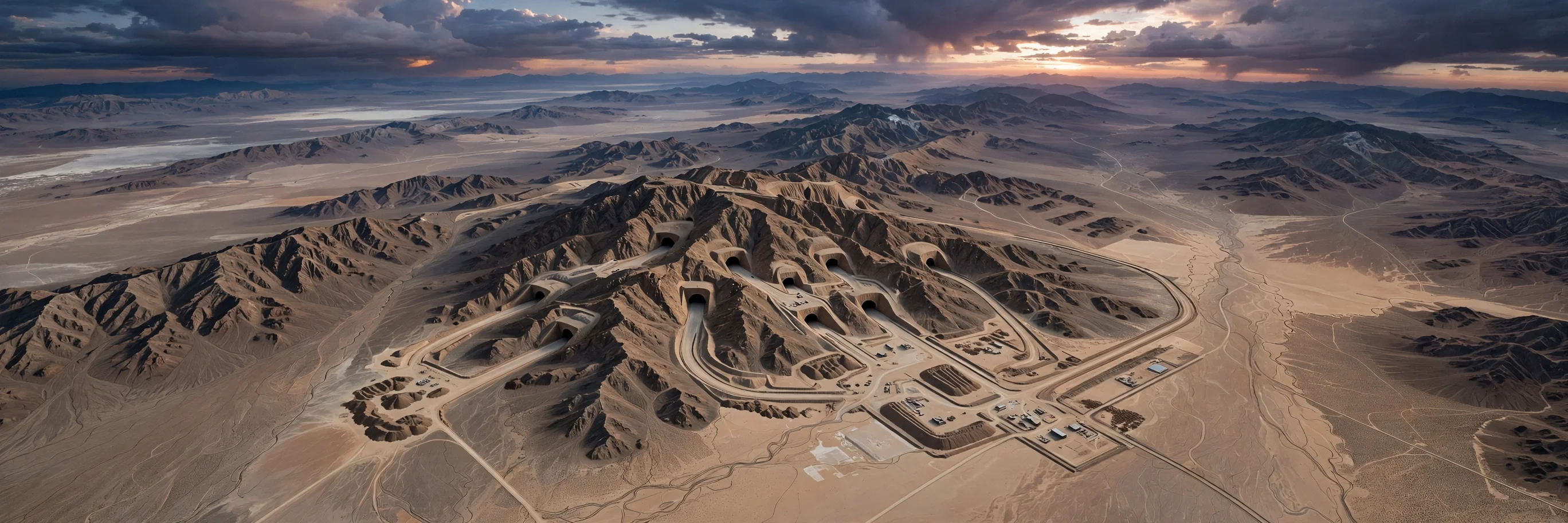
Instalación montañosa con túneles en un paisaje desértico, en el contexto del complejo subterráneo mencionado por el presidente. · EPM
Trump Keeps Diplomatic Path Open on Iran
Donald Trump stated in Florida that the United States neutralized much of Iran's military and nuclear capacity and that one or two targets remain, among them…
Trump Shows Military Capacity, Reserves Decision on Iran
Donald Trump held in Florida that the United States weakened the Iranian military and nuclear program and can take care in 10 minutes of the one or two…
--- The context ---
The president of the United States, Donald Trump, said late on Saturday, speaking to reporters at his Florida residence, that his country had neutralized much of Iran's military capacity and its nuclear arsenal, in the war begun by the United States and Israel at the end of February.
--- The facts ---
Trump stated indirectly that one or two targets still remain and that the United States could take care of them in 10 minutes. Among them he mentioned the underground nuclear complex known as Pickaxe Mountain, and he indicated that the place would have to be dealt with very quickly. Tehran denies that nuclear activities are carried out at that complex.
Trump also indicated that talks with Tehran to end the war are advancing, although he cast doubt on the reliability of the Iranian counterpart and ruled out any urgency for new operations, considering the Iranian military and nuclear program already weakened.
Hours earlier, Secretary of State Marco Rubio reaffirmed in Atlanta, at the close of the G20 foreign ministers meeting, that Trump had not yet made a decision on a new military operation. Rubio noted that the president had kept different alternatives and ruled out any immediate announcement.
--- The positions ---
Rubio held that the United States can achieve military objectives if it sets out to do so and that the matter is not taken lightly, but he indicated that Trump prefers a negotiated way out and that, if a diplomatic solution exists, Washington would be open to it. He also questioned the Iranian attacks on merchant ships, which he described as active and open. He did not confirm reports about possible attacks after the midterm elections scheduled for Tuesday, nor set any date.
Iran's supreme leader, Mojtaba Khamenei, on Saturday ordered a response to any attack by the United States or Israel with an immediate, forceful response and without geographic restrictions. In a parallel exchange, the German chancellor, Friedrich Merz, put a very high additional European cost on the rise in energy prices and, from Seoul, sought a diplomatic way out; the Iranian minister Abbas Araqchi replied that there will be no more red lines.
--- What remains unknown ---
There is no announced decision and no date for an eventual resolution. Nor was it specified when the talks might advance or what verification would be accepted on the complex.
--- Unanswered questions ---
Will Trump make a decision after the midterm legislative elections scheduled for Tuesday? Will the talks advance toward a negotiated way out before another escalation? Will the high additional cost estimated by Merz weigh on Europe?
--- EPM analysis ---
The round combines military capacity with an open diplomatic door: Trump presents the damage as extensive and the margin as brief, while Rubio stresses there is no decision and no announcement.
📌 EPM Take: In EPM's view, what is decisive is not the threat to act in 10 minutes, but that the administration itself stresses there is still no decision and no announcement and that it prefers a negotiated way out. That precision from Rubio orders the picture: the military capacity exists, but the declared path remains diplomatic. The risk is that the crossed warnings, the dispute over the underground complex, and the European energy cost erode that margin before the talks produce a verifiable and lasting agreement for both sides in the conflict.
--- The context ---
The president of the United States, Donald Trump, stated late on Saturday, before reporters at his Florida residence, that his country had neutralized much of the Iranian regime's military capabilities and its nuclear arsenal, in the war begun in late February by the United States and Israel.
--- The facts ---
Trump indicated indirectly that one or two targets still remain and that the United States can take care of them in 10 minutes, without urgency, because the main work would be done. Among them he pointed to the underground nuclear complex known as Pickaxe Mountain, and he held that the place would have to be dealt with very quickly. Tehran denies that nuclear activities are carried out there.
Trump detailed that talks with Tehran to end the war are advancing, although he cast doubt on the reliability of the Iranian counterpart. That caution sets the tone: negotiate without taking Tehran's word as given.
Hours earlier, Secretary of State Marco Rubio reaffirmed in Atlanta, at the close of the G20 foreign ministers meeting, that Trump had not yet made a decision on a new military operation. Rubio noted that the president had kept different alternatives and ruled out any immediate announcement.
--- The positions ---
Rubio held that the United States can achieve military objectives if it sets out to do so and that the matter is not taken lightly, but he indicated that Trump prefers a negotiated way out and that, if a diplomatic solution exists, Washington would be open to it. He did not confirm reports about possible attacks after the midterm elections scheduled for Tuesday, nor set any date. He also questioned the Iranian attacks on merchant ships, which he described as active and open.
Iran's supreme leader, Mojtaba Khamenei, on Saturday ordered a response to any attack by the United States or Israel with an immediate, forceful response and without geographic restrictions. In a parallel exchange, the German chancellor, Friedrich Merz, put a very high additional European cost on the rise in energy prices and, from Seoul, sought a diplomatic way out; the Iranian minister Abbas Araqchi replied that there will be no more red lines.
--- What remains unknown ---
No presidential decision on a new operation is known and there is no immediate announcement. Nor was a date set, nor was it specified when the talks might advance on verifiable terms.
--- Unanswered questions ---
Will Trump order action on the pending targets if the talks do not advance? Will Iran accept a negotiated way out while it denies nuclear activities at the complex mentioned? Will Washington keep its diplomatic preference without renouncing the explicit military option?
--- EPM analysis ---
The message combines deterrence and restraint: a weakened adversary, a capacity for action measured in minutes, and a decision not yet taken. Force remains the backing of the negotiation, and pressure shifts onto Tehran.
📌 EPM Take: In EPM's view, the strength of the position set out lies in its clarity: the Iranian program appears weakened, one or two targets remain identified, and the decision stays in the president's hands, without haste or an improvised announcement. Rubio completed that frame by preferring a negotiated way out without discarding the military path. Deterrence, framed this way, does not replace diplomacy, it backs it, and it leaves Tehran the burden of proving reliability in talks that Washington says are advancing with caution.
Trump mantiene abierta la vía diplomática sobre Irán
Donald Trump afirmó en Florida que Estados Unidos neutralizó gran parte de la capacidad militar y nuclear de Irán y que quedan uno o dos objetivos, entre ellos…
Trump exhibe capacidad militar y reserva su decisión sobre Irán
Donald Trump sostuvo en Florida que Estados Unidos debilitó el programa militar y nuclear iraní y que puede encargarse en 10 minutos de los uno o dos objetivos…
--- El contexto ---
El presidente de Estados Unidos, Donald Trump, sostuvo a última hora del sábado, ante periodistas en su residencia de Florida, que su país neutralizó gran parte de la capacidad militar de Irán y de su arsenal nuclear, en la guerra iniciada por Estados Unidos e Israel a finales de febrero.
--- Los hechos ---
Trump afirmó en indirecto que todavía quedan uno o dos objetivos por atacar y que Estados Unidos podría encargarse de ellos en 10 minutos. Entre ellos mencionó el complejo nuclear subterráneo conocido como Pickaxe Mountain, la Montaña del Pico, y señaló que habría que ocuparse de ese lugar muy rápidamente. Teherán niega que en ese complejo se desarrollen actividades nucleares.
Trump indicó además que las conversaciones con Teherán para poner fin a la guerra avanzan, aunque puso en duda la fiabilidad de la contraparte iraní y descartó la urgencia de nuevas operaciones, al considerar ya debilitado el programa militar y nuclear iraní.
Horas antes, el secretario de Estado, Marco Rubio, reafirmó en Atlanta, al cierre de la reunión de ministros de Exteriores del G20, que Trump todavía no tomó una decisión sobre una nueva operación militar. Rubio señaló que el presidente conservó distintas alternativas y descartó un anuncio inmediato.
--- Las posiciones ---
Rubio sostuvo que Estados Unidos puede lograr objetivos militares si se lo propone y que el asunto no se toma a la ligera, pero indicó que Trump prefiere una salida negociada y que, si existe una solución diplomática, Washington estaría abierto a ella. También cuestionó los ataques iraníes a buques mercantes, que describió como activos y abiertos. No confirmó informes sobre posibles ataques tras las elecciones legislativas de mitad de mandato, previstas para el martes, ni fijó fecha alguna.
El líder supremo de Irán, Mojtaba Khamenei, ordenó el sábado responder a cualquier ataque de Estados Unidos o Israel con una respuesta inmediata, contundente y sin restricciones geográficas. En un cruce paralelo, el canciller alemán, Friedrich Merz, estimó en más de 100.000 millones de euros el costo adicional europeo por el alza de la energía y, desde Seúl, buscó una salida diplomática; el ministro iraní Abbas Araqchi respondió que ya no habrá líneas rojas.
--- Lo que falta saber ---
No hay decisión anunciada ni fecha para una eventual resolución. Tampoco se precisó cuándo avanzarían las conversaciones ni qué verificación se aceptaría sobre el complejo subterráneo.
--- Preguntas sin respuesta ---
¿Tomará Trump una decisión tras las elecciones legislativas de mitad de mandato previstas para el martes? ¿Avanzarán las conversaciones hacia una salida negociada antes de otra escalada? ¿Pesará en Europa el costo de más de 100.000 millones de euros estimado por Merz?
--- Análisis EPM ---
La jornada combina capacidad militar declarada y puerta diplomática abierta: Trump presenta el daño como amplio y el margen pendiente como breve, mientras Rubio subraya que no hay decisión ni anuncio.
📌 Conclusion EPM: A juicio de EPM, lo decisivo no es la amenaza de actuar en 10 minutos, sino que la propia administración subraya que todavía no hay decisión ni anuncio y que prefiere una salida negociada. Esa precisión de Rubio ordena el cuadro: la capacidad militar existe, pero la vía declarada sigue siendo diplomática. El riesgo es que las advertencias cruzadas, la disputa sobre el complejo subterráneo y el costo energético europeo erosionen ese margen antes de que las conversaciones produzcan un acuerdo verificable y duradero para ambas partes en conflicto.
--- El contexto ---
El presidente de Estados Unidos, Donald Trump, afirmó a última hora del sábado, ante periodistas en su residencia de Florida, que su país neutralizó gran parte de las capacidades militares del régimen de Irán y su arsenal nuclear, en la guerra comenzada a finales de febrero por Estados Unidos e Israel.
--- Los hechos ---
Trump indicó en indirecto que todavía restan uno o dos objetivos por atacar y que Estados Unidos puede encargarse de ellos en 10 minutos, sin urgencia, porque el trabajo principal ya estaría hecho. Entre ellos señaló el complejo nuclear subterráneo conocido como Pickaxe Mountain, la Montaña del Pico, y sostuvo que habría que ocuparse de ese lugar muy rápidamente. Teherán niega que allí se desarrollen actividades nucleares.
Trump detalló además que las conversaciones con Teherán para poner fin a la guerra avanzan, aunque puso en duda la fiabilidad de la contraparte iraní. Esa cautela marca el tono: negociar sin dar por sentada la palabra de Teherán.
Horas antes, el secretario de Estado, Marco Rubio, reafirmó en Atlanta, al cierre de la reunión de ministros de Exteriores del G20, que Trump todavía no tomó una decisión sobre una nueva operación militar. Rubio señaló que el presidente conservó distintas alternativas y descartó un anuncio inmediato.
--- Las posiciones ---
Rubio sostuvo que Estados Unidos puede lograr objetivos militares si se lo propone y que el asunto no se toma a la ligera, pero indicó que Trump prefiere una salida negociada y que, si existe una solución diplomática, Washington estaría abierto a ella. No confirmó informes sobre posibles ataques tras las elecciones legislativas de mitad de mandato, previstas para el martes, ni fijó fecha alguna. También cuestionó los ataques iraníes a buques mercantes, que describió como activos y abiertos.
El líder supremo de Irán, Mojtaba Khamenei, ordenó el sábado responder a cualquier ataque de Estados Unidos o Israel con una respuesta inmediata, contundente y sin restricciones geográficas. En un cruce paralelo, el canciller alemán, Friedrich Merz, estimó en más de 100.000 millones de euros el costo adicional europeo por el alza de la energía y, desde Seúl, buscó una salida diplomática; el ministro iraní Abbas Araqchi respondió que ya no habrá líneas rojas.
--- Lo que falta saber ---
No se conoce decisión presidencial sobre una nueva operación ni existe anuncio inmediato. Tampoco se fijó fecha ni se precisó cuándo avanzarían las conversaciones en términos verificables.
--- Preguntas sin respuesta ---
¿Ordenará Trump actuar sobre los objetivos pendientes si las conversaciones no avanzan? ¿Aceptará Irán una salida negociada mientras niega actividades nucleares en el complejo mencionado? ¿Mantendrá Washington su preferencia diplomática sin renunciar a la opción militar explícita?
--- Análisis EPM ---
El mensaje combina disuasión y contención: un adversario debilitado, una capacidad de acción de minutos y una decisión aún no tomada. La fuerza queda como respaldo de la negociación y la presión pasa a Teherán.
📌 Conclusion EPM: A juicio de EPM, la fortaleza de la posición expuesta está en su claridad: el programa iraní aparece debilitado, quedan uno o dos objetivos identificados y la decisión final sigue en manos del presidente, sin apuro ni anuncio improvisado. Rubio completó ese marco al preferir una salida negociada sin descartar la vía militar. La disuasión, así planteada, no sustituye a la diplomacia, la respalda, y deja a Teherán la carga de demostrar fiabilidad en unas conversaciones que Washington dice que avanzan con cautela.