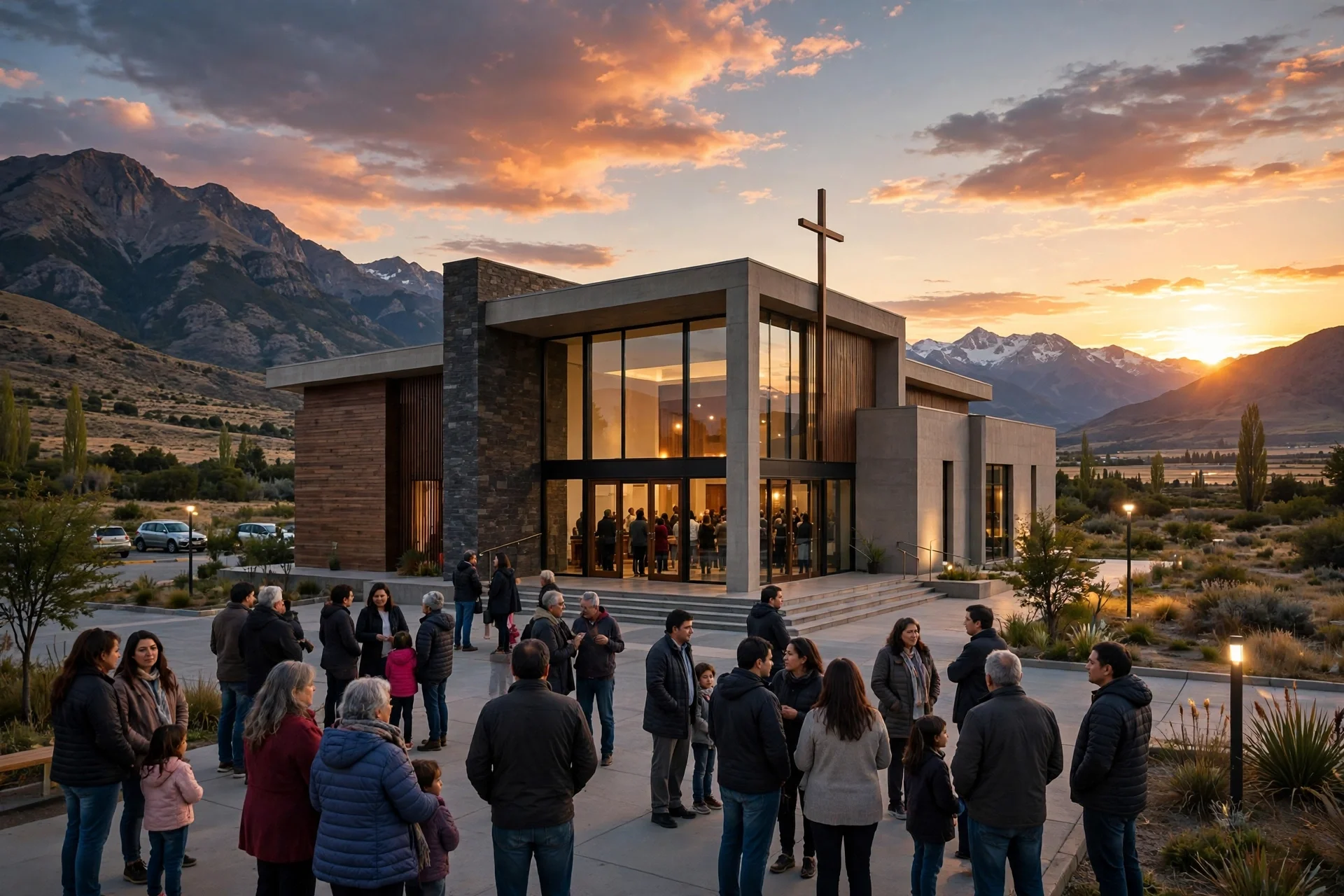
Templo evangélico moderno al atardecer en un paisaje patagónico, con miembros de la congregación reunidos en el exterior. · EPM
Milei opened a church in Neuquén and rejected fighting populism with populism
Javier Milei opened an evangelical temple in Neuquén with room for 4,000 people, financed by its congregation, and said he will not fight populism with more…
Milei defended fiscal balance at a church opening in Neuquén
Javier Milei opened an evangelical temple for 4,000 people in Neuquén, financed by its congregation, and presented it as a model of a free society.
--- The context ---
President Javier Milei traveled to Neuquén on Saturday to open the new temple of an evangelical church and turned the religious ceremony into a political statement ahead of an eventual second term. The event coincided with the National Day of Evangelical and Protestant Churches and gathered figures from his political space, in a province where his movement plans a governorship challenge in 2027.
--- The facts ---
Milei took part in the opening of the new auditorium of the Jesús es Rey Baptist Church, led by pastor Hugo Márquez. The venue, financed with contributions from the congregation, holds 4,000 people and was presented by Milei as the largest in Patagonia. The same congregation runs a school with 1,700 students and a clinic with 30 specialties, as the president highlighted in his speech.
In his remarks, Milei said his government has already kept its promises and that he does not believe in easy solutions or in fighting populism with more populism. He also said his administration is building an edifice designed to last for decades and laying the foundations for Argentina's golden century, in a speech full of religious references and Judeo-Christian appeals.
--- The positions ---
Milei described his government as morality turned into state policy, based on the rights to life, liberty and property, and placed fiscal balance as an obligation toward future generations and toward the sectors hit by inflation. He argued that it is unfair for the state to spend more than it collects and to pass the bill through debt or inflation, and he blamed populist governments for issuing money to meet impossible promises. He also linked that path to the 70% of children in poverty and the 200% annual inflation that, in his account, the country inherited.
--- What remains unknown ---
There are no independent measurements yet of the impact the economic program will have on the social indicators the president himself cited, nor concrete definitions of how the works and services that communities like the one in Neuquén sustain without state intervention will be financed in the future.
--- Unanswered questions ---
How will morality as state policy translate into verifiable improvements for the 70% of children in poverty that the president mentioned? What role will faith communities play in the electoral strategy toward 2027 in Neuquén? Will fiscal balance alone be enough to reverse the social deterioration the president described in his speech?
--- EPM analysis ---
The event combined three layers: the celebration of a work financed by a congregation, the reaffirmation of an economic program and an electoral signal in a key province. The open tension is clear: the president praised the solidarity of a community that helps every day, while his diagnosis blames state spending for the poverty those communities try to contain with their own schools and clinics.
📌 EPM Take: In EPM's view, the Neuquén opening shows a president who seeks to sustain his program with a moral and religious narrative rather than with new economic announcements, and who holds up organized society as the example of what he expects from the country. That bet has a flip side that the speech itself exposed: if 70% of children in poverty and 200% annual inflation are the inheritance he denounces, the yardstick for judging his government will be how much of that damage it manages to repair with measurable facts and not only with convictions.
--- The context ---
President Javier Milei opened the new temple of an evangelical church in Neuquén on Saturday and presented the work as an example of the country he wants to build: a community that creates solid institutions without waiting for state intervention. The ceremony coincided with the National Day of Evangelical and Protestant Churches and was attended by figures from La Libertad Avanza.
--- The facts ---
Milei took part in the opening of the new auditorium of the Jesús es Rey Baptist Church, led by pastor Hugo Márquez. The venue, financed with contributions from the congregation, holds 4,000 people and was presented by Milei as the largest in Patagonia. The congregation also runs a school with 1,700 students and a clinic with 30 specialties, works the president highlighted as the expression of a society that organizes itself.
During his speech, Milei said his government has already kept its promises and that what it offers for a second term is clear: he does not believe in easy solutions or in fighting populism with more populism. He said his administration is building an edifice designed to last for decades and laying the foundations for Argentina's golden century, backed by Judeo-Christian values.
--- The positions ---
The president repeated that his government applies morality as state policy, based on the rights to life, liberty and property, and argued that the state must not consume more resources than it collects. In his view, spending above revenue passes the bill to the next generations through debt or to the most vulnerable through inflation. He contrasted that conduct with populist governments, which he accused of issuing money to sustain impossible promises, and recalled that this path led the country to 70% of children in poverty and 200% annual inflation.
--- What remains unknown ---
It remains to be seen how the strategy of La Libertad Avanza will advance in Neuquén, where senator Nadia Márquez, the daughter of the host pastor, appears in the movement's plans to contest the governorship in 2027 against provincial governor Rolando Figueroa, who had also been invited to the ceremony.
--- Unanswered questions ---
Will the government be able to sustain fiscal balance as a permanent rule and not as the slogan of a single term? Will the model of community institutions that Milei showcased in Neuquén be replicated in other provinces? How will the contest for the Neuquén governorship in 2027 be organized between the libertarian movement and the provincial government?
--- EPM analysis ---
The choice of setting was no accident: a temple raised with private contributions, a school and a clinic sustained by a congregation sum up, in the president's logic, the difference between building on rock and promising on sand. Milei closed his remarks with that biblical parable and defined the Argentina he seeks as a country founded on justice, responsibility and effort.
📌 EPM Take: In EPM's view, the Neuquén message sets the course for the ruling movement: fiscal order, respect for property and communities that build without depending on the state as pillars of a project designed to last for decades. The comparison with the house founded on rock sums up that ambition of permanence against the short-term promises the president attributes to populism. The challenge will be to sustain that discipline when the 2027 electoral debate begins to press for immediate answers in every province of the country in the months ahead and beyond.
Milei inauguró un templo en Neuquén y rechazó combatir el populismo con populismo
Javier Milei inauguró en Neuquén un templo evangélico con capacidad para 4.000 personas, financiado por su congregación, y afirmó que no combatirá el populismo…
Milei defendió el equilibrio fiscal al inaugurar un templo en Neuquén
Javier Milei inauguró en Neuquén un templo evangélico para 4.000 personas, financiado por su congregación, y lo presentó como modelo de sociedad libre.
--- El contexto ---
El presidente Javier Milei viajó este sábado a Neuquén para inaugurar el nuevo templo de una iglesia evangélica y convirtió la ceremonia en una definición política de cara a un eventual segundo mandato. El acto coincidió con el Día Nacional de las Iglesias Evangélicas y Protestantes y reunió a referentes oficialistas, en plena proyección electoral hacia 2027.
--- Los hechos ---
El mandatario participó de la apertura del nuevo auditorio del templo de la Iglesia Bautista Jesús es Rey, conducida por el pastor Hugo Márquez. El espacio, financiado con aportes de la congregación, tiene capacidad para 4.000 personas y fue presentado por Milei como el mayor de la Patagonia. La misma congregación sostiene una escuela con 1.700 alumnos y una clínica con 30 especialidades, según destacó el presidente en su discurso.
En su intervención, Milei sostuvo que su gobierno ya cumplió sus promesas y que no cree en soluciones fáciles ni en combatir el populismo con más populismo. Afirmó que su administración construye un edificio pensado para durar décadas y que está sentando las bases para el siglo de oro de la Argentina, con referencias religiosas y apelación a los valores judeocristianos.
--- Las posiciones ---
Milei definió su gestión como moral convertida en política de Estado, basada en los derechos a la vida, la libertad y la propiedad, y ubicó al equilibrio fiscal como una obligación con las generaciones futuras y con los sectores afectados por la inflación. Sostuvo que no es justo que el Estado gaste más de lo que recauda y traslade la factura con deuda o con inflación, y atribuyó a los gobiernos populistas la emisión de dinero para cumplir promesas imposibles. Vinculó ese camino con el 70% de niños pobres y la inflación del 200% anual que, según su exposición, heredó el país.
--- Lo que falta saber ---
No hay mediciones independientes del impacto que el programa económico tendrá en los indicadores sociales que el propio presidente citó, ni definiciones sobre cómo se financiarán las obras y los servicios que hoy sostienen comunidades como la neuquina sin intervención estatal.
--- Preguntas sin respuesta ---
¿Cómo se traducirá la moral como política de Estado en mejoras verificables para el 70% de niños pobres que el presidente mencionó? ¿Qué lugar ocuparán las comunidades de fe en la estrategia electoral hacia 2027 en Neuquén? ¿Alcanzará el equilibrio fiscal, por sí solo, para revertir el deterioro social que el mandatario describió en su discurso?
--- Análisis EPM ---
El acto combinó tres planos: la celebración de una obra de una congregación, la reafirmación de un programa económico y una señal electoral en una provincia clave. La tensión es evidente: el presidente celebró la solidaridad de una comunidad que ayuda cada día, mientras su diagnóstico atribuye al gasto estatal la pobreza que esas comunidades intentan contener con escuelas y clínicas.
📌 Conclusion EPM: A juicio de EPM, la inauguración en Neuquén muestra a un presidente que busca sostener su programa con un relato moral y religioso antes que con nuevos anuncios económicos, y que traslada a la sociedad organizada el ejemplo de lo que espera del país. Esa apuesta tiene una contracara que el propio discurso dejó expuesta: si el 70% de niños pobres y la inflación del 200% anual son la herencia que denuncia, la vara para juzgar su gestión será cuánto de ese daño logra reparar con hechos medibles y no solo con convicciones.
--- El contexto ---
El presidente Javier Milei inauguró este sábado en Neuquén el nuevo templo de una iglesia evangélica y presentó la obra como ejemplo del país que quiere construir: una comunidad que crea instituciones sin esperar la intervención del Estado. La ceremonia coincidió con el Día Nacional de las Iglesias Evangélicas y Protestantes y contó con la presencia de referentes de La Libertad Avanza.
--- Los hechos ---
El mandatario participó de la apertura del nuevo auditorio del templo de la Iglesia Bautista Jesús es Rey, conducida por el pastor Hugo Márquez. El espacio, financiado por la congregación, tiene capacidad para 4.000 personas y fue presentado como el mayor de la Patagonia. La congregación también sostiene una escuela con 1.700 alumnos y una clínica con 30 especialidades, que el presidente destacó como expresión de una sociedad que se organiza sola.
Milei afirmó que su gobierno ya cumplió sus promesas y que su oferta para un segundo mandato es clara: no cree en soluciones fáciles ni en combatir el populismo con más populismo. Sostuvo que su administración está construyendo un edificio pensado para durar décadas y sentando las bases para el siglo de oro de la Argentina, con apoyo en los valores judeocristianos.
--- Las posiciones ---
El presidente reiteró que aplica una moral como política de Estado, basada en los derechos a la vida, la libertad y la propiedad, y planteó que el Estado no debe consumir más recursos de los que recauda. A su juicio, gastar más de lo que recauda traslada la factura a las siguientes generaciones con deuda o a los más vulnerables con inflación. Contrapuso esa conducta con la de los gobiernos populistas, a los que acusó de emitir dinero para sostener promesas imposibles, y recordó que ese camino llevó al país a un 70% de niños pobres y una inflación del 200% anual.
--- Lo que falta saber ---
Resta conocer cómo avanzará la estrategia de La Libertad Avanza en Neuquén, donde la senadora Nadia Márquez, hija del pastor anfitrión, aparece en los planes para disputar la gobernación en 2027 frente al mandatario Rolando Figueroa, también invitado a la ceremonia.
--- Preguntas sin respuesta ---
¿Podrá el oficialismo sostener el equilibrio fiscal como regla permanente y no como consigna de un solo mandato? ¿Se replicará en otras provincias el modelo de instituciones comunitarias que Milei exhibió en Neuquén? ¿Cómo se ordenará la disputa por la gobernación neuquina en 2027 entre el espacio libertario y el gobierno provincial?
--- Análisis EPM ---
La elección no fue casual: un templo levantado con aportes propios, una escuela y una clínica sostenidas por una congregación resumen la diferencia entre construir sobre roca y prometer sobre arena. Milei cerró con esa parábola bíblica y definió la Argentina que busca: un país fundado sobre la justicia, la responsabilidad y el esfuerzo.
📌 Conclusion EPM: A juicio de EPM, el mensaje de Neuquén ordena el rumbo del oficialismo: orden fiscal, respeto por la propiedad y comunidades que construyen sin depender del Estado como pilares de un proyecto pensado para durar décadas. La comparación con la casa fundada sobre la roca resume esa ambición de permanencia frente a las promesas de corto plazo que el presidente atribuye al populismo. El desafío será sostener esa disciplina cuando la discusión electoral de 2027 empiece a presionar por respuestas inmediatas en cada provincia del país y en la conversación pública nacional que se viene.