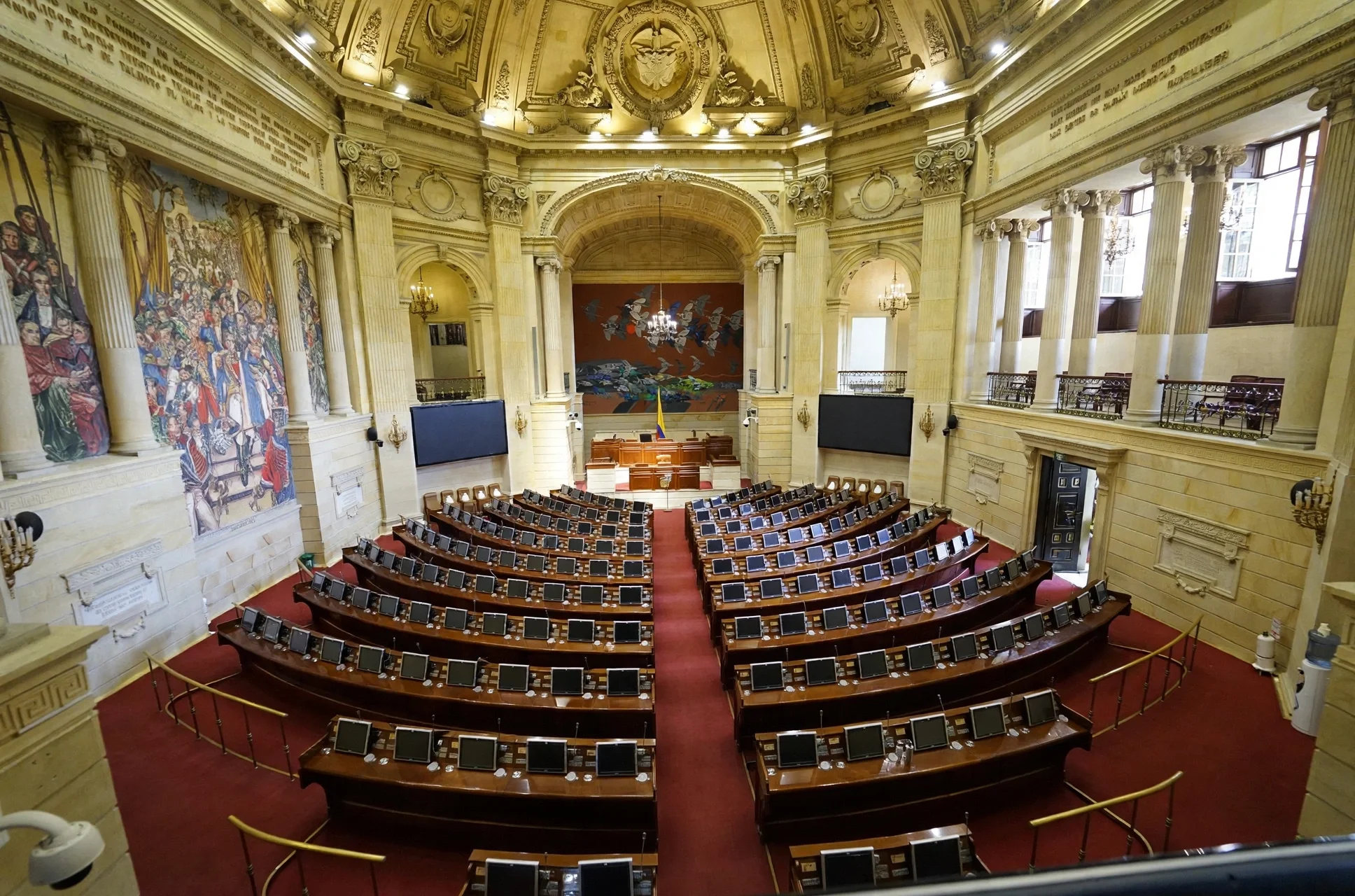
El Congreso de la República, donde se tramita la Ley de Rescate Económico defendida por el Gobierno. · Imagen generada por EPM
Colombia Faces Default Next Year Without Rescue Law, Ministers Warn
Vice President José Manuel Restrepo and Finance Minister Miguel Gómez Martínez defended the Economic Rescue Law of President Abelardo De La Espriella's…
Rescue Law Is Colombia's Path to Avoid Default Next Year, Government Says
Vice President José Manuel Restrepo and Finance Minister Miguel Gómez Martínez warned that Colombia would enter default next year if the Economic Rescue Law…
--- The context ---
The government of President Abelardo De La Espriella is defending its Economic Rescue Law in Congress, a bill designed to repair public finances while easing the burden on Colombia's most vulnerable households. In an interview, Vice President José Manuel Restrepo and Finance Minister Miguel Gómez Martínez explained that the initiative combines VAT refunds, cuts to state spending and a larger contribution from those with the most resources. Both officials said the country faces an unprecedented fiscal situation and that the legislative debate in the coming weeks will be decisive for Colombia's economic course.
According to both officials, the administration they lead found a landscape they described as the most complex problem any government could face. Restrepo said there were not enough resources to pay public employees' salaries, pensions, health care, defense or even the interest on the public debt. He also noted that the economy grew only 1.6 percent under the previous government and that 90 percent of Colombians lacked full access to medicines, amid problems paying medical staff.
--- The facts ---
Restrepo warned that if the rescue law does not move forward by the end of 2026, Colombia would enter default next year, struggling to pay public employees' salaries and to finance the programs the country needs. Gómez Martínez said the law must be approved before the end of the year and that, without the adjustment, the country would have difficulty financing the national budget and paying payrolls next year. Both defended a normal legislative process aimed at national consensus, while acknowledging that an urgency message could be sent later if time runs short during the debate in Congress.
The social heart of the bill is the VAT refund. Restrepo explained that 19 million Colombians will have that tax returned in full and that another 16.5 million will receive up to 50 percent of the VAT back. In total, 36.5 million people would benefit, which he described as two out of every three Colombians. Gómez Martínez specified that the refund starts in January 2028, leaving a year to prepare, with technological support for shopkeepers and businesses that do not yet issue electronic invoices and monthly phone notifications telling each beneficiary when the money has been deposited.
--- The positions ---
Restrepo said the government's priority has to be social and that it is not fair for the most vulnerable to pay VAT on a range of products. He explained that 70 percent of the adjustment will come from reducing bureaucracy, waste and unproductive state assets, while the remaining 30 percent will be contributed by the 10 percent of the population with the most resources. In his account, those who are most vulnerable will receive and those with higher incomes will contribute, with the state itself setting the example first.
Gómez Martínez also defended order in the public accounts. He explained that the bill proposes cutting service-provision orders by 50 percent, reviewing the state's 260 transfer lines and increasing oversight of more than 50 funds that handle large sums with insufficient control. He also proposed selling unproductive assets that currently generate costs, limiting the growth of state purchases to inflation and keeping health contributions progressive: the 4 percent rate stays for workers earning up to two minimum wages and rises gradually to 8 percent for the highest salaries.
--- What remains unknown ---
The outcome of the process in Congress is still unknown, as is whether the government will send the urgency message both officials left on the table. It is also unclear how the refund will be guaranteed for people who shop at establishments that do not issue electronic invoices, although Gómez Martínez anticipated a minimum refund amount for those cases, along with the use of digital payment methods and postal transfers.
--- Unanswered questions ---
Will Congress approve the Economic Rescue Law before the end of 2026, as the vice president and the finance minister are asking? Will the VAT refund actually reach the announced 36.5 million beneficiaries when it begins in January 2028? Will the cut in state spending deliver the 70 percent of the adjustment without affecting the services citizens receive? And what would happen to the country's finances if the process extends beyond the end of this year?
--- EPM analysis ---
The government's proposal combines two messages that usually travel separately: social protection for the majority and discipline in the public accounts. Refunding VAT to 36.5 million people turns the adjustment into a policy with visible beneficiaries, while cutting bureaucracy and unproductive assets seeks to ensure that the first effort comes from the state rather than from households. Congress now has the floor in a discussion that will define the government's fiscal room to govern.
📌 EPM Take:
In EPM's view, the Economic Rescue Law deserves to be debated on its concrete effects rather than on slogans: refunding VAT in full to 19 million people and up to half to another 16.5 million would directly relieve the most vulnerable households, while the adjustment falls first on state spending and on those who have the most. The warning of a default next year, issued by the vice president and the finance minister, obliges Congress to decide quickly and with the numbers on the table, because postponing the decision also carries a cost for the entire country and its future.
--- The context ---
Colombia faces a fundamental fiscal decision. The government of President Abelardo De La Espriella has filed the Economic Rescue Law, and its two economic spokesmen, Vice President José Manuel Restrepo and Finance Minister Miguel Gómez Martínez, defended it in an interview with a severe diagnosis: without adjustment, the country will not be able to finance its budget next year. The officials described an unprecedented fiscal situation, with insufficient resources even for basic obligations, and argued that the adjustment must begin with the state itself, reducing bureaucracy, waste and unproductive assets.
The starting point, as they told it, is an inherited imbalance. Restrepo said that on arrival they found there were not enough resources to pay public employees' salaries, pensions, health care, defense or even the interest on the public debt. He added that in four years the previous government overindebted the country and multiplied by four the difference between monthly income and spending, a comparison he illustrated as living off the credit card until nobody wants to lend anymore.
--- The facts ---
The central warning is about the calendar. Restrepo warned that if the rescue law does not move forward by the end of 2026, Colombia would enter default next year, which would mean difficulties paying public employees' salaries and financing the programs the country needs. Gómez Martínez said the law must be approved before the end of the year and that, otherwise, the country would face a serious economic crisis, with problems financing the national budget and paying payrolls. If time runs short, he acknowledged, the government could send an urgency message to speed up the process.
To avoid that scenario, the bill distributes the effort under a clear rule that both officials repeated: 70 percent of the adjustment will come from the state and the remaining 30 percent from the 10 percent of the population with the most resources. On the spending side, Gómez Martínez explained that the proposal cuts service-provision orders by 50 percent, a hiring method where he pointed to politicking and corruption, limits the growth of state purchases to inflation and sells unproductive assets. He also announced a review of the 260 state transfer lines and of more than 50 funds handling large sums with little oversight.
--- The positions ---
On taxation, the proposal seeks a fairer structure without punishing investment. Restrepo explained that the base of taxpayers is widened with minimal charges, starting above five million pesos a month with a modest monthly payment, while the corporate income tax rate falls from 35 percent to 31 percent for 90 percent of the business fabric, namely micro and small companies, entrepreneurs and independent workers. The financial sector's surcharge would remain until 2030, and the wealth tax is kept because it levies those with the greatest resources, according to the officials' explanation of the bill.
The social component of the adjustment is the VAT refund. Restrepo explained that 19 million Colombians will receive the full refund and another 16.5 million up to 50 percent, for a total of 36.5 million beneficiaries. Gómez Martínez specified that the refund begins in January 2028, with a year of technological preparation for shopkeepers and businesses, and that every month beneficiaries will receive a phone notification of the money deposited. On health, contributions stay at 4 percent up to two minimum wages and rise gradually to 8 percent for the highest salaries, because the system needs more resources.
--- What remains unknown ---
It remains to be seen whether Congress will process the bill within the timeframe the government considers indispensable and whether the urgency message will prove necessary. Also unknown is how sectors warning of possible effects on employment and consumption will respond; against those concerns, the officials asked that the greater cost of not approving the reform be weighed, which they listed as more poverty, recession, inflation and default risk for the country as a whole.
--- Unanswered questions ---
Will Congress approve the Economic Rescue Law before the end of 2026, as the government's calendar demands? Will the cut in service-provision orders and bureaucratic spending be enough to deliver the 70 percent of the adjustment that the state must contribute? Will lowering the corporate income tax from 35 percent to 31 percent translate into more investment and employment, as the officials project? And what room will the country have to finance its budget for next year if the process drags on?
--- EPM analysis ---
The design defended by Restrepo and Gómez Martínez reverses the usual sequence of adjustments: first the state tightens its own belt, with fewer contractors, contained purchases and sales of idle assets, and only then is the contribution of the top 10 percent requested. The signal the law seeks to send is that Colombia corrects its course without halting investment, lowering the burden on small businesses while protecting vulnerable households through the VAT refund mechanism.
📌 EPM Take:
In EPM's view, the fiscal responsibility raised by the Economic Rescue Law is the right discussion at the right time: a country which, according to its two economic spokesmen, cannot guarantee even public salaries or debt interest cannot afford to postpone the adjustment. The fact that 70 percent of the effort comes from the state itself, and that income tax falls for 90 percent of the business fabric, distinguishes this proposal from a simple tax increase. Approving it before the end of 2026, as the vice president and the minister are asking, is the path the government offers to avoid a default next year.
Colombia ante el default: el Gobierno defiende su Ley de Rescate Económico
El vicepresidente José Manuel Restrepo y el ministro de Hacienda, Miguel Gómez Martínez, defendieron la Ley de Rescate Económico del Gobierno de Abelardo De La…
Sin la Ley de Rescate, Colombia entraría en default el próximo año, advierte Hacienda
El vicepresidente José Manuel Restrepo y el ministro de Hacienda, Miguel Gómez Martínez, advirtieron que Colombia entraría en default el próximo año si la Ley…
--- El contexto ---
El Gobierno del presidente Abelardo De La Espriella defiende en el Congreso la Ley de Rescate Económico, el proyecto con el que busca corregir las finanzas públicas y aliviar el bolsillo de los colombianos más vulnerables. En una entrevista, el vicepresidente José Manuel Restrepo y el ministro de Hacienda, Miguel Gómez Martínez, explicaron que la iniciativa combina la devolución del IVA, el recorte del gasto estatal y una contribución mayor de quienes más recursos tienen. Ambos funcionarios sostuvieron que el país enfrenta una situación fiscal sin precedentes.
Según relataron los dos funcionarios, al llegar al Gobierno encontraron un panorama que describieron como el problema más complejo que pudiera enfrentar una administración. Restrepo afirmó que no había recursos suficientes para pagar salarios de funcionarios públicos, pensiones, salud, defensa ni siquiera los intereses de la deuda pública. También señaló que la economía apenas creció 1,6 % durante el gobierno anterior y que el 90 % de los colombianos no tenía acceso completo a medicamentos, en medio de problemas de pago al personal médico.
--- Los hechos ---
Restrepo advirtió que, si de aquí al cierre de 2026 no se avanza en la ley de rescate, Colombia entraría en default el próximo año, con dificultades para pagar los salarios de los funcionarios públicos y financiar los programas que necesita el país. Gómez Martínez sostuvo, por su parte, que la ley debe aprobarse antes de finalizar el año y que, si no se hace el ajuste, el año próximo habrá dificultades para financiar el presupuesto general de la Nación y para pagar las nóminas.
El corazón social del proyecto es la devolución del IVA. Restrepo explicó que a 19 millones de colombianos se les devolverá ese impuesto, lo que para algunos significaría cerca de 220.000 pesos mensuales, y que a otros 16,5 millones se les devolverá hasta el 50 % del IVA. En total, 36,5 millones de personas recibirían el beneficio. Gómez Martínez precisó que la devolución empezará en enero de 2028 y que habrá un año de preparación, con apoyo tecnológico a tenderos y negocios que aún no usan factura electrónica y notificaciones mensuales en el celular de cada beneficiario.
--- Las posiciones ---
Restrepo sostuvo que la prioridad del Gobierno tiene que ser lo social y que no es justo que los más vulnerables paguen IVA por una cantidad de productos. Calificó la ampliación de beneficiarios como lo más progresivo de la historia reciente del país y como un compromiso social gigantesco. También explicó que el 70 % del ajuste provendrá de reducir la burocracia, el derroche y los activos improductivos del Estado, mientras el 30 % restante lo aportará el 10 % de la población con más recursos.
Gómez Martínez defendió además el componente de orden en las cuentas. Explicó que el proyecto propone reducir el 50 % de las órdenes de prestación de servicios, revisar las 260 partidas de transferencias del Estado y vigilar más de 50 fondos que manejan billones de pesos sin suficiente control. También planteó vender activos improductivos que hoy generan costos, limitar el aumento de las compras estatales a la inflación y mantener aportes de salud progresivos: hasta dos salarios mínimos se mantiene la tarifa del 4 % y después sube gradualmente hasta el 8 % para los salarios más altos.
--- Lo que falta saber ---
Todavía no se conoce el resultado del trámite en el Congreso ni si el Gobierno enviará el mensaje de urgencia que ambos funcionarios dejaron sobre la mesa. Tampoco está definido cómo se garantizará que la devolución llegue a quienes compran en establecimientos que no expiden factura electrónica, aunque Gómez Martínez anticipó un tope mínimo de devolución para esos casos y el uso de medios de pago digitales y giros postales.
--- Preguntas sin respuesta ---
¿Logrará el Congreso aprobar la Ley de Rescate Económico antes de que termine 2026, como piden el vicepresidente y el ministro de Hacienda? ¿La devolución del IVA alcanzará en la práctica a los 36,5 millones de beneficiarios anunciados cuando empiece en enero de 2028? ¿El recorte del gasto estatal entregará el 70 % del ajuste sin afectar los servicios que reciben los ciudadanos? ¿Qué pasará con las finanzas del país si el trámite se extiende más allá del cierre de este año?
--- Análisis EPM ---
La apuesta del Gobierno combina dos mensajes que suelen ir por separado: protección social para la mayoría y disciplina en las cuentas públicas. La devolución del IVA a 36,5 millones de personas convierte el ajuste en una política con beneficiarios visibles, mientras el recorte de burocracia y activos improductivos busca que el primer esfuerzo lo haga el Estado y no los hogares. El Congreso tiene ahora la palabra en una discusión que definirá el margen fiscal del Gobierno.
📌 Conclusion EPM:
A juicio de EPM, la Ley de Rescate Económico merece discutirse desde sus efectos concretos y no desde consignas: devolver el IVA a 19 millones de personas por completo y hasta la mitad a otros 16,5 millones aliviaría de forma directa a los hogares más vulnerables, mientras el ajuste recae primero sobre el gasto del Estado y sobre quienes más tienen. La advertencia de default el próximo año, hecha por el vicepresidente y el ministro de Hacienda, obliga al Congreso a decidir con rapidez y con los números sobre la mesa, porque postergar la decisión también tiene un costo para el país entero.
--- El contexto ---
Colombia enfrenta una decisión fiscal de fondo. El Gobierno del presidente Abelardo De La Espriella radicó la Ley de Rescate Económico y sus dos voceros económicos, el vicepresidente José Manuel Restrepo y el ministro de Hacienda, Miguel Gómez Martínez, la defendieron en una entrevista con un diagnóstico severo: sin ajuste, el país no podrá financiar su presupuesto el próximo año. Los funcionarios describieron una situación fiscal sin precedentes, con recursos insuficientes incluso para obligaciones básicas, y plantearon que el ajuste debe hacerlo primero el Estado, reduciendo burocracia, derroche y activos improductivos.
El punto de partida, según relataron, es una herencia de desequilibrio. Restrepo afirmó que al llegar encontraron que no había recursos suficientes para pagar salarios de funcionarios públicos, pensiones, salud, defensa ni siquiera los intereses de la deuda pública. Añadió que en cuatro años el gobierno anterior sobreendeudó al país y multiplicó por cuatro la diferencia entre ingresos y gastos mensuales, una comparación que ilustró como vivir de la tarjeta de crédito hasta que nadie quiere prestar.
--- Los hechos ---
La advertencia central es de calendario. Restrepo advirtió que, si de aquí al cierre de 2026 no se avanza en la ley de rescate, Colombia entraría en default el próximo año, lo que significaría dificultades para pagar los salarios de los funcionarios públicos y financiar los programas que el país necesita. Gómez Martínez sostuvo que la ley debe aprobarse antes de finalizar el año y que, de lo contrario, el país enfrentaría una grave crisis económica, con problemas para financiar el presupuesto general de la Nación y pagar las nóminas.
Para evitar ese escenario, el proyecto reparte el esfuerzo con una regla clara que ambos funcionarios repitieron: el 70 % del ajuste provendrá del Estado y el 30 % restante del 10 % de la población con más recursos. Del lado del gasto, Gómez Martínez explicó que se propone reducir el 50 % de las órdenes de prestación de servicios, una modalidad donde señaló politiquería y corrupción, limitar el aumento de las compras estatales a la inflación y vender activos improductivos. También anunció la revisión de las 260 partidas de transferencias y de más de 50 fondos con billones de pesos y poca vigilancia.
--- Las posiciones ---
En materia tributaria, la propuesta busca una estructura más equitativa sin castigar la inversión. Restrepo explicó que se amplía la base de contribuyentes con cargas mínimas, empezando por encima de los 5 millones de pesos mensuales con un pago del orden de 15.000 pesos, y que al mismo tiempo la renta de las empresas baja del 35 % al 31 % para el 90 % del tejido empresarial, que son las micro y pequeñas empresas, los emprendedores y los independientes. La sobretasa del sector financiero se mantendría hasta 2030 y el impuesto al patrimonio se conserva porque grava a quienes tienen mayores recursos.
El componente social del ajuste es la devolución del IVA. Restrepo explicó que 19 millones de colombianos recibirán la devolución completa y otros 16,5 millones hasta el 50 %, para un total de 36,5 millones de beneficiados. Gómez Martínez precisó que la devolución empieza en enero de 2028, con un año de preparación tecnológica para tenderos y negocios, y que cada mes los beneficiarios recibirán en su celular la notificación del dinero consignado. En salud, los aportes se mantienen en el 4 % hasta dos salarios mínimos y suben gradualmente hasta el 8 % para los salarios más altos.
--- Lo que falta saber ---
Queda por verse si el Congreso tramitará el proyecto en los tiempos que el Gobierno considera indispensables y si hará falta el mensaje de urgencia. Falta saber, además, cómo responderán los sectores que advierten posibles efectos sobre el empleo y el consumo, preocupaciones frente a las cuales los funcionarios pidieron ponderar el costo mayor de no aprobar la reforma: más pobreza, recesión, inflación y riesgo de default, según su propia enumeración.
--- Preguntas sin respuesta ---
¿Aprobará el Congreso la Ley de Rescate Económico antes del cierre de 2026, como exige el calendario que plantea el Gobierno? ¿El recorte de órdenes de prestación de servicios y de gasto burocrático alcanzará para entregar el 70 % del ajuste que debe poner el Estado? ¿La rebaja de la renta empresarial del 35 % al 31 % se traducirá en más inversión y empleo, como proyectan los funcionarios? ¿Y qué margen tendrá el país para financiar su presupuesto del próximo año si el trámite se prolonga?
--- Análisis EPM ---
El diseño que defienden Restrepo y Gómez Martínez invierte la secuencia habitual de los ajustes: primero se aprieta el Estado, con menos contratistas, compras contenidas y venta de activos ociosos, y solo después se pide la contribución del 10 % con más recursos. La señal que busca enviar la ley es que Colombia corrige el rumbo sin frenar la inversión, bajando la carga a las pequeñas empresas mientras protege a los hogares vulnerables con la devolución del IVA.
📌 Conclusion EPM:
A juicio de EPM, la responsabilidad fiscal que plantea la Ley de Rescate Económico es la discusión correcta en el momento correcto: un país que, según sus dos voceros económicos, no tiene garantizados ni los salarios públicos ni los intereses de la deuda no puede darse el lujo de postergar el ajuste. Que el 70 % del esfuerzo provenga del propio Estado y que la renta baje para el 90 % del tejido empresarial distingue esta propuesta de un simple aumento de impuestos. Aprobarla antes de que termine 2026, como piden el vicepresidente y el ministro, es la vía que el Gobierno ofrece para evitar el default el próximo año.