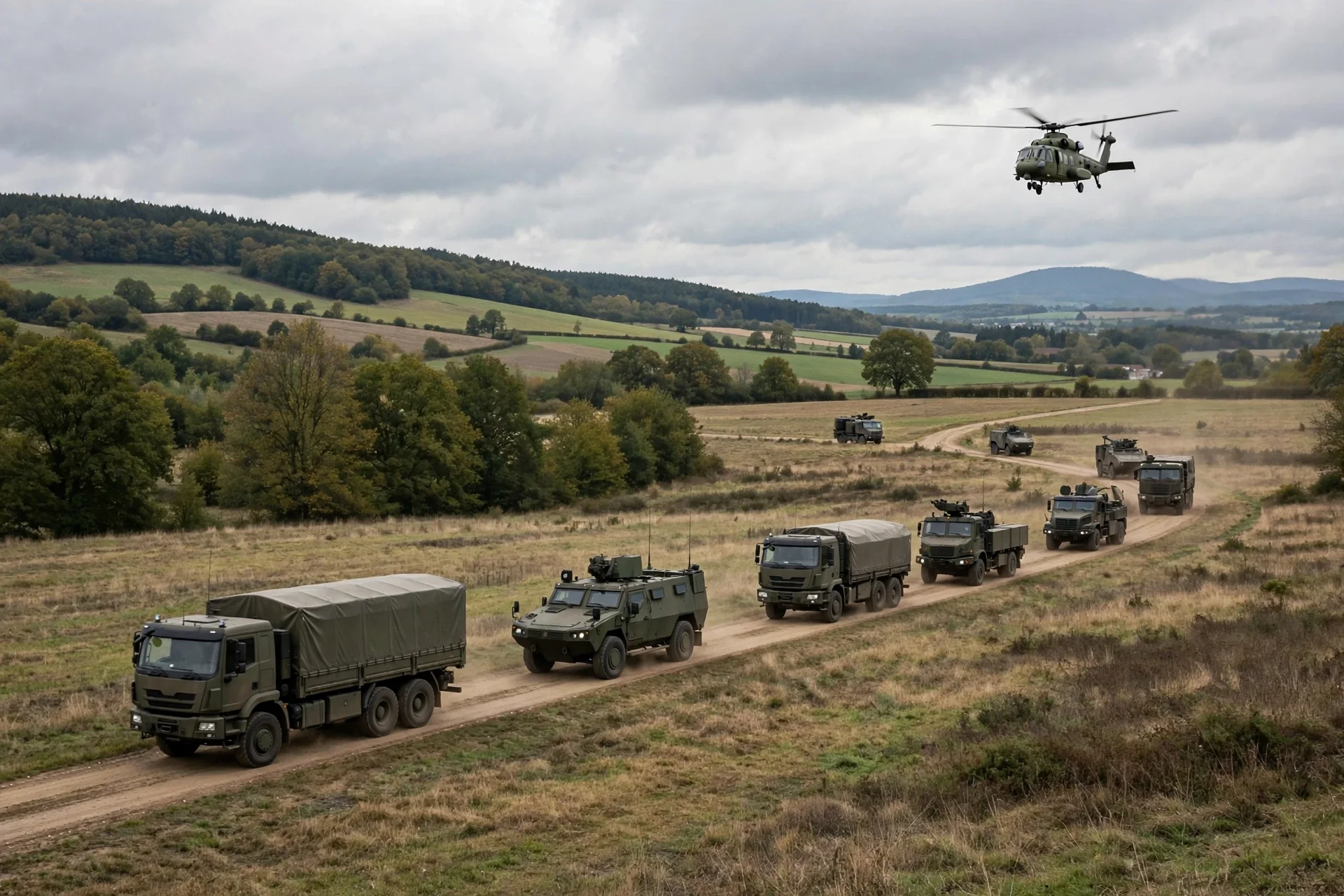
Ilustración alusiva al Exercise Koalicja en Polonia: tropas de 11 naciones ensayan cómo apoyar a Ucrania cuando termine el conflicto. · Imagen generada por EPM
UK and France Lead Polish Exercise to Prepare for Peace in Ukraine
The UK and France will jointly lead Exercise Koalicja in Poland, with 2,800 troops from 11 nations and 300 UK personnel.
Eleven Nations Rehearse in Poland How to Underpin Ukraine's Security
Exercise Koalicja will bring 2,800 troops from 11 nations to Poland under joint UK and French leadership, including 300 UK personnel.
--- The context ---
The United Kingdom and France will jointly lead thousands of troops from 11 nations in Exercise Koalicja in Poland. It is the first major exercise of the Multinational Force Ukraine, the MNF-U, the military arm of the Coalition of the Willing, whose nations have pledged strengthened military, economic and diplomatic support to Ukraine.
--- The facts ---
The exercise runs from 9 November to 22 November and will test allied readiness to support Ukraine and rebuild its Armed Forces once the conflict ends. It will test how to move, protect and supply a force, alongside command and control, the movement of personnel, equipment and supplies, and how the components integrate as one multinational force.
Some 300 UK personnel are among the 2,800 troops taking part on land, in the air and at sea. Soldiers from the British Army's 7 Brigade, the Desert Rats, will rehearse crucial logistical movements, while RAF Typhoons and a Voyager refuelling aircraft will fly sorties overhead. The jets will simulate how they would reassure commercial air travel once Ukraine's skies reopen after the fighting ends.
--- The positions ---
Defence Secretary Wes Streeting said, in remarks reported in the announcement, that the exercise shows the UK stepping up alongside France and its allies to prepare for the day peace comes to Ukraine. He added that this is not a hypothetical plan but a real force, ready to help Ukraine once the fighting stops, and that Ukraine's security is also the UK's security.
The MNF-U is commanded by British Lieutenant General Tom Bateman, and the UK jointly leads it with France, with the force's headquarters set to move from Paris to London this year. Bateman said the exercise will show a real, capable and readily deployable force that represents a serious commitment to Ukraine's long-term stability and security, and that the force will be more ready every day to support Ukraine when the fighting ends.
--- What remains unknown ---
In the event of peace, the MNF-U would help underpin Ukraine's future security by enabling safer skies and seas and regenerating Ukrainian forces. It would only move into Ukraine once fighting has ceased and at the request of Ukraine's government, and it would not carry out peacekeeping or ceasefire-monitoring duties. Turkish forces, meanwhile, will stand up the maritime element in Istanbul, testing maritime mine clearance so commercial shipping can safely return to Ukraine's ports.
--- Unanswered questions ---
What concrete results will the exercise produce on the force's real deployability? How will responsibilities be shared among the 11 nations when the moment to act arrives? What exact conditions will have to be met before the force moves into Ukraine?
--- EPM analysis ---
The 11 participating nations are Belgium, Estonia, France, Germany, Lithuania, the Netherlands, Poland, Spain, Sweden, Türkiye and the UK. The announcement sits within a rise in British defence spending described as the biggest sustained increase since the Cold War: 2.7% of GDP from 2027-2028 and nearly £300 billion over four years.
📌 EPM Take:
In EPM's view, the value of Exercise Koalicja is that it turns a political pledge into a rehearsed capability: moving, protecting and supplying 2,800 troops from 11 nations demands real coordination, not statements. Joint UK and French leadership, with a British commander, places London at the centre of planning for the day after the conflict. The decisive test, however, will not be the rehearsal in Poland, but whether that preparation holds together when peace demands concrete decisions.
--- The context ---
Thousands of troops from 11 nations will gather in Poland for Exercise Koalicja, under joint UK and French leadership. It will be the first major exercise of the Multinational Force Ukraine, the MNF-U, the military arm of the Coalition of the Willing, and its stated purpose is to prepare support for Ukraine for when the conflict ends.
--- The facts ---
The exercise will take place from 9 November to 22 November and will test allied readiness to support Ukraine and rebuild its Armed Forces once the fighting ends. The rehearsals will cover how to move, protect and supply a force, command and control, the movement of personnel, equipment and supplies, and how the components integrate as one multinational force.
A total of 2,800 troops will take part, including 300 UK personnel. The British Army's 7 Brigade, the Desert Rats, will rehearse crucial logistical movements. RAF Typhoons and a Voyager refuelling aircraft will fly sorties and simulate how they would reassure commercial air travel once Ukraine's skies reopen, while Turkish forces will stand up the maritime element in Istanbul, testing mine clearance arrangements so commercial shipping can safely return to Ukraine's ports.
--- The positions ---
Defence Secretary Wes Streeting said the exercise shows the UK stepping up with France and its allies for the day peace comes to Ukraine, stressing it is not a hypothetical plan but a real force, ready to help once the fighting stops. He linked the work to protecting the UK and Europe for the long term, arguing that Ukraine's security is the UK's security.
British Lieutenant General Tom Bateman commands the MNF-U, which the UK jointly leads with France and whose headquarters is set to move from Paris to London this year. Bateman said the exercise will show a real, capable and readily deployable force, and that it will be more ready every day to support Ukraine when the fighting ends, leaving Ukraine's Armed Forces in the strongest possible position to deter future aggression.
--- What remains unknown ---
If peace comes, the MNF-U would help underpin Ukraine's future security by enabling safer skies and seas and regenerating Ukrainian forces. The announcement itself sets the limits of that mission: the force would only move into Ukraine once fighting has ceased and at the request of Ukraine's government, and it would not carry out peacekeeping or ceasefire-monitoring duties, a boundary that keeps expectations clearly defined.
--- Unanswered questions ---
What level of readiness will the force actually demonstrate by the end of the exercise? Will the 11 nations sustain their commitment if peace takes time to arrive? How would the timing and the form of any move into Ukraine be decided if that moment comes?
--- EPM analysis ---
The participating nations are Belgium, Estonia, France, Germany, Lithuania, the Netherlands, Poland, Spain, Sweden, Türkiye and the UK. The exercise coincides with stronger British defence spending, the biggest sustained increase since the Cold War: up to 2.7% of GDP from 2027-2028 and nearly £300 billion over four years.
📌 EPM Take:
In EPM's view, restraint is a central part of this force's design: it rehearses support for Ukraine in depth, yet states clearly that it would act only after the fighting stops, at Kyiv's request and without peacekeeping duties. That restraint, with shared London and Paris leadership and a clear legal boundary, seeks credibility without escalation. The exercise will show whether coordination among 11 nations can sustain that balance once the rehearsal ends and real planning begins.
Reino Unido y Francia lideran en Polonia el ensayo para la paz en Ucrania
El Reino Unido y Francia liderarán conjuntamente el Exercise Koalicja en Polonia, con 2.800 tropas de 11 naciones y 300 efectivos británicos.
Once naciones ensayan en Polonia cómo sostener la seguridad de Ucrania
El Exercise Koalicja reunirá en Polonia a 2.800 tropas de 11 naciones, con liderazgo conjunto del Reino Unido y Francia y 300 efectivos británicos.
--- El contexto ---
El Reino Unido y Francia liderarán conjuntamente a miles de tropas de 11 naciones en el Exercise Koalicja, en Polonia. Es el primer ejercicio importante de la Multinational Force Ukraine, la MNF-U, brazo militar de la Coalition of the Willing, el grupo comprometido a reforzar el apoyo militar, económico y diplomático a Ucrania.
--- Los hechos ---
El ejercicio se desarrollará del 9 de noviembre al 22 de noviembre y probará la preparación aliada para apoyar a Ucrania y reconstruir sus Fuerzas Armadas cuando termine el conflicto. Pondrá a prueba cómo mover, proteger y abastecer a una fuerza, además del mando y control, el movimiento de personal, equipo y suministros y la integración de sus componentes.
Entre las 2.800 tropas que participarán en tierra, aire y mar figuran 300 efectivos del Reino Unido. Soldados de la 7 Brigade del Ejército británico, los Desert Rats, ensayarán movimientos logísticos cruciales, mientras Typhoons de la RAF y un avión Voyager de reabastecimiento volarán salidas y simularán cómo tranquilizarían el tráfico aéreo comercial cuando se reabra el cielo ucraniano.
--- Las posiciones ---
El secretario de Defensa, Wes Streeting, señaló que el ejercicio muestra que el Reino Unido se refuerza junto a Francia y sus aliados para prepararse para el día en que llegue la paz. Añadió que no es un plan hipotético, sino una fuerza real, lista para ayudar cuando cesen los combates, y que la seguridad de Ucrania es también la del Reino Unido.
La MNF-U la comanda el teniente general británico Tom Bateman; el Reino Unido la lidera con Francia y su cuartel general se trasladará de París a Londres este año. Bateman indicó que el ejercicio mostrará una fuerza real, capaz y desplegable, compromiso serio con la estabilidad de Ucrania a largo plazo, y que estará más preparada cada día para apoyarla cuando termine la lucha.
--- Lo que falta saber ---
En caso de paz, la MNF-U ayudaría a respaldar la seguridad futura de Ucrania con cielos y mares más seguros y regenerando las fuerzas ucranianas. Solo entraría cuando cesen los combates y a petición del gobierno ucraniano, sin tareas de mantenimiento de la paz ni de supervisión de un alto el fuego. Las fuerzas turcas pondrán en pie el elemento marítimo en Estambul, probando la limpieza de minas para que la navegación comercial vuelva con seguridad a los puertos ucranianos.
--- Preguntas sin respuesta ---
¿Qué resultados dejará el ejercicio sobre la capacidad real de despliegue? ¿Cómo se repartirán las responsabilidades entre las 11 naciones cuando llegue el momento de actuar? ¿Qué condiciones exactas deberán cumplirse para que la fuerza entre en Ucrania?
--- Análisis EPM ---
Las 11 naciones participantes son Bélgica, Estonia, Francia, Alemania, Lituania, Países Bajos, Polonia, España, Suecia, Türkiye y el Reino Unido. El anuncio se enmarca en un aumento del gasto británico descrito como el mayor sostenido desde la Guerra Fría: hasta el 2,7% del producto interior bruto desde 2027-2028 y casi £300 billion en cuatro años.
📌 Conclusion EPM:
A juicio de EPM, el valor del Exercise Koalicja está en que convierte una promesa política en una capacidad ensayada: mover, proteger y abastecer a 2.800 tropas de 11 naciones exige coordinación real, no declaraciones. Que lo lideren conjuntamente el Reino Unido y Francia, con mando británico, sitúa a Londres en el centro de la planificación para el día después. La prueba definitiva, sin embargo, no será el ensayo en Polonia, sino si esa preparación se mantiene unida cuando la paz exija decisiones concretas.
--- El contexto ---
Miles de tropas de 11 naciones se reunirán en Polonia para el Exercise Koalicja, liderado conjuntamente por el Reino Unido y Francia. Será el primer ejercicio de la Multinational Force Ukraine, la MNF-U, brazo militar de la Coalition of the Willing, con el fin de preparar el apoyo a Ucrania para cuando termine el conflicto.
--- Los hechos ---
El ejercicio será del 9 de noviembre al 22 de noviembre y probará la preparación aliada para apoyar a Ucrania y reconstruir sus Fuerzas Armadas cuando acabe la lucha. Los ensayos cubrirán cómo mover, proteger y abastecer a una fuerza, el mando y control, el traslado de personal, equipo y suministros y su integración como una sola fuerza.
Participarán 2.800 tropas en tierra, aire y mar, entre ellas 300 efectivos del Reino Unido. La 7 Brigade del Ejército británico, los Desert Rats, ensayará movimientos logísticos cruciales. Typhoons de la RAF y un avión Voyager de reabastecimiento volarán salidas y simularán cómo tranquilizarían el tráfico aéreo comercial cuando se reabra el cielo ucraniano, mientras las fuerzas turcas activarán en Estambul el elemento marítimo, probando la limpieza de minas para el regreso de la navegación comercial a los puertos.
--- Las posiciones ---
El secretario de Defensa, Wes Streeting, afirmó que el ejercicio muestra al Reino Unido reforzándose con Francia y los aliados para el día en que llegue la paz, y subrayó que no es un plan hipotético, sino una fuerza real, lista para ayudar cuando cesen los combates. Streeting vinculó ese trabajo con la protección del Reino Unido y de Europa a largo plazo, pues la seguridad de Ucrania es también la del Reino Unido.
El teniente general británico Tom Bateman comanda la MNF-U, liderada por el Reino Unido con Francia, con cuartel general que se trasladará de París a Londres este año. Bateman señaló que el ejercicio mostrará una fuerza real, capaz y desplegable, más preparada cada día para apoyar a Ucrania cuando termine la lucha, dejando a sus Fuerzas Armadas en la posición más fuerte posible para disuadir agresiones.
--- Lo que falta saber ---
Si llega la paz, la MNF-U ayudaría a respaldar la seguridad de Ucrania con cielos y mares más seguros y regenerando sus fuerzas. El anuncio precisa los límites: la fuerza solo entraría cuando cesen los combates y a petición del gobierno ucraniano, sin tareas de mantenimiento de la paz ni de supervisión de un alto el fuego.
--- Preguntas sin respuesta ---
¿Qué preparación demostrará la fuerza al cierre del ejercicio? ¿Mantendrán las 11 naciones su compromiso si la paz tarda? ¿Cómo se decidirá el momento de entrar en Ucrania?
--- Análisis EPM ---
Las naciones participantes son Bélgica, Estonia, Francia, Alemania, Lituania, Países Bajos, Polonia, España, Suecia, Türkiye y el Reino Unido. Coincide con un refuerzo del gasto británico, el mayor aumento sostenido desde la Guerra Fría: hasta el 2,7% del producto interior bruto desde 2027-2028 y casi £300 billion en cuatro años.
📌 Conclusion EPM:
A juicio de EPM, la prudencia es parte central del diseño de esta fuerza: ensaya a fondo el apoyo a Ucrania, pero delimita con claridad que solo actuaría tras el cese de los combates, a petición de Kiev y sin funciones de mantenimiento de la paz. Esa contención, con liderazgo compartido entre Londres y París, busca credibilidad sin escalada. El ejercicio medirá si la coordinación entre 11 naciones está a la altura de ese equilibrio cuando deje de ser un ensayo.