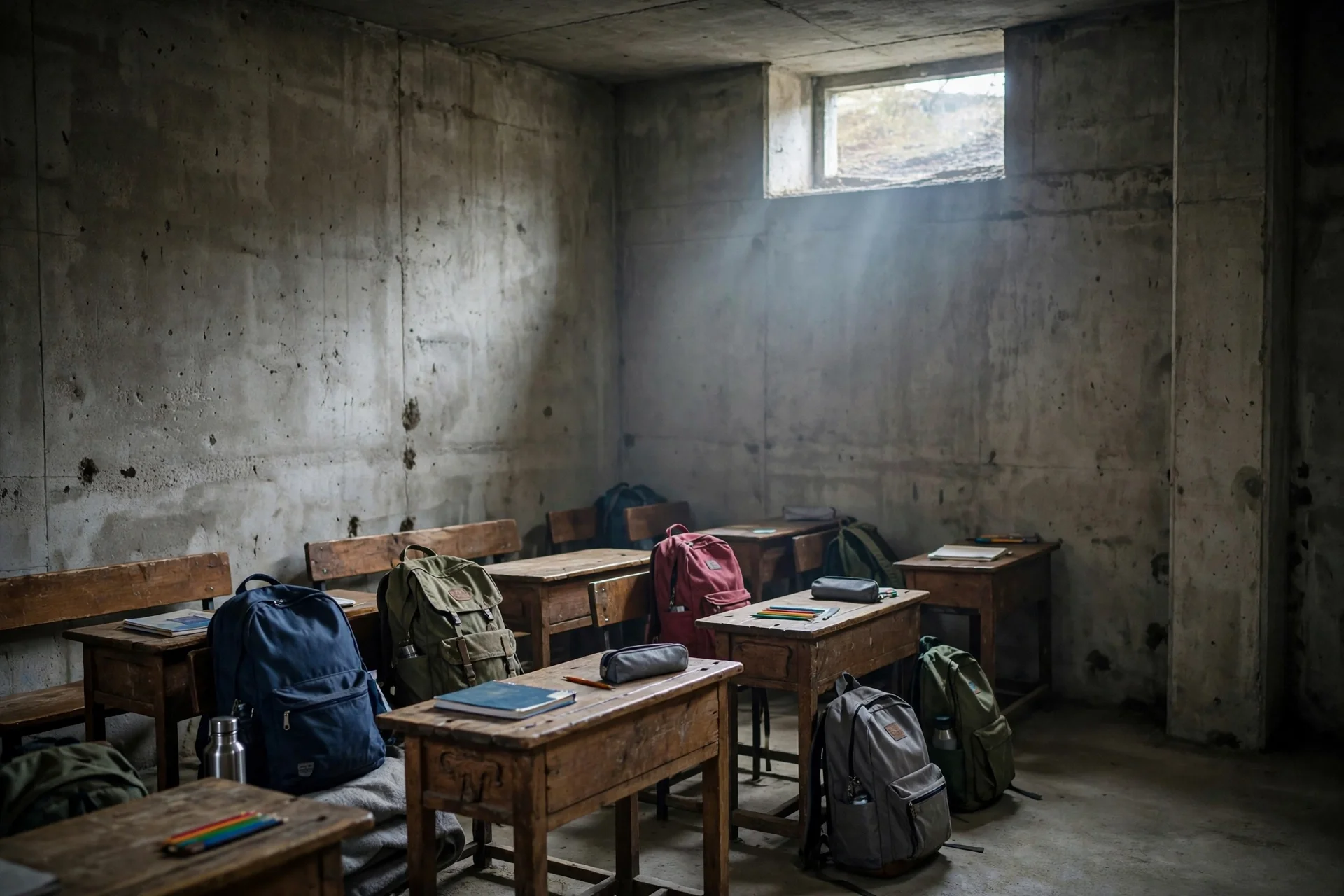
Imagen alusiva a las aulas refugio donde estudian los niños ucranianos durante las alertas aéreas. · Imagen generada para EPM
Ukraine nears 2,000 attacks on education since the 2022 invasion
UNICEF counts almost 2,000 attacks on education in Ukraine since 2022, with 270 this year, 34 average hours lost to alarms and at least 29 civilians reportedly…
Air alarms erase over 13 per cent of Ukraine's school year
Ukrainian children average 34 hours of school-time alarms this year, with almost 2,000 attacks on education since 2022 and at least 29 civilians reportedly…
--- The context ---
Education in Ukraine has unfolded since 2022 under the pressure of the war that began with Russia's full-scale invasion. Classrooms are no longer predictable spaces, and each school day depends on air raid alarms and the shelters available nearby.
United Nations agencies warn that the cost for children is cumulative. Interrupted learning is compounded by anxiety, lost routines and an emotional burden affecting pupils of all ages, in frontline regions and in cities far from the fighting.
--- The facts ---
According to UNICEF, Ukraine has sustained almost 2,000 attacks on education since 2022, some 270 this year alone. Since the school year began, children have averaged 34 hours of alarms during school time up to 20 October, more than 13 per cent of scheduled learning.
Monday's attack on a school and shelter in Komyshuvakha, in the Zaporizhzhia region, reportedly killed at least 29 civilians, with nearly 50 people still missing. Most victims were residents seeking aid and local administration employees, the humanitarian coordinator said.
--- The positions ---
UNICEF spokesperson Ricardo Pires said alarms in Kyiv rose from 12 in September 2025 to 71 in September 2026. He also shared the account of Katia, aged 15, from Mykolaiv, who said most of her school day is still spent in a shelter.
Maysa Jabout, head of Education Cannot Wait, explained that the war forces her fund to prioritise psychosocial support, diverting essential teaching resources. In Dnipropetrovsk, Kirovohrad and Kharkiv, more than 560,000 children faced over 60 hours of alarms, about a quarter of scheduled learning.
--- What remains unknown ---
The final toll in Komyshuvakha remains unknown while people are still missing, as does the full extent of school damage this year. It is also unclear how much lost learning can be recovered or what funding will sustain psychological support.
--- Unanswered questions ---
How will schools that also distribute aid be protected from further strikes? What measures can cut learning time lost to alarms without risking pupils? Will the hardest-hit regions receive enough funding for both teaching and mental health support?
--- EPM analysis ---
The figures point to structural harm rather than a temporary disruption. Every hour in a shelter protects lives but cuts learning, concentration and stability. The effect accumulates year after year and threatens the education of an entire generation without a sustained response.
📌 EPM Take: In EPM's view, protecting education in Ukraine means treating schools and school shelters as essential civilian infrastructure. The attacks, alarms and lost learning describe an emergency that requires verifiable safety, sustained funding for teachers and psychosocial support, and accountability for every strike on an educational site. Without those conditions, children will keep bearing the cost in years of schooling that replacement calendars alone cannot restore, and in opportunities that shape their entire future.
--- The context ---
Since Russia's full-scale invasion in 2022, Ukrainian schools have operated under constant threat. Whether classes continue depends on shelters, evacuation protocols and daily decisions by families and local authorities whenever air raid alarms sound across the country.
The result is fragmented schooling nationwide. The United Nations describes prolonged strain in which immediate safety competes every day with the need to keep teaching and preserve some normality for children whose routines have already been upended by war.
--- The facts ---
UNICEF counts almost 2,000 attacks on education since 2022, some 270 this year alone. Up to 20 October, children averaged 34 hours of alarms during school time, more than 13 per cent of scheduled learning, with over 60 hours in some regions.
On Monday, an attack on a school and shelter in Komyshuvakha, in Zaporizhzhia, reportedly killed at least 29 civilians, with nearly 50 missing. The humanitarian coordinator said most victims were residents who came for aid and local administration staff.
--- The positions ---
UNICEF spokesperson Ricardo Pires noted that alarms in Kyiv increased from 12 in September 2025 to 71 in September 2026. He recalled young people forced to learn underground because remaining above ground in class is not considered safe.
That pressure affects more than 560,000 children in Dnipropetrovsk, Kirovohrad and Kharkiv, with over 60 hours of alarms, about a quarter of scheduled learning. Education Cannot Wait said essential teaching funds must now be carved away for psychosocial counselling.
--- What remains unknown ---
The final number of victims in Komyshuvakha and the fate of those missing are still to be confirmed. The full inventory of schools damaged this year is also unknown, as is each region's real capacity to recover hours and keep operating.
--- Unanswered questions ---
Can authorities guarantee safe shelters at every exposed school in the country? How will lost learning be recovered without lowering educational standards? What added protection will school sites that gather civilians for aid receive in the coming months?
--- EPM analysis ---
The central fact is the loss of safe learning time. Without basic security, neither teachers nor families can plan, and any effort to rebuild education will remain limited while schools stay exposed to repeated attacks and constant alarms.
📌 EPM Take: In EPM's view, the first duty is to ensure the safety of pupils, teachers and families around schools. The UNICEF figures show that without effective protection there will be no educational continuity and no real recovery. Adequate shelters, clear protocols and international aid with oversight and measurable results are needed, so communities' efforts are not lost under the sirens and children's schooling is not left at the mercy of war.
Ucrania acumula casi 2.000 ataques contra la educación desde 2022
UNICEF cifra en casi 2.000 los ataques contra la educación en Ucrania desde 2022, con 270 este año, decenas de horas perdidas por alertas y al menos 29 civiles…
Las alertas aéreas roban más del 13% del curso escolar en Ucrania
Los niños ucranianos promedian 34 horas de alertas en horario escolar este curso, con casi 2.000 ataques contra la educación desde 2022 y al menos 29 civiles…
--- El contexto ---
La educación en Ucrania transcurre desde 2022 bajo la presión de la guerra iniciada con la invasión rusa a gran escala. Las aulas dejaron de ser espacios previsibles y cada jornada depende de las alertas aéreas y de los refugios disponibles.
Organismos de Naciones Unidas advierten que el coste para la infancia es acumulativo. Al aprendizaje interrumpido se suman la ansiedad, la pérdida de rutinas y una carga emocional que afecta a alumnos de todas las edades y regiones.
--- Los hechos ---
Según UNICEF, Ucrania ha sufrido casi 2.000 ataques contra la educación desde 2022, unos 270 solo este año. Desde el inicio del curso, los niños acumulan una media de 34 horas de alertas en horario escolar hasta el 20 de octubre, más del 13% del aprendizaje programado.
El ataque del lunes contra una escuela y refugio en Komyshuvakha, en Zaporiyia, mató, según reportes, a al menos 29 civiles, con casi 50 desaparecidos. Las víctimas eran en su mayoría residentes que buscaban ayuda y empleados locales, según el coordinador humanitario.
--- Las posiciones ---
El portavoz de UNICEF, Ricardo Pires, indicó que en Kiev las alertas pasaron de 12 en septiembre de 2025 a 71 en septiembre de 2026. También compartió el testimonio de Katia, de 15 años, de Mykolaiv, quien contó que gran parte del día escolar transcurre en un refugio.
La responsable del fondo Education Cannot Wait, Maysa Jabout, explicó que la guerra obliga a priorizar el apoyo psicosocial desviando recursos de la enseñanza. En Dnipropetrovsk, Kirovohrad y Járkov, más de 560.000 niños superaron las 60 horas de alertas, cerca de una cuarta parte del horario lectivo.
--- Lo que falta saber ---
Aún no se conoce el balance definitivo de Komyshuvakha por el número de desaparecidos, ni el alcance total de los daños escolares de este curso. Tampoco está claro cuánto aprendizaje perdido podrá recuperarse ni con qué recursos se sostendrá la ayuda psicológica.
--- Preguntas sin respuesta ---
¿Cómo se protegerán las escuelas que también distribuyen ayuda humanitaria? ¿Qué medidas reducirán el tiempo perdido bajo alertas sin arriesgar a los alumnos? ¿Llegará financiación suficiente para enseñanza y salud mental a las regiones más afectadas?
--- Análisis EPM ---
Las cifras muestran un daño estructural, no pasajero. Cada hora en un refugio protege vidas, pero recorta aprendizaje, concentración y estabilidad. El efecto se acumula curso tras curso y compromete la formación de una generación entera si no hay una respuesta sostenida.
📌 Conclusion EPM: A juicio de EPM, proteger la educación en Ucrania exige tratar escuelas y refugios como infraestructura civil esencial. Los ataques, las alertas y el aprendizaje perdido describen una emergencia que requiere seguridad verificable, financiación sostenida para docentes y apoyo psicosocial, y rendición de cuentas por cada centro atacado. Sin esas condiciones, el coste seguirá recayendo sobre los niños, en años de formación que no podrán recuperarse con simples calendarios de reposición.
--- El contexto ---
Desde la invasión rusa a gran escala de 2022, las escuelas ucranianas funcionan bajo una amenaza constante. La continuidad de las clases depende de refugios, protocolos de evacuación y decisiones diarias de familias y autoridades locales ante cada alerta aérea.
El resultado es una escolaridad fragmentada en todo el país. Naciones Unidas describe un desgaste prolongado en el que la seguridad inmediata compite cada día con la necesidad de mantener la enseñanza y cierta normalidad para los menores.
--- Los hechos ---
UNICEF contabiliza casi 2.000 ataques contra la educación desde 2022, unos 270 solo este año. Hasta el 20 de octubre, los niños promediaron 34 horas de alertas en horario escolar, más del 13% del aprendizaje programado, y algunas regiones superaron las 60 horas.
El lunes, un ataque contra una escuela y refugio en Komyshuvakha, en Zaporiyia, mató, según reportes, a al menos 29 civiles, con casi 50 desaparecidos. Según el coordinador humanitario, la mayoría eran vecinos que acudieron por ayuda y personal de la administración local.
--- Las posiciones ---
Ricardo Pires, portavoz de UNICEF, señaló que en Kiev las alertas subieron de 12 en septiembre de 2025 a 71 en septiembre de 2026. Recordó además a jóvenes obligados a aprender bajo tierra porque la superficie no se considera segura para permanecer en clase.
Esa presión alcanza a más de 560.000 niños en Dnipropetrovsk, Kirovohrad y Járkov, con más de 60 horas de alertas, cerca de una cuarta parte del horario lectivo. El fondo Education Cannot Wait indicó que debe destinar recursos esenciales de enseñanza al apoyo psicosocial.
--- Lo que falta saber ---
Queda por confirmar el número final de víctimas en Komyshuvakha y la situación de los desaparecidos. Tampoco se conoce el inventario completo de centros dañados este curso ni la capacidad real de cada región para recuperar horas y sostener sus escuelas.
--- Preguntas sin respuesta ---
¿Podrán las autoridades garantizar refugios seguros en todas las escuelas expuestas? ¿Cómo se recuperará el aprendizaje perdido sin bajar las exigencias educativas? ¿Qué protección adicional tendrán los puntos escolares que concentran ayuda para civiles?
--- Análisis EPM ---
El dato central es la pérdida de tiempo seguro de aprendizaje. Sin seguridad básica no hay planificación posible para docentes ni familias, y cualquier esfuerzo de reconstrucción educativa quedará limitado mientras los centros sigan expuestos a ataques y alertas constantes.
📌 Conclusion EPM: A juicio de EPM, la primera obligación es garantizar la seguridad de alumnos, docentes y familias en torno a las escuelas. Las cifras de UNICEF muestran que sin protección efectiva no habrá continuidad educativa ni recuperación real. Hacen falta refugios adecuados, protocolos claros y ayuda internacional con control y resultados medibles, para que el esfuerzo de las comunidades no se pierda bajo las sirenas ni la formación de los niños quede a merced de la guerra.