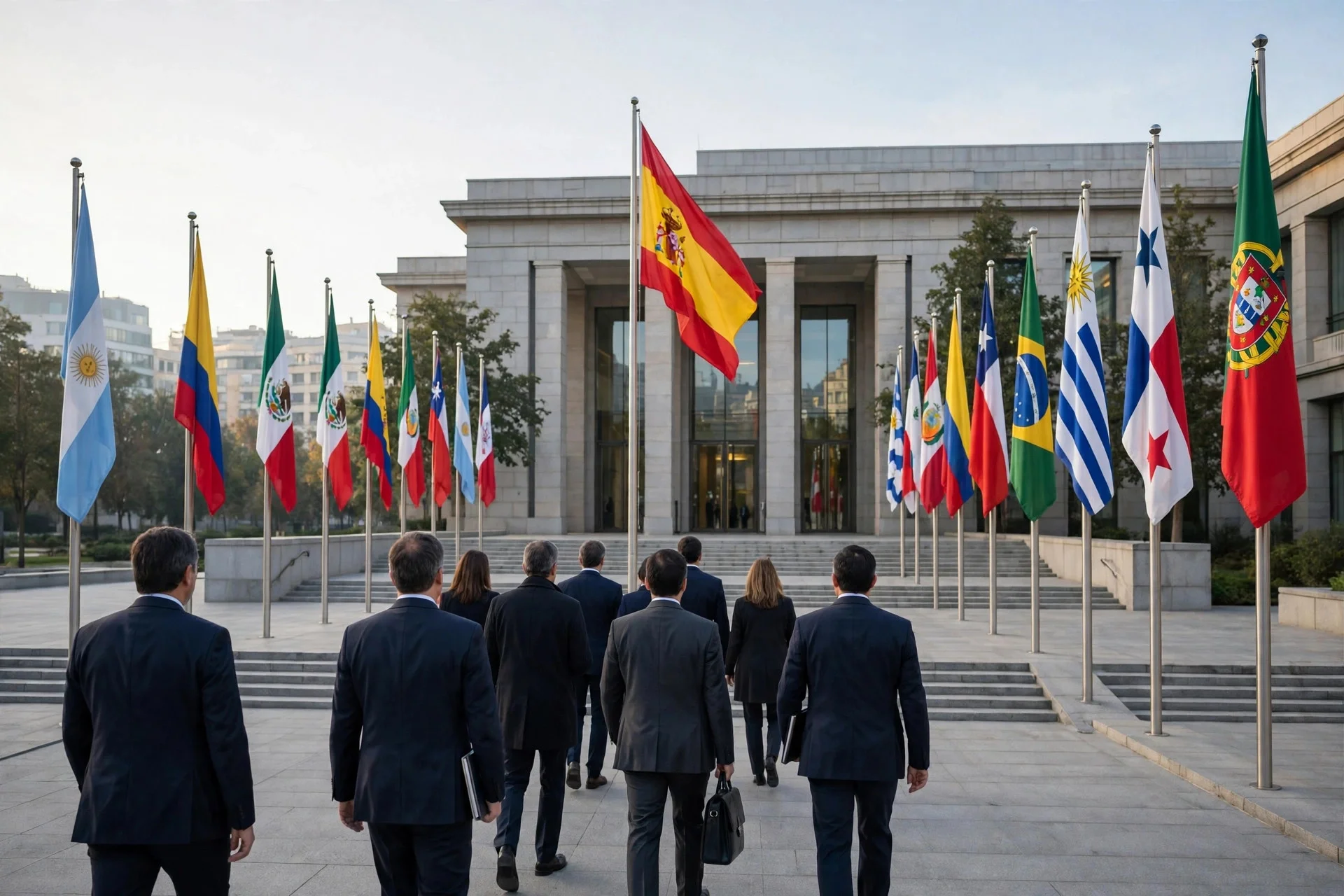
Imagen alusiva: una delegación avanza entre banderas iberoamericanas hacia la sede de un encuentro internacional en Madrid. · Imagen generada por EPM
Colombia seeks renewed Ibero-American cooperation at Madrid summit
Colombia takes part in the thirtieth Ibero-American Summit in Madrid, scheduled for November 4 and 5, 2026, with a delegation headed by Vice President José…
Colombia arrives in Madrid to restore its diplomatic standing
With a delegation headed by Vice President José Manuel Restrepo and Foreign Minister Omar Bula, Colombia arrives at the Ibero-American Summit in Madrid to…
--- The context ---
Colombia returns to a central multilateral stage to rebuild bridges and expand cooperation across the Ibero-American space. The government of President Abelardo De La Espriella is taking part in the thirtieth Ibero-American Summit of Heads of State and Government, a meeting for dialogue among countries that share history, language and common challenges.
--- The facts ---
The summit is scheduled for November 4 and 5, 2026, in Madrid, Spain, and will bring together representatives of 22 countries, including 19 from Latin America and three from Europe. The Colombian delegation is headed by Vice President José Manuel Restrepo and Foreign Minister Omar Bula, accompanied by other national government officials.
On arriving in Spain, the foreign minister gave his first impressions. The Foreign Ministry noted that the presence seeks to turn international agreements into opportunities for training, knowledge exchange, trade, investment and cooperation.
--- The positions ---
Bula said indirectly that the primary goal is to strengthen strategic relations that bring tangible benefits in trade and culture during four key working days. He also said indirectly that they seek to reposition Colombia where it belongs, to show it is a prominent country in international diplomacy and to establish useful relations in trade, culture and other areas, and he stressed that preparation is required.
--- What remains unknown ---
The concrete agreements that could result from the Colombian participation are not yet known, nor is the detail of the delegation meetings. It also remains undefined how the announced benefits in training, trade, investment and cooperation will be measured, or within what timeframes they could be felt.
--- Unanswered questions ---
What concrete agreements will the Colombian delegation manage to close during the summit in Madrid? How will the strengthened relations translate into real opportunities in training, trade and investment for citizens? What follow-up will the government give to the commitments that emerge from these four key working days?
--- EPM analysis ---
The approach combines multilateral presence with practical results. A forum with 22 countries makes it possible to build alliances beyond the bilateral relationship and open channels of cooperation in culture, knowledge and trade. The value of the mission will be judged by sustaining those ties after the summit and turning dialogue into verifiable projects.
📌 EPM Take: In EPM's view, Colombia presence in Madrid matters for its focus on cooperation and on tangible benefits for citizens, provided that dialogue turns into verifiable agreements. Strengthening Ibero-American integration in training, culture, trade and investment can open real opportunities if there is public follow-up and continuity. The first step announced by the foreign minister will be credible when each commitment has owners, deadlines and measurable results for Colombians in the coming months.
--- The context ---
Colombia arrives in Madrid with a purpose its foreign minister has described as a rescue operation for its international position. The government of President Abelardo De La Espriella is taking part in the thirtieth Ibero-American Summit of Heads of State and Government to recover the prestige the country held last century.
--- The facts ---
The summit is scheduled for November 4 and 5, 2026, in Madrid, Spain, and will bring together representatives of 22 countries, including 19 from Latin America and three from Europe. The delegation is headed by Vice President José Manuel Restrepo and Foreign Minister Omar Bula, together with other national government officials.
On arriving in Spain, Bula said indirectly that this will be the first step to recover the level of international relations after the controversies of the previous administration. The Foreign Ministry noted that the presence seeks to turn agreements into opportunities for training, exchange, trade, investment and cooperation.
--- The positions ---
The foreign minister described the mission indirectly as a rescue operation and said the country suffered impressive damage in the last four years and must be rescued and lifted out of the hole it was put into. He mentioned the difficulties following the handling of international relations under the government of Gustavo Petro and said indirectly that Colombia does not deserve what happened to it in the last four years and that they will work without stopping so the country returns to the heights it held last century.
--- What remains unknown ---
The balance of the mission is not yet known, nor are the commitments the delegation hopes to secure on trade, investment and cooperation, nor the mechanisms to show that the repositioning holds.
--- Unanswered questions ---
Will Colombia recover the level of its international relations in Madrid? What commitments will back the rescue operation described by Foreign Minister Bula? How will the government show the country once again holds the prominent place it claims in international diplomacy?
--- EPM analysis ---
The message is one of authority and of a corrected course. Presenting the mission as a rescue sets a demanding bar. If the repositioning brings useful agreements on trade and culture, Madrid can mark the start of a stage of greater international weight.
📌 EPM Take: In EPM's view, Colombia is right to frame its return to the summit as a recovery of prestige and of the place it deserves in international diplomacy. The bar set by the foreign minister himself is high and therefore useful, because it requires showing results in trade, culture and investment. The announced rescue will be confirmed if the work of these days is sustained with discipline and turns into respect and verifiable benefits.
Colombia busca reposicionarse en la Cumbre Iberoamericana de Madrid
Colombia participa en la trigésima Cumbre Iberoamericana en Madrid, prevista para el 4 y 5 de noviembre de 2026, con una delegación encabezada por el…
Colombia llega a Madrid para recuperar su prestigio diplomático
Con una delegación encabezada por el vicepresidente José Manuel Restrepo y el canciller Omar Bula, Colombia llega a la Cumbre Iberoamericana de Madrid para…
--- El contexto ---
Colombia vuelve a un escenario multilateral central para reconstruir puentes y ampliar su cooperación iberoamericana. El Gobierno del presidente Abelardo De La Espriella hace presencia en la trigésima Cumbre Iberoamericana de Jefas y Jefes de Estado y de Gobierno, un encuentro de diálogo entre países que comparten historia, lengua y desafíos comunes.
--- Los hechos ---
La Cumbre está prevista para el 4 y 5 de noviembre de 2026 en Madrid, España, y reunirá a representantes de 22 países, incluidos 19 de Latinoamérica y tres de Europa. La delegación colombiana está encabezada por el vicepresidente José Manuel Restrepo y por el ministro de Relaciones Exteriores, Omar Bula, acompañados por otros funcionarios del Gobierno nacional.
Al llegar a España, el canciller ofreció sus primeras impresiones. La Cancillería señaló que la presencia busca convertir los acuerdos internacionales en oportunidades de formación, intercambio de conocimientos, comercio, inversión y cooperación.
--- Las posiciones ---
Bula sostuvo en indirecto que la meta primordial es fortalecer relaciones estratégicas que aporten beneficios tangibles en comercio y cultura durante cuatro jornadas clave de trabajo. También indicó en indirecto que buscan reposicionar a Colombia donde tiene que estar, demostrar que es un país prominente en la diplomacia internacional y establecer relaciones útiles en comercio, cultura y otros ámbitos, y recalcó que hay que prepararse.
--- Lo que falta saber ---
Todavía no se conocen los acuerdos concretos que podrían derivarse de la participación colombiana ni el detalle de las reuniones de la delegación. Tampoco está definido cómo se medirán los beneficios anunciados en formación, comercio, inversión y cooperación, ni en qué plazos podrían sentirse.
--- Preguntas sin respuesta ---
¿Qué acuerdos concretos logrará cerrar la delegación colombiana durante la Cumbre en Madrid? ¿Cómo se traducirán las relaciones fortalecidas en oportunidades reales de formación, comercio e inversión para la ciudadanía? ¿Qué seguimiento hará el Gobierno a los compromisos que surjan de estas cuatro jornadas clave de trabajo?
--- Análisis EPM ---
La apuesta combina presencia multilateral y resultados prácticos. Un foro con 22 países permite alianzas más allá de la relación bilateral y canales de cooperación en cultura, conocimiento y comercio. El valor de la misión se juzgará por sostener esos vínculos tras la Cumbre.
📌 Conclusion EPM: A juicio de EPM, la presencia de Colombia en Madrid vale por su enfoque en la cooperación y en beneficios tangibles para la ciudadanía, siempre que el diálogo se traduzca en acuerdos verificables. Fortalecer la integración iberoamericana en formación, cultura, comercio e inversión puede abrir oportunidades reales si hay seguimiento público y continuidad. El primer paso anunciado por el canciller será creíble cuando cada compromiso tenga responsables, plazos y resultados medibles para los colombianos en los próximos meses.
--- El contexto ---
Colombia acude a Madrid con un propósito definido por su canciller como una operación de rescate internacional. El Gobierno del presidente Abelardo De La Espriella hace presencia en la trigésima Cumbre Iberoamericana de Jefas y Jefes de Estado y de Gobierno para recuperar el prestigio que el país tuvo en el siglo pasado.
--- Los hechos ---
La Cumbre está prevista para el 4 y 5 de noviembre de 2026 en Madrid, España, y reunirá a representantes de 22 países, incluidos 19 de Latinoamérica y tres de Europa. La delegación está encabezada por el vicepresidente José Manuel Restrepo y el canciller Omar Bula, junto con otros funcionarios del Gobierno nacional.
Al llegar a España, Bula señaló en indirecto que este será el primer paso para recuperar el nivel de las relaciones internacionales tras las polémicas de la administración anterior. La Cancillería señaló que la presencia busca convertir los acuerdos en oportunidades de formación, intercambio de conocimientos, comercio, inversión y cooperación.
--- Las posiciones ---
El canciller calificó la misión en indirecto como una operación rescate y afirmó que al país le hicieron un daño impresionante en los últimos cuatro años y que hay que rescatarlo y sacarlo del hueco en el que lo metieron. Mencionó las dificultades tras los manejos de las relaciones internacionales en el Gobierno de Gustavo Petro y afirmó en indirecto que Colombia no se merece lo que le pasó en los últimos cuatro años y que trabajarán sin parar para que vuelva a las alturas en que estuvo en el siglo pasado.
--- Lo que falta saber ---
Aún no se conoce el balance de la misión ni los compromisos que la delegación espera asegurar en comercio, inversión y cooperación.
--- Preguntas sin respuesta ---
¿Logrará Colombia recuperar en Madrid el nivel de sus relaciones internacionales? ¿Qué compromisos respaldarán la operación rescate descrita por el canciller Bula? ¿Cómo demostrará el Gobierno que el país volvió al lugar prominente que reclama en la diplomacia internacional?
--- Análisis EPM ---
El mensaje es de autoridad y de corrección de rumbo. Presentar la misión como un rescate fija una vara exigente. Si el reposicionamiento trae acuerdos útiles en comercio y cultura, Madrid puede marcar el inicio de una etapa de mayor peso internacional.
📌 Conclusion EPM: A juicio de EPM, Colombia acierta al plantear su regreso a la Cumbre como una recuperación del prestigio y del lugar que le corresponde en la diplomacia internacional. La vara que fija el propio canciller es alta y por eso mismo útil, porque obliga a mostrar resultados en comercio, cultura e inversión. El rescate anunciado se confirmará si el trabajo de estas jornadas se sostiene con disciplina y se traduce en respeto y beneficios verificables.