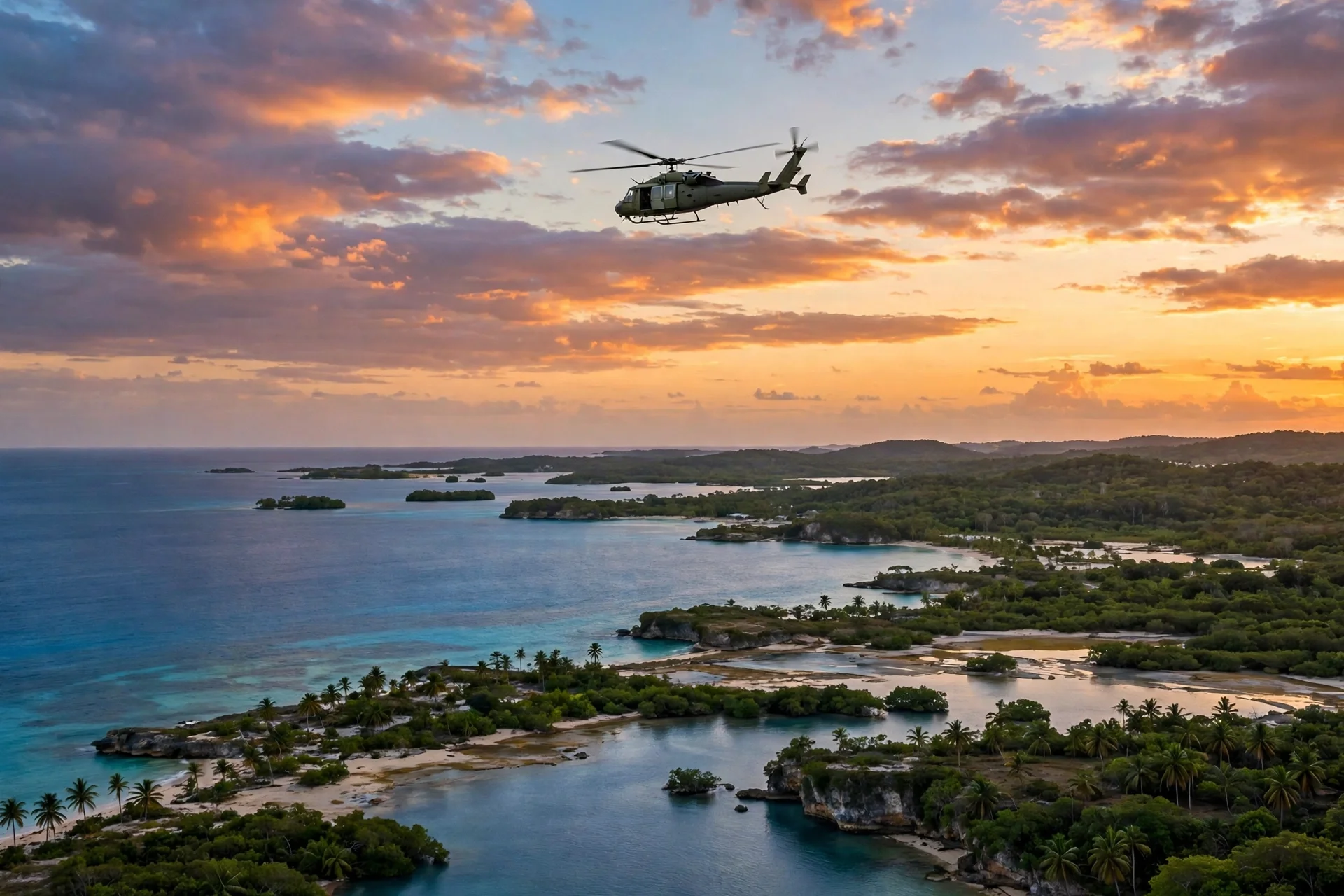
Imagen alusiva a las operaciones aéreas en Haití. · Imagen generada para EPM
Salvadoran helicopters respond to attack on forces in Haiti
Salvadoran helicopters responded to a gang attack on GSF forces in Haiti as the search continues for four technicians missing since October 18, and the United…
El Salvador deploys force in Haiti as Dominican support grows
El Salvador answered a gang attack on the GSF in Haiti with helicopters, deployed more than 2,000 troops to search for four missing technicians, and received…
--- The context ---
Haiti faces a deep security crisis marked by the strong territorial presence of gangs and frequent clashes with security forces. The Gang Suppression Force, known as the GSF, operates in that setting alongside international contingents seeking to contain criminal organizations.
--- The facts ---
Salvadoran military helicopters intervened against armed gangs after an attack on GSF members. According to the reports, at around 6:16 in the evening a helicopter flew over the commune of Croix-des-Bouquets, where shots from the aircraft were heard and flashes were seen in the sky.
President Nayib Bukele said the gangs were attacking GSF soldiers from Chad and that they were repelled with the attack helicopters, and he maintained that the gangs no longer have the advantage over the forces deployed in Haitian territory.
--- The positions ---
The intervention comes amid Salvadoran operations to locate four aeronautical technicians who disappeared on October 18, after the vehicle in which they were traveling was ambushed by armed groups near Port-au-Prince. The Salvadoran government ordered the deployment of more than 2,000 troops to join the search and support efforts against criminal organizations.
The leader of 400 Mawozo, Wilson Joseph, claimed that the four technicians had died, but he presented no evidence to support that claim, and the Salvadoran government continues its operations to locate them.
--- What remains unknown ---
Wilson Joseph recently requested United Nations intervention to facilitate dialogue between the armed organizations and the international forces. The organization confirmed it received a letter signed by him and addressed to Secretary-General António Guterres requesting mediation.
Its spokesman, Stéphane Dujarric, clarified that receiving the letter does not represent recognition of its author or endorsement of its content, and he expressed concern about the consequences of security operations for the civilian population and respect for international law.
--- Unanswered questions ---
Where are the four Salvadoran technicians missing since October 18? What evidence supports the claim made by the leader of 400 Mawozo without proof? How will civilians be protected while air and ground operations continue in Haiti? What real scope could the mediation requested from the United Nations have in this crisis?
--- EPM analysis ---
Dujarric also specified that most of the Salvadoran troops recently deployed do not operate under the GSF structure or under the supervision mechanisms of the United Nations support office, a distinction that raises questions about accountability.
The Dominican Republic, meanwhile, took on a logistical support role: seven helicopters, five Salvadoran and two Black Hawk, stopped at the El Rodeo fortress in Jimaní before continuing onward. Foreign Minister Víctor Ito Bisonó said the Dominican Republic will not take part directly in clashes against the gangs, but will maintain diplomatic, humanitarian and logistical support.
📌 EPM Take: In EPM's view, the air response marks an escalation that requires independent verification and effective civilian protection, not only military force. Without evidence about the missing technicians, without clarity on who supervises the deployment and without verifiable guarantees for the population, a tactical advance can leave the root of the Haitian crisis untouched and create responsibilities that no government should evade before the international community and its own citizens, who deserve clear answers about this mission.
--- The context ---
Gangs hold a strong territorial presence in Haiti and clash repeatedly with security forces, in a crisis that overwhelmed the local response. The Gang Suppression Force, known as the GSF, carries out operations alongside international forces to contest that control.
--- The facts ---
Salvadoran military helicopters responded against armed gangs that attacked GSF members. According to the reports, at around 6:16 in the evening a helicopter flew over the commune of Croix-des-Bouquets, where shots from the aircraft were heard and flashes were seen in the sky.
President Nayib Bukele said the gangs were attacking GSF soldiers from Chad and that they were repelled with the attack helicopters, and he stated that the gangs no longer have the advantage over the forces deployed on the ground.
--- The positions ---
The deployment also answers the disappearance of four Salvadoran aeronautical technicians on October 18, after the vehicle in which they were traveling was ambushed by armed groups near Port-au-Prince. The government of Bukele ordered the deployment of more than 2,000 troops to search for them and support the fight against criminal organizations.
The leader of 400 Mawozo, Wilson Joseph, claimed that the four technicians had died, although he presented no evidence to support that claim, while the Salvadoran government maintains its operations to locate them.
--- What remains unknown ---
Wilson Joseph recently requested United Nations intervention to facilitate dialogue between the armed organizations and the international forces, and the organization confirmed it received a letter from him addressed to Secretary-General António Guterres.
Spokesman Stéphane Dujarric clarified that receiving the letter does not represent recognition of its author or endorsement of its content. The organization also expressed concern about the impact of the operations on the civilian population and insisted that all interventions must respect international law and human rights protections.
--- Unanswered questions ---
Will the four Salvadoran technicians missing since October 18 be found alive? Will the leader of 400 Mawozo present any evidence for the deaths he claimed without support? Can the deployed forces sustain the advantage that Bukele said they have already taken from the gangs? Will the Dominican Republic keep its support without entering the fighting directly?
--- EPM analysis ---
Dujarric specified that most of the recently deployed Salvadoran troops do not operate under the GSF structure or the supervision of the United Nations support office, which marks the institutional boundary of the deployment.
The Dominican Republic facilitates the movement of personnel and equipment: seven helicopters, five Salvadoran and two Black Hawk, stopped at the El Rodeo fortress in Jimaní, along with support for supplies and medical evacuations. Foreign Minister Víctor Ito Bisonó said his country will not take part directly in clashes against the gangs, but will maintain its diplomatic, humanitarian and logistical backing.
📌 EPM Take: In EPM's view, Haiti needs order backed by legitimate authority and measurable results, and the Salvadoran response marks a change from the paralysis that came before. Dominican logistical support, without entering direct combat, is the prudent formula for a neighbor that cannot look the other way. The advantage over the gangs will only matter if it holds, if the missing men are found and if dialogue does not reward those who spread terror.
Helicópteros salvadoreños responden a ataque contra fuerzas en Haití
Helicópteros de El Salvador respondieron a un ataque contra soldados de la GSF en Haití, mientras continúa la búsqueda de cuatro técnicos desaparecidos el 18…
El Salvador despliega fuerza en Haití y Dominicana apoya la logística
El Salvador respondió con helicópteros a un ataque de pandillas contra la GSF en Haití, desplegó más de 2,000 efectivos para buscar a cuatro técnicos…
--- El contexto ---
Haití vive una crisis de seguridad marcada por la fuerte presencia territorial de las pandillas y por enfrentamientos frecuentes con las fuerzas de seguridad. En ese escenario opera la Fuerza de Supresión de Pandillas, conocida como GSF, junto a contingentes internacionales.
--- Los hechos ---
Helicópteros militares de El Salvador intervinieron contra bandas armadas luego de un ataque contra integrantes de la GSF. Según lo informado, alrededor de las 6:16 de la tarde un helicóptero sobrevoló la comuna de Croix-des-Bouquets, desde donde se escucharon disparos procedentes de la aeronave y se observaron destellos en el cielo.
El presidente Nayib Bukele dijo que las pandillas atacaban a soldados del GSF de Chad y que fueron repelidas con los helicópteros de ataque, y sostuvo además que las pandillas ya no tienen la ventaja.
--- Las posiciones ---
La intervención ocurre mientras fuerzas salvadoreñas buscan a cuatro técnicos aeronáuticos desaparecidos el 18 de octubre, tras una emboscada contra el vehículo en el que se desplazaban cerca de Puerto Príncipe.
El Gobierno salvadoreño ordenó el envío de más de 2,000 efectivos para participar en la búsqueda y apoyar los esfuerzos contra las organizaciones criminales. El jefe de 400 Mawozo, Wilson Joseph, afirmó que los cuatro técnicos habrían muerto, pero no presentó pruebas que respaldaran esa afirmación, y el Gobierno salvadoreño mantiene las operaciones para localizarlos.
--- Lo que falta saber ---
Wilson Joseph solicitó recientemente la intervención de Naciones Unidas para facilitar un diálogo entre las organizaciones armadas y las fuerzas internacionales. La organización confirmó que recibió una carta firmada por él y dirigida al secretario general, António Guterres, en la que solicita mediación.
Su portavoz, Stéphane Dujarric, aclaró que recibir la comunicación no representa un reconocimiento de su autor ni un respaldo a su contenido, y expresó preocupación por las consecuencias de las operaciones sobre la población civil.
--- Preguntas sin respuesta ---
¿Dónde están los cuatro técnicos salvadoreños desaparecidos desde el 18 de octubre? ¿Qué pruebas existen sobre lo afirmado por el jefe de 400 Mawozo sin respaldo presentado? ¿Cómo se protegerá a la población civil mientras continúan las operaciones aéreas y terrestres? ¿Qué alcance real tendrá la mediación solicitada a Naciones Unidas?
--- Análisis EPM ---
Dujarric precisó además que la mayoría de los militares salvadoreños desplegados recientemente no opera bajo la estructura de la GSF ni está sujeta a los mecanismos de supervisión de la oficina de apoyo de Naciones Unidas, y la organización insistió en que toda intervención debe respetar el derecho internacional.
En paralelo, República Dominicana asumió un papel de apoyo logístico: siete helicópteros, cinco salvadoreños y dos Black Hawk, hicieron escala en la fortaleza El Rodeo, en Jimaní. El canciller Víctor Ito Bisonó dijo que República Dominicana no participará directamente en los enfrentamientos, pero mantendrá su respaldo diplomático, humanitario y logístico.
📌 Conclusion EPM: A juicio de EPM, la respuesta aérea muestra una escalada que exige verificación independiente y protección civil efectiva, no solo contundencia militar. Sin pruebas sobre los desaparecidos, sin claridad sobre la cadena de supervisión del despliegue y sin garantías verificables para la población, el avance táctico puede dejar intacta la raíz de la crisis haitiana y abrir un frente de responsabilidades que ningún gobierno debería eludir ante la comunidad internacional.
--- El contexto ---
Las pandillas mantienen una fuerte presencia territorial en Haití y protagonizan enfrentamientos con las fuerzas de seguridad. La Fuerza de Supresión de Pandillas, conocida como GSF, sostiene operaciones junto a fuerzas internacionales para disputar ese control.
--- Los hechos ---
Helicópteros militares de El Salvador abrieron respuesta contra bandas armadas que atacaron a integrantes de la GSF. De acuerdo con lo informado, alrededor de las 6:16 de la tarde un helicóptero sobrevoló la comuna de Croix-des-Bouquets, desde donde se escucharon disparos procedentes de la aeronave y se observaron destellos en el cielo.
El presidente Nayib Bukele dijo que las pandillas atacaban a soldados del GSF de Chad y que fueron repelidas con los helicópteros de ataque, y afirmó además que las pandillas ya no tienen la ventaja.
--- Las posiciones ---
El despliegue responde también a la desaparición de cuatro técnicos aeronáuticos salvadoreños el 18 de octubre, luego de que el vehículo en el que se desplazaban fuera emboscado por grupos armados cerca de Puerto Príncipe.
El Gobierno de Bukele ordenó el envío de más de 2,000 efectivos para buscarlos y apoyar el combate contra las organizaciones criminales. El jefe de 400 Mawozo, Wilson Joseph, afirmó que los cuatro técnicos habrían muerto, aunque no presentó pruebas que respaldaran esa afirmación, mientras el Gobierno salvadoreño mantiene las operaciones para localizarlos.
--- Lo que falta saber ---
Wilson Joseph pidió recientemente la intervención de Naciones Unidas para facilitar un diálogo entre las organizaciones armadas y las fuerzas internacionales, y la organización confirmó haber recibido una carta suya dirigida al secretario general, António Guterres.
El portavoz Stéphane Dujarric aclaró que recibir la carta no representa un reconocimiento de su autor ni un respaldo a su contenido. La organización expresó además preocupación por el impacto de las operaciones sobre la población civil e insistió en el respeto al derecho internacional.
--- Preguntas sin respuesta ---
¿Aparecerán con vida los cuatro técnicos salvadoreños desaparecidos el 18 de octubre? ¿Presentará alguna prueba el jefe de 400 Mawozo sobre la muerte que afirmó sin respaldo? ¿Podrán las fuerzas desplegadas sostener la ventaja que, según Bukele, ya arrebataron a las pandillas? ¿Mantendrá República Dominicana su apoyo sin entrar directamente en los enfrentamientos?
--- Análisis EPM ---
La precisión de Dujarric de que la mayoría de los militares salvadoreños recientes no opera bajo la estructura de la GSF ni bajo la supervisión de la oficina de apoyo de Naciones Unidas marca el límite institucional del despliegue.
República Dominicana, en tanto, facilita el traslado de personal y equipos: siete helicópteros, cinco salvadoreños y dos Black Hawk, hicieron escala en la fortaleza El Rodeo, en Jimaní, además de apoyo en suministros y evacuaciones médicas. El canciller Víctor Ito Bisonó dijo que su país no participará directamente en los enfrentamientos, pero mantendrá el respaldo diplomático, humanitario y logístico.
📌 Conclusion EPM: A juicio de EPM, Haití necesita orden con autoridad legítima y resultados medibles, y la respuesta salvadoreña marca un cambio frente a la parálisis previa. El respaldo logístico dominicano, sin entrar en combate directo, es la fórmula prudente para un vecino que no puede mirar hacia otro lado. La ventaja sobre las pandillas solo valdrá si se sostiene, si aparecen los desaparecidos y si el diálogo no premia a quienes siembran el terror.