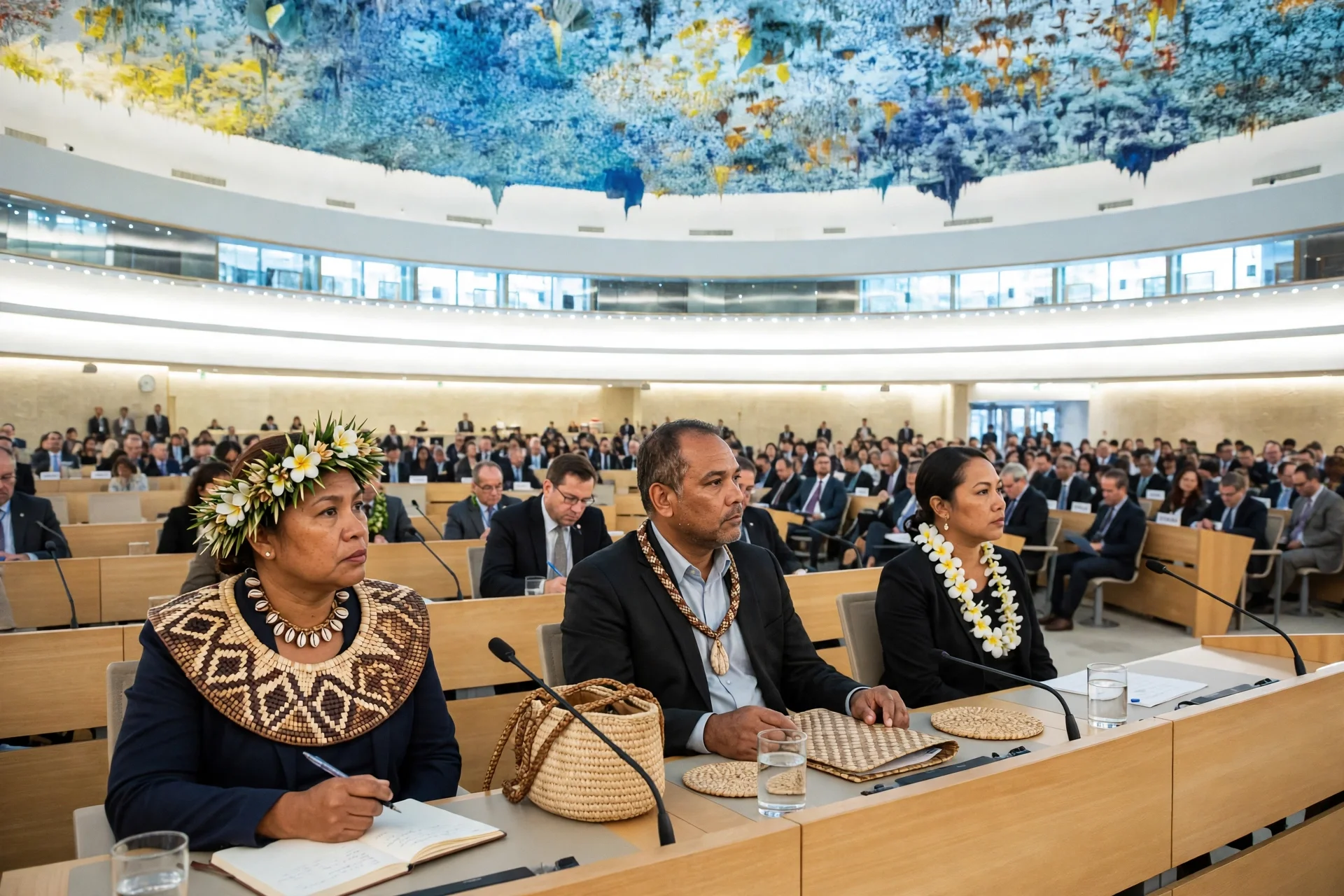
Imagen alusiva a la sesión del Examen Periódico Universal en Ginebra. · Imagen generada para EPM
UK urges stronger rights protection for vulnerable people in Papua New Guinea
In Geneva, the United Kingdom praised Papua New Guinea's progress on children, disability rights, abolition of the death penalty and sorcery-accusation…
Britain presses Papua New Guinea on corruption and institutional capacity
Britain's statement at the Universal Periodic Review commended Papua New Guinea for abolishing the death penalty and advancing children's and disability…
--- The context ---
At the Universal Periodic Review, held under the Human Rights Council in Geneva, each state presents its record and hears recommendations. The British statement on Papua New Guinea placed the emphasis on people who face the greatest risks, treating legal reform as a starting point rather than a finished achievement.
--- The facts ---
The statement welcomed progress on the rights of children and persons with disabilities, linked to the National Ending Violence Against Children Roadmap and the introduction of the Disability Services Act 2025. It also commended the abolition of the death penalty and the criminalisation of violence related to sorcery accusations.
--- The positions ---
With survivors at the centre, the United Kingdom urged Papua New Guinea to accelerate and properly fund the National Strategy to Prevent and Respond to Gender-Based Violence 2026–2035, expanding survivor-centred services and access to justice in rural and remote areas. It also called for a National Human Rights Institution under the Paris Principles.
--- What remains unknown ---
The statement sets no timetable for the new institution and gives no funding figures for the gender-based violence strategy. It also leaves open how recommendations will be followed up and how progress will be checked in communities far from the cities.
--- Unanswered questions ---
How soon could Papua New Guinea establish and operationalise its National Human Rights Institution? What funding will sustain survivor-centred services across rural and remote areas through 2035? How will victims of gender-based violence gain real access to justice under the strategy?
--- EPM analysis ---
Recognition and pressure run together here: recent legal steps are praised, yet the statement insists that rights depend on services people can reach, institutions that watch over commitments and resources that survive beyond the announcement.
📌 EPM Take: In EPM's view, the strength of this intervention lies in refusing to separate legal progress from lived protection for children, persons with disabilities and survivors of violence. Ending the death penalty and criminalising sorcery-accusation violence matter, but their meaning will be tested where support is scarcest. A credible human rights institution and funded, accessible services would turn the praise heard in Geneva into protection people can feel.
--- The context ---
The Universal Periodic Review, convened by the Human Rights Council in Geneva, tests whether states can show working institutions behind their commitments. Britain's remarks on Papua New Guinea were built around that test, giving institutional strength and the fight against corruption a central place in the assessment.
--- The facts ---
London commended the abolition of the death penalty and the criminalisation of violence related to sorcery accusations. It also noted advances for children and persons with disabilities, connected with the National Ending Violence Against Children Roadmap and the Disability Services Act 2025, while making clear that implementation remains the decisive question.
--- The positions ---
The practical demand came first: further strengthen the Independent Commission Against Corruption by ensuring the resources and institutional capacity it needs to fulfil its mandate effectively. The statement also recommended establishing a National Human Rights Institution in accordance with the Paris Principles and adequately resourcing the National Strategy on Gender-Based Violence 2026–2035.
--- What remains unknown ---
No deadlines, budget figures or verification arrangements were specified for any of the three recommendations. The statement does not say what capacity the anti-corruption commission currently lacks, nor how services and access to justice will be sustained in rural and remote areas.
--- Unanswered questions ---
What resources and capacity will the Independent Commission Against Corruption actually receive to fulfil its mandate? When could a National Human Rights Institution be established and made operational under the Paris Principles? What measurable results will be required from the gender-based violence strategy by 2035?
--- EPM analysis ---
This was not praise without conditions. By leading with corruption and institutional capacity, the British position treated accountable government as the foundation on which protection for children, persons with disabilities and survivors must rest, rather than as a separate technical issue.
📌 EPM Take: In EPM's view, the most consequential part of the British statement is its order of priorities, because institutions that cannot enforce the law cannot protect anyone for long. Strengthening the anti-corruption commission, building an independent rights body and funding the strategy through 2035 are tests of state capacity. Whether Papua New Guinea meets them will decide if the progress acknowledged in Geneva endures.
Reino Unido pide más protección de derechos en Papúa Nueva Guinea
En Ginebra, el Reino Unido elogió ante el Consejo de Derechos Humanos los avances de Papúa Nueva Guinea en infancia, discapacidad, abolición de la pena de…
Londres exige instituciones sólidas y lucha anticorrupción en Papúa
La declaración británica en el Examen Periódico Universal reconoció la abolición de la pena de muerte y avances en infancia y discapacidad en Papúa Nueva…
--- El contexto ---
El Examen Periódico Universal, en su sesión ante el Consejo de Derechos Humanos en Ginebra, revisa el historial de los Estados y permite formular recomendaciones. En ese marco, la delegación británica evaluó la situación de Papúa Nueva Guinea poniendo el acento en la protección de las personas expuestas.
--- Los hechos ---
La declaración reconoció avances en los derechos de la infancia y de las personas con discapacidad, vinculados a la hoja de ruta para poner fin a la violencia contra los niños y a la Disability Services Act 2025. También valoró la abolición de la pena de muerte y la tipificación de la violencia relacionada con acusaciones de brujería.
--- Las posiciones ---
Desde una mirada centrada en las víctimas, el planteamiento británico pidió crear una institución nacional de derechos humanos conforme a los Principios de París. Además, reclamó acelerar y financiar la Estrategia Nacional contra la Violencia de Género 2026–2035, con servicios centrados en las sobrevivientes y acceso a la justicia en zonas rurales y remotas.
--- Lo que falta saber ---
La declaración no precisa plazos para crear la institución ni detalla montos para la estrategia contra la violencia de género. Tampoco indica qué seguimiento tendrá cada recomendación ni cómo se medirá su cumplimiento fuera de las ciudades.
--- Preguntas sin respuesta ---
¿En qué plazo podría Papúa Nueva Guinea crear su institución nacional de derechos humanos? ¿Qué recursos concretos recibirá la estrategia contra la violencia de género hasta 2035? ¿Cómo llegarán los servicios de apoyo y la justicia a las comunidades rurales y remotas?
--- Análisis EPM ---
El mensaje combina reconocimiento y exigencia: celebra pasos recientes, pero subraya que los derechos solo se vuelven reales cuando existen instituciones cercanas, presupuesto y atención efectiva para quienes sufren violencia o discriminación.
📌 Conclusion EPM: A juicio de EPM, el valor de esta intervención está en poner a las personas vulnerables en el centro del examen, sin conformarse con leyes aprobadas sobre el papel. La abolición de la pena de muerte y la protección frente a acusaciones de brujería son avances que merecen respaldo, pero su alcance dependerá de servicios accesibles, justicia cercana y una institución independiente capaz de vigilar cada compromiso asumido ante el Consejo.
--- El contexto ---
En Ginebra, durante la sesión del Examen Periódico Universal del Consejo de Derechos Humanos, cada Estado presenta su balance y recibe observaciones. La intervención británica sobre Papúa Nueva Guinea se ordenó alrededor de una idea exigente: sin instituciones capaces y sin orden legal, cualquier avance queda incompleto.
--- Los hechos ---
El Reino Unido saludó la abolición de la pena de muerte y la tipificación de la violencia vinculada a acusaciones de brujería. Reconoció además progresos para la infancia y las personas con discapacidad, asociados a la hoja de ruta contra la violencia infantil y a la Disability Services Act 2025.
--- Las posiciones ---
La prioridad práctica señalada fue fortalecer la Comisión Independiente contra la Corrupción, garantizando recursos y capacidad institucional para cumplir su mandato con eficacia. Junto a ello, se pidió establecer una institución nacional de derechos humanos según los Principios de París y dotar de financiación suficiente a la Estrategia Nacional contra la Violencia de Género 2026–2035.
--- Lo que falta saber ---
No se anunciaron plazos, cifras de presupuesto ni mecanismos de verificación para ninguna de las tres recomendaciones. La declaración tampoco aclara qué capacidad tendrá la comisión anticorrupción ni cómo se sostendrán los servicios en áreas rurales y remotas.
--- Preguntas sin respuesta ---
¿Qué calendario y qué presupuesto tendrá el refuerzo de la Comisión Independiente contra la Corrupción? ¿Podrá la nueva institución de derechos humanos operar con independencia y medios suficientes? ¿Qué resultados medibles se exigirán a la estrategia contra la violencia de género 2026–2035?
--- Análisis EPM ---
A diferencia de un elogio, el planteamiento pone el foco en la arquitectura del Estado: combatir la corrupción, crear contrapesos y financiar políticas concretas. El reconocimiento convive con una advertencia sobre la distancia entre norma y cumplimiento.
📌 Conclusion EPM: A juicio de EPM, lo más sólido de la declaración británica es su insistencia en la capacidad institucional como condición de todo lo demás. De poco sirven nuevas estrategias si la comisión anticorrupción carece de recursos o si la justicia no llega a las zonas remotas. El orden, la rendición de cuentas y la aplicación efectiva de la ley decidirán si los avances elogiados se consolidan o se quedan en formulación diplomática.