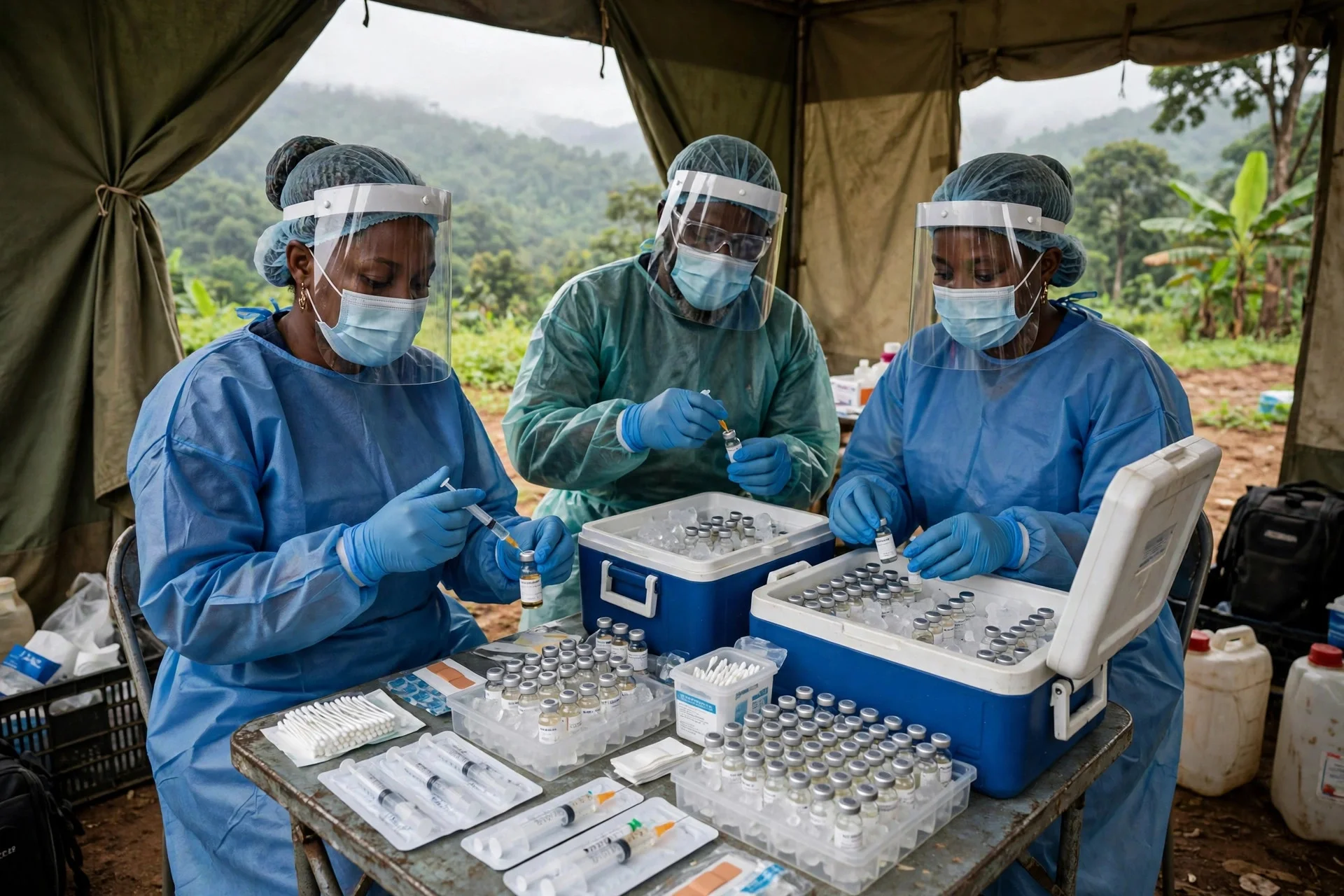
Imagen alusiva: preparación de vacunas en una clínica de campaña durante el brote de ébola en el Congo. · EPM
Two Bundibugyo Ebola vaccines join the Tumaini trial in DR Congo
Two vaccines designed for the Bundibugyo species, ChAdOx1 and mRNA-1469, will join the Tumaini trial in Bunia after a WHO expert recommendation, during Congo's…
Tumaini trial adds two vaccines amid Congo's largest Ebola outbreak
ChAdOx1 and mRNA-1469 will enter the Tumaini trial in Ituri, which already tests Ervebo through ring vaccination, as the Bundibugyo outbreak reaches more than…
--- The context ---
The Democratic Republic of the Congo has battled for nearly six months an Ebola outbreak caused by the Bundibugyo species, now the largest in the country's history. As of 1 November, there were more than 10,500 confirmed cases and 5,126 deaths. The response is concentrated in the east, where health teams work to interrupt transmission and protect the close contacts of each confirmed case, in a setting where speed and trust in the communities are decisive.
--- The facts ---
Two new vaccine candidates will be added to the Tumaini clinical trial. They are ChAdOx1, developed by the University of Oxford with the Serum Institute of India, and mRNA-1469, developed by Moderna. Their inclusion follows the recommendation of the WHO Technical Advisory Group on Candidate Vaccines Prioritization, which met this week and advised further clinical evaluation based on the available evidence. It will be the first time vaccines specifically designed for Bundibugyo are evaluated during an active outbreak.
--- The positions ---
WHO Director-General Tedros Adhanom Ghebreyesus said in attributed remarks that the fact that these vaccines are ready to enter clinical trials is a testament to the power of science and partnership. He also stressed, in indirect terms, that vaccines alone will not end the outbreak, although they could become a powerful new tool for bringing it under control. The message pairs recognition of scientific progress with a clear warning against expecting a single solution.
The Tumaini trial, named after the Swahili word for hope, was launched on 23 October in Bunia, capital of Ituri province, which remains the epicentre. Ervebo, used against the Zaire species, is already being tested there to determine whether it is effective against Bundibugyo. The two new candidates will enter the trial following national approvals.
--- What remains unknown ---
Tumaini is designed to test multiple candidates within a single trial, using ring vaccination focused on contacts of people with confirmed Ebola Bundibugyo. Four vaccination rings have been set up and several more are being prepared, while research into other potential treatments also moves forward. The ring strategy was pioneered a decade ago during the West Africa outbreak, when a trial in Guinea established the efficacy of Ervebo.
--- Unanswered questions ---
Will ChAdOx1 and mRNA-1469 show clear protection against Bundibugyo under real outbreak conditions? How quickly will national approvals and new rings translate into meaningful coverage in Ituri? Can the trial keep pace if confirmed cases continue to rise in the coming weeks?
--- EPM analysis ---
The significance lies in testing vaccines built for this specific species, inside one coordinated protocol, where the outbreak is actually unfolding. That approach can produce answers grounded in the field and help direct scarce resources to the people at highest risk first, the contacts around each confirmed case, rather than dispersing efforts across disconnected studies.
📌 EPM Take: In EPM's view, adding ChAdOx1 and mRNA-1469 to Tumaini is a serious and measurable step against the country's largest Ebola outbreak, because it combines vaccines designed for Bundibugyo, ring vaccination and direct work in Bunia. It does not promise an immediate end, as WHO leadership itself warned, but it offers a concrete way to protect contacts and to learn, during the emergency itself, what truly works against this species in practice.
--- The context ---
For nearly six months, the Democratic Republic of the Congo has fought a deadly Ebola outbreak caused by the rare Bundibugyo species, now the largest in its history. As of 1 November, there were more than 10,500 confirmed cases and 5,126 deaths. The epicentre remains in the east of the country, where each new case requires rapid identification of contacts and disciplined follow-through to prevent further spread into surrounding communities.
--- The facts ---
Two vaccine candidates will now join the Tumaini clinical trial: ChAdOx1, developed by the University of Oxford with the Serum Institute of India, and mRNA-1469, developed by Moderna. The move follows the recommendation of the WHO Technical Advisory Group on Candidate Vaccines Prioritization, convened this week, which recommended both for further clinical evaluation based on available evidence. For the first time, vaccines specifically designed for Bundibugyo will be evaluated during an outbreak of the disease.
--- The positions ---
WHO Director-General Tedros Adhanom Ghebreyesus said in attributed remarks that the readiness of these vaccines for clinical trials testifies to the power of science and partnership. He stressed in indirect terms, however, that vaccines alone will not end the outbreak, even if they could become a powerful new tool for bringing it under control. The caution is warranted: containment still depends on surveillance, care and the daily work of teams on the ground.
Tumaini takes its name from the Swahili word for hope. It was launched on 23 October in Bunia, the capital of Ituri province and the current epicentre. Ervebo, used to treat the Zaire species, is already being tested to determine whether it is effective against Bundibugyo. The two newly announced candidates will enter after national approvals are completed.
--- What remains unknown ---
The trial is designed to test multiple candidates in a single study, using a ring-vaccination approach that focuses on contacts of people with confirmed Ebola Bundibugyo. Four rings have been set up and several more are being prepared, while work on other potential treatments continues. The precedent matters: a decade ago, during the West Africa outbreak, the same strategy in Guinea established the efficacy of Ervebo.
--- Unanswered questions ---
Will ChAdOx1 and mRNA-1469 prove effective enough against Bundibugyo to support wider use? Can the current four rings, and those in preparation, reach the highest-risk contacts in time? What will the Ervebo results show against this species once the trial data are known?
--- EPM analysis ---
Order and evidence should govern the response: protect the immediate circle around each case first, then expand on the basis of results. A single trial with common rules, centred on the epicentre, reduces improvisation and helps authorities decide which vaccine deserves priority. That operational discipline, more than any announcement, is what can make a difference in Bunia and across Ituri.
📌 EPM Take: In EPM's view, adding ChAdOx1 and mRNA-1469 to Tumaini is a prudent and necessary decision: it does not replace the basic work of containment, but it finally brings tools designed for Bundibugyo to the country's deadliest outbreak, with more than 10,500 cases and 5,126 deaths as of 1 November. If ring vaccination is carried out rigorously and quickly in Ituri, the trial can deliver both real protection and useful knowledge.
Dos vacunas contra el ébola Bundibugyo se suman al ensayo Tumaini en el Congo
Dos candidatas diseñadas para la especie Bundibugyo, ChAdOx1 y mRNA-1469, se incorporan al ensayo Tumaini en Bunia tras la recomendación de expertos de la OMS…
El ensayo Tumaini incorpora dos vacunas frente al mayor brote de ébola del Congo
ChAdOx1 y mRNA-1469 entrarán en el ensayo Tumaini en Ituri, que ya prueba Ervebo con vacunación en anillo, mientras el brote de Bundibugyo suma más de 10.500…
--- El contexto ---
La República Democrática del Congo enfrenta desde hace casi seis meses un brote de ébola causado por la especie Bundibugyo, el mayor registrado en la historia del país. Al 1 de noviembre se contabilizaban más de 10.500 casos confirmados y 5.126 muertes, una magnitud que ha puesto a prueba a los equipos sanitarios en el este del territorio, donde la respuesta se concentra en contener la transmisión y proteger a los contactos cercanos de cada caso confirmado.
--- Los hechos ---
Dos nuevas candidatas a vacuna se incorporarán al ensayo clínico Tumaini. Se trata de ChAdOx1, desarrollada por la University of Oxford junto al Serum Institute of India, y de mRNA-1469, desarrollada por Moderna. Ambas llegan tras la recomendación del Technical Advisory Group on Candidate Vaccines Prioritization de la OMS, reunido esta semana para evaluar la evidencia disponible. Será la primera vez que vacunas diseñadas específicamente contra Bundibugyo se evalúan durante un brote activo de la enfermedad.
--- Las posiciones ---
El director general de la OMS, Tedros Adhanom Ghebreyesus, sostuvo en declaraciones atribuidas que el hecho de que estas vacunas estén listas para entrar en ensayos clínicos es testimonio del poder de la ciencia y de la colaboración. También subrayó, en indirecto, que las vacunas por sí solas no acabarán con el brote, aunque podrían convertirse en una herramienta poderosa para lograr controlarlo. La valoración combina reconocimiento al trabajo previo y cautela sobre lo que puede esperarse de una sola medida.
El ensayo Tumaini, cuyo nombre significa esperanza en suajili, fue lanzado el 23 de octubre en Bunia, capital de la provincia de Ituri, que sigue siendo el epicentro. Allí ya se prueba Ervebo, la vacuna utilizada frente a la especie Zaire, para determinar si también resulta eficaz contra Bundibugyo. Las dos nuevas candidatas entrarán tras las aprobaciones nacionales correspondientes.
--- Lo que falta saber ---
El diseño prevé probar varias candidatas dentro de un mismo ensayo, con un enfoque de vacunación en anillo centrado en los contactos de personas con ébola Bundibugyo confirmado. Hasta ahora se han creado cuatro anillos de vacunación y se preparan varios más, mientras avanzan también investigaciones sobre otros posibles tratamientos. La estrategia en anillo fue pionera hace una década durante el brote de África Occidental, cuando un ensayo en Guinea estableció la eficacia de Ervebo.
--- Preguntas sin respuesta ---
¿Mostrarán ChAdOx1 y mRNA-1469 una protección clara frente a Bundibugyo en condiciones reales de brote? ¿Cuánto tardarán las aprobaciones nacionales y la ampliación de los anillos en traducirse en cobertura suficiente en Ituri? ¿Podrá el ensayo sostener su ritmo si los casos siguen creciendo en las próximas semanas?
--- Análisis EPM ---
La novedad no es solo sumar dos productos, sino hacerlo con vacunas pensadas para esta especie concreta y dentro de un único protocolo que permite comparar caminos sin dispersar esfuerzos. Para las comunidades afectadas, esa coordinación puede significar respuestas más rápidas y decisiones basadas en datos recogidos en el propio terreno, no en supuestos lejanos al epicentro.
📌 Conclusion EPM: A juicio de EPM, la incorporación de ChAdOx1 y mRNA-1469 al ensayo Tumaini representa un paso serio y medible frente al brote más grave del país, porque une ciencia específica para Bundibugyo, vacunación en anillo y presencia directa en Bunia. No promete un final inmediato, como advirtió la propia dirección de la OMS, pero sí ofrece una vía concreta para proteger a los contactos y aprender, durante la emergencia, qué funciona de verdad.
--- El contexto ---
La República Democrática del Congo lleva casi seis meses combatiendo un brote de ébola provocado por la especie Bundibugyo, ya convertido en el mayor de su historia. Al 1 de noviembre, las cifras oficiales recogían más de 10.500 casos confirmados y 5.126 muertes. El foco principal permanece en el este del país, donde cada cadena de transmisión exige identificar contactos, aislar riesgos y actuar con rapidez para evitar que el brote siga extendiéndose a nuevas comunidades.
--- Los hechos ---
Al ensayo clínico Tumaini se sumarán dos candidatas: ChAdOx1, de la University of Oxford con el Serum Institute of India, y mRNA-1469, de Moderna. La decisión sigue la recomendación del Technical Advisory Group on Candidate Vaccines Prioritization de la OMS, que esta semana las propuso para una evaluación clínica adicional a partir de la evidencia disponible. Por primera vez, vacunas diseñadas específicamente para Bundibugyo serán evaluadas en pleno brote, y no fuera de una emergencia.
--- Las posiciones ---
Tedros Adhanom Ghebreyesus, director general de la OMS, afirmó en términos atribuidos que la disponibilidad de estas vacunas para la fase de ensayo demuestra la fuerza de la ciencia y de las alianzas. Al mismo tiempo, advirtió en indirecto que las vacunas solas no pondrán fin al brote, aunque podrían ser una herramienta poderosa para controlarlo. El mensaje, sobrio, evita promesas excesivas y recuerda que la contención depende también de la vigilancia, la atención y el trabajo sobre el terreno.
Tumaini significa esperanza en suajili. El ensayo comenzó el 23 de octubre en Bunia, capital de Ituri y epicentro actual. En ese marco ya se está probando Ervebo, empleada contra la especie Zaire, para comprobar su posible eficacia frente a Bundibugyo. Las dos candidatas anunciadas se incorporarán una vez completadas las aprobaciones nacionales exigidas.
--- Lo que falta saber ---
El protocolo está diseñado para evaluar múltiples candidatas en un solo ensayo, mediante vacunación en anillo dirigida a los contactos de casos confirmados de ébola Bundibugyo. De momento se han establecido cuatro anillos y se preparan varios más, en paralelo a la investigación de otros tratamientos potenciales. El antecedente es claro: hace una década, durante el brote de África Occidental, esa misma estrategia permitió en Guinea demostrar la eficacia de Ervebo.
--- Preguntas sin respuesta ---
¿Lograrán las dos candidatas demostrar eficacia suficiente contra Bundibugyo para justificar un uso más amplio? ¿Serán los cuatro anillos actuales y los que vienen capaces de llegar a tiempo a los contactos de mayor riesgo? ¿Qué resultados ofrecerá Ervebo frente a esta especie cuando se conozcan los datos del ensayo?
--- Análisis EPM ---
El orden importa: primero proteger el círculo inmediato de cada caso, después ampliar con evidencia. Un ensayo único, con reglas comunes y foco en el epicentro, reduce improvisación y permite decidir con datos qué vacuna merece prioridad. Esa disciplina operativa, más que cualquier anuncio, es lo que puede marcar diferencia en Bunia y en el resto de Ituri.
📌 Conclusion EPM: A juicio de EPM, sumar ChAdOx1 y mRNA-1469 a Tumaini es una decisión prudente y necesaria: no sustituye el trabajo básico de contención, pero añade por fin herramientas pensadas para Bundibugyo al brote más letal del país, con más de 10.500 casos y 5.126 muertes al 1 de noviembre. Si la vacunación en anillo se ejecuta con rigor y rapidez en Ituri, el ensayo puede aportar protección real y conocimiento útil.