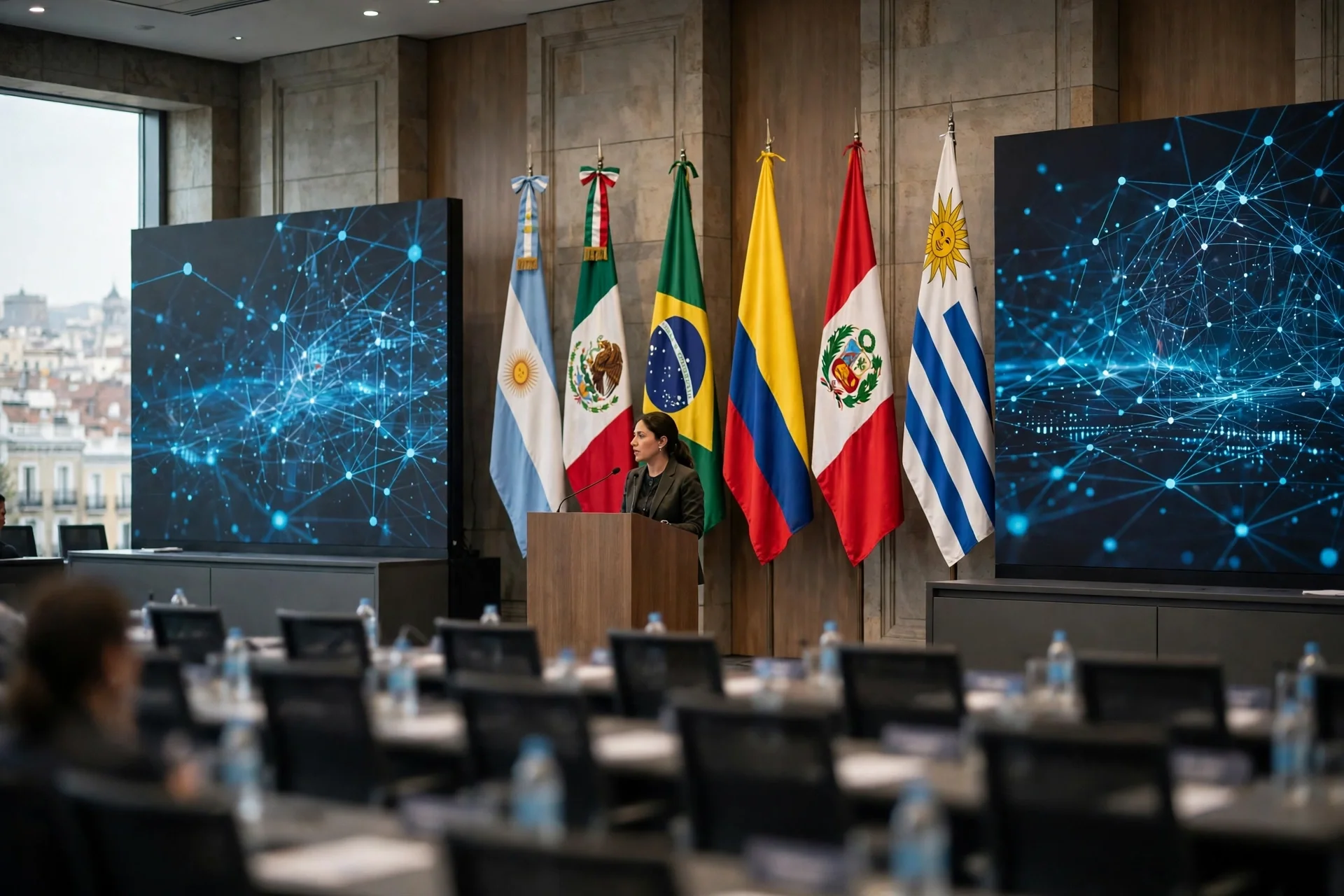
Imagen alusiva generada por EPM de una cumbre iberoamericana. · Imagen generada por EPM
Abinader proposes Dominican Republic host Ibero-American AI center in Madrid
President Luis Abinader proposed at the Thirtieth Ibero-American Summit in Madrid that the Dominican Republic host a center to consolidate the Ibero-American…
Dominican Republic offers to host Ibero-American artificial intelligence center
In Madrid, during the Thirtieth Ibero-American Summit, President Luis Abinader offered the Dominican Republic as host of a center to consolidate the…
--- The context ---
The Thirtieth Ibero-American Summit brings heads of state together in Madrid at a moment shaped by global crises, technological transformation and the need for common responses. Within that setting, according to the presidential address, artificial intelligence occupied a central place in the debate over development, alongside cooperation on family agriculture, social protection and climate risk management across the Ibero-American community.
--- The facts ---
President Luis Abinader proposed that the Dominican Republic become the host of a center that would help consolidate the purposes of the Ibero-American artificial intelligence alliance agreed at this gathering. To that end, he said the country makes available all the institutional and technical infrastructure resources it has. That center, he continued, could operate as the entity that drives the consolidation of that important instrument, so necessary to promote the development of these countries.
President Abinader stressed that artificial intelligence must be a tool to close gaps, not to widen inequalities. He also recalled the commitment to the Ibero-American Charter of Principles and Rights in Digital Environments, adopted in Santo Domingo in 2023, which, according to him, places human dignity at the center of the technological revolution. With the head of state in the Assembly hall were Foreign Minister Víctor Ito Bisonó, his assistant Eilyn Beltrán and Vice Minister Rubén Silié.
--- The positions ---
During his address, President Abinader called for stronger collaboration through concrete actions against global crises, expanding cooperation on family agriculture, social protection and early warning systems for climate risk management. At the national level, he highlighted that the country reduced the prevalence of undernourishment to below 2.5%, a milestone he said was recognized by the FAO and that allowed it to leave the Hunger Map. He also highlighted that monetary poverty fell from 19% in 2024 to 17.3% in 2025, and even further in 2026, and underlined the 2024 constitutional reform to limit presidential tenure and guarantee democratic alternation.
--- What remains unknown ---
The available information records no responses from other leaders to the proposal. It also does not specify a creation date, an exact location, financing or a summit decision. Those elements remain pending official confirmation and will determine the real scope of what was proposed in Madrid.
--- Unanswered questions ---
Will the summit accept the Dominican Republic as host of the center proposed by President Abinader? Which countries would contribute financing, technical staff and resources to launch it? When could it begin operating, and through which mechanisms would its impact on development be evaluated?
--- EPM analysis ---
The address combines a technological offer with a social and climate agenda. By linking artificial intelligence with human dignity and narrowing gaps, the approach seeks to ensure that innovation is measured by its effect on food security, poverty and emergency response.
📌 EPM Take: In EPM's view, the proposal attributed to President Abinader places the Dominican Republic inside a regional conversation where artificial intelligence can help close gaps if it is governed with clear rules, human dignity and effective cooperation among countries. The value of the initiative will depend on concrete agreements, defined financing and measurable results in education, social protection and risk management, without turning technology into a privilege concentrated in a few hands or a promise lacking verifiable public follow-up for Ibero-American citizens.
--- The context ---
Madrid hosts the Thirtieth Ibero-American Summit, a forum where leaders discuss cooperation, development and responses to global crises. In that setting, President Luis Abinader presented a technological proposal accompanied by a national record on social, economic and institutional matters, with emphasis on stability, democratic alternation and the strength of the rule of law, according to his address before the Assembly.
--- The facts ---
President Abinader proposed that the Dominican Republic host a center that would help consolidate the purposes of the Ibero-American artificial intelligence alliance agreed at the summit. He said the country makes available all the institutional and technical infrastructure resources it has. That center, he continued, could operate as the entity that drives the consolidation of that instrument, so necessary to promote the development of these countries.
The president stressed that artificial intelligence must be a tool to close gaps and not to widen inequalities. He also recalled the Ibero-American Charter of Principles and Rights in Digital Environments, adopted in Santo Domingo in 2023, which places human dignity at the center of the technological revolution. In the Assembly hall with him were Foreign Minister Víctor Ito Bisonó, his assistant Eilyn Beltrán and Vice Minister Rubén Silié.
--- The positions ---
On the economic and social front, President Abinader highlighted that undernourishment fell below 2.5%, a milestone he noted was recognized by the FAO and that allowed the country to leave the Hunger Map. He also said monetary poverty decreased from 19% in 2024 to 17.3% in 2025, and even further in 2026. On the institutional front, he underlined the 2024 constitutional reform to reinforce limits on presidential tenure and guarantee democratic alternation.
--- What remains unknown ---
The available information contains no response from other leaders and no summit decision on the proposed host. The date for creating the center, its exact location, its financing and its governing structure are also unknown. Without those details, the initiative remains a formal offer presented by President Abinader, awaiting definitions that would allow it to be assessed precisely.
--- Unanswered questions ---
Will the other leaders support the Dominican host proposed by President Abinader? How much would the center cost, and who would assume its initial and permanent financing? Which institutional safeguards would guarantee its continuity beyond the governments in office?
--- EPM analysis ---
The speech links technology, social results and limits on power within a single national narrative. By stating that institutions must always be stronger than those who lead them, President Abinader connects the center offer with the 2024 reform and with democratic alternation. That institutional coherence, together with cooperation on family agriculture, social protection and climate early warning, forms the political core of his presentation in Madrid.
📌 EPM Take: In EPM's view, the offer presented by President Abinader projects institutional order, democratic continuity and technical capacity as Dominican assets before Ibero-America. Presenting results on food and poverty alongside a reform that limits presidential tenure reinforces a message of responsibility and alternation. The proposal will gain weight if it becomes a sober structure, with defined costs, verifiable rules and concrete benefits, avoiding unnecessary bureaucracy and upholding the principle that institutions must remain above any temporary officeholder in a constitutional democracy.
Abinader propone en Madrid un centro iberoamericano de inteligencia artificial
El presidente Luis Abinader propuso en la XXX Cumbre Iberoamericana, en Madrid, que República Dominicana sea sede de un centro para consolidar la alianza…
República Dominicana se ofrece como sede del centro iberoamericano de IA
En Madrid, durante la XXX Cumbre Iberoamericana, el presidente Luis Abinader ofreció a República Dominicana como sede de un centro para consolidar la alianza…
--- El contexto ---
La XXX Cumbre Iberoamericana reúne en Madrid a mandatarios de la región en medio de crisis globales y transformación tecnológica. Según lo expuesto en la intervención presidencial, la inteligencia artificial ocupó un lugar central en el debate sobre el desarrollo, junto a la cooperación en agricultura familiar, protección social y gestión de riesgos climáticos.
--- Los hechos ---
El presidente Luis Abinader propuso que la República Dominicana se convierta en sede de un centro que contribuya a consolidar los propósitos de la alianza iberoamericana de inteligencia artificial acordados en este escenario. Para ello, dijo que el país pone a disposición todos los recursos de infraestructura institucionales y técnicos con los cuales cuenta. Ese centro, continuó, podría operar como la entidad que motorizará la consolidación de ese importante instrumento, tan necesario para impulsar el desarrollo de estos países.
El presidente Abinader recalcó que la inteligencia artificial debe ser una herramienta para cerrar brechas y no para ensanchar desigualdades. También recordó el compromiso con la Carta Iberoamericana de Principios y Derechos en los Entornos Digitales, adoptada en Santo Domingo en 2023, la cual, según indicó, coloca la dignidad humana en el centro de la revolución tecnológica. Junto al jefe de Estado estuvieron el canciller Víctor Ito Bisonó, su asistente Eilyn Beltrán y el viceministro Rubén Silié.
--- Las posiciones ---
Durante su intervención, el presidente Abinader llamó a fortalecer la colaboración mediante acciones concretas frente a las crisis globales, potenciando la cooperación en agricultura familiar, protección social y alerta temprana climática. A nivel nacional, resaltó que el país logró reducir la prevalencia de la subalimentación por debajo del 2,5 %, un hito que atribuyó como reconocido por la FAO y que le ha permitido salir del Mapa del Hambre. También resaltó que la pobreza monetaria bajó del 19 % en 2024 al 17,3 % en 2025, y aún más en 2026, y subrayó la reforma constitucional de 2024 para limitar el ejercicio presidencial y garantizar la alternancia democrática.
--- Lo que falta saber ---
La información disponible no registra respuestas de otros mandatarios a la propuesta. Tampoco precisa fecha de creación, sede exacta, financiación ni decisión de la cumbre. Esos elementos quedan pendientes de confirmación oficial y serán determinantes para medir el alcance real de lo planteado en Madrid.
--- Preguntas sin respuesta ---
¿Aceptará la cumbre que República Dominicana sea la sede del centro propuesto por el presidente Abinader? ¿Qué países aportarían financiación, personal técnico y recursos para ponerlo en marcha? ¿En qué plazo podría comenzar a operar y con qué mecanismos se evaluará su impacto en el desarrollo?
--- Análisis EPM ---
La intervención combina tecnología, agenda social y clima. Al vincular la inteligencia artificial con la dignidad humana, el planteamiento busca que la innovación se mida por su efecto en la alimentación, la pobreza y la respuesta ante emergencias.
📌 Conclusion EPM: A juicio de EPM, la propuesta atribuida al presidente Abinader coloca a República Dominicana en una conversación regional donde la inteligencia artificial puede servir para cerrar brechas si se gobierna con reglas claras, dignidad humana y cooperación efectiva entre países. El valor de la iniciativa dependerá de acuerdos concretos, financiación definida y resultados medibles en educación, protección social y gestión de riesgos, sin convertir la tecnología en un privilegio concentrado en pocas manos ni en una promesa sin seguimiento público verificable para la ciudadanía iberoamericana.
--- El contexto ---
Madrid acoge la XXX Cumbre Iberoamericana, foro donde los mandatarios discuten cooperación, desarrollo y respuestas ante crisis globales. En ese escenario, el presidente Luis Abinader presentó una propuesta tecnológica acompañada de un balance nacional social, económico e institucional, con énfasis en la alternancia democrática y el Estado de derecho, según su intervención.
--- Los hechos ---
El presidente Abinader propuso que la República Dominicana sea sede de un centro que contribuya a consolidar los propósitos de la alianza iberoamericana de inteligencia artificial acordados en la cumbre. Dijo que el país pone a disposición todos los recursos de infraestructura institucionales y técnicos con los cuales cuenta. Ese centro, continuó, podría operar como la entidad que motorizará la consolidación de ese instrumento, tan necesario para impulsar el desarrollo de estos países.
El mandatario recalcó que la inteligencia artificial debe ser una herramienta para cerrar brechas y no para ensanchar desigualdades. Recordó además la Carta Iberoamericana de Principios y Derechos en los Entornos Digitales, adoptada en Santo Domingo en 2023, la cual coloca la dignidad humana en el centro de la revolución tecnológica. En el salón de la Asamblea estuvieron junto a él el canciller Víctor Ito Bisonó, su asistente Eilyn Beltrán y el viceministro Rubén Silié.
--- Las posiciones ---
En el plano económico y social, el presidente Abinader resaltó que la subalimentación se redujo por debajo del 2,5 %, un hito que señaló como reconocido por la FAO y que permitió salir del Mapa del Hambre. También indicó que la pobreza monetaria disminuyó del 19 % en 2024 al 17,3 % en 2025, y aún más en 2026. En el plano institucional, subrayó la reforma constitucional de 2024 para reforzar los límites del ejercicio presidencial y garantizar la alternancia democrática.
--- Lo que falta saber ---
No consta en la información disponible una respuesta de otros mandatarios ni una decisión de la cumbre sobre la sede propuesta. Tampoco se conocen la fecha de creación del centro, su ubicación exacta, su financiación ni su estructura de gobierno. Sin esos datos, la iniciativa permanece como una oferta formal presentada por el presidente Abinader, a la espera de definiciones que permitan evaluarla con precisión.
--- Preguntas sin respuesta ---
¿Respaldarán los demás mandatarios la sede dominicana propuesta por el presidente Abinader? ¿Cuánto costaría el centro y quién asumiría su financiación inicial y permanente? ¿Qué salvaguardas institucionales garantizarían su continuidad más allá de los gobiernos de turno?
--- Análisis EPM ---
El discurso enlaza tecnología, resultados sociales y límites al poder en una misma narrativa de país. Al afirmar que las instituciones deben ser siempre más fuertes que quienes las dirigen, el presidente Abinader conecta la oferta del centro con la reforma de 2024 y con la alternancia democrática. Esa coherencia institucional, sumada a la cooperación en agricultura familiar, protección social y alerta temprana climática, constituye el núcleo político de su presentación en Madrid.
📌 Conclusion EPM: A juicio de EPM, la oferta presentada por el presidente Abinader proyecta orden institucional, continuidad democrática y capacidad técnica como activos de República Dominicana ante Iberoamérica. Presentar resultados en alimentación y pobreza junto a una reforma que limita el ejercicio presidencial refuerza un mensaje de responsabilidad y alternancia. La propuesta ganará peso si se traduce en una estructura sobria, con costos definidos, reglas verificables y beneficios concretos, evitando burocracia innecesaria y manteniendo el principio de que las instituciones deben permanecer por encima de cualquier gobernante temporal.