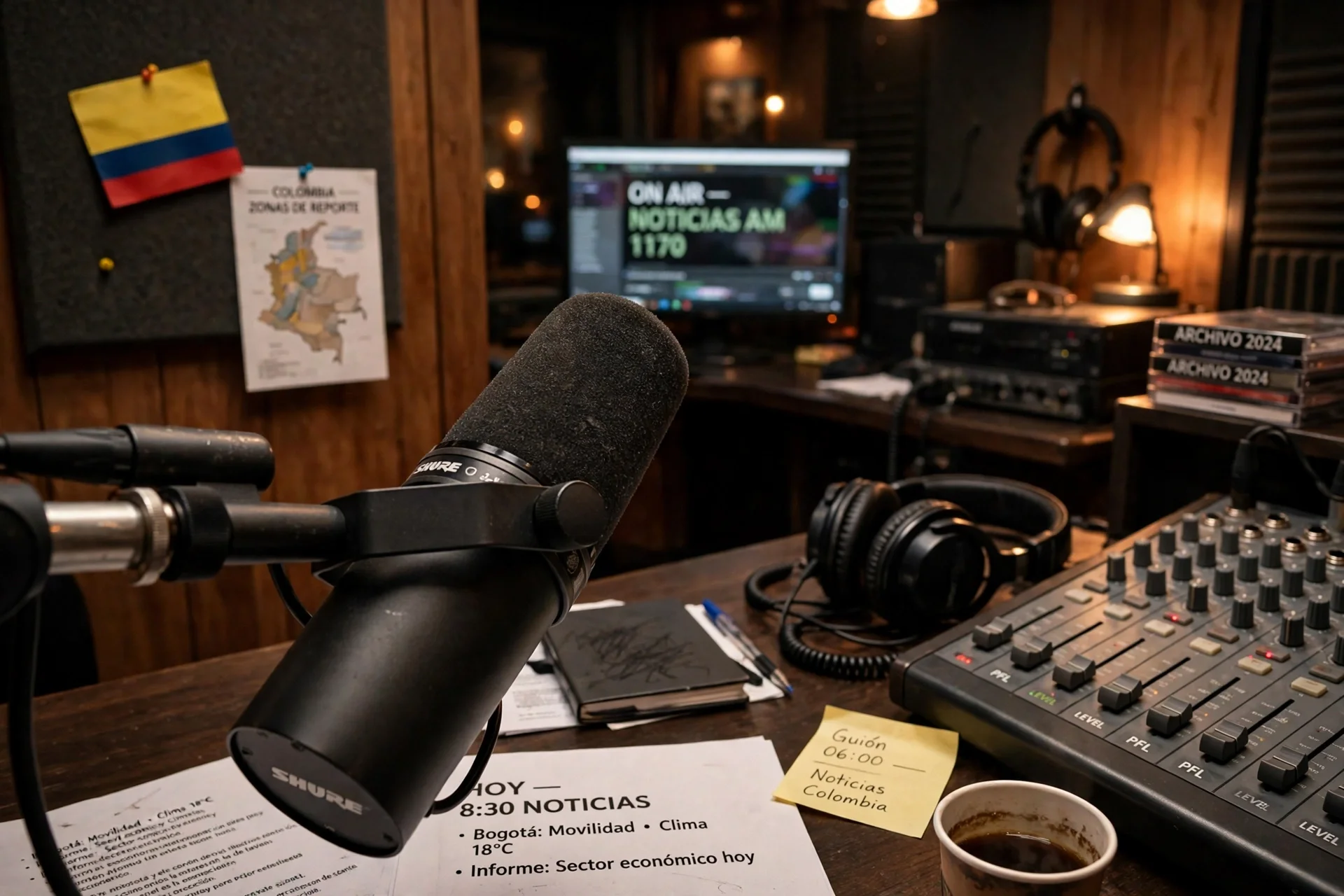
El testimonio radial de una periodista sobre un encuentro con el entonces presidente Gustavo Petro reavivó la controversia por las denuncias en su contra. · Imagen generada para EPM
Radio testimony on Petro revives controversy over alleged contracts
Journalist Vanessa de la Torre described on a live radio broadcast an encounter with then President Gustavo Petro in Cartagena, amid allegations by Deicy…
De la Torre account on Petro demands evidence and due process
Vanessa de la Torre said on a live radio broadcast that she met then President Gustavo Petro at the Cartagena airport after he canceled his agenda over an…
Journalist Vanessa de la Torre described on a live radio broadcast an encounter that, according to her account, she had with then President Gustavo Petro at the Cartagena airport.
--- The context ---
Her testimony became public amid the controversy over the allegations of Deicy Jiménez, a former contractor who claims Petro allegedly favored women with jobs or service orders in exchange for sexual relations, alleged accusations with no judicial decision.
According to the journalist, she traveled to Cartagena one day after Petro canceled his agenda over an alleged flu-like illness, and she said she found him at the airport in circumstances that contrasted with the official announcement.
--- The facts ---
According to De la Torre, Petro was accompanied, protected by his security detail and in poor condition, and when she greeted him and asked about his health, he allegedly replied that he had already improved a little.
The journalist said she kept the episode private for years because she considered it part of the president's personal life, and that she only made it public now, amid the national debate over Jiménez's allegations.
Jiménez released a 54-second video alongside the former president that, according to her, supports a link, but the recording by itself does not prove contracts in exchange for favors, and Secop records show her contracts with the Senate, the Interior Ministry and the Superintendency of Surveillance, with no judicial decision linking them to intimate encounters.
--- The positions ---
Petro categorically denied the accusations and maintained that the video has not been examined by experts or assessed by a judge and that no contracts or payments appear in the images.
Jiménez stands by her complaint, has already testified before the Supreme Court of Justice and her lawyer Dina Luz Malo announced she will hand the video to the authorities, while prosecutors opened a criminal investigation on October 23 and the Inspector General's Office conducts a preliminary disciplinary inquiry.
--- What remains unknown ---
There is still no judicial assessment of the video or substantive pronouncement on the unproven relationship between Jiménez's verifiable contracts and the conduct she denounces, so the available elements remain testimonies and records whose scope has yet to be determined.
--- Unanswered questions ---
What will prosecutors and oversight bodies determine about the authenticity, date and context of the 54-second video? Is there verifiable evidence linking the Secop contracts to the conduct denounced by Jiménez? What weight will De la Torre's testimony carry in the ongoing investigations?
--- EPM analysis ---
Her account adds public pressure to the case, but it does not replace the evidentiary burden of the authorities, because it is testimony about a private encounter that the journalist herself kept reserved for years and whose independent verification has not yet occurred.
In a matter mixing private life, public power and alleged irregularities in state contracting, distinguishing between what is recounted, what is recorded and what is proven is decisive to avoid an early judgment without competent decisions.
📌 EPM Take: In EPM's view, De la Torre's testimony should be read with the caution required by any account not yet verified by an authority, without dismissing it outright or turning it into proof of Jiménez's allegations. The accusations are serious because they involve the alleged use of power and public contracting, and for that very reason they require expert examinations, judicial decisions and results from prosecutors and oversight bodies before any definitive conclusion about the responsibilities of the former president or of those who publicly accuse him in this case.
A radio testimony once again placed then President Gustavo Petro under scrutiny, after journalist Vanessa de la Torre described on a live radio broadcast an encounter with him in Cartagena.
--- The context ---
The account emerges while the allegations of Deicy Jiménez move forward, a former contractor who claims Petro allegedly favored women with jobs or service orders in exchange for sexual relations, claims he has denied and that remain unproven in court.
According to the journalist, the encounter occurred one day after Petro suspended his agenda over an alleged flu-like illness, and she claimed he was accompanied, protected by his security detail and in poor condition, a version forming part of her testimony.
--- The facts ---
De la Torre recounted that she approached him to greet him and that, when she asked how he was recovering from the condition behind the cancellation, he replied that he had already improved a little, according to her own account on the broadcast.
The journalist stated that for years she refrained from revealing episodes from the former president's personal life because she considered them private, and that she decided to speak now, amid the controversy unleashed by Jiménez's complaints.
In parallel, Jiménez released a 54-second video alongside the former president that, according to her, supports a link, but the recording by itself does not prove contracts in exchange for favors, and Secop records show her contracts with the Senate, the Interior Ministry and the Superintendency of Surveillance, with no judicial decision linking them to intimate encounters.
--- The positions ---
Petro categorically denied the accusations and maintained that the video has not been examined by experts or assessed by a judge and that no contracts or payments appear in the images.
Jiménez stands by her version, has already given a statement before the Supreme Court of Justice and her lawyer Dina Luz Malo announced the handover of the video to the authorities, while prosecutors opened a criminal investigation on October 23 and the Inspector General's Office maintains a preliminary disciplinary inquiry.
--- What remains unknown ---
Authorities still must establish the authenticity, date, context and chain of custody of the video, as well as any demonstrable relationship between the registered contracts and the denounced conduct, without which the accusations retain their alleged character.
--- Unanswered questions ---
When will Jiménez's defense hand the video to the authorities and what will its technical examination show? Will prosecutors and oversight bodies prove or rule out a link between the Secop contracts and the allegations? What other testimonies will be incorporated into the criminal investigation opened on October 23?
--- EPM analysis ---
The center of the case remains institutional, because what is under discussion is not only a former president's private conduct, but the alleged use of state jobs and service orders, a matter demanding documentary evidence and formal decisions.
The presumption of innocence and due process protect all parties, including the complainant, whose testimony deserves rigorous verification, and the accused, who has the right not to have any accusation treated as proven without judicial assessment.
📌 EPM Take: In EPM's view, no radio testimony, however detailed it may seem, can replace the formal investigation already being conducted by prosecutors, oversight bodies and the Supreme Court of Justice. If public contracting was misused, it must be proven with documents, expert examinations and rulings, and if it was not, that too must be established with the same clarity before the country. Institutions, and not the pressure of public debate, are the only legitimate path to close this case with verifiable truth.
Testimonio radial sobre Petro reaviva la controversia por presuntos contratos
La periodista Vanessa de la Torre relató en una transmisión radial en vivo un encuentro con el entonces presidente Gustavo Petro en Cartagena, en medio de las…
Relato de De la Torre sobre Petro exige pruebas y debido proceso
Vanessa de la Torre contó en una transmisión radial en vivo que encontró al entonces presidente Gustavo Petro en el aeropuerto de Cartagena tras la cancelación…
La periodista Vanessa de la Torre relató en una transmisión radial en vivo un encuentro que, según su versión, sostuvo con el entonces presidente Gustavo Petro en el aeropuerto de Cartagena.
--- El contexto ---
El testimonio se conoció en medio de la controversia por las denuncias de Deicy Jiménez, excontratista que asegura que Petro habría favorecido a mujeres con empleos u órdenes de servicios a cambio de relaciones sexuales, acusaciones presuntas y sin decisión judicial.
Según la periodista, ella viajó a Cartagena un día después de que Petro cancelara su agenda por un supuesto cuadro gripal, y aseguró que lo encontró en la terminal aérea en circunstancias que contrastaban con el anuncio oficial.
--- Los hechos ---
Según De la Torre, Petro estaba acompañado, protegido por su esquema de seguridad y en mal estado, y al saludarlo y preguntarle por su salud, él le habría respondido que ya se había mejorado un poco.
La periodista aseguró que guardó el episodio durante años por considerarlo vida privada del mandatario, y que solo ahora lo hizo público, en pleno debate nacional por las denuncias de Jiménez.
Jiménez difundió un video de 54 segundos junto al expresidente que, según ella, respalda un vínculo, pero la grabación por sí misma no prueba contratos a cambio de favores, y los registros del Secop muestran contratos suyos con el Senado, el Ministerio del Interior y la Superintendencia de Vigilancia, sin decisión judicial que los vincule a encuentros íntimos.
--- Las posiciones ---
Petro negó categóricamente las acusaciones y sostuvo que el video no ha sido peritado ni valorado por un juez y que en las imágenes no aparecen contratos ni pagos.
Jiménez mantiene su denuncia, ya declaró ante la Corte Suprema de Justicia y su abogada Dina Luz Malo anunció que entregará el video a las autoridades, mientras la Fiscalía abrió una investigación penal el 23 de octubre y la Procuraduría adelanta una indagación previa disciplinaria.
--- Lo que falta saber ---
Aún no existe valoración judicial del video ni pronunciamiento de fondo sobre la relación, no probada, entre los contratos verificables de Jiménez y las conductas que ella denuncia, por lo que los elementos disponibles siguen siendo testimonios y registros cuyo alcance está por determinarse.
--- Preguntas sin respuesta ---
¿Qué determinarán la Fiscalía y la Procuraduría sobre la autenticidad, la fecha y el contexto del video de 54 segundos? ¿Existe evidencia verificable que vincule los contratos del Secop con las conductas denunciadas por Jiménez? ¿Qué peso tendrá el testimonio de De la Torre en las investigaciones en curso?
--- Análisis EPM ---
El relato añade presión pública al caso, pero no sustituye la carga probatoria de las autoridades, porque es un testimonio sobre un encuentro privado que la propia periodista reservó durante años y cuya verificación independiente aún no se produce.
En un asunto que mezcla vida privada, poder público y presuntas irregularidades en la contratación estatal, distinguir entre lo relatado, lo registrado y lo probado es decisivo para evitar un juicio anticipado sin decisiones competentes.
📌 Conclusion EPM: A juicio de EPM, el testimonio de De la Torre debe leerse con la prudencia que exige todo relato aún no verificado por una autoridad, sin desestimarlo de entrada ni convertirlo en prueba de las denuncias de Jiménez. Las acusaciones son graves porque involucran el uso presunto del poder y de la contratación pública, y por eso mismo requieren peritajes, decisiones judiciales y resultados de la Fiscalía y la Procuraduría antes de cualquier conclusión definitiva sobre responsabilidades del expresidente o de quienes hoy lo señalan públicamente en este caso.
Un testimonio radial volvió a poner bajo escrutinio al entonces presidente Gustavo Petro, luego de que la periodista Vanessa de la Torre relatara en una transmisión radial en vivo un encuentro con él en Cartagena.
--- El contexto ---
El relato surge mientras avanzan las denuncias de Deicy Jiménez, excontratista que asegura que Petro habría favorecido a mujeres con empleos u órdenes de servicios a cambio de relaciones sexuales.
Según la periodista, el encuentro ocurrió un día después de que Petro suspendiera su agenda por un supuesto cuadro gripal, y ella aseguró que estaba acompañado, protegido por su esquema de seguridad y en mal estado.
--- Los hechos ---
De la Torre relató que se acercó a saludarlo y que, al preguntarle cómo seguía de la afección que motivó la cancelación, él le respondió que ya se había mejorado un poco, de acuerdo con su propio relato en la transmisión.
La comunicadora afirmó que durante años se abstuvo de revelar episodios de la vida personal del exmandatario por considerarlos privados, y que decidió hablar ahora, en medio de la controversia desatada por las denuncias de Jiménez.
En paralelo, Jiménez difundió un video de 54 segundos junto al expresidente que, según ella, respalda un vínculo, pero la grabación por sí misma no prueba contratos a cambio de favores, y los registros del Secop muestran contratos suyos con el Senado, el Ministerio del Interior y la Superintendencia de Vigilancia, sin decisión judicial que los vincule a encuentros íntimos.
--- Las posiciones ---
Petro negó categóricamente las acusaciones y sostuvo que el video no ha sido peritado ni valorado por un juez y que en las imágenes no aparecen contratos ni pagos.
Jiménez sostiene su versión, ya rindió declaración ante la Corte Suprema de Justicia y su abogada Dina Luz Malo anunció la entrega del video a las autoridades, en tanto la Fiscalía abrió una investigación penal el 23 de octubre y la Procuraduría mantiene una indagación previa disciplinaria.
--- Lo que falta saber ---
Las autoridades aún deben establecer la autenticidad, la fecha, el contexto y la cadena de custodia del video, así como cualquier relación demostrable entre los contratos registrados y las conductas denunciadas, sin lo cual las acusaciones mantienen su carácter de presuntas.
--- Preguntas sin respuesta ---
¿Cuándo entregará la defensa de Jiménez el video a las autoridades y qué arrojará su peritaje técnico? ¿Podrán la Fiscalía y la Procuraduría demostrar o descartar un vínculo entre los contratos del Secop y los señalamientos? ¿Qué otros testimonios se incorporarán a la investigación penal abierta el 23 de octubre?
--- Análisis EPM ---
El centro del caso es institucional, porque lo discutido no es solo la conducta privada de un expresidente, sino la presunta utilización de empleos y órdenes de servicios del Estado, asunto que exige pruebas y decisiones formales.
La presunción de inocencia y el debido proceso protegen a todas las partes, incluida la denunciante, cuyo testimonio merece verificación, y al señalado, que tiene derecho a que ninguna acusación se dé por probada sin valoración judicial.
📌 Conclusion EPM: A juicio de EPM, ningún testimonio radial, por detallado que parezca, puede reemplazar la investigación formal que ya adelantan la Fiscalía, la Procuraduría y la Corte Suprema de Justicia. Si existió un uso indebido de la contratación pública, debe probarse con documentos, peritajes y fallos, y si no existió, también debe quedar establecido con la misma claridad ante el país. La institucionalidad, y no la presión del debate público, es la única vía legítima para cerrar este caso con verdad verificable y responsabilidades debidamente sustentadas.