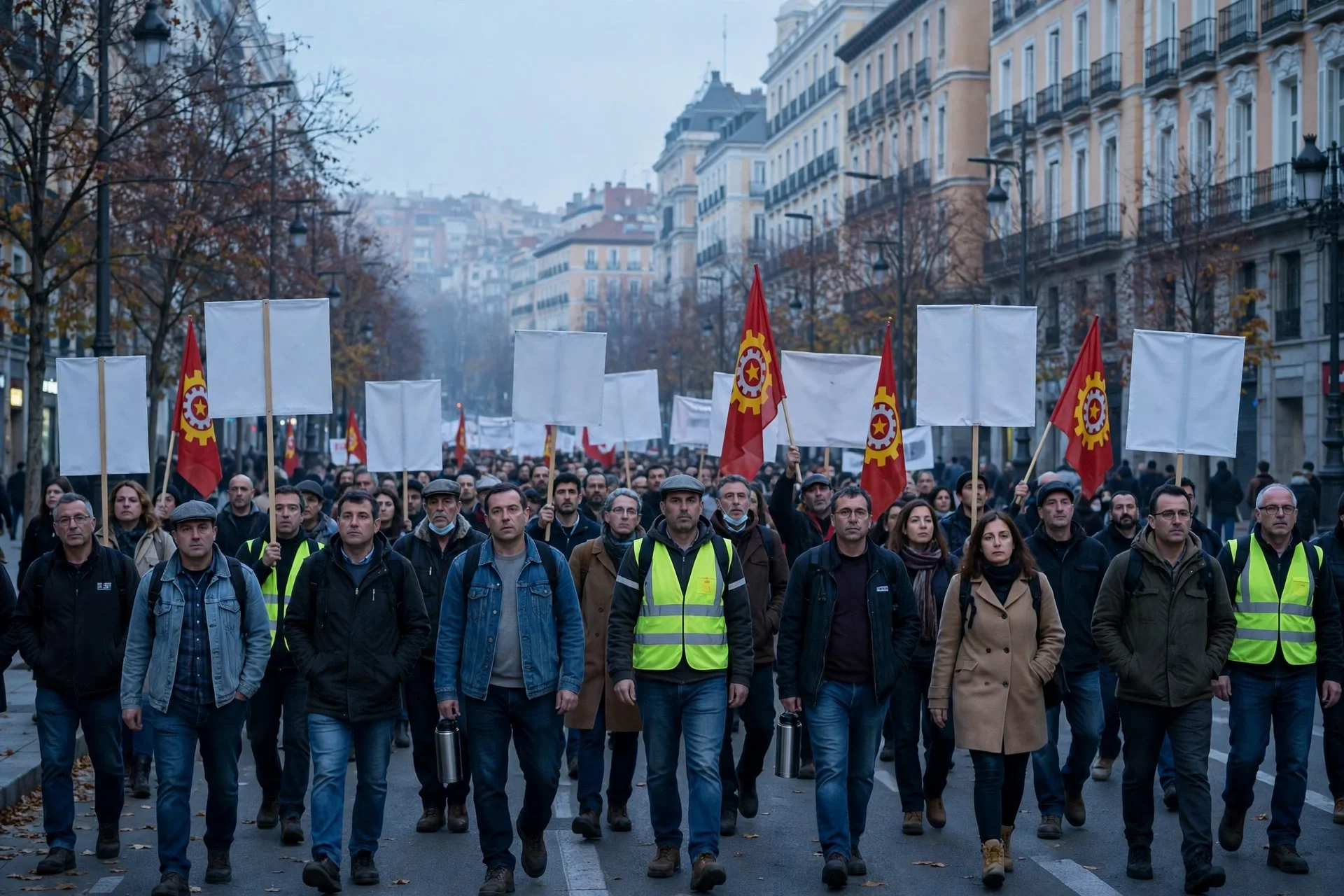
Marcha de trabajadores en Madrid en vísperas de la huelga general del 11 de noviembre. · Imagen generada por EPM
Diaz urges November 11 general strike and November 29 vote
Yolanda Diaz called for support for the November 11 general strike, defended its political character, guaranteed a new minimum wage rise before the end of the…
Diaz defends political strike and promises a wage rise
Yolanda Diaz defended the political character of the November 11 general strike, guaranteed a new minimum wage rise before the end of the year, accused…
--- The context --- Spain faces two decisive dates in November, a general strike called by trade union organisations for November 11 and a general election set for November 29. In that climate of mobilisation and campaigning, the debate over wages, prices and labour rights sits at the centre of the country's public conversation
--- The facts --- Second Deputy Prime Minister and Labour Minister Yolanda Diaz on Friday called on workforces and works councils across Spain to back the general strike on November 11. She openly defended its political character, described criticism and doubts about its legality or constitutionality as delirious, while saying a worker who strikes gives up pay hoping to improve living conditions.
Diaz justified the mobilisation with corporate results, noting that the 35 Ibex 35 companies closed the first half of 2026 with combined profits of 36,473 million euros, double the figures of European corporations. Citing a recent Bank of Spain report, she also said the margins of microbusinesses with fewer than ten employees are even higher than those of the blue-chip index.
--- The positions --- The minister reproached employers for blocking a new Agreement for Employment and Collective Bargaining and for refusing to raise wages in a country with inflation at 4.9%. In contrast, she guaranteed that the government will raise the interprofessional minimum wage again before the end of the year, and warned that employers trust in the arrival of the PP to freeze that wage, link pensions to 0.25% and force more overtime, in a context where 2.5 million hours are worked unpaid each week.
--- What remains unknown --- The concrete amount of the new minimum wage rise promised before the end of the year is still unknown, as is whether there will be room to unblock the pay agreement with employers. It is also unclear what support the strike will achieve across sectors.
--- Unanswered questions --- How much will the minimum wage finally rise before the year ends? Will the general strike manage to unblock collective bargaining with employers? Will the appeal to vote on November 29 succeed in preserving the labour rights the minister defends?
--- EPM analysis --- The message combines labour mobilisation and an electoral appeal in a single act, linking protest in the street with the decision at the ballot box. The reference to corporate profits and the cost of living seeks to give the protest an economic basis, while the closing appeals to voting with joy and conviction.
📌 EPM Take: In EPM's view, Diaz's intervention turns the November 11 strike into a test of strength ahead of the November 29 election, where it will be measured whether discontent over wages and prices also transfers to the ballot box. The contrast between record profits and contained wages explains the hardness of the speech, although its real effect will depend on the strike's support, on the concrete minimum wage rise and on collective bargaining that remains blocked.
--- The context --- Spain faces in November a general strike called by trade union organisations for November 11 and a general election scheduled for November 29. Both dates intersect with wages, inflation and labour reforms as central issues in the national debate.
--- The facts --- Second Deputy Prime Minister and Labour Minister Yolanda Diaz on Friday asked workers and works councils to back the general strike on November 11. She defended it as a political mobilisation, rejected doubts about its legality by calling them delirious, and joked that her team has forbidden her from joining as a picket, although she will support the call.
To support her position, Diaz recalled that the 35 Ibex 35 companies obtained in the first half of 2026 combined profits of 36,473 million euros, double those of European corporations. She added, relying on a recent Bank of Spain report, that the margins of microbusinesses with fewer than ten employees even exceed those of the blue-chip index
--- The positions --- The minister accused employers of blocking a new Agreement for Employment and Collective Bargaining and of refusing to raise wages with inflation at 4.9%, and she guaranteed a new rise in the interprofessional minimum wage before the end of the year. She also argued that employers await the arrival of the PP to freeze that wage, link pensions to 0.25% and increase overtime, recalling that 2.5 million hours are worked unpaid each week.
--- What remains unknown --- The amount of the promised minimum wage rise still needs to be specified, as does whether there will be any prior negotiation with employers and unions. It has also not been clarified which pending reforms, such as dismissal rules or the part-time contract, could be resumed after the election.
--- Unanswered questions --- What cost will the announced new minimum wage rise have for companies and workers? Can a strike declared to be political unblock collective bargaining or will it harden it further? What weight will wages and pensions carry in the November 29 election result?
--- EPM analysis --- The speech assumes without qualification the political character of the strike, a point that feeds discussion about the boundary between labour protest and election campaigning. Diaz also boasted of employment figures by noting that the country is close to 23 million people in work and has 10.7 million women working, compared with 18.4 million people in work when she arrived at the ministry, and she evoked the reelection of Lula da Silva in Brazil and the defeat of Donald Trump in the United States.
📌 EPM Take: In EPM's view, the main question raised by the call is not only about labour, but institutional and electoral, because a strike presented as political requires careful measurement of its support, its cost and its real social backing. The corporate profits cited are a powerful argument in the wage debate, but blocked bargaining and pending reforms show that the conflict will remain open after November 29, whatever government emerges from the ballot box.
Díaz llama a la huelga del 11 de noviembre y a votar el 29N
Yolanda Díaz llamó a secundar la huelga general del 11 de noviembre, defendió su carácter político, garantizó una nueva subida del salario mínimo antes de fin…
Díaz defiende el carácter político de la huelga general del 11N
Yolanda Díaz defendió el carácter político de la huelga general del 11 de noviembre, garantizó una nueva subida del salario mínimo antes de fin de año, acusó a…
--- El contexto --- España se acerca a dos citas decisivas en noviembre, una huelga general convocada por las organizaciones sindicales para el día 11 y unas elecciones generales fijadas para el 29 de noviembre. En ese ambiente, el debate sobre salarios, precios y derechos laborales ocupa el centro de la conversación pública.
--- Los hechos --- La vicepresidenta segunda y ministra de Trabajo, Yolanda Díaz, llamó este viernes a las plantillas y a los comités de empresa de toda España a secundar la huelga general del 11 de noviembre. Defendió su carácter político y calificó de delirantes las dudas expresadas sobre su legalidad o su constitucionalidad.
Díaz justificó la movilización con los resultados empresariales y señaló que las 35 empresas del Ibex 35 cerraron el primer semestre de 2026 con un beneficio conjunto de 36.473 millones de euros, el doble de los registros de las corporaciones europeas. También citó un informe del Banco de España según el cual los márgenes de las microempresas son incluso superiores a los del selectivo.
--- Las posiciones --- La ministra reprochó a la patronal que bloquee la firma de un nuevo Acuerdo para el Empleo y la Negociación Colectiva y que se niegue a subir los salarios en un país con un IPC al 4,9%. Frente a ello, garantizó que el Gobierno volverá a incrementar el salario mínimo interprofesional antes de que finalice el año y advirtió de que la patronal confía en la llegada del PP para congelar ese salario, ligar las pensiones al 0,25% y forzar más horas extras, con 2,5 millones de horas sin retribuir a la semana.
--- Lo que falta saber --- Todavía no se conoce la cuantía concreta de la nueva subida del salario mínimo anunciada para antes de fin de año, ni si habrá margen para desbloquear el acuerdo salarial con la patronal. Tampoco está claro qué seguimiento tendrá la huelga en los distintos sectores.
--- Preguntas sin respuesta --- ¿Cuánto subirá finalmente el salario mínimo antes de que termine el año? ¿Logrará la huelga general desbloquear la negociación del acuerdo salarial con la patronal? ¿Conseguirá la llamada al voto del 29 de noviembre preservar los derechos laborales que la ministra defiende?
--- Análisis EPM --- El mensaje combina movilización laboral y llamamiento electoral en un mismo acto, porque vincula la protesta en la calle con la decisión en las urnas. La referencia a los beneficios y al coste de la vida busca dar base económica a la protesta, y el cierre apela a votar con alegría y convicción.
📌 Conclusion EPM: A juicio de EPM, la intervención de Díaz convierte la huelga del 11 de noviembre en una prueba de fuerza previa a las elecciones del 29 de noviembre, donde se medirá si el malestar por los salarios y los precios se traslada también a las urnas. El contraste entre beneficios récord y salarios contenidos explica la dureza del discurso, aunque su efecto real dependerá del seguimiento de la protesta, de la subida concreta del salario mínimo y de una negociación colectiva que sigue bloqueada.
--- El contexto --- España afronta en noviembre una huelga general convocada por las organizaciones sindicales para el día 11 y unas elecciones generales previstas para el 29 de noviembre. Ambas fechas se cruzan con los salarios, la inflación y las reformas laborales como asuntos centrales del debate.
--- Los hechos --- La vicepresidenta segunda y ministra de Trabajo, Yolanda Díaz, pidió este viernes a trabajadores y comités de empresa que secunden la huelga general del 11 de noviembre. La defendió como una movilización política, rechazó las dudas sobre su legalidad calificándolas de delirantes y bromeó con que su equipo le ha prohibido acudir como piquete, aunque apoyará la convocatoria.
Para sostener su posición, Díaz recordó que las 35 empresas del Ibex 35 obtuvieron en el primer semestre de 2026 un beneficio conjunto de 36.473 millones de euros, el doble que las corporaciones europeas. Añadió, apoyándose en un informe del Banco de España, que los márgenes de las microempresas superan incluso a los del selectivo.
--- Las posiciones --- La ministra acusó a la patronal de bloquear un nuevo Acuerdo para el Empleo y la Negociación Colectiva y de negarse a subir salarios con un IPC al 4,9%, y garantizó una nueva subida del salario mínimo interprofesional antes de fin de año. También sostuvo que la patronal espera la llegada del PP para congelar ese salario, ligar las pensiones al 0,25% y aumentar las horas extras, recordando que cada semana se hacen 2,5 millones de horas sin retribuir.
--- Lo que falta saber --- Falta por concretar el importe de la subida del salario mínimo prometida y si existirá alguna negociación previa con empresarios y sindicatos. Tampoco se ha precisado qué reformas pendientes, como la revisión del despido o el contrato a tiempo parcial, podrían retomarse tras las elecciones.
--- Preguntas sin respuesta --- ¿Qué coste tendrá para empresas y trabajadores la nueva subida del salario mínimo anunciada? ¿Puede una huelga declaradamente política desbloquear la negociación colectiva o la endurecerá más? ¿Qué peso tendrán los salarios y las pensiones en el resultado electoral del 29 de noviembre?
--- Análisis EPM --- El discurso asume sin matices el carácter político de la huelga, un punto que alimenta la discusión sobre la frontera entre protesta laboral y campaña electoral. Díaz presumió además de empleo al señalar que el país roza los 23 millones de ocupados y cuenta con 10,7 millones de mujeres trabajando, frente a los 18,4 millones de ocupados existentes cuando llegó al ministerio, y evocó la reelección de Lula da Silva en Brasil y la derrota de Donald Trump en Estados Unidos.
📌 Conclusion EPM: A juicio de EPM, el principal interrogante del llamamiento no es solo laboral, sino institucional y electoral, porque una huelga presentada como política exige medir con cuidado su seguimiento, su coste y su respaldo social real. Los beneficios empresariales citados son un argumento potente en el debate salarial, pero la negociación bloqueada y las reformas pendientes muestran que el conflicto seguirá abierto tras el 29 de noviembre, sea cual sea el gobierno que salga de las urnas.