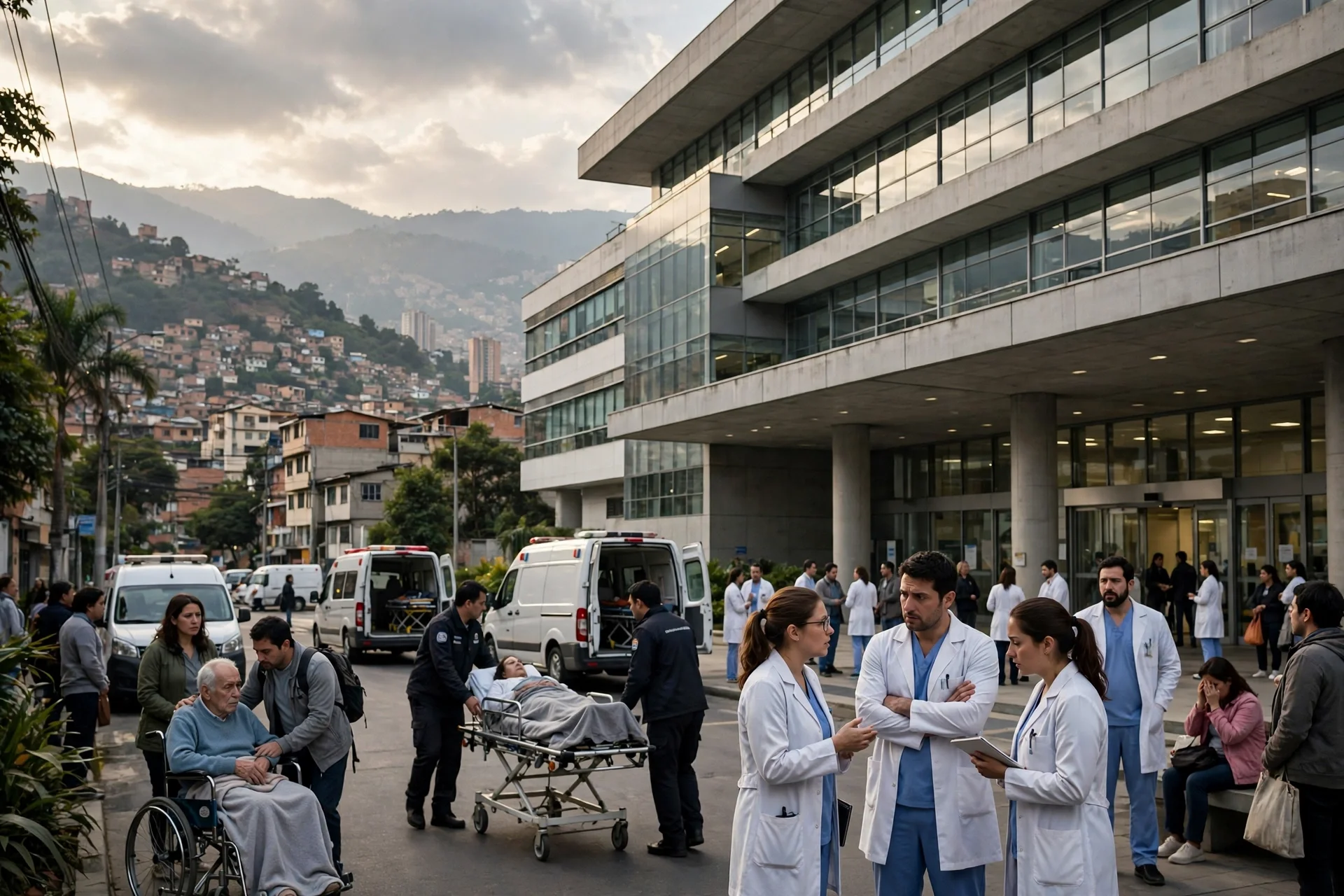
Personal y pacientes a la entrada de una gran clínica en Santander. Imagen generada.
Foscal Clinic Seeks Presidential Help to Avoid Service Closures
Foscal Clinic in Floridablanca, Santander, warned of a possible progressive closure of services over debts of more than 600.000 million pesos owed by health…
Foscal Warns of Gradual Service Closures Over Unpaid Debts
Foscal Clinic warned it could progressively close some services over debts of more than 600.000 million pesos owed by health insurers, and asked President…
--- The context ---
Foscal Clinic, located in Floridablanca in the department of Santander, is one of the reference medical institutions for thousands of patients across the region. Its daily operation sustains consultations, surgeries, hospitalizations and specialized treatments on which entire families depend, many of them without any nearby alternative for complex care.
--- The facts ---
The institution issued a statement saying it faces debts of more than 600.000 million pesos in resources owed to it by health insurers known as EPS. Faced with that situation, it warned of the possibility of a progressive closure of some of its services if the outstanding portfolio remains unresolved.
The scale of the center helps measure the risk. According to the institution itself, each year it handles 664.423 consultations, performs 21.081 surgical procedures and records more than 28.000 hospital discharges. Added to that are 6.583 chemotherapy and radiotherapy treatments and more than 27.000 oncology appointments, services that are especially sensitive for the patients receiving them.
--- The positions ---
Through a letter addressed to the president of Colombia, Abelardo De La Espriella, the institution sent an SOS and requested his intervention to prevent the closure. In the letter it said that Nueva EPS and FOMAG are the entities that owe it the most, accounting for more than 90 % of the outstanding portfolio.
The institution said it has made every effort needed to keep operating, but noted that the accumulated debts exceeded the limits of its financial capacity and compromised the continuity of its operations. In its statement it also explained, in terms attributed to the institution itself, that the situation directly affected its cash flow and the timely fulfillment of essential obligations.
--- What remains unknown ---
The statement attributed to the clinic specified that the affected obligations include payments to suppliers of medicines, supplies and indispensable services, the purchase of resources needed to guarantee continuous and safe care, the sustaining of its operational and administrative capacity, and payroll for its workers and health professionals. It also warned that the lack of payments affected compliance with obligations toward its employees and the ability to guarantee better care for patients.
--- Unanswered questions ---
Which specific services would be first in an eventual progressive closure, and on what timeline? When will payments from Nueva EPS and FOMAG arrive to relieve the outstanding portfolio? What would happen to oncology patients and to treatments already under way if the clinic is forced to reduce its capacity?
--- EPM analysis ---
When an institution of this size stops receiving what it is owed, the harm does not stay on an accounting balance: it moves to the payroll of health workers, to suppliers of medicines and supplies and, at the end of the chain, to the patient waiting for surgery or cancer treatment.
The underlying problem this case reveals is structural and predates any single moment: a system in which the provider finances, out of its own cash flow, the delays of those who must pay. Making those payments orderly and predictable is the discussion this SOS puts on the table, and it does not depend on any one actor alone.
📌 EPM Take:
In EPM's view, the Foscal letter should be read for what it is: a call for help from an institution that sustains much of the specialized care in Santander and that is asking for intervention before it is forced to close services. With debts above 600.000 million and a portfolio concentrated in two payers, the way out runs through certain and verifiable payments that protect patients and workers. The health of a region cannot rest on the financial endurance of a single hospital.
--- The context ---
In Floridablanca, Santander, Foscal Clinic provides high-demand medical services for the region and sustains a broad operation that includes consultations, surgery, hospitalization and oncology. An institution of that size runs on high fixed costs and a specialized payroll that cannot stop without immediate consequences for patients.
--- The facts ---
The clinic issued a statement saying it faces debts of more than 600.000 million pesos in resources owed to it by health insurers known as EPS. Against that backdrop, it warned of the possibility of a progressive closure of some of its services, a step it described as the consequence of the accumulated weight of unpaid bills.
Its care volumes explain the concern. The institution said it handles 664.423 consultations each year, performs 21.081 surgical procedures and records more than 28.000 hospital discharges. It also reports 6.583 chemotherapy and radiotherapy treatments and more than 27.000 oncology appointments, figures that show how many patients depend on its operational continuity.
--- The positions ---
Through a letter addressed to the president of Colombia, Abelardo De La Espriella, the institution sent an SOS and requested his intervention to prevent the closure. In the letter it reported that Nueva EPS and FOMAG are the entities that owe it the most, accounting for more than 90 % of the portfolio still awaiting payment.
The institution said it has made every effort needed to keep operating; however, it held that the accumulated debts exceeded the limits of its financial capacity and compromised the continuity of its operations. As it explained in its statement, the situation directly affected its cash flow and the timely fulfillment of obligations that are essential to operate.
--- What remains unknown ---
Among those obligations, the statement attributed to the clinic mentioned financial commitments with suppliers of medicines, supplies and indispensable services, the purchase of resources needed for continuous and safe care, the sustaining of operational and administrative capacity, and payroll for workers and health professionals. The institution added that the lack of payments also affected compliance with its employees and the care provided to patients.
--- Unanswered questions ---
Is there an agreed payment schedule with Nueva EPS and FOMAG to reduce the portfolio? Which services would be the first to feel a progressive closure if the payments do not arrive? How long can the clinic sustain its operation on its current cash flow before it has to take more drastic decisions?
--- EPM analysis ---
No institution, however well managed, can operate indefinitely when those who must pay it accumulate a portfolio of this magnitude. Payment discipline is not an administrative detail: it is the condition that makes it possible to buy medicines, meet payroll and keep operating rooms open.
This case also leaves a lesson in financial order for the whole system. When the payer falls behind, the cost does not disappear: the provider absorbs it through its credit, its staff and its suppliers, until the bill becomes unsustainable. Correcting that chain of delays is what would give lasting stability to clinics such as Foscal.
📌 EPM Take:
In EPM's view, the Foscal SOS is above all a signal of pending financial discipline: the services have already been provided and the bills must be honored so the institution can keep operating. With more than 600.000 million at stake and more than 90 % of the portfolio held by two entities, the priority is a payment plan that can actually be met and that gives certainty to the clinic, its workers and the Santander patients who depend on it every day.
Clínica Foscal pide ayuda presidencial ante deudas de 600.000 millones
La Clínica Foscal, de Floridablanca, Santander, advirtió una posible reducción progresiva de servicios por deudas superiores a 600.000 millones de pesos que le…
Foscal advierte cierre progresivo de servicios por cartera vencida
La Clínica Foscal advirtió que podría cerrar progresivamente algunos servicios por una deuda superior a 600.000 millones de pesos que le adeudan las EPS, y…
--- El contexto ---
La Clínica Foscal, ubicada en Floridablanca, Santander, es una institución médica de referencia para miles de pacientes de la región. Su funcionamiento sostiene consultas, cirugías, hospitalizaciones y tratamientos especializados de los que dependen familias enteras.
--- Los hechos ---
La institución emitió un comunicado en el que expuso que enfrenta una deuda superior a los 600.000 millones de pesos por recursos que las EPS le adeudan. Ante esa situación, advirtió sobre la posibilidad de un cierre progresivo de algunos de sus servicios si la cartera pendiente sigue sin resolverse.
La magnitud del centro ayuda a dimensionar el riesgo. Según dio a conocer la propia institución, cada año atiende 664.423 consultas, realiza 21.081 procedimientos quirúrgicos y registra más de 28.000 egresos hospitalarios. A ello se suman 6.583 tratamientos de quimioterapia y radioterapia y más de 27.000 citas de oncología, servicios especialmente sensibles para los pacientes que los reciben.
--- Las posiciones ---
A través de una carta dirigida al presidente de Colombia, Abelardo De La Espriella, la entidad lanzó un SOS y solicitó su intervención para evitar el cierre. En la misiva dio a conocer que la Nueva EPS y el FOMAG son las entidades que más le adeudan, concentrando más del 90 % de la cartera pendiente.
La institución indicó que ha realizado todos los esfuerzos necesarios para mantenerse en funcionamiento, pero señaló que las deudas acumuladas superaron los límites de su capacidad financiera y comprometieron la continuidad de sus operaciones. En su comunicado explicó además, en términos atribuidos a la propia entidad, que la situación afectó directamente su flujo de caja y el cumplimiento oportuno de obligaciones esenciales.
--- Lo que falta saber ---
El comunicado atribuido a la clínica precisó que entre las obligaciones afectadas están el pago a proveedores de medicamentos, insumos y servicios indispensables, la adquisición de recursos para una prestación continua y segura, el sostenimiento de su capacidad operativa y el pago de la nómina de sus trabajadores. También advirtió que la falta de pagos afectó las obligaciones con sus empleados y la prestación a los pacientes.
--- Preguntas sin respuesta ---
¿Qué servicios concretos entrarían primero en un eventual cierre progresivo y en qué plazos? ¿Cuándo se producirán los pagos de la Nueva EPS y del FOMAG que permitan aliviar la cartera pendiente? ¿Qué pasaría con los pacientes de oncología y con los tratamientos en curso si la capacidad de la clínica se reduce?
--- Análisis EPM ---
Cuando una institución de este tamaño deja de recibir lo que le deben, el daño no se queda en un balance: se traslada a la nómina del personal de salud, a los proveedores de medicamentos y, al final de la cadena, al paciente que espera una cirugía o un tratamiento contra el cáncer.
El problema de fondo es estructural: un sistema en el que quien presta el servicio financia con su propio flujo de caja la demora de quien debe pagar. Ordenar esos pagos y hacerlos previsibles es la discusión que este SOS pone sobre la mesa.
📌 Conclusion EPM:
A juicio de EPM, la carta de la Foscal debe leerse como lo que es: el llamado de auxilio de una institución que sostiene buena parte de la atención especializada de Santander y que pide intervención antes de verse obligada a cerrar servicios. Con deudas por encima de los 600.000 millones y una cartera concentrada en dos pagadores, la salida pasa por pagos ciertos y verificables que protejan a pacientes y trabajadores. La salud de la región no puede depender de la resistencia financiera de un solo hospital.
--- El contexto ---
En Floridablanca, Santander, la Clínica Foscal presta servicios médicos de alta demanda para la región y sostiene una operación amplia que incluye consultas, cirugía, hospitalización y oncología. Una institución de ese tamaño funciona con costos fijos elevados y con una nómina especializada que no puede detenerse sin consecuencias inmediatas para los pacientes.
--- Los hechos ---
La clínica emitió un comunicado en el que expuso que enfrenta una deuda superior a los 600.000 millones de pesos por recursos que las EPS le adeudan. Con ese panorama, advirtió sobre la posibilidad de un cierre progresivo de algunos de sus servicios, una decisión que describió como consecuencia del peso acumulado de la cartera sin pagar.
Los volúmenes de atención explican la preocupación. La institución dio a conocer que anualmente atiende 664.423 consultas, realiza 21.081 procedimientos quirúrgicos y registra más de 28.000 egresos hospitalarios. También reporta 6.583 tratamientos de quimioterapia y radioterapia y más de 27.000 citas de oncología, cifras que muestran cuántos pacientes dependen de su continuidad operativa.
--- Las posiciones ---
Mediante una carta dirigida al presidente de Colombia, Abelardo De La Espriella, la entidad lanzó un SOS y solicitó su intervención para evitar el cierre. En la misiva informó que la Nueva EPS y el FOMAG son las entidades que más le adeudan, concentrando más del 90 % de la cartera pendiente de pago.
La institución indicó que ha realizado todos los esfuerzos necesarios para mantenerse en funcionamiento; sin embargo, sostuvo que las deudas acumuladas superaron los límites de su capacidad financiera y comprometieron la continuidad de sus operaciones. Según explicó en su comunicado, la situación afectó directamente su flujo de caja y el cumplimiento oportuno de obligaciones esenciales para operar.
--- Lo que falta saber ---
Entre esas obligaciones, el comunicado atribuido a la clínica mencionó el pago de compromisos financieros con proveedores de medicamentos, insumos y servicios indispensables, la adquisición de los recursos necesarios para una prestación continua y segura, el sostenimiento de la capacidad operativa y administrativa y el pago de la nómina de trabajadores y profesionales de la salud. La entidad añadió que la falta de pagos afectó también el cumplimiento con sus empleados y la prestación a los pacientes.
--- Preguntas sin respuesta ---
¿Existe un cronograma de pagos acordado con la Nueva EPS y el FOMAG para reducir la cartera? ¿Qué servicios serían los primeros en resentir un cierre progresivo si los pagos no llegan? ¿Cuánto tiempo puede sostener la clínica su operación con el flujo de caja actual antes de tomar decisiones más drásticas?
--- Análisis EPM ---
Ninguna institución, por bien administrada que esté, puede operar indefinidamente cuando quienes deben pagarle acumulan una cartera de esta magnitud. La disciplina de pago no es un detalle administrativo: es la condición que permite comprar medicamentos, pagar nóminas y mantener abiertas las salas de cirugía.
Este caso deja además una lección de orden financiero. Cuando el pagador se atrasa, el costo no desaparece: lo asume el prestador con su crédito, su personal y sus proveedores, hasta que la cuenta se vuelve insostenible.
📌 Conclusion EPM:
A juicio de EPM, el SOS de la Foscal es ante todo una señal de disciplina financiera pendiente: los servicios ya fueron prestados y las cuentas deben honrarse para que la institución pueda seguir operando. Con más de 600.000 millones en juego y más del 90 % de la cartera en dos entidades, la prioridad es un plan de pagos cumplible que dé certidumbre a la clínica, a sus trabajadores y a los pacientes de Santander que dependen de ella cada día.