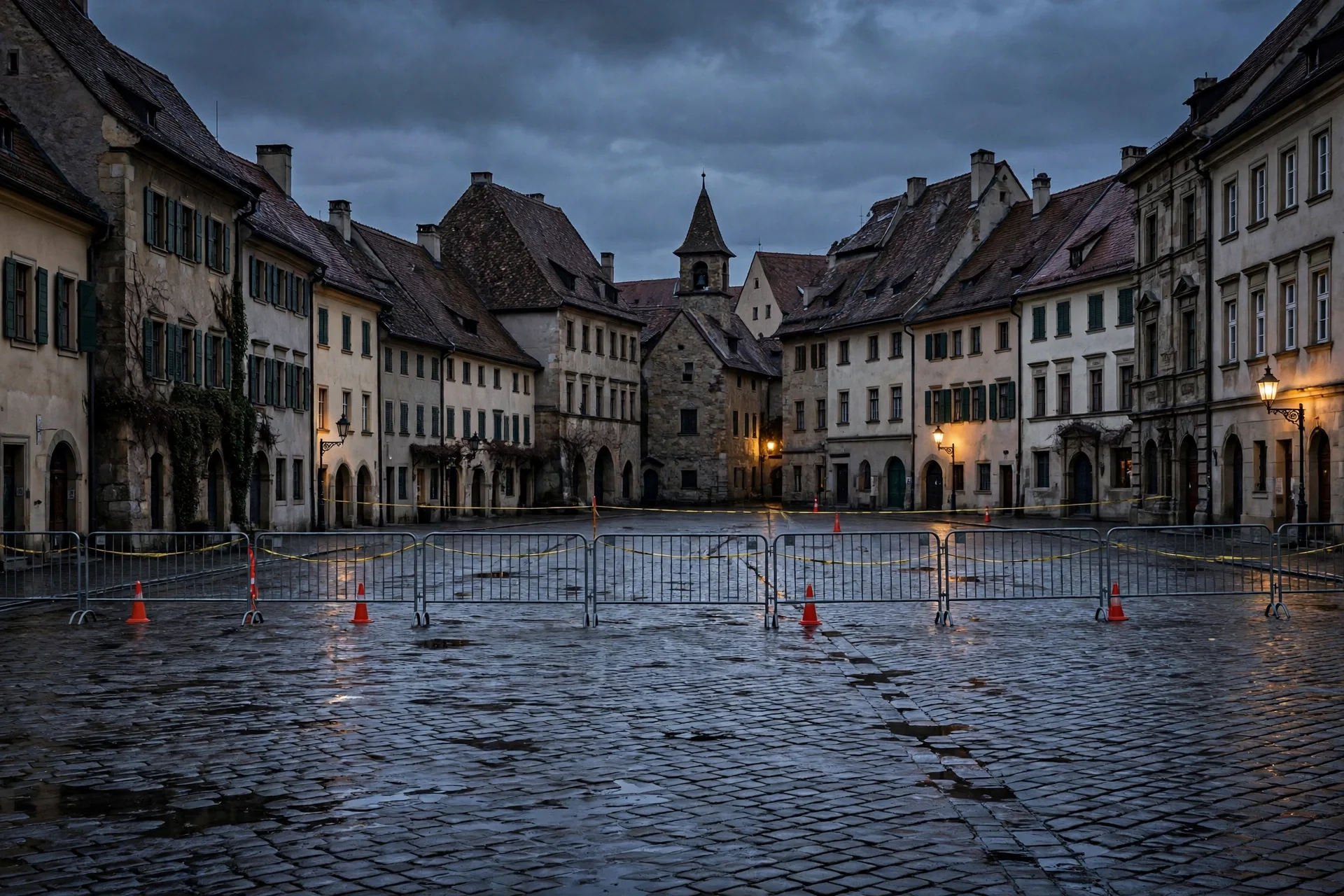
Plaza histórica europea acordonada al atardecer. Imagen generada.
Krakow Attacker Killed His Parents and Sister Before Shooting
The Krakow attacker, a young man aged 25, allegedly killed his father aged 53, his mother aged 52 and his sister aged 21 at their home in Ostrowiec…
Krakow Gunman Killed His Family Before the Market Square Attack
Police found the Krakow attacker's father aged 53, mother aged 52 and sister aged 21 dead at their home in Ostrowiec Swietokryski, and suspect he killed them…
--- The context ---
Krakow is a medieval, tourist city whose Market Square draws large numbers of visitors. On Saturday, that calm was shattered by a shooting that left six dead and 16 wounded and that, as later became known, had extended earlier to the attacker's family home in another Polish city some 200 kilometers away.
--- The facts ---
At his home in Ostrowiec Swietokryski, police found the bodies, with gunshot wounds, of his father, aged 53, his mother, aged 52, and his sister, aged 21. Investigators suspect that the young man, aged 25 and identified as Michal Oksinski, killed his family before the attack on the square.
He then drove his black car into the center and entered the square at three in the afternoon, firing at the crowd from the window. Of the six fatal victims, four women and two men, three are Polish, one is British and two lack confirmed nationalities. There were also 16 wounded, including two officers, the attacker and five foreigners from Austria, the United Kingdom, Germany, Portugal and Russia.
A patrol car chased his vehicle, which crashed into another at the junction of Dietla and Stardomska. After the impact, dressed in military camouflage, he got out firing at the officers in an exchange that left all three wounded. He was neutralized three minutes after the massacre began.
--- The positions ---
Polish prime minister Donald Tusk defined what happened as an attack and described as heroes the two officers who chased the attacker, Jakub Kulik and Artur Moranski, one of them in critical condition after receiving three bullets. Interior minister Marcin Kierwinski explained that everything points to the suspect holding a far right ideology and being an ultranationalist.
Mayor Lukasz Gibala decreed mourning until Wednesday. British prime minister Andy Burnham showed solidarity with the Polish people, and EU high representative Kaja Kallas held that it is a tragedy that will be felt beyond Poland. Zelenski, Merz and Macron also conveyed their condolences.
--- What remains unknown ---
Police, who cordoned off the square, continue investigating the causes. Despite the proximity of the Auschwitz-Birkenau extermination camps, the indiscriminate character of the attack suggests it had no antisemitic motive.
It was reported that the attacker held a gun license and that he carried numerous weapons in his car that apparently belonged to his father. Although he wore a military campaign uniform, he was not a soldier, but a turner.
--- Unanswered questions ---
What led the young man to allegedly kill his family before heading to the square? How did he gather the weapons he carried in the car and that apparently belonged to his father? Will the investigation confirm the far right ideology that the interior minister attributes to him?
--- EPM analysis ---
The sequence deepens the picture: an alleged family crime and, hours later, shots at a crowd of tourists in Krakow. The neutralization within three minutes prevented a higher death toll.
After the initial panic, some passersby returned to help the wounded and, apparently, two doctors treated the officers.
📌 EPM Take:
In EPM's view, Krakow faces a double wound: that of a tourist square turned into the scene of a massacre and that of a family found dead at home before the shooting. The investigation must establish with evidence the full sequence, the origin of the weapons and the attacker's motive, without shortcuts or speculation. Meanwhile, the response of the officers who stopped him within three minutes and of those who returned to help the wounded marks the difference between horror and an even greater tragedy.
--- The context ---
The Market Square of Krakow, a medieval and tourist city, was full of visitors on Saturday at three in the afternoon. In that setting, a young man aged 25 opened fire from his car at the crowd. The known toll is six dead and 16 wounded, and the investigation points to the violence having begun earlier, at his family home.
--- The facts ---
Police found at the attacker's home in Ostrowiec Swietokryski, some 200 kilometers from Krakow, the bodies with gunshot wounds of his father, aged 53, his mother, aged 52, and his sister, aged 21. Investigators suspect that the young man, identified as Michal Oksinski, killed them before driving to Krakow.
Once in the square, he fired from the window of his black car. Among the six fatal victims are four women and two men: three Polish, one British and two still unconfirmed. The 16 wounded include two officers, the attacker and five foreigners from Austria, the United Kingdom, Germany, Portugal and Russia.
A patrol car chased him until his vehicle crashed into another at the junction of Dietla and Stardomska. Dressed in military camouflage, he got out firing and all three were wounded in the exchange. He was neutralized three minutes after the massacre began.
--- The positions ---
Prime minister Donald Tusk called what happened an attack and defined as heroes officers Jakub Kulik and Artur Moranski. One of them remains in critical condition because he received three bullets. Interior minister Marcin Kierwinski pointed out that everything suggests a far right ideology and an ultranationalist profile on the part of the suspect.
Mayor Lukasz Gibala decreed official mourning until Wednesday. British prime minister Andy Burnham expressed solidarity with the Polish people after the death of a Briton, and European high representative Kaja Kallas stated that the tragedy will be felt beyond Poland. Ukrainian president Zelenski, German chancellor Merz and French president Macron also conveyed their condolences.
--- What remains unknown ---
The square remains cordoned off and police investigate the causes. Although Krakow is near the Auschwitz-Birkenau extermination camps, the indiscriminate character of the attack suggests no antisemitic motive.
The attacker held a gun license, according to the available information, and carried in the car numerous weapons that apparently belonged to his father. He wore a military campaign uniform, but he was not a soldier: he was a turner.
--- Unanswered questions ---
What evidence supports the suspicion that he killed his family before leaving for Krakow? Why did he carry in the car numerous weapons that apparently were his father's? What do investigators confirm about his ideology and about the reason chosen to attack a square full of tourists?
--- EPM analysis ---
The fact that orders the account is the sequence: first the family home in Ostrowiec Swietokryski and then the Market Square. Between the two points lie some 200 kilometers and a decision the investigation must still explain with verified facts.
The immediate reaction also stands out: the police chase closed the attack in three minutes and passersby returned to help the wounded, also treated, apparently, by two doctors.
📌 EPM Take:
In EPM's view, what is required now is rigor: an investigation that fixes the sequence, accredits the origin of each weapon and confirms or rules out the motive attributed to the suspect. Krakow has decreed mourning until Wednesday and Europe has responded with condolences, but grief does not replace answers. The memory of the six victims in the square and of the family found dead at home deserves proven facts, not hasty versions the investigation has not confirmed with solid evidence.
Atacante de Cracovia mató antes a sus padres y a su hermana
El atacante de Cracovia, un joven de 25 años, mató presuntamente a su padre de 53 años, su madre de 52 y su hermana de 21 en su domicilio de Ostrowiec…
Cracovia: el atacante mató a su familia antes del tiroteo
La Policía halló muertos al padre de 53 años, la madre de 52 y la hermana de 21 del atacante de Cracovia en su domicilio de Ostrowiec Swietokryski, y sospecha…
--- El contexto ---
Cracovia es una ciudad turística y medieval cuya plaza mayor del Mercado concentra a numerosos visitantes. El sábado, esa tranquilidad quedó rota por un tiroteo que dejó seis muertos y 16 heridos y que se había extendido antes hasta el domicilio familiar del atacante.
--- Los hechos ---
En su domicilio de Ostrowiec Swietokryski, la Policía halló los cadáveres con heridas de bala de su padre, de 53 años, su madre, de 52, y su hermana, de 21. Los investigadores sospechan que el joven, de 25 años, mató a su familia antes del ataque en la plaza.
Tras ello, condujo su coche negro hasta el centro y entró a las tres de la tarde en la plaza disparando desde la ventanilla. De las seis víctimas mortales, cuatro mujeres y dos hombres, tres son polacas, una británica y dos sin nacionalidad confirmada. Hubo 16 heridos, incluidos dos policías, el atacante y cinco extranjeros de Austria, el Reino Unido, Alemania, Portugal y Rusia.
Un coche patrulla persiguió al vehículo, que chocó contra otro en el cruce de Dietla y Stardomska. Tras el impacto, el joven, vestido con ropa militar de camuflaje, salió disparando contra los policías en un intercambio que dejó a los tres heridos. Fue neutralizado tres minutos después de que empezara la masacre.
--- Las posiciones ---
El primer ministro polaco, Donald Tusk, definió lo ocurrido como un atentado y describió como héroes a los dos policías que persiguieron al atacante, Jakub Kulik y Artur Moranski, uno de ellos en estado crítico tras recibir tres balazos. El ministro del Interior, Marcin Kierwinski, explicó que todo apunta a que el sospechoso tenía una ideología de extrema derecha.
El alcalde, Lukasz Gibala, decretó el luto hasta el miércoles. El primer ministro británico, Andy Burnham, mostró su solidaridad con el pueblo polaco, y la alta representante europea, Kaja Kallas, sostuvo que es una tragedia que se sentirá más allá de Polonia. También transmitieron condolencias el presidente ucraniano, Volodímir Zelenski, el canciller alemán, Friedrich Merz, y el presidente francés, Emmanuel Macron.
--- Lo que falta saber ---
La Policía, que acordonó la plaza, sigue investigando las causas. Pese a la proximidad de los campos de exterminio de Auschwitz-Birkenau, el carácter indiscriminado del ataque hace pensar que no tuvo un móvil antisemita.
Se informó de que el atacante tenía licencia de armas y llevaba en el coche numerosas armas que, al parecer, pertenecían a su padre. Vestía uniforme militar, pero no era soldado, sino tornero.
--- Preguntas sin respuesta ---
¿Qué llevó al joven a matar presuntamente a su familia antes de dirigirse a la plaza? ¿Cómo reunió las armas que llevaba en el coche y que, al parecer, eran de su padre? ¿Confirmará la investigación la ideología de extrema derecha que se le atribuye?
--- Análisis EPM ---
La secuencia agrava el cuadro: un presunto crimen familiar y, horas después, disparos contra una multitud de turistas en Cracovia. La neutralización en tres minutos impidió que el número de fallecidos fuera mayor.
Tras el pánico inicial, algunos viandantes volvieron para auxiliar a los heridos y, al parecer, dos médicos atendieron a los agentes.
📌 Conclusion EPM:
A juicio de EPM, Cracovia enfrenta una doble herida: la de una plaza turística convertida en escena de una masacre y la de una familia hallada muerta en su casa antes del tiroteo. La investigación debe establecer con pruebas la secuencia completa, el origen de las armas y el móvil del atacante, sin atajos ni especulación. Mientras tanto, la respuesta de los policías que lo detuvieron en tres minutos y de quienes volvieron a auxiliar a los heridos marca la diferencia entre el horror y una tragedia todavía mayor.
--- El contexto ---
La plaza mayor del Mercado de Cracovia, ciudad medieval y turística, estaba llena de visitantes el sábado a las tres de la tarde. Un joven de 25 años abrió fuego desde su coche contra la multitud. El balance es de seis muertos y 16 heridos, y la investigación apunta a que la violencia había empezado antes, en su casa familiar.
--- Los hechos ---
La Policía halló en el domicilio del atacante, en Ostrowiec Swietokryski, a unos 200 kilómetros, los cadáveres con heridas de bala de su padre, de 53 años, su madre, de 52, y su hermana, de 21. Los investigadores sospechan que los mató antes de conducir hasta Cracovia.
Ya en la plaza, disparó desde la ventanilla de su coche negro. Entre las seis víctimas mortales hay cuatro mujeres y dos hombres: tres polacas, una británica y dos de nacionalidad sin confirmar. Los 16 heridos incluyen a dos policías, al atacante y a cinco extranjeros de Austria, el Reino Unido, Alemania, Portugal y Rusia.
Un coche patrulla lo persiguió hasta que chocó contra otro vehículo en el cruce de Dietla y Stardomska. Vestido con ropa militar de camuflaje, salió disparando contra los agentes y los tres resultaron heridos. Fue neutralizado tres minutos después de que empezara la masacre.
--- Las posiciones ---
El primer ministro, Donald Tusk, calificó lo ocurrido de atentado y definió como héroes a los policías Jakub Kulik y Artur Moranski, uno en estado crítico tras recibir tres balazos. El ministro del Interior, Marcin Kierwinski, señaló que todo apunta a una ideología de extrema derecha del sospechoso.
El alcalde, Lukasz Gibala, decretó luto oficial hasta el miércoles. El primer ministro británico, Andy Burnham, expresó su solidaridad con el pueblo polaco tras la muerte de un británico, y la alta representante europea, Kaja Kallas, afirmó que la tragedia se sentirá más allá de Polonia. El presidente ucraniano Zelenski, el canciller alemán Merz y el presidente francés Macron transmitieron también sus condolencias.
--- Lo que falta saber ---
La plaza permanece acordonada y la Policía investiga las causas. Aunque Cracovia está cerca de los campos de exterminio de Auschwitz-Birkenau, el carácter indiscriminado del ataque hace pensar que no existe un móvil antisemita.
El atacante tenía licencia de armas y llevaba en el coche numerosas armas que, al parecer, pertenecían a su padre. Vestía uniforme militar de campaña, pero no era soldado: era tornero.
--- Preguntas sin respuesta ---
¿Qué pruebas sostienen la sospecha de que mató a su familia antes de salir hacia Cracovia? ¿Por qué llevaba en el coche numerosas armas que, al parecer, eran de su padre? ¿Qué confirman los investigadores sobre su ideología y sobre el motivo del ataque a una plaza llena de turistas?
--- Análisis EPM ---
El dato que ordena el relato es el orden de los hechos: primero el domicilio familiar y después la plaza del Mercado. Entre ambos median unos 200 kilómetros y una decisión que la investigación debe explicar con hechos verificados.
También destaca la reacción inmediata: la persecución cerró el ataque en tres minutos y hubo viandantes que regresaron a socorrer a los heridos, atendidos también, al parecer, por dos médicos.
📌 Conclusion EPM:
A juicio de EPM, lo exigible ahora es rigor: una investigación que fije la secuencia, acredite el origen de cada arma y confirme o descarte el móvil atribuido al sospechoso. Cracovia ha decretado luto hasta el miércoles y Europa ha respondido con condolencias, pero el duelo no sustituye a las respuestas. La memoria de las seis víctimas de la plaza y de la familia hallada muerta en su casa merece hechos comprobados, no versiones apresuradas que la investigación no haya confirmado con pruebas sólidas.