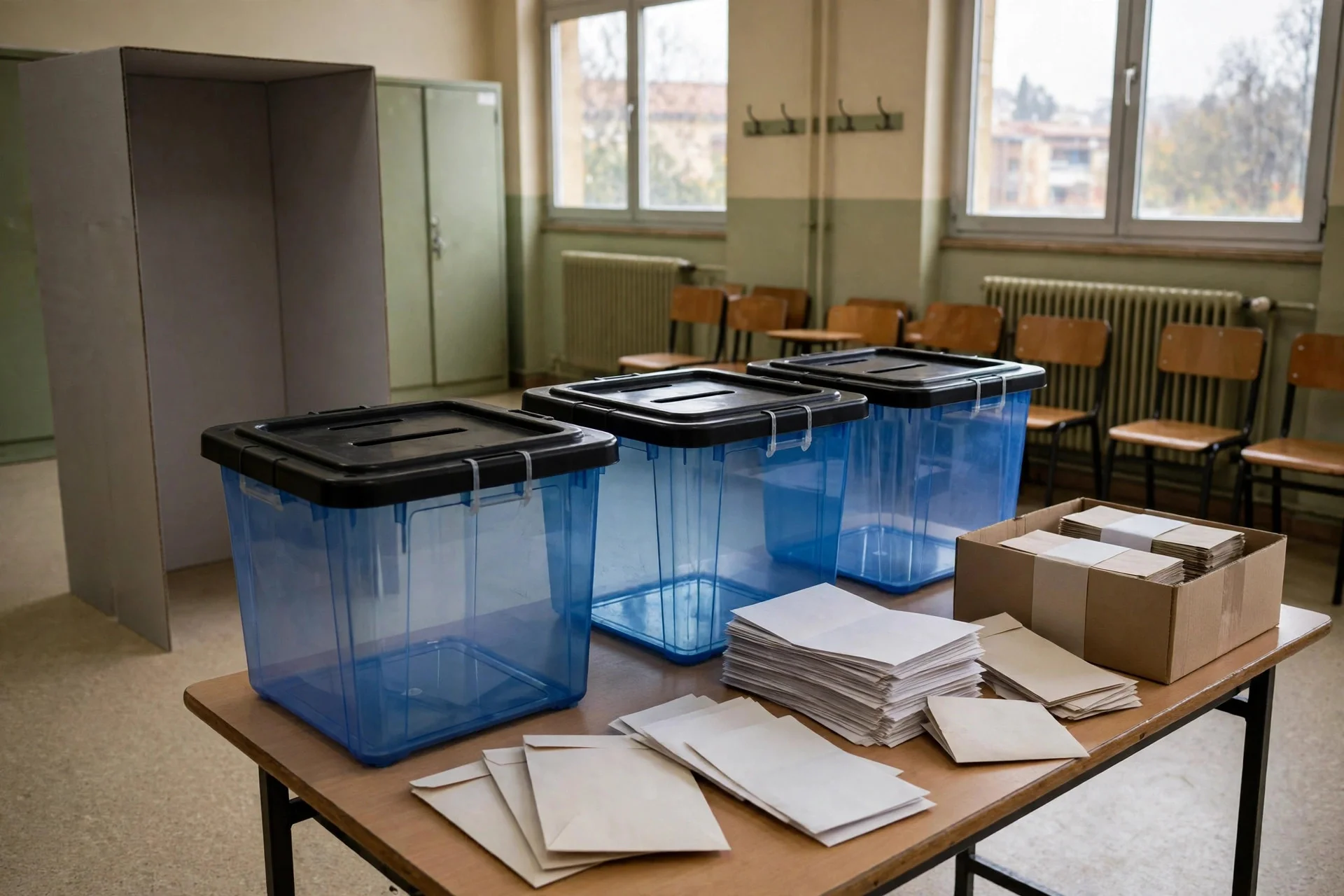
Urnas y papeletas preparadas en un colegio electoral. · Imagen generada por EPM
Right bloc tops 190 seats as PSOE closes to two points
The 40dB. survey keeps the PP, Vox and UPN bloc above 190 seats, but the PSOE improves by 1.8 points and cuts the PP lead to two points.
PP and Vox hold their lead while PSOE narrows the gap
The PP, Vox and UPN would pass 190 seats with half the vote, according to 40dB., and a PP-Vox coalition is preferred by 25.4%.
--- The context ---
With three weeks to go before polling day, Spain heads into the general election on the 29th with two simultaneous readings in the same 40dB. survey. The first is the broad and steady lead of the right-wing bloc. The second is the PSOE recovery, now just two points behind the PP, within the survey margin of error. Fieldwork was carried out from November 2 to 4, with 2,000 online interviews and a sampling error of +-2.2%, amid the shock of the Urda rail disaster and after Transport Minister Óscar Puente resigned.
--- The facts ---
The PP, Vox and UPN together would gather half of all votes cast and pass 190 seats, more than 15 above the absolute majority in Congress. The PP would remain the largest party with 31.9% of the vote and 129 seats, eight fewer than it holds now, after slipping by more than a point. Vox would rise 5.6 points compared with 2023 and move from 33 to 61 seats, although it sheds almost a point in the final stretch of fieldwork compared with the previous reading.
The PSOE improves by 1.8 points compared with late October and closes the gap with the PP to two points. That advance comes despite the collision of two trains on the Madrid-Seville AVE line, with 69 fatalities, and despite the final stretch of the survey coinciding with the hours after Óscar Puente resigned. According to the poll, Pedro Sánchez and his party would lose two of their current 121 deputies and would still stand almost two points below their July 2023 result.
--- The positions ---
Flows within the right explain much of the distribution. Transfers toward Vox could reach 15% of those who had voted for the PP, 1.2 million people in absolute terms. In preferences for prime minister, Alberto Núñez Feijóo scores 20% and is practically tied with Santiago Abascal, who sits just two tenths behind him. Pedro Sánchez leads that same ranking with 30% support and is the favorite among Socialist voters, among voters of sovereigntist parties and also among Frente Amplio voters.
In the space to the left of the PSOE, the decline is severe. Frente Amplio would win 5% of the vote and 10 seats, compared with the 31 that Sumar placed in the last Congress, and its candidate, Ada Colau, records 4.4% in prime minister preferences, almost level with Irene Montero. Podemos, standing alone, would fall to 1.2% and risks ending up outside Parliament, retaining only 8 out of every 100 voters who backed Sumar in 2023.
--- What remains unknown ---
The poll does not settle which party will finish first, because the two-point distance between the PP and the PSOE falls within the +-2.2% sampling error. Nor does it clarify the real scope for Socialist mobilization: among the electorates of the main parties, PSOE voters are the least certain to turn out, with 68% saying they will vote, almost seven points less than among PP voters. Socialists also lose 6.5% of their voters to the PP, around half a million people, although they capture one in four of those who supported Sumar in 2023 and improve among voters who describe themselves as centrists.
--- Unanswered questions ---
Will the PSOE confirm at the ballot box its recovery to within two points, or will the distance from the PP widen again in the final stretch? Will it manage to mobilize its least certain voters, who today say they will turn out at only 68%? Will Podemos end up outside Parliament on 1.2%, and what will happen to representation on the left if Frente Amplio is left with just 10 seats?
--- EPM analysis ---
The territorial map adds significant contrasts. ERC could rise from 7 to 10 seats, EH Bildu from 6 to 7, the BNG from 1 to 2, and Adelante Andalucía would break through with 3. By contrast, the PNV could lose 2 of its 5 deputies and be left without a parliamentary group for the first time since 1978, Junts would retain only 3 of its 7 seats, Coalición Canaria would keep its single deputy and UPN would add another seat. On motivations, 41.9% say the election serves to end sanchismo, against 31% whose main motivation is to keep the far right out of government, and average ideological self-placement stands at 5, the exact center of a scale from 0 to 10.
📌 EPM Take: In EPM's view, the survey offers a double picture that must be read in full, without triumphalism on any side. The right keeps a very comfortable bloc advantage, with more than 190 seats, but the PSOE has closed to within two points of the PP at the government's most adverse moment, after a disaster with 69 fatalities. The key to the remaining three weeks lies not in the blocs but in the mobilization of the undecided, and in whether the collapse of the left of the PSOE is consolidated or finds a floor before the 29th.
--- The context ---
The general election on the 29th approaches with one constant that no recent measurement has altered: the right-wing bloc starts with a broad lead over the left. The latest 40dB. survey, carried out from November 2 to 4 with 2,000 online interviews and a sampling error of +-2.2%, confirms that bloc distance and adds a new nuance between the two large parties. The gap between the PP and the PSOE has narrowed to two points, within the margin of error, in a week marked by the Urda rail disaster and by the resignation of Transport Minister Óscar Puente.
--- The facts ---
The PP, Vox and UPN would gather half of all votes cast and pass 190 seats, more than 15 above the absolute majority in Congress. The PP would remain the largest party with 31.9% of the vote and 129 seats, eight fewer than it holds now. Vox would grow by 5.6 points compared with 2023 and almost double its representation, moving from 33 to 61 seats, sustained by transfers that could reach 15% of those who had previously voted for the PP, 1.2 million people in absolute terms.
Accuracy also requires recognizing the opposite movement with the same precision. The PSOE improves by 1.8 points compared with late October and closes to within two points, even though the final stretch of fieldwork coincided with the hours after Óscar Puente resigned and with the debate over the collision of two trains on the Madrid-Seville AVE line, with 69 fatalities. Even so, the poll assigns it the loss of two of its current 121 deputies and leaves it almost two points below its July 2023 result.
--- The positions ---
In preferences for prime minister, Pedro Sánchez leads the list with 30% support. Alberto Núñez Feijóo scores 20% and is practically tied with Santiago Abascal, who stands just two tenths behind, a figure that measures the internal contest for leadership of the right. A total of 42% of respondents take it for granted that Vox will form part of the next government, and a PP-Vox coalition is the preferred governing formula for 25.4%, ahead of the 23% who would like the left-wing alliance to be repeated.
The underlying mood supports that expectation. Some 41.9% answer that the election serves to bring an end to sanchismo, against 31% whose main motivation is to keep the far right out of government. Average ideological self-placement has shifted to 5, the exact center on a scale from 0 to 10, and among right-wing voters hope and enthusiasm prevail, while concern and fear dominate on the left. The pact between the PP and Vox to support each other on Senate lists also wins more backing among their voters than the earlier agreement between the PSOE and Frente Amplio won among theirs.
--- What remains unknown ---
It remains to be seen whether the Socialist recovery holds beyond the immediate impact of the Urda disaster or reflects the specific moment when fieldwork was done. It is also unclear whether the PP can contain the transfers toward Vox, which already reach 15% of its previous electorate, and whether PSOE voters, the least certain among the large parties with 68% saying they will vote, will finally turn out. Citizens, in any case, are demanding with everyone: only one in four gives a positive rating to the government or to the opposition, and close to half fail both.
--- Unanswered questions ---
Will the right-wing bloc advantage of more than 190 seats translate into a stable government from the first investiture vote? Will the PP hold first place on 31.9%, or will the PSOE recovery keep narrowing the two-point distance? Will voters of both right-wing parties accept, with the same naturalness suggested by the 42% who take a government including Vox for granted, the coalition now preferred by 25.4% of the electorate?
--- EPM analysis ---
To the left of the PSOE, the poll sketches a collapse that also orders the board. Frente Amplio would win 5% and 10 seats against the 31 of Sumar, with Ada Colau on 4.4% in prime minister preferences, and Podemos would fall to 1.2% with a risk of ending up outside Parliament. In territories with sovereigntist parties, ERC would rise from 7 to 10 seats, EH Bildu from 6 to 7 and the BNG from 1 to 2, while the PNV would lose 2 of its 5 deputies, Junts would retain only 3 of 7, Coalición Canaria would keep its seat and UPN would add another.
📌 EPM Take: In EPM's view, the survey confirms with hard data that the desire for change is today the dominant electoral force, with a right-wing bloc above 190 seats and 41.9% defining the election as the end of sanchismo. It would be a mistake, however, to treat the contest as closed: the PSOE has cut the gap creditably in its hardest week, and the two-point distance lies within the error margin. The right will win if it turns its advantage into turnout and into a credible agreement, not merely into a favorable expectation.
La derecha supera los 190 escaños y el PSOE recorta a dos puntos
La encuesta de 40dB. mantiene al bloque PP, Vox y UPN por encima de los 190 escaños, pero el PSOE mejora 1,8 puntos y recorta la diferencia con el PP a dos…
PP y Vox mantienen la ventaja mientras el PSOE se acerca
PP, Vox y UPN superarían los 190 escaños con la mitad de los votos, según 40dB., y la coalición PP-Vox es la preferida por el 25,4%.
--- El contexto ---
A tres semanas de que se abran las urnas, España llega a las elecciones generales del día 29 con dos lecturas simultáneas en la misma encuesta de 40dB. La primera es la ventaja amplia y estable del bloque de la derecha. La segunda es el recorte del PSOE, que se sitúa a solo dos puntos del PP, dentro del margen de error del sondeo. El trabajo de campo se realizó del 2 al 4 de noviembre, con 2.000 entrevistas en línea y un error muestral de +-2,2%, en plena conmoción por la catástrofe ferroviaria de Urda y tras la dimisión del ministro de Transportes, Óscar Puente.
--- Los hechos ---
La suma del PP, Vox y UPN reuniría la mitad de los votos emitidos y rebasaría los 190 escaños, más de 15 por encima de la mayoría absoluta del Congreso. El PP seguiría como primera fuerza con el 31,9% de los sufragios y 129 escaños, ocho menos que hasta ahora, tras restar más de un punto. Vox aumentaría 5,6 puntos respecto a 2023 y pasaría de 33 a 61 escaños, aunque en el tramo final del trabajo de campo cede casi un punto frente a la medición anterior.
El PSOE presenta una mejoría de 1,8 puntos respecto a finales de octubre y se acerca al PP hasta dejar la diferencia en dos puntos. Ese avance se produce pese al choque de dos trenes en la línea del AVE Madrid-Sevilla, con 69 víctimas mortales, y pese a que el tramo final de la encuesta coincidió con las horas posteriores a la dimisión de Óscar Puente. Según el sondeo, el partido de Pedro Sánchez perdería dos de sus 121 diputados actuales y seguiría casi dos puntos por debajo de sus resultados de julio de 2023.
--- Las posiciones ---
Las fugas dentro de la derecha explican buena parte del reparto. Los trasvases hacia Vox pueden alcanzar el 15% de quienes habían votado al PP, 1,2 millones en términos absolutos. En preferencias para presidente del Gobierno, Alberto Núñez Feijóo obtiene el 20% y prácticamente empata con Santiago Abascal, situado solo dos décimas por detrás. Pedro Sánchez encabeza esa misma clasificación con un 30% de respaldo y es el favorito entre los votantes socialistas, entre los de las formaciones soberanistas y también entre los del Frente Amplio.
En el espacio a la izquierda del PSOE, el retroceso es severo. El Frente Amplio obtendría el 5% de los votos y 10 escaños, frente a los 31 que Sumar sentó en el último Congreso, y su candidata, Ada Colau, recoge el 4,4% en preferencias presidenciales, casi igualada con Irene Montero. Podemos, que concurre en solitario, se quedaría en un 1,2% y corre el riesgo de quedar fuera del Parlamento, al retener solo a 8 de cada 100 votantes que en 2023 apostaron por Sumar.
--- Lo que falta saber ---
El sondeo no resuelve quién será la fuerza más votada, porque la distancia de dos puntos entre PP y PSOE queda dentro del error muestral de +-2,2%. Tampoco aclara el margen real de movilización socialista: entre el electorado de los principales partidos, el del PSOE es el menos decidido a votar, con un 68% que lo asegura, casi siete puntos menos que en el caso de los populares. Los socialistas sufren además una desafección del 6,5% de sus votantes en favor del PP, sobre medio millón de personas, aunque captan a uno de cada cuatro que habían apoyado a Sumar en 2023 y mejoran entre quienes se declaran de centro.
--- Preguntas sin respuesta ---
¿Confirmará el PSOE en las urnas el recorte hasta los dos puntos o la distancia con el PP volverá a abrirse en la recta final? ¿Logrará movilizar a sus votantes menos decididos, que hoy solo aseguran su voto en un 68%? ¿Quedará Podemos fuera del Parlamento con ese 1,2% y qué ocurrirá con la representación de la izquierda si el Frente Amplio se queda en 10 escaños?
--- Análisis EPM ---
El mapa territorial añade contrastes relevantes. ERC puede pasar de 7 a 10 escaños, EH Bildu de 6 a 7, el BNG de 1 a 2 y Adelante Andalucía irrumpiría con 3. En cambio, el PNV puede perder 2 de sus 5 diputados y quedarse sin grupo parlamentario por primera vez desde 1978, Junts retendría solo 3 de sus 7 asientos, Coalición Canaria mantendría su único diputado y UPN sumaría otro escaño. En motivaciones, el 41,9% afirma que las elecciones sirven para terminar con el sanchismo, frente al 31% cuya motivación principal es que no gobierne la extrema derecha, y el promedio de autoubicación ideológica se sitúa en el 5, el centro justo de una escala de 0 a 10.
📌 Conclusion EPM: A juicio de EPM, la encuesta deja una foto doble que obliga a leerla completa y sin triunfalismos de ningún lado. La derecha conserva una ventaja de bloque muy holgada, con más de 190 escaños, pero el PSOE ha recortado hasta situarse a dos puntos del PP en el momento más adverso del Gobierno, tras una catástrofe con 69 víctimas mortales. La clave de las tres semanas restantes no está en los bloques, sino en la movilización de los indecisos y en si el desplome de la izquierda del PSOE se consolida o encuentra un suelo antes del día 29.
--- El contexto ---
Las elecciones generales del día 29 se acercan con una constante que ninguna medición reciente ha alterado: el bloque de la derecha parte con una ventaja amplia sobre la izquierda. La última encuesta de 40dB., realizada del 2 al 4 de noviembre con 2.000 entrevistas en línea y un error muestral de +-2,2%, confirma esa distancia de bloque y añade un matiz nuevo entre los dos grandes partidos. La diferencia entre PP y PSOE se ha acortado a dos puntos, dentro del margen de error, en una semana marcada por la catástrofe ferroviaria de Urda y por la dimisión del ministro de Transportes, Óscar Puente.
--- Los hechos ---
El PP, Vox y UPN reunirían la mitad de los votos emitidos y rebasarían los 190 escaños, más de 15 por encima de la mayoría absoluta del Congreso. El PP permanecería como primera fuerza con el 31,9% de los sufragios y 129 escaños, ocho menos que hasta ahora. Vox crecería 5,6 puntos respecto a 2023 y casi duplicaría su representación, al pasar de 33 a 61 escaños, sostenido por fugas que pueden alcanzar el 15% de quienes habían votado al PP, 1,2 millones en términos absolutos.
El dato exige también reconocer el movimiento contrario con la misma precisión. El PSOE mejora 1,8 puntos respecto a finales de octubre y recorta hasta los dos puntos, pese a que el tramo final del trabajo de campo coincidió con las horas posteriores a la dimisión de Óscar Puente y con el debate sobre el choque de dos trenes en la línea del AVE Madrid-Sevilla, con 69 víctimas mortales. Con todo, el sondeo le asigna la pérdida de dos de sus 121 diputados actuales y lo deja casi dos puntos por debajo de sus resultados de julio de 2023.
--- Las posiciones ---
En preferencias para presidente del Gobierno, Pedro Sánchez encabeza la lista con un 30% de respaldo. Alberto Núñez Feijóo obtiene el 20% y prácticamente empata con Santiago Abascal, que queda solo dos décimas por detrás, un dato que mide la disputa interna por el liderazgo del espacio de la derecha. El 42% de los entrevistados da por hecho que Vox formará parte del próximo Ejecutivo, y la coalición entre PP y Vox es la fórmula de Gobierno preferida por el 25,4%, por delante del 23% que querría que se repitiese la alianza de izquierdas.
El clima de fondo acompaña esa expectativa. El 41,9% responde que las elecciones sirven para terminar con el sanchismo, frente al 31% cuya motivación principal es que no gobierne la extrema derecha. La autoubicación ideológica media se ha desplazado al 5, el centro justo en una escala de 0 a 10, y entre los votantes de la derecha priman la esperanza y la ilusión, mientras en la izquierda se imponen la preocupación y el miedo. El pacto entre PP y Vox para apoyarse en las listas al Senado cosecha además más apoyos entre sus votantes que el acuerdo previo entre PSOE y Frente Amplio entre los suyos.
--- Lo que falta saber ---
Queda por ver si el recorte socialista se sostiene fuera del impacto inmediato de la catástrofe de Urda o si responde al momento concreto en que se hizo el trabajo de campo. También falta saber si el PP contiene las fugas hacia Vox, que ya alcanzan al 15% de su electorado anterior, y si el electorado del PSOE, el menos decidido de los grandes partidos con un 68% que asegura su voto, acude finalmente a las urnas. La valoración ciudadana, en todo caso, es exigente con todos: solo uno de cada cuatro da una calificación positiva al Gobierno o a la oposición y cerca de la mitad suspende a ambos.
--- Preguntas sin respuesta ---
¿Se traducirá la ventaja de más de 190 escaños del bloque de la derecha en un Gobierno estable desde la primera votación? ¿Mantendrá el PP la primera posición con su 31,9% o el recorte del PSOE seguirá estrechando la distancia de dos puntos? ¿Aceptarán los votantes de ambos partidos de la derecha, con la misma naturalidad que sugiere el 42% que da por hecho un Ejecutivo con Vox, la coalición que hoy prefiere el 25,4% del electorado?
--- Análisis EPM ---
A la izquierda del PSOE, el sondeo dibuja un desplome que también ordena el tablero. El Frente Amplio obtendría el 5% y 10 escaños frente a los 31 de Sumar, con Ada Colau en el 4,4% de preferencias presidenciales, y Podemos caería al 1,2% con riesgo de quedar fuera del Parlamento. En los territorios con fuerzas soberanistas, ERC subiría de 7 a 10 escaños, EH Bildu de 6 a 7 y el BNG de 1 a 2, mientras el PNV perdería 2 de sus 5 diputados, Junts retendría solo 3 de 7, Coalición Canaria mantendría su escaño y UPN sumaría otro.
📌 Conclusion EPM: A juicio de EPM, el sondeo confirma con datos que el deseo de cambio es hoy la fuerza electoral dominante, con un bloque de la derecha por encima de los 190 escaños y un 41,9% que define las elecciones como el fin del sanchismo. Sería un error, sin embargo, dar la contienda por cerrada: el PSOE ha recortado con mérito en su semana más difícil y la distancia de dos puntos está dentro del error. La derecha ganará si convierte su ventaja en movilización y en un acuerdo creíble, no solo en expectativa favorable.