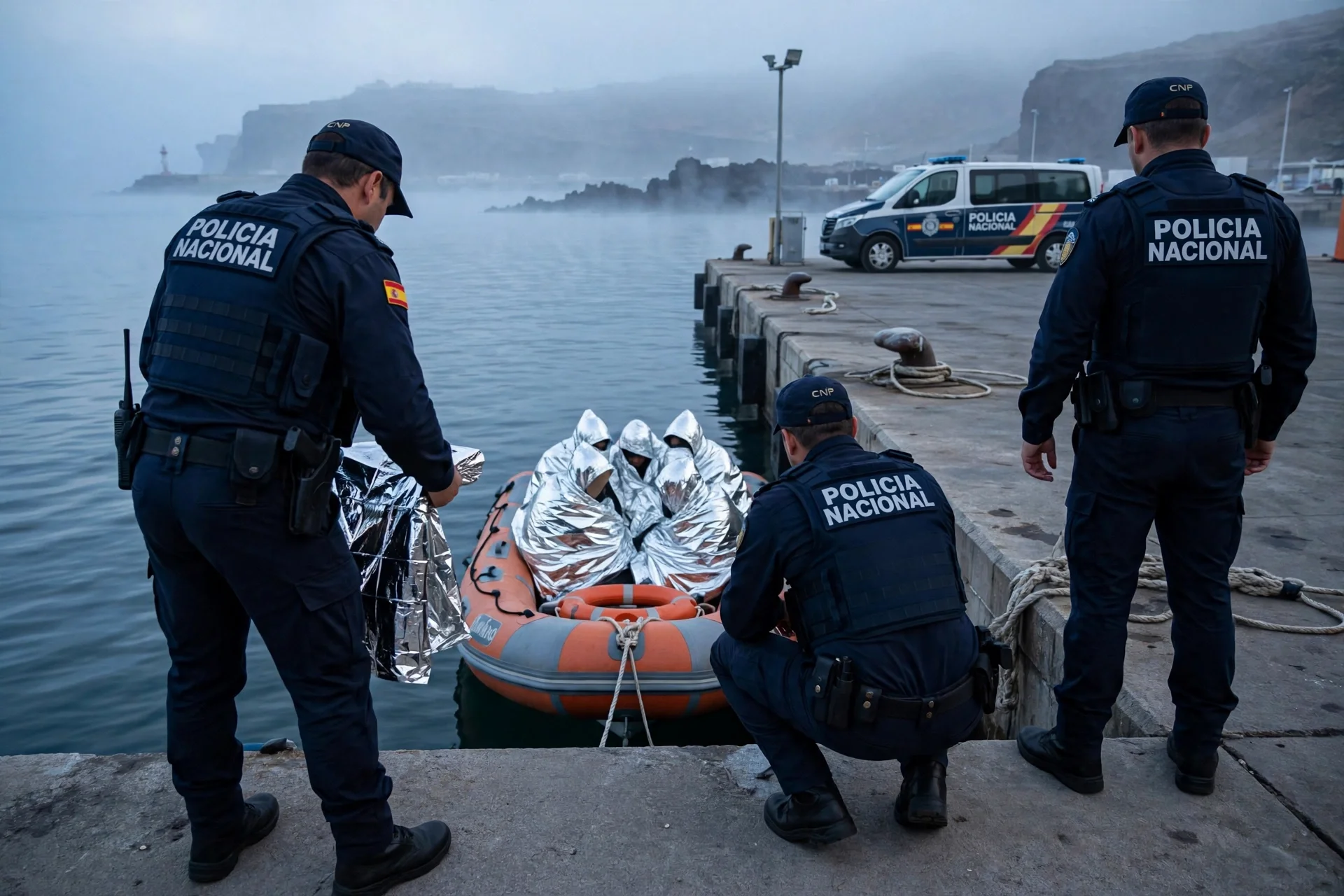
Imagen generada alusiva a la atención policial en un puerto de Canarias ante las llegadas de embarcaciones. · EPM
Police unions in Canaries overwhelmed by migrant arrivals
Jupol, the Unified Police Union and the Federal Police Union say National Police officers in the Canaries are overwhelmed by vessel arrivals, with shifts of up…
Unions demand reinforcements as Canary police reach limit
The three police unions warn that officers are at their limit in the Canaries, with the greatest intensity on El Hierro, and demand reinforcements on three…
--- The context ---
The Canary Islands have faced continuous arrivals of precarious vessels for years, straining reception and transfer operations. In recent days the pressure has grown with greater intensity on El Hierro and has again tested National Police officers deployed across the archipelago, who must handle landings and organize transfers of hundreds of people within very short intervals and with little margin for rest between services.
--- The facts ---
Since November 1, close to 6,000 people have arrived in the Canaries aboard small boats and cayucos, with special incidence on El Hierro. This weekend alone, more than 1,300 migrants arrived aboard precarious vessels. According to complaints by Jupol, the Unified Police Union and the Federal Police Union, officers are chaining services with insufficient rest and shifts that, according to each organization, reach up to 20 hours, up to 17 hours, or stretches of 16 and 18 hours.
--- The positions ---
Jupol has asked the Interior Ministry for an immediate reinforcement of personnel on El Hierro, Lanzarote and Fuerteventura, rational shifts, mandatory rest and full payment of allowances, and has said some officers reach lodging at midnight and are back on their feet at four in the morning for transfers. The Unified Police Union has said on social media that officers are at the limit of their strength, has recalled that it has demanded reinforcements and resources since 2023, and has called for a structural and permanent strategy against people-smuggling mafias. The Federal Police Union has reported shifts of up to 17 hours without the necessary extraordinary reinforcements and has demanded reinforcements, rest and dignified conditions.
--- What remains unknown ---
The available information does not state what concrete reinforcements the Interior Ministry is considering or when they could reach El Hierro, Lanzarote and Fuerteventura. It also does not detail how many officers currently form the operation, how shifts are distributed, or what planning measures will apply if arrivals maintain the pace recorded since November 1 and during this weekend in the archipelago.
It also remains unclear whether the ministry will size the operation to the real volume of arrivals or ensure that transfers no longer rely on insufficient rest in the coming days.
--- Unanswered questions ---
Will the Interior Ministry announce an immediate reinforcement for El Hierro, Lanzarote and Fuerteventura? Will mandatory rest be guaranteed and shifts of 16, 17, 18 and up to 20 hours be brought to an end? Will there be a structural and permanent strategy, with early detection, against people-smuggling mafias?
--- EPM analysis ---
The core of the union warning is not only one difficult weekend, but a lack of foresight in the face of a crisis that has been unfolding in the Canaries for years. When the operation is not sized to the real volume of arrivals and transfers, officers pay the cost through exhaustion and port assistance suffers as well. Reasonable working conditions and advance planning are two sides of the same management demand raised by the three unions.
📌 EPM Take: In EPM's view, the warning from the three unions should be read as a management alert rather than background noise, because it describes extreme shifts, insufficient rest and an overwhelmed operation facing close to 6,000 arrivals since November 1. The ministry should respond with verifiable reinforcements, public schedules of rational shifts and full payment of allowances, alongside a permanent strategy against the mafias. Without planning proportionate to the real volume, each new peak will repeat the same exhaustion on El Hierro and across the Canary archipelago as a whole.
--- The context ---
The Canary route is again showing how quickly it can saturate within a few days when several arrivals of small boats and cayucos coincide. The archipelago, and El Hierro in particular, bears continuous migratory pressure that requires properly sized police operations, sufficient relief and a firm response against the networks organizing the transit of people, instead of patches applied when the system is already at its limit.
--- The facts ---
Since November 1, close to 6,000 people have arrived in the Canaries aboard small boats and cayucos, with special incidence on El Hierro, and more than 1,300 this weekend alone aboard precarious vessels. Jupol, the Unified Police Union and the Federal Police Union have said National Police officers are overwhelmed, with shifts reported at up to 20 hours by Jupol, up to 17 hours according to the Federal Police Union, and stretches of 16 and 18 hours that Jupol expressly asks to avoid.
--- The positions ---
Jupol has demanded immediate reinforcement from the Interior Ministry on El Hierro, Lanzarote and Fuerteventura, has described officers reaching lodging at midnight and standing again at four in the morning for transfers, and has required rational shifts, mandatory rest and full allowances. The Unified Police Union has maintained on social media that the pressure overwhelms officers, that they are at the limit of their strength, that since 2023 it has sought reinforcements and human and material resources, and that a structural and permanent strategy against the mafias is needed. The Federal Police Union has demanded extraordinary reinforcements, rest and dignified conditions in the face of shifts of up to 17 hours.
--- What remains unknown ---
The concrete response of the Interior Ministry remains unknown, along with the number of personnel to be sent and whether reinforcement will cover El Hierro, Lanzarote and Fuerteventura at the same time. Nor has it been detailed what containment and early detection plan will be applied against the mafias or how transfers will stop relying on marathon shifts when weekends with more than 1,300 arrivals are repeated.
It also remains unclear whether rational shifts will be established immediately or whether allowances and compensation for displacements and extraordinary services already carried out by officers will be paid promptly.
--- Unanswered questions ---
Will the ministry send sufficient reinforcements in time to the three islands named by Jupol? Will the shifts of up to 20 hours reported by the unions be ended in practice? Will the strategy against the mafias translate into containment and early detection with measurable results?
--- EPM analysis ---
A state that asks its police to sustain the external border cannot do so with staff at their limit and curtailed rest. Order in reception begins with having enough officers, workable shifts and resources matched to the real volume of arrivals. Firmness against the mafias and logistical foresight are not incompatible with orderly assistance in port, but both require prior decisions, not improvisation when El Hierro already concentrates the greatest intensity of the episode.
📌 EPM Take: In EPM's view, the Canaries do not need another late response but a permanent operation sized for peaks such as the close to 6,000 arrivals since November 1 and the more than 1,300 this weekend. The ministry must send immediate reinforcements to El Hierro, Lanzarote and Fuerteventura, guarantee mandatory rest, pay allowances in full and sustain a structural strategy against people-smuggling mafias. Keeping officers at their limit weakens control, assistance in port and the credibility of the institutional response in the archipelago.
Policías desbordados en Canarias piden refuerzos urgentes a Interior
Jupol, el Sindicato Unificado de Policías y la Unión Federal de Policía denuncian que los agentes en Canarias están desbordados por las llegadas de…
Sindicatos alertan del colapso policial ante la llegada de migrantes
Los tres sindicatos policiales alertan de agentes al límite en Canarias, con mayor intensidad en El Hierro, reclaman refuerzos en tres islas, turnos racionales…
--- El contexto ---
Canarias afronta desde hace años llegadas continuas de embarcaciones precarias que tensionan los dispositivos de recepción y traslado. En los últimos días la presión se ha concentrado con mayor intensidad en El Hierro y ha vuelto a poner a prueba a los agentes de la Policía Nacional desplegados en el archipiélago, encargados de atender desembarcos y organizar traslados de cientos de personas en intervalos muy cortos.
--- Los hechos ---
Desde el 1 de noviembre han llegado cerca de 6.000 personas a Canarias en pateras y cayucos, con especial incidencia en El Hierro. Solo este fin de semana han arribado más de 1.300 migrantes a bordo de embarcaciones precarias. Según han denunciado Jupol, el Sindicato Unificado de Policías y la Unión Federal de Policía, los agentes encadenan servicios con descansos insuficientes y jornadas que, según cada organización, alcanzan hasta 20 horas, hasta 17 horas o tramos de 16 y 18 horas.
--- Las posiciones ---
Jupol ha pedido al Ministerio del Interior un refuerzo inmediato de efectivos en El Hierro, Lanzarote y Fuerteventura, turnos racionales, descansos obligatorios y el abono íntegro de dietas, y ha señalado que hay agentes que llegan a medianoche al alojamiento y a las cuatro de la madrugada están de nuevo en pie para los traslados. El SUP ha afirmado en redes sociales que los agentes están al límite de sus fuerzas, ha recordado que reclama refuerzos y medios desde 2023 y ha pedido una estrategia estructural y permanente contra las mafias del tránsito de personas. La UFP ha denunciado jornadas de hasta 17 horas sin los refuerzos extraordinarios necesarios y ha exigido refuerzos, descansos y condiciones dignas.
--- Lo que falta saber ---
No consta en la información disponible qué refuerzos concretos estudia el Ministerio del Interior ni en qué plazo podrían llegar a El Hierro, Lanzarote y Fuerteventura. Tampoco se detalla cuántos agentes componen hoy el dispositivo, cómo se reparten los turnos ni qué medidas de planificación se aplicarán si las llegadas mantienen el ritmo registrado desde el 1 de noviembre y durante este fin de semana.
Tampoco consta si Interior adecuará los medios al volumen real de llegadas ni si dimensionará los dispositivos para evitar que los traslados dependan de descansos insuficientes en los próximos días.
--- Preguntas sin respuesta ---
¿Anunciará Interior un refuerzo inmediato para El Hierro, Lanzarote y Fuerteventura? ¿Se garantizarán descansos obligatorios y el fin de las jornadas de 16, 17, 18 y hasta 20 horas? ¿Habrá una estrategia estructural y permanente, con detección temprana, frente a las mafias del tránsito de personas?
--- Análisis EPM ---
El fondo del aviso sindical no es solo el pico de un fin de semana, sino la falta de previsión ante una crisis que lleva años produciéndose en Canarias. Cuando el dispositivo no se dimensiona conforme al volumen real de llegadas y traslados, el coste lo asumen los agentes con agotamiento y también la calidad de la atención en puerto. Proteger condiciones laborales razonables y planificar con antelación son dos caras de la misma exigencia de gestión.
📌 Conclusion EPM: A juicio de EPM, el aviso de los tres sindicatos debe leerse como una alerta de gestión y no como un ruido de fondo, porque describe turnos extremos, descansos insuficientes y un dispositivo desbordado ante cerca de 6.000 llegadas desde el 1 de noviembre. Interior debería responder con refuerzos verificables, calendarios públicos de turnos racionales y pago íntegro de dietas, además de una estrategia permanente contra las mafias. Sin planificación proporcional al volumen real, cada nuevo pico repetirá el mismo agotamiento en El Hierro y en el resto del archipiélago canario.
--- El contexto ---
La ruta canaria vuelve a mostrar su capacidad de saturación en pocos días cuando coinciden varias llegadas de pateras y cayucos. El archipiélago, y en particular El Hierro, soporta una presión migratoria continuada que exige dispositivos policiales dimensionados, relevo suficiente y una respuesta firme frente a las redes que organizan el tránsito de personas, en lugar de parches cuando el sistema ya está al límite.
--- Los hechos ---
Desde el 1 de noviembre han llegado cerca de 6.000 personas a Canarias en pateras y cayucos, con especial incidencia en El Hierro, y más de 1.300 solo este fin de semana en embarcaciones precarias. Jupol, el Sindicato Unificado de Policías y la Unión Federal de Policía han denunciado que los agentes de la Policía Nacional están desbordados, con jornadas denunciadas de hasta 20 horas por Jupol, de hasta 17 horas según la UFP y tramos de 16 y 18 horas que Jupol pide evitar de forma expresa.
--- Las posiciones ---
Jupol ha reclamado al Ministerio del Interior refuerzo inmediato en El Hierro, Lanzarote y Fuerteventura, ha descrito agentes que llegan a medianoche al alojamiento y a las cuatro de la madrugada vuelven a estar en pie para traslados, y ha exigido turnos racionales, descansos obligatorios y dietas íntegras. El SUP ha sostenido en redes que la presión desborda a los agentes, que están al límite de sus fuerzas, que desde 2023 pide refuerzos y medios humanos y materiales, y que hace falta una estrategia estructural y permanente contra las mafias. La UFP ha reclamado refuerzos extraordinarios, descansos y condiciones dignas ante jornadas de hasta 17 horas.
--- Lo que falta saber ---
Falta conocer la respuesta concreta del Ministerio del Interior, el número de efectivos que se enviarán y si el refuerzo cubrirá a la vez El Hierro, Lanzarote y Fuerteventura. Tampoco se ha detallado qué plan de contención y detección temprana se aplicará frente a las mafias ni cómo se evitará que los traslados sigan apoyándose en jornadas maratonianas cuando se repitan fines de semana con más de 1.300 llegadas.
Tampoco consta si se establecerán turnos racionales de forma inmediata ni si se abonarán sin demora las dietas y compensaciones por los desplazamientos y servicios extraordinarios ya realizados por los agentes.
--- Preguntas sin respuesta ---
¿Enviará Interior refuerzos suficientes y a tiempo a las tres islas señaladas por Jupol? ¿Se pondrá fin en la práctica a las jornadas de hasta 20 horas denunciadas por los sindicatos? ¿Se traducirá la estrategia contra las mafias en contención y detección temprana con resultados medibles?
--- Análisis EPM ---
Un Estado que exige a su policía sostener la frontera exterior no puede hacerlo con plantillas al límite y descansos recortados. El orden en la recepción empieza por tener agentes suficientes, turnos cumplibles y medios acordes al volumen real de llegadas. La firmeza frente a las mafias y la previsión logística no son incompatibles con una atención ordenada en puerto, pero ambas requieren decisión previa, no improvisación cuando El Hierro ya concentra la mayor intensidad del episodio.
📌 Conclusion EPM: A juicio de EPM, Canarias no necesita otra respuesta tardía sino un dispositivo permanente dimensionado para picos como los cerca de 6.000 llegados desde el 1 de noviembre y los más de 1.300 de este fin de semana. Interior debe enviar refuerzos inmediatos a El Hierro, Lanzarote y Fuerteventura, garantizar descansos obligatorios, abonar las dietas íntegras y sostener una estrategia estructural contra las mafias del tránsito de personas. Mantener agentes al límite debilita el control, la atención en puerto y la credibilidad de la respuesta institucional.