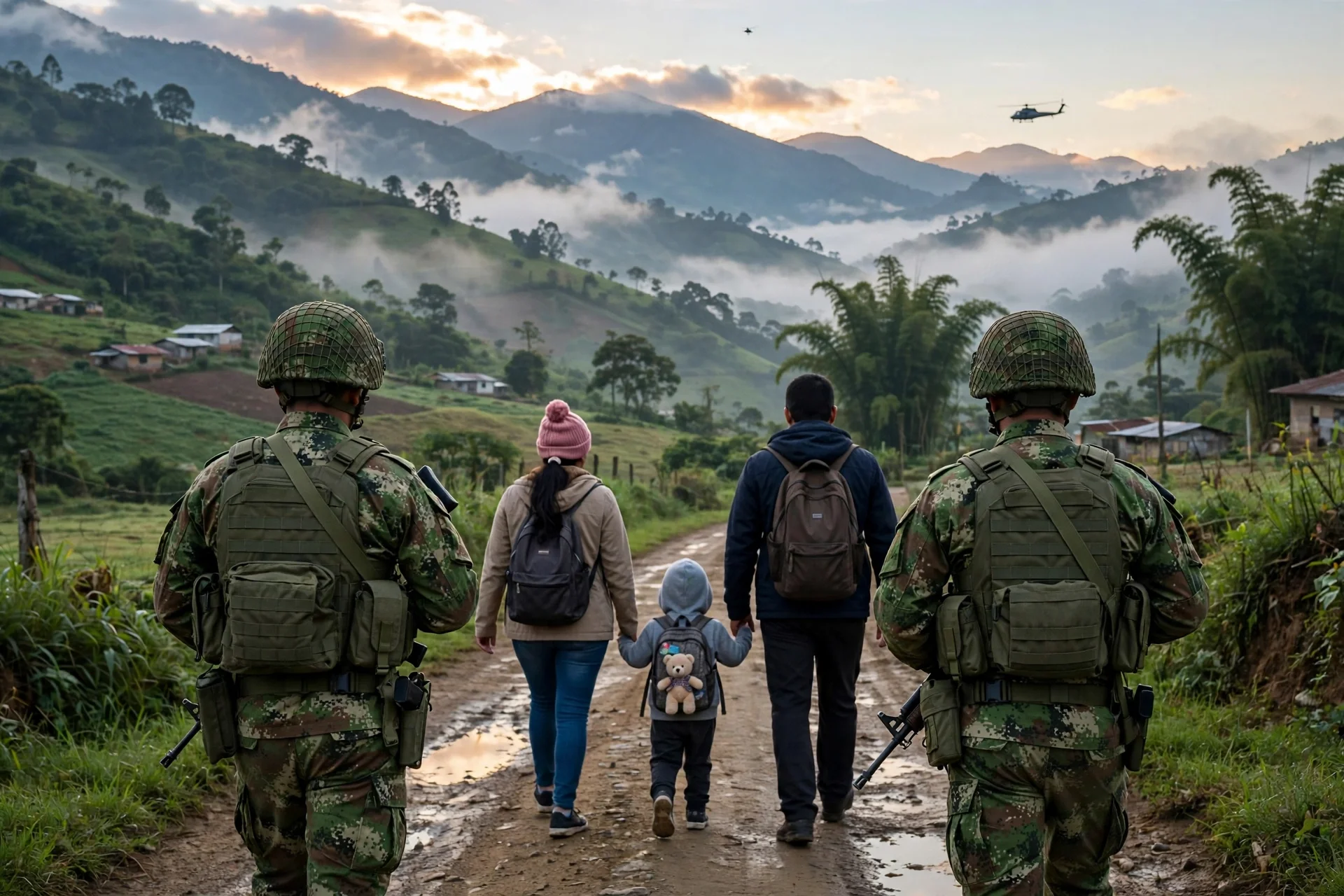
Soldados acompañan a una familia a un lugar seguro en zona rural del Cauca, en una imagen alusiva al rescate en Suárez. · Imagen generada para Erick Prometeo Media
Army rescues a recruited child and protects his family in Cauca
Rapid Deployment Force troops recovered in Suárez, northern Cauca, a minor recruited by the Iván Mordisco dissidents and moved him to a safe place.
Rescue in Cauca: a recruited minor is brought to safety
The Army recovered in Suárez, northern Cauca, a minor recruited by the Iván Mordisco dissidents, in Rapid Deployment Force operations with air support.
--- The context ---
In northern Cauca, communities live under pressure from illegal armed structures that use the recruitment of minors as a form of territorial control. For a family, that pressure does not stop at a single event: it reaches the mother and the other minors in the household, and it turns daily life into permanent exposure to threats and fear.
Against that backdrop, protecting a recovered minor requires more than moving him beyond the reach of the armed group. It also requires safeguarding his family and activating the institutional protection and rights-restoration routes.
--- The facts ---
Troops of the Rapid Deployment Force, supported by air mobility capabilities of the Army Air Assault Aviation Division, recovered in Suárez, in northern Cauca, a minor who had been recruited by the dissidents led by Iván Mordisco. The troops moved him to a safe place, after months in which the minor lived in the hands of that illegal armed group in the region.
According to the Army, the Jaime Martínez substructure was responsible not only for recruiting the minor, but also for serious threats against his mother and against two other minors who are members of his family circle. After bringing all four to safety, the institution activated protection measures to preserve his integrity and that of his family environment, through the institutional routes.
--- The positions ---
The Third Division, which has jurisdiction in that area of the country, said that 73 minors have been recovered in the southwest. Colonel Andrés Johany Noval Páez, chief of staff and second commander of the Rapid Deployment Force, said in substance that each of those cases shows a reality that the institution rejects in a forceful and categorical manner, according to his statement.
The Army also said that the detachment continues military operations and humanitarian support actions in Cauca, to protect communities, prevent child recruitment and reduce the capacity of the illegal armed structures that threaten the southwest.
--- What remains unknown ---
The institution repeated its invitation to report in time terrorist actions, threats or recruitment of minors through the free line 107. That channel seeks to ensure that alerts arrive before threats materialize and allow the planned protection measures to be activated.
--- Unanswered questions ---
How will the restoration of rights move forward for the recovered minor and for the other minors in his family circle? What concrete measures will keep the family safe from new threats by the accused substructure? Will timely reporting and institutional presence manage to reduce the recruitment of minors in northern Cauca?
--- EPM analysis ---
The rescue in Suárez shows that child recruitment works as a mechanism of pressure on entire families, because the threat reached the mother and two other minors in the household. That is why moving the minor to safety and protecting his family form a single operation, inseparable from the later restoration of rights.
📌 EPM Take: In EPM's view, recovering a recruited minor and protecting his family at the same time is the right response to a practice that uses children as an instrument of armed control. The result in Suárez protects concrete lives, but its lasting reach will depend on the restoration of rights moving forward without interruption, on the threats against the family circle not being repeated, and on communities in northern Cauca being able to report without fear and with a timely and sustained institutional response in the territory.
--- The context ---
The southwest of the country faces the action of illegal armed structures that threaten communities and resort to recruiting minors. That practice strikes twice: it tears a child away from his environment and subjects his family to direct threats, as happened with the mother and with two other minors from the same family circle in this case reported in Cauca.
In that setting, military operations in Cauca combine pressure on the armed structures with humanitarian support actions to protect communities. Preventing child recruitment and reducing the capacity of those groups are declared objectives of the institutional presence in the area.
--- The facts ---
During military operations in Suárez, in northern Cauca, troops of the Rapid Deployment Force, supported by air mobility capabilities of the Army Air Assault Aviation Division, recovered a minor recruited by the dissidents led by Iván Mordisco and moved him to a safe place, the Army reported.
According to the Army, the Jaime Martínez substructure was responsible for recruiting the minor and also for serious threats against his mother and against two other minors in his family circle. Once all four were brought to safety, the institution activated protection measures to preserve his integrity and that of his family environment, with support from the institutional protection and rights-restoration routes.
--- The positions ---
The Third Division said that 73 minors have been recovered in the southwest of the country. Colonel Andrés Johany Noval Páez, chief of staff and second commander of the Rapid Deployment Force, said in substance that each of those cases shows a reality that is rejected in a forceful and categorical manner, according to the officer's remarks as reported by the institution.
The Army also repeated the invitation to report in time terrorist actions, threats or recruitment of minors through the free line 107. It also said that operations and humanitarian actions continue in Cauca to protect communities.
--- What remains unknown ---
On Monday, November 9, the Army released images of the joint training at the Tolemaida military fort, about 150 kilometers from Bogotá, together with the United States Army, in the exercise called Vanguardia del Sur. According to the institution, that training strengthens operational capabilities and air interoperability against groups dedicated to drug trafficking such as Jaime Martínez.
--- Unanswered questions ---
What follow-up will the recovered minor and his family receive within the protection and rights-restoration routes? What additional results will the ongoing operations and humanitarian actions in Cauca bring? Will training cooperation translate into a greater capacity to protect communities in the southwest of the country?
--- EPM analysis ---
The Suárez case confirms that confronting child recruitment requires military capacity and family protection at the same time, because the accused structure also threatened the mother and two other minors. Added to that task is the joint training disclosed on November 9, aimed according to the Army at strengthening capabilities against structures such as Jaime Martínez.
📌 EPM Take: In EPM's view, the rescue of the minor in Suárez and the protection of his family show the path that must be maintained: sustained pressure on the structures that recruit minors and immediate shelter for every threatened household. The recovery of 73 minors in the southwest marks a trend that must be consolidated with a permanent presence, reports answered in time and training that translates into effective operations, so that no minor is ever again left in the hands of an illegal armed group in Cauca.
Ejército rescata en Suárez a un menor reclutado por disidencias
Tropas de la Fuerza de Despliegue Rápido recuperaron en Suárez, norte del Cauca, a un menor reclutado por las disidencias de Iván Mordisco y lo trasladaron a…
Rescate en el Cauca: un menor vuelve a salvo con su familia
El Ejército recuperó en Suárez, norte del Cauca, a un menor reclutado por las disidencias de Iván Mordisco, en operaciones de la Fuerza de Despliegue Rápido…
--- El contexto ---
En el norte del Cauca, las comunidades conviven con la presión de estructuras armadas ilegales que recurren al reclutamiento de menores como forma de control territorial. Para una familia, esa presión alcanza a la madre y a los demás menores del hogar, y convierte la vida cotidiana en exposición permanente a la amenaza.
Frente a ese panorama, proteger a un menor recuperado exige más que su traslado. Exige también resguardar a su familia y activar las rutas de protección y de restablecimiento de derechos.
--- Los hechos ---
Tropas de la Fuerza de Despliegue Rápido, con apoyo de capacidades de movilidad aérea de la División de Aviación Asalto Aéreo, recuperaron en Suárez, en el norte del Cauca, a un menor que había sido reclutado por las disidencias al mando de Iván Mordisco. Las tropas lo trasladaron a un lugar seguro, tras meses en los que el menor vivió en manos de ese grupo armado ilegal.
Según el Ejército, la subestructura Jaime Martínez era la responsable no solo del reclutamiento del menor, sino también de graves amenazas contra su mamá y otros dos menores de su núcleo familiar. Después de poner a los cuatro a salvo, la institución activó las medidas de protección para preservar su integridad y la de su entorno familiar.
--- Las posiciones ---
La Tercera División, con jurisdicción en esa zona del país, indicó que en el suroccidente se ha logrado recuperar a 73 menores de edad. El coronel Andrés Johany Noval Páez, jefe de estado mayor y segundo comandante de la Fuerza de Despliegue Rápido, sostuvo en síntesis que cada uno de esos casos evidencia una realidad que la institución rechaza de manera contundente y categórica.
El Ejército señaló además que ese destacamento continúa con operaciones militares y acciones de apoyo humanitario en el Cauca, para proteger a las comunidades, prevenir el reclutamiento infantil y reducir la capacidad de las estructuras armadas que amenazan el suroccidente.
--- Lo que falta saber ---
La institución reiteró su invitación a denunciar a tiempo acciones terroristas, amenazas o reclutamiento de menores a través de la línea gratuita 107. Ese canal busca que las alertas lleguen antes de que las amenazas se concreten y permitan activar la protección prevista.
--- Preguntas sin respuesta ---
¿Cómo avanzará el restablecimiento de derechos del menor recuperado y de los demás menores de su núcleo familiar? ¿Qué medidas concretas mantendrán a salvo a la familia frente a nuevas amenazas de la subestructura señalada? ¿Podrán las denuncias a tiempo y la presencia institucional reducir el reclutamiento de menores en el norte del Cauca?
--- Análisis EPM ---
El rescate en Suárez muestra que el reclutamiento infantil opera como mecanismo de presión sobre familias enteras, porque la amenaza alcanzó a la madre y a otros dos menores del hogar. Por eso su traslado a un lugar seguro y la protección de su familia forman una sola operación, inseparable del restablecimiento de derechos posterior.
📌 Conclusion EPM: A juicio de EPM, recuperar a un menor reclutado y proteger al mismo tiempo a su familia es la respuesta correcta frente a una práctica que usa a los niños como instrumento de control armado. El resultado en Suárez protege vidas concretas, pero su alcance duradero dependerá de que el restablecimiento de derechos avance sin interrupciones, de que las amenazas contra el núcleo familiar no se repitan y de que las comunidades del norte del Cauca puedan denunciar sin miedo y con respuesta institucional oportuna y sostenida en el territorio.
--- El contexto ---
El suroccidente del país enfrenta la acción de estructuras armadas ilegales que amenazan a las comunidades y recurren al reclutamiento de menores de edad. Esa práctica golpea dos veces: arrebata a un niño de su entorno y somete a su familia a amenazas directas, como ocurrió en este caso.
En ese escenario, las operaciones en el Cauca combinan la presión sobre las estructuras armadas con acciones de apoyo humanitario para proteger a las comunidades. Prevenir el reclutamiento infantil y reducir la capacidad de esos grupos son objetivos declarados de la presencia institucional.
--- Los hechos ---
En desarrollo de operaciones militares en Suárez, en el norte del Cauca, tropas de la Fuerza de Despliegue Rápido, con apoyo de capacidades de movilidad aérea de la División de Aviación Asalto Aéreo, recuperaron a un menor reclutado por las disidencias al mando de Iván Mordisco y lo trasladaron a un lugar seguro.
De acuerdo con el Ejército, la subestructura Jaime Martínez era la responsable del reclutamiento y de graves amenazas contra su mamá y otros dos menores de su núcleo familiar. Puestos los cuatro a salvo, la institución activó las medidas de protección para preservar su integridad y la de su entorno, con apoyo de las rutas institucionales correspondientes.
--- Las posiciones ---
La Tercera División indicó que en el suroccidente del país se ha logrado recuperar a 73 menores de edad. El coronel Andrés Johany Noval Páez, jefe de estado mayor y segundo comandante de la Fuerza de Despliegue Rápido, afirmó en síntesis que cada uno de esos casos evidencia una realidad que se rechaza de manera contundente y categórica, según lo expresado por el oficial.
El Ejército reiteró además la invitación a denunciar a tiempo acciones terroristas, amenazas o reclutamiento de menores, a través de la línea gratuita 107. También indicó que continúan las operaciones y las acciones humanitarias en el Cauca para proteger a las comunidades.
--- Lo que falta saber ---
El lunes 9 de noviembre, el Ejército reveló imágenes de los entrenamientos conjuntos en el fuerte militar de Tolemaida, a unos 150 kilómetros de Bogotá, junto con el Ejército de Estados Unidos, en el ejercicio Vanguardia del Sur. Según la institución, esos entrenamientos fortalecen las capacidades operacionales y la interoperabilidad aérea contra grupos dedicados al narcotráfico como la Jaime Martínez.
--- Preguntas sin respuesta ---
¿Qué seguimiento recibirán el menor recuperado y su familia dentro de las rutas de protección y restablecimiento de derechos? ¿Qué resultados adicionales traerán las operaciones y las acciones humanitarias en curso en el Cauca? ¿Alcanzará la cooperación en entrenamiento a traducirse en mayor capacidad para proteger a las comunidades del suroccidente?
--- Análisis EPM ---
El caso de Suárez confirma que enfrentar el reclutamiento infantil exige capacidad militar y protección familiar al mismo tiempo, porque la estructura señalada amenazaba también a la madre y a otros dos menores. A esa tarea se suma el entrenamiento conjunto revelado el 9 de noviembre, orientado según el Ejército a fortalecer capacidades contra estructuras como la Jaime Martínez.
📌 Conclusion EPM: A juicio de EPM, el rescate del menor en Suárez y la protección de su familia muestran el camino que debe mantenerse: presión sostenida sobre las estructuras que reclutan menores y resguardo inmediato de cada hogar amenazado. La recuperación de 73 menores en el suroccidente marca una tendencia que debe consolidarse con presencia permanente, denuncias atendidas a tiempo y entrenamiento que se traduzca en operaciones eficaces, para que ningún menor vuelva a quedar en manos de un grupo armado ilegal en el Cauca.