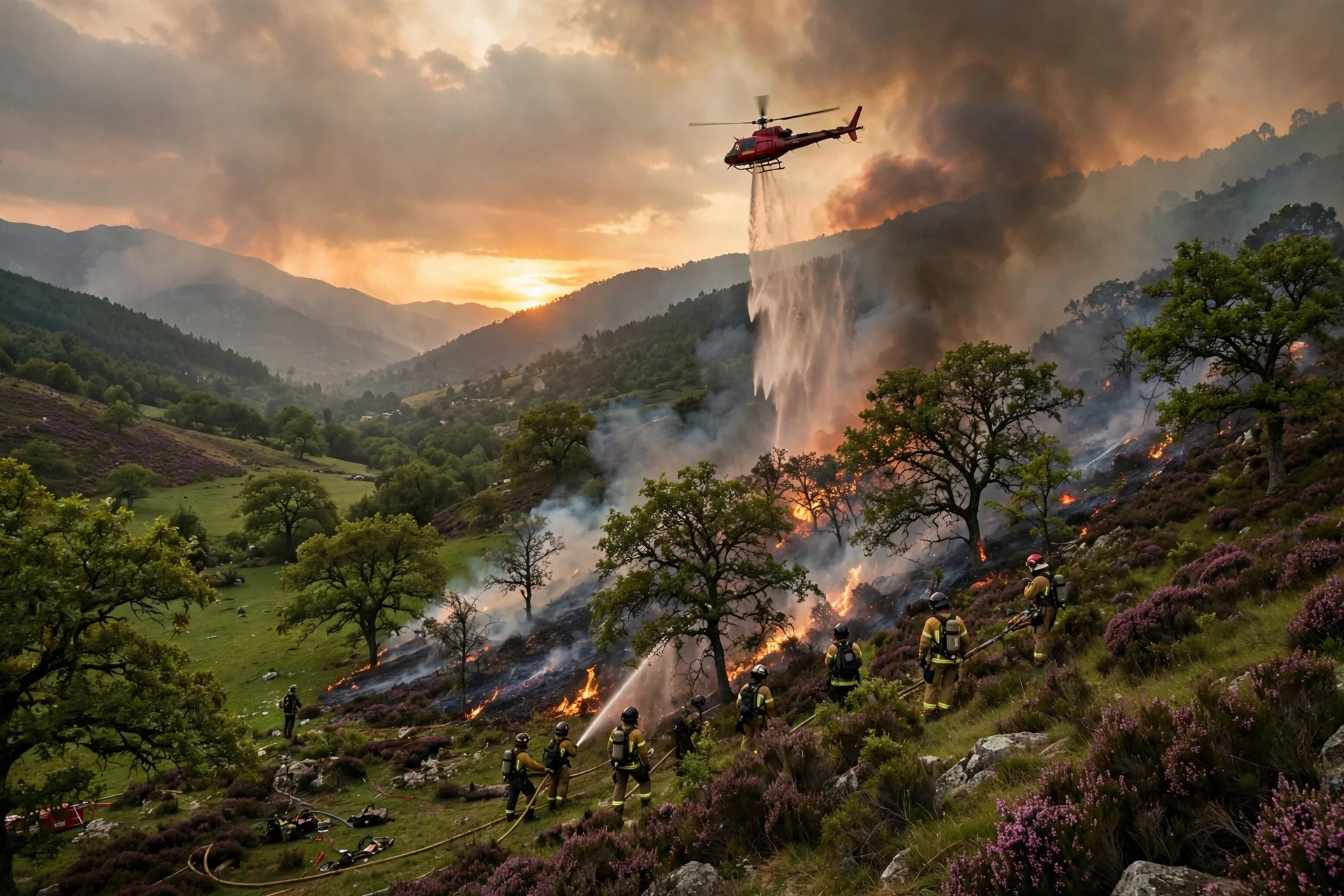
Efectivos terrestres y un medio aéreo combaten un incendio en un valle de monte bajo, en una imagen alusiva al fuego de Valderredible. · EPM
Man investigated over wildfire that burned 47.33 hectares in Valderredible
A 38-year-old man is investigated as the alleged perpetrator of the September 1 wildfire in Valderredible, which burned 47.33 hectares, affected 152 private…
Alleged reckless burn investigated after fire hit 152 plots in Valderredible
SEPRONA is investigating a 38-year-old man as the alleged perpetrator of a wildfire through serious negligence in Valderredible: the burn took place under a…
--- The context ---
Valderredible, in Cantabria, faced a wildfire in September that highlighted the fragility of the landscape and the safety of people living close to it. The area includes oak trees, gorse, heather, low scrubland, brambles and pastureland, native vegetation described as similar to Mediterranean vegetation and prone to large fires.
The fire took place on a day with a Level 2 alert and a total ban on burning. That context explains why a burn to eliminate spontaneous vegetation got out of control, and why prevention and resident protection are the immediate lessons of the case.
--- The facts ---
The fire broke out on September 1 and burned 47.33 hectares, equivalent to 67 soccer fields, belonging to 152 private plots and to public utility woodland. In total it affected more than 150 plots and woodland in Valderredible.
SEPRONA, of the Civil Guard in Cantabria, investigated the case with Natural Environment agents from the Government of Cantabria. They located the start in a burn to eliminate spontaneous vegetation, carried out on a day with a total ban because of the weather conditions.
The fire got out of control due to intense dry heat and wind. Ground and air resources from Cantabria and Castilla y León stabilized and controlled it, prevented personal injuries and contained a serious risk to nearby homes.
--- The positions ---
The Civil Guard maintains that the alleged perpetrator was identified after SEPRONA inquiries and that proceedings were opened against him as investigated for an alleged wildfire offense through serious negligence. He is a 38-year-old man and his status is always that of alleged perpetrator.
The institution recalls the obligation to respect restrictions and bans on burning, especially when weather multiplies the danger to the environment and to people. Residents collaborated with their own means to stop the flames and protect their homes.
--- What remains unknown ---
No outcome has been reported for the proceedings, nor any concrete further measures. The final scope of the procedure and any consequences for the affected woodland remain pending what the corresponding authorities determine.
--- Unanswered questions ---
What outcome will the proceedings against the man investigated as the alleged perpetrator have? What prevention will be applied to avoid another burn on a day of total ban? How will the burned 47.33 hectares of oak, heather and pastureland be recovered?
--- EPM analysis ---
The chain is complete: a burn on a banned day, a fire driven by dry heat and wind, and a response with resources from two regions and resident help. Anticipating that chain, with clear alerts and prepared communities, protects the landscape before flames reach homes.
The environmental dimension is measurable: 47.33 hectares include oak, gorse, heather, low scrubland, brambles and pastureland, and affect the use of 152 plots and public woodland. Prevention thus becomes a shared task between institutions and residents.
📌 EPM Take: In EPM's view, this fire shows that prevention is the first form of protection for Valderredible, because a single burn on a day with a total ban and a Level 2 alert was enough to burn 47.33 hectares, place nearby homes at serious risk and mobilize ground and air resources from Cantabria and Castilla y León, while residents defended their houses with their own means against a fire driven by dry heat and wind.
--- The context ---
A wildfire on September 1 in Valderredible, Cantabria, led to a 38-year-old man being investigated as the alleged perpetrator. The case centers on a clear ban: that day there was a total ban on burning and a Level 2 wildfire alert.
The area includes oak trees, gorse, heather, low scrubland, brambles and pastureland, vegetation prone to large fires. With dry heat and wind, ignoring a restriction in force can turn a localized burn into a fire of large dimensions very quickly.
--- The facts ---
The fire burned 47.33 hectares, equivalent to 67 soccer fields, belonging to 152 private plots and to public utility woodland. In total it affected more than 150 plots and woodland in Valderredible.
SEPRONA, of the Civil Guard in Cantabria, investigated with Natural Environment agents from the Government of Cantabria. They located the start in a burn to eliminate spontaneous vegetation and identified the alleged perpetrator of the brush burn that caused the fire.
Ground and air resources from Cantabria and Castilla y León stabilized and controlled the fire. There were no personal injuries, but there was serious risk to nearby homes and residents collaborated with their own means to stop the flames.
--- The positions ---
Proceedings were opened against the man as investigated for an alleged wildfire offense through serious negligence. The investigation underlines the serious negligence and that the burn was carried out despite the total ban in force under the Level 2 alert.
The Civil Guard recalls the obligation to respect restrictions and bans on burning, especially when weather multiplies the danger to the environment and to people. Complying with the rule is what separates a task in the countryside from a collective risk.
--- What remains unknown ---
No outcome has been reported for the proceedings, nor the next steps. Nor are actions known regarding the burned area, pending what the corresponding authorities determine about the alleged perpetrator.
--- Unanswered questions ---
What consequences will the proceedings for an alleged fire through serious negligence have? Will control of burning be strengthened on days with a total ban? What responsibilities will arise for damage to 152 plots and public woodland?
--- EPM analysis ---
This is not an unforeseeable accident, but conduct identified as reckless: the ban was total, the alert was Level 2 and the dry heat and wind were known. When the rule is explicit, compliance does not depend on the intention of the person who burns.
The emergency response and resident help prevented personal injuries, but do not erase the cost of mobilizing resources from Cantabria and Castilla y León or the loss of 47.33 hectares. Individual responsibility directly protects third parties, their plots and their homes.
📌 EPM Take: In EPM's view, the investigation in Valderredible leaves a clear, important and practical lesson about individual responsibility, because the alleged perpetrator acted on a day with a total ban and a Level 2 alert, and his burn to eliminate spontaneous vegetation ended in a fire of 47.33 hectares that affected 152 plots, required resources from Cantabria and Castilla y León and placed nearby homes at serious risk despite residents' collaboration.
Investigan a un hombre por el incendio que quemó 47,33 hectáreas en Valderredible
Un hombre de 38 años es investigado como presunto autor del incendio del 1 de septiembre en Valderredible, que quemó 47,33 hectáreas, afectó a 152 fincas…
Un presunto incendio por imprudencia grave afectó a 152 fincas en Valderredible
El SEPRONA investiga a un hombre de 38 años como presunto autor de un incendio forestal por imprudencia grave en Valderredible: la quema se hizo con…
--- El contexto ---
Valderredible, en Cantabria, vivió en septiembre un incendio que puso en primer plano la fragilidad del monte y la seguridad de quienes viven junto a él. La zona reúne robles, tojo, brezo, monte bajo, zarzas y pastizales, vegetación autóctona descrita como similar a la del mediterráneo y propensa a grandes incendios.
El fuego ocurrió en una jornada con Nivel 2 de alerta y prohibición total de quemas. Ese contexto explica por qué una quema para eliminar vegetación espontánea terminó descontrolada y por qué la prevención y la protección vecinal son las lecciones inmediatas del caso.
--- Los hechos ---
El incendio se produjo el día 1 de septiembre y quemó 47,33 hectáreas, equivalentes a 67 campos de fútbol, pertenecientes a 152 fincas particulares y a monte de utilidad pública. En total afectó a más de 150 fincas y monte de Valderredible.
El SEPRONA de la Guardia Civil de Cantabria investigó el caso con agentes del Medio Natural del Gobierno de Cantabria. Localizaron el inicio en una quema para eliminar vegetación espontánea, hecha en un día con prohibición total por las condiciones meteorológicas.
El fuego se descontroló por el intenso calor seco y el viento. Medios terrestres y aéreos de Cantabria y de Castilla y León lo estabilizaron y controlaron, evitaron daños personales y contuvieron un grave riesgo para las viviendas próximas.
--- Las posiciones ---
La Guardia Civil sostiene que el presunto autor fue identificado tras las pesquisas del SEPRONA y que se le instruyeron diligencias como investigado por un presunto delito de incendio forestal por imprudencia grave. Es un hombre de 38 años y su condición es siempre la de presunto autor.
La institución recuerda la obligación de respetar las restricciones y prohibiciones de quemas, sobre todo cuando el clima multiplica el peligro para el medio ambiente y las personas. Los vecinos colaboraron con sus propios medios para frenar las llamas y proteger sus casas.
--- Lo que falta saber ---
No se ha informado de la resolución de las diligencias ni de medidas posteriores concretas. Quedan pendientes el alcance final del procedimiento y cualquier consecuencia para el monte afectado, a la espera de lo que determinen las instancias correspondientes.
--- Preguntas sin respuesta ---
¿Qué resolución tendrán las diligencias contra el hombre investigado como presunto autor? ¿Qué prevención se aplicará para evitar otra quema en día de prohibición total? ¿Cómo se recuperarán las 47,33 hectáreas quemadas de robles, brezo y pastizales?
--- Análisis EPM ---
La cadena es completa: una quema en día prohibido, un fuego impulsado por calor seco y viento, y una respuesta con medios de dos comunidades y ayuda vecinal. Anticiparse a esa cadena, con alertas claras y comunidades preparadas, es proteger el monte antes de que las llamas lleguen a las viviendas.
La dimensión ambiental es medible: 47,33 hectáreas incluyen robles, tojo, brezo, monte bajo, zarzas y pastizales, y afectan al uso de 152 fincas y de monte público. La prevención queda así como tarea compartida entre instituciones y vecinos.
📌 Conclusion EPM: A juicio de EPM, este incendio muestra que la prevención es la primera forma de protección para Valderredible, porque una sola quema en un día con prohibición total y Nivel 2 de alerta bastó para quemar 47,33 hectáreas, poner en grave riesgo viviendas próximas y movilizar medios terrestres y aéreos de Cantabria y de Castilla y León, mientras los vecinos defendían sus casas con sus propios medios ante un fuego impulsado por el calor seco y el viento.
--- El contexto ---
Un incendio el día 1 de septiembre en Valderredible, Cantabria, terminó con un hombre de 38 años investigado como presunto autor. El caso se centra en una prohibición clara: ese día había prohibición total de quemas y Nivel 2 de alerta de incendios forestales.
La zona reúne robles, tojo, brezo, monte bajo, zarzas y pastizales, vegetación propensa a grandes incendios. Con calor seco y viento, desatender una restricción vigente puede convertir una quema localizada en un fuego de grandes dimensiones en muy poco tiempo.
--- Los hechos ---
El incendio quemó 47,33 hectáreas, equivalentes a 67 campos de fútbol, de 152 fincas particulares y monte de utilidad pública. En total afectó a más de 150 fincas y monte de Valderredible.
El SEPRONA de la Guardia Civil de Cantabria investigó con agentes del Medio Natural del Gobierno de Cantabria. Localizaron el inicio en una quema para eliminar vegetación espontánea e identificaron al presunto autor de la quema de maleza que originó el incendio.
Medios terrestres y aéreos de Cantabria y de Castilla y León estabilizaron y controlaron el fuego. No hubo daños personales, pero hubo grave riesgo para las viviendas próximas y los vecinos colaboraron con sus propios medios para frenar las llamas.
--- Las posiciones ---
Al hombre se le instruyeron diligencias como investigado por un presunto delito de incendio forestal por imprudencia grave. La investigación subraya la imprudencia grave y que la quema se hizo pese a la prohibición total vigente bajo el Nivel 2 de alerta.
La Guardia Civil recuerda la obligación de respetar las restricciones y prohibiciones de quemas, especialmente cuando el clima multiplica el peligro para el medio ambiente y las personas. Cumplir la norma es lo que separa una tarea en el campo de un riesgo colectivo.
--- Lo que falta saber ---
No se ha informado de la resolución de las diligencias ni de los pasos siguientes. Tampoco se conocen actuaciones sobre la superficie quemada, a la espera de lo que determinen las instancias correspondientes sobre el presunto autor.
--- Preguntas sin respuesta ---
¿Qué consecuencias tendrán las diligencias por presunto incendio por imprudencia grave? ¿Se reforzará el control de quemas en días con prohibición total? ¿Qué responsabilidades habrá por los daños en 152 fincas y en monte público?
--- Análisis EPM ---
Aquí no hay un accidente imprevisible, sino una conducta señalada como imprudente: la prohibición era total, la alerta era de Nivel 2 y el calor seco y el viento eran conocidos. Cuando la norma es explícita, cumplirla no depende de la intención de quien quema.
La respuesta de emergencia y la ayuda vecinal evitaron daños personales, pero no borran el coste de movilizar medios de Cantabria y de Castilla y León ni la pérdida de 47,33 hectáreas. La responsabilidad individual protege directamente a terceros, a sus fincas y a sus casas.
📌 Conclusion EPM: A juicio de EPM, la investigación en Valderredible deja una enseñanza clara sobre responsabilidad individual, porque el presunto autor actuó en un día con prohibición total y Nivel 2 de alerta, y su quema para eliminar vegetación espontánea terminó en un incendio de 47,33 hectáreas que afectó a 152 fincas, exigió medios de Cantabria y de Castilla y León y puso en grave riesgo viviendas próximas pese a la colaboración de los vecinos.