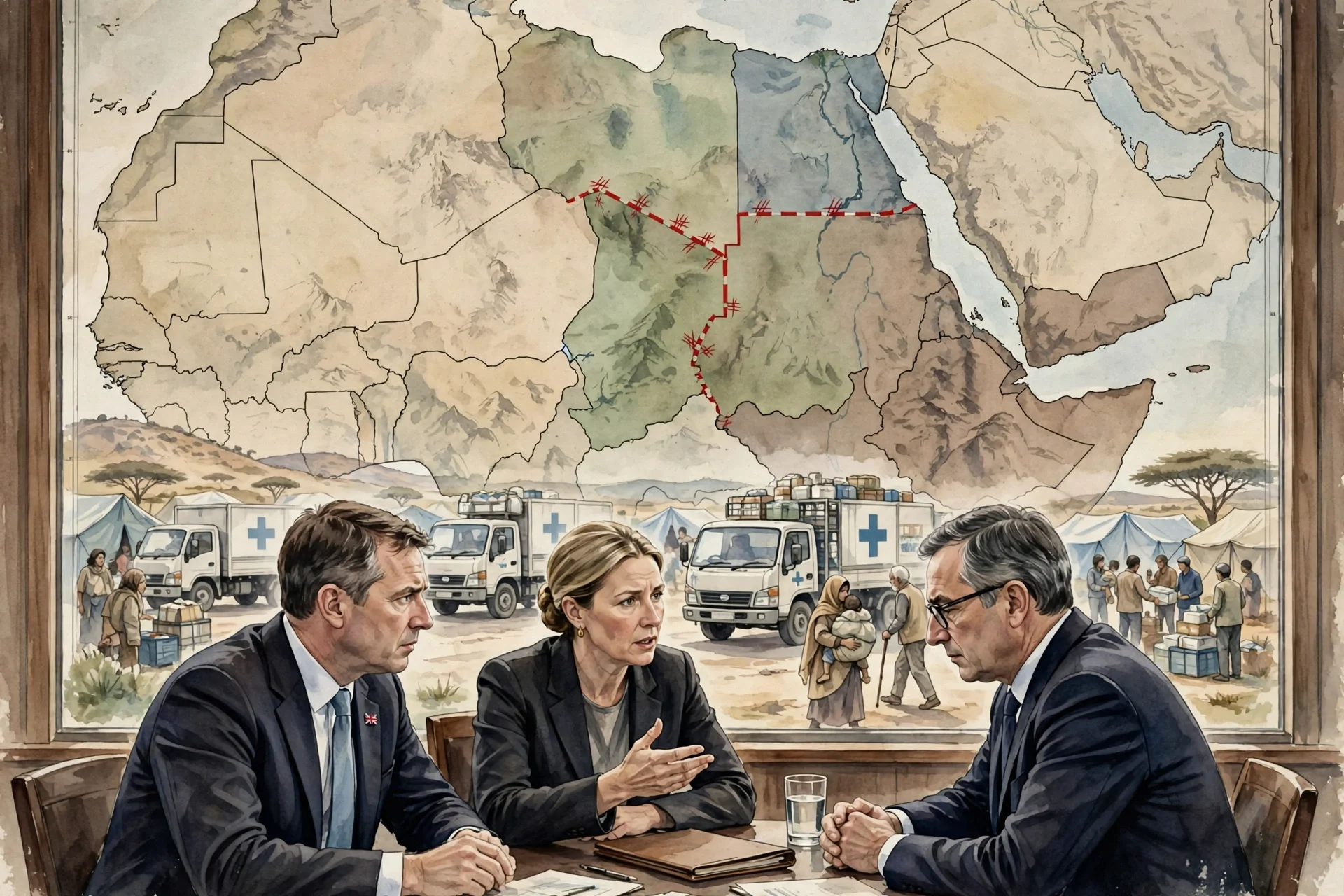
Imagen ilustrativa generada con IA: diplomáticos en una mesa de diálogo ante un mapa del noreste de África, con ayuda humanitaria y civiles al fondo, en alusión a la escalada entre Etiopía y Eritrea. · Imagen generada con IA para Erick Prometeo Media
UK urges de-escalation between Ethiopia and Eritrea
A UK government spokesperson voiced great concern at the worsening security situation in the Horn of Africa, urged respect for regional sovereignty…
Britain defends sovereignty and borders in Horn of Africa
The British government voiced great concern at security in the Horn of Africa, defended regional sovereignty and territorial integrity, opposed breaches of…
--- The context ---
Tensions between Ethiopia and Eritrea are again drawing concern beyond the region, in a Horn of Africa where security has been worsening. The deterioration prompted a public response from London, focused on containing the risk before it turns into a larger crisis for civilians.
--- The facts ---
A UK government spokesperson expressed great concern at the worsening security situation in the region. According to the statement, all parties were called on to respect the sovereignty, independence and territorial integrity of every country in the region, and to avoid actions that could escalate tensions further. It also opposed any party breaching the border of a neighbouring state.
--- The positions ---
The only position recorded is Britain's: an urgent call for de-escalation and dialogue, with support for the African Union's facilitating role. The statement also stressed that safe, unhindered humanitarian access is essential and that civilians must be protected. The source includes no response from Ethiopia, Eritrea or the African Union.
--- What remains unknown ---
The statement does not detail specific incidents or set any timeline for mediation. It also does not say what diplomatic steps will follow, or how the protection of civilians, including women and girls, and compliance with international humanitarian law will be guaranteed in practice on the ground.
--- Unanswered questions ---
What specific events prompted this warning now? Will Ethiopia and Eritrea agree to resume dialogue facilitated by the African Union? How will safe and unhindered humanitarian access be ensured if tensions keep rising?
--- EPM analysis ---
The statement bets on prevention, putting civilian protection and international law ahead of further escalation. Its effectiveness will depend on whether the parties accept restraint and regional mediation gets real room to work.
📌 EPM Take: In EPM's view, the value of this statement lies in its preventive and humanitarian focus: it recalls that civilians pay first for any escalation and that dialogue cannot wait for a new outbreak. Its limit is also clear, because a call without public responses from the parties or concrete follow-up measures risks remaining a diplomatic warning if the situation keeps deteriorating on the ground in the coming days and weeks ahead.
--- The context ---
Escalating tensions between Ethiopia and Eritrea have revived the risk of instability in the Horn of Africa, where borders and sovereignty are again at the centre of international concern. As security worsened, London set out a position built on firmness, restraint and respect for territorial order.
--- The facts ---
A UK government spokesperson expressed great concern at the worsening regional security situation. The statement called on all parties to respect the sovereignty, independence and territorial integrity of all countries in the region, and to avoid actions that could escalate tensions further. It also stated British opposition to any party breaching a neighbouring state's border.
--- The positions ---
The only declared position is Britain's, and it rests on a clear principle: borders are not changed by force, and disputes are settled through dialogue. It therefore urgently called for de-escalation and a return to talks, backing the African Union's facilitating role. The source includes no response from Ethiopia, Eritrea or the African Union itself.
--- What remains unknown ---
The text points to no specific incidents, assigns no responsibility to any party and announces no further measures. It also does not explain what would follow if a party failed to respect another state's sovereignty, or how civilian protection and humanitarian access would be verified in practice.
--- Unanswered questions ---
Will all parties respect their neighbours' borders in practice? What would happen if a party crossed a neighbouring state's border? Will Ethiopia and Eritrea accept a verifiable de-escalation mediated by the African Union?
--- EPM analysis ---
The message combines firmness on principle with caution in form, defending territorial order without naming culprits. Its real weight will depend on whether restraint is honoured on the ground, not only in statements.
📌 EPM Take: In EPM's view, the statement is right to place sovereignty and territorial integrity at the centre, because without respected borders there can be no order or dialogue in the region. Its firmness, however, remains declarative for now: it is still unknown what concrete steps will follow, what effective role the African Union will play, and whether the parties are willing to show restraint before tension turns into open and prolonged confrontation.
Reino Unido pide desescalar la tensión entre Etiopía y Eritrea
Un portavoz británico expresó gran preocupación por el empeoramiento de la seguridad en el Cuerno de África, pidió respetar la soberanía regional, desescalar y…
Londres defiende la soberanía y las fronteras en el Cuerno de África
El Gobierno británico expresó gran preocupación por la seguridad en el Cuerno de África, defendió la soberanía y la integridad territorial regional, rechazó…
--- El contexto ---
La tensión entre Etiopía y Eritrea vuelve a preocupar fuera de la región, en un Cuerno de África cada vez más frágil. El empeoramiento de la seguridad motivó una reacción pública desde Londres, centrada en contener el riesgo antes de una crisis mayor.
--- Los hechos ---
Un portavoz británico expresó gran preocupación por el deterioro de la seguridad regional. Según la declaración, todas las partes deben respetar la soberanía, la independencia y la integridad territorial regional, y evitar acciones que escalen más las tensiones. El texto rechaza además que cualquier parte viole la frontera de un Estado vecino.
--- Las posiciones ---
La única posición recogida es la británica: petición urgente de desescalada, regreso al diálogo y respaldo al papel de la Unión Africana para facilitarlo. La declaración subraya también que el acceso humanitario seguro y sin obstáculos es esencial. La fuente no recoge respuestas de Etiopía, de Eritrea ni de la Unión Africana.
--- Lo que falta saber ---
El comunicado no detalla incidentes concretos ni plazos para una posible mediación. Tampoco precisa qué pasos seguirán a la declaración ni cómo se garantizará sobre el terreno la protección de los civiles, incluidas mujeres y niñas, conforme al derecho internacional humanitario.
--- Preguntas sin respuesta ---
¿Qué hechos concretos provocaron esta advertencia ahora? ¿Aceptarán Etiopía y Eritrea retomar el diálogo con facilitación de la Unión Africana? ¿Cómo se garantizará el acceso humanitario sin obstáculos si la tensión sigue creciendo?
--- Análisis EPM ---
La declaración apuesta por la prevención: acentúa la protección civil y el derecho internacional antes de que la escalada se consolide. Su eficacia dependerá de que las partes acepten contenerse y de la mediación regional.
📌 Conclusion EPM: A juicio de EPM, el valor de esta declaración está en su enfoque preventivo y humanitario: recuerda que cualquier escalada la pagan primero los civiles y que el diálogo no puede esperar a un nuevo estallido. Su límite también es evidente, porque un llamamiento sin respuestas públicas de las partes ni medidas concretas de seguimiento corre el riesgo de quedarse en advertencia diplomática si la situación sigue deteriorándose sobre el terreno regional.
--- El contexto ---
La escalada entre Etiopía y Eritrea reaviva el riesgo de inestabilidad en el Cuerno de África, donde las fronteras y la soberanía vuelven al centro de la preocupación internacional. Ante el empeoramiento de la seguridad, Londres fijó una posición de firmeza y contención.
--- Los hechos ---
Un portavoz británico expresó gran preocupación por el empeoramiento de la seguridad. La declaración llamó a todas las partes a respetar la soberanía, la independencia y la integridad territorial regional, y a evitar acciones que escalen más las tensiones. También afirmó la oposición británica a que cualquier parte viole la frontera de sus vecinos.
--- Las posiciones ---
La posición declarada es solo la británica, apoyada en un principio claro: las fronteras no se alteran por la fuerza y los conflictos se resuelven hablando. Por eso pidió urgentemente desescalada y diálogo, con respaldo a la Unión Africana como facilitadora. La fuente no incluye respuestas de Etiopía, Eritrea ni la Unión Africana.
--- Lo que falta saber ---
El texto no señala incidentes concretos, no atribuye responsabilidades a ninguna parte y no anuncia medidas adicionales. Tampoco explica qué ocurrirá si alguna parte incumple ese respeto a la soberanía ajena, ni cómo se verificará la protección de los civiles y el acceso humanitario.
--- Preguntas sin respuesta ---
¿Respetarán todas las partes las fronteras de sus vecinos? ¿Habrá consecuencias si alguna parte cruza la frontera de un Estado vecino? ¿Aceptarán Etiopía y Eritrea una desescalada verificable con mediación de la Unión Africana?
--- Análisis EPM ---
El mensaje combina firmeza en el principio y prudencia en la forma: defiende el orden territorial sin señalar culpables. Su peso real dependerá de que la contención se cumpla sobre el terreno, no solo en comunicados.
📌 Conclusion EPM: A juicio de EPM, la declaración acierta al poner la soberanía y la integridad territorial en el centro, porque sin fronteras respetadas no hay orden ni diálogo posible en la región. Su firmeza, sin embargo, queda por ahora en el plano declarativo: falta saber qué pasos concretos seguirán, qué papel efectivo tendrá la Unión Africana y si las partes están dispuestas a contenerse antes de que la tensión se convierta en un choque abierto y prolongado.