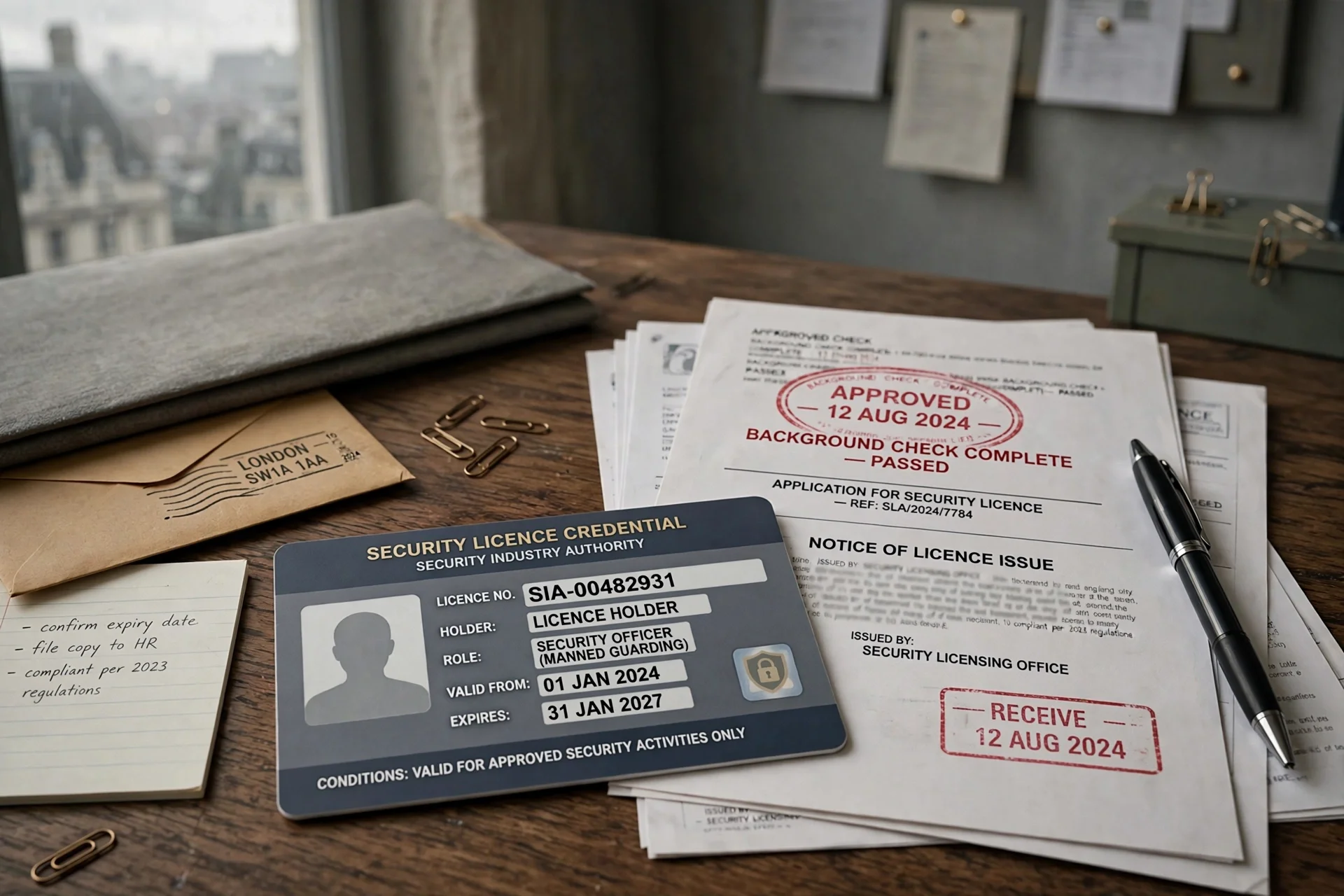
Imagen ilustrativa generada con IA: una credencial genérica de licencia de seguridad sobre un escritorio con documentos sellados, en alusión al fraude de referencias para obtener una licencia. · Imagen generada con IA para Erick Prometeo Media
Man convicted over fake references for a security licence
North London man Marius Serban pleaded guilty to 2 offences after supplying forged character references to obtain an SIA licence illegally, and was ordered to…
Fake references for security licence end in conviction
Marius Serban pleaded guilty to 2 offences for using forged references in an attempt to obtain an SIA licence, and must pay £904 comprising a fine of £180 per…
--- The context ---
In north London, the licence that security operatives working under contract must by law hold and display is not a minor formality, because it underpins public trust in the people who guard places and protect others. When that system is challenged with false documents, what is at stake is the integrity of the whole process of checks that comes before anyone is authorised.
--- The facts ---
A north London man, Marius Serban, was convicted of 2 offences after supplying the SIA with false character references in an attempt to illegally obtain an SIA licence. On 30 September 2026 at Highbury Magistrates Court, he pleaded guilty to 2 offences under section 3 of the Forgery and Counterfeiting Act 1981. He was ordered to pay a fine of £180 per offence, a victim surcharge of £144 and prosecution costs of £400, totalling £904.
Serban had applied for an SIA licence in October 2025, and was asked by the SIA to supply 2 character references to support his appeal against a potential refusal of his licence due to a previous conviction. One reference claimed to be from a former employer at a business where he had never worked, and the other claimed to be from a doctor whose name was not registered with the General Medical Council. Both references had been forged.
--- The positions ---
Tara Moutray, SIA Criminal Investigations Manager, welcomed the outcome and said in reported terms that she was glad to see the acts of forgery result in conviction and an order to pay almost £1,000. She conveyed that Serban had attempted to put the public's safety at risk by illegally obtaining a licence, and that the institution is committed to stopping dishonest applications and prosecuting where appropriate.
--- What remains unknown ---
The available information does not say whether Serban may apply for a licence again in the future or what additional checks were applied after the forgeries were detected. It also does not detail exactly when it was discovered that neither of the 2 references was genuine, or whether there were consequences beyond the fine, the surcharge and the costs set by the court in this case.
--- Unanswered questions ---
How were the 2 forged references detected before any licence was granted? Will Serban be able to submit a fresh application in the future after this conviction? What additional safeguards now protect the public against similar attempts to obtain a licence through fraud?
--- EPM analysis ---
The case shows that reference checking served a protective purpose: the appeal required supporting evidence and that evidence turned out to be false. The court outcome confirms that the system did not simply accept the documents, although the financial penalty leaves open the debate over whether it is enough to deter conduct that puts collective safety at risk.
📌 EPM Take: In EPM's view, this case defends a simple and necessary idea: a security licence only protects the public if the person who obtains it has passed real and verifiable checks without shortcuts or invented documents. The conviction and the order to pay almost £1,000 confirm that false references carry consequences, but they also recall that the integrity of the system depends on detecting fraud before any licence is granted and on keeping that vigilance in every future application submitted.
--- The context ---
Private security work under contract rests on a basic rule set by law: operatives must hold and display a valid SIA licence. That requirement loses its meaning if an applicant can bypass it with invented references, so documentary fraud in this field is a direct attack on the order that licensing is meant to guarantee for the public and for honest applicants alike.
--- The facts ---
A north London man, Marius Serban, was convicted of 2 offences after supplying the SIA with false character references in an attempt to illegally obtain an SIA licence. On 30 September 2026 at Highbury Magistrates Court, he pleaded guilty to 2 offences under section 3 of the Forgery and Counterfeiting Act 1981, the provision covering knowingly using a false instrument. He was ordered to pay a fine of £180 per offence, a victim surcharge of £144 and prosecution costs of £400, totalling £904.
Serban had applied for an SIA licence in October 2025, and the SIA asked him to supply 2 character references to support his appeal against a potential refusal due to a previous conviction. The first reference claimed to be from a former employer at a business where he had never worked, and the second claimed to be from a doctor whose name was not registered with the General Medical Council. Both references had been forged.
--- The positions ---
Tara Moutray, SIA Criminal Investigations Manager, welcomed the conviction and the order to pay almost £1,000. She conveyed in reported terms that Serban had attempted to put the public's safety at risk by seeking the licence illegally, and that the institution will stop dishonest applications and prosecute where appropriate. That institutional firmness is the central position recorded in the available information about this case.
--- What remains unknown ---
It is not detailed whether Serban may apply for a licence again or what additional measures were adopted after the fraud. Nor is it recorded when the forgery of each reference was discovered, or whether the previous conviction that prompted the potential refusal will have any further effect on his position after this new court proceeding has now been resolved.
--- Unanswered questions ---
Will Serban be able to apply for an SIA licence again after pleading guilty to these 2 offences? Is a total penalty of £904 enough to deter similar documentary fraud? Were reference verification checks strengthened after this attempt at deception was detected by the authorities?
--- EPM analysis ---
The institutional outcome is clear: there was a guilty plea, a conviction and a payment order. The attempt to obtain with false documents a permit that demands trust was frustrated and punished. The underlying question is whether the amount imposed conveys with sufficient force that forging references in a sensitive sector is never a shortcut without personal cost for the offender.
📌 EPM Take: In EPM's view, the conviction sends the right message: someone who forges references to obtain a security licence does not commit a mere administrative irregularity, but tries to bypass a control created to protect the public. The fine of £180 per offence, the surcharge of £144 and the costs of £400 add up to £904 and leave a court record of the fraud, although it is fair to ask whether that amount suffices as deterrence against deliberate and planned conduct.
Condenado por falsificar referencias para una licencia de seguridad
Marius Serban, del norte de Londres, se declaró culpable de 2 delitos por entregar referencias falsas a la SIA para obtener ilegalmente una licencia, y fue…
Fraude con referencias falsas para trabajar en seguridad acaba en condena
Marius Serban se declaró culpable de 2 delitos por usar referencias falsificadas para intentar obtener una licencia SIA, y deberá pagar £904 entre multa de…
--- El contexto ---
En el norte de Londres, la licencia que deben tener y mostrar los operarios de seguridad que trabajan bajo contrato no es un trámite menor, porque sostiene la confianza del público en quienes vigilan espacios y personas. Cuando ese sistema se intenta burlar con documentos falsos, lo que queda en cuestión es la integridad de todo el procedimiento de control previo.
--- Los hechos ---
Un hombre del norte de Londres, Marius Serban, fue condenado por 2 delitos tras entregar referencias de carácter falsas a la SIA para intentar obtener ilegalmente una licencia SIA. El 30 September 2026, en Highbury Magistrates Court, se declaró culpable de 2 delitos bajo la sección 3 de la Forgery and Counterfeiting Act 1981. Se le impuso una multa de £180 por delito, un recargo de víctima de £144 y costas de £400, con un total de £904.
Serban había solicitado la licencia en October 2025 y la SIA le pidió 2 referencias de carácter para respaldar su apelación contra una posible denegación por una condena previa. Una referencia decía ser de un antiguo empleador en una empresa donde nunca trabajó, y la otra decía ser de un médico cuyo nombre no consta en el General Medical Council. Ambas referencias habían sido falsificadas, según quedó establecido en el caso.
--- Las posiciones ---
La responsable de investigaciones criminales de la SIA, Tara Moutray, celebró que los actos de falsificación terminaran en condena y en una orden de pago de casi £1,000. Según transmitió, Serban intentó poner en riesgo la seguridad del público al tratar de obtener ilegalmente la licencia, y la institución está comprometida a detener las solicitudes deshonestas y a procesar cuando proceda.
--- Lo que falta saber ---
No consta en la información disponible si Serban podrá volver a solicitar la licencia en el futuro ni qué controles adicionales se aplicaron tras detectarse las falsificaciones. Tampoco se detalla en qué momento exacto se descubrió que ninguna de las 2 referencias era auténtica, ni si hubo consecuencias más allá de la multa, el recargo y las costas fijadas por el tribunal.
--- Preguntas sin respuesta ---
¿Cómo se detectaron las 2 referencias falsificadas antes de que la licencia llegara a concederse? ¿Podrá Serban presentar una nueva solicitud en el futuro tras esta condena? ¿Qué garantías adicionales protegen ahora al público frente a intentos similares de fraude en las solicitudes?
--- Análisis EPM ---
El caso muestra que la verificación de referencias cumplió una función protectora: la apelación exigía respaldo y ese respaldo resultó ser falso. La respuesta judicial confirma que el sistema no aceptó los documentos sin más, aunque la sanción económica deja abierto el debate sobre si basta para disuadir conductas que comprometen la seguridad colectiva.
📌 Conclusion EPM: A juicio de EPM, este caso defiende una idea sencilla y necesaria: una licencia de seguridad solo protege al público si quien la obtiene ha superado controles reales y verificables sin atajos ni documentos inventados. La condena y el pago de casi £1,000 confirman que las referencias falsas tienen consecuencias, pero también recuerdan que la integridad del sistema depende de detectar el fraude antes de conceder el permiso y de mantener esa vigilancia en cada solicitud futura presentada.
--- El contexto ---
La seguridad privada bajo contrato funciona con una regla básica establecida por ley: los operarios deben tener y mostrar una licencia SIA válida. Esa exigencia pierde sentido si un solicitante puede sortearla con referencias inventadas, por lo que el fraude documental en este ámbito es un ataque directo al orden que la licencia pretende garantizar.
--- Los hechos ---
Un hombre del norte de Londres, Marius Serban, fue condenado por 2 delitos tras entregar referencias de carácter falsas a la SIA para intentar obtener ilegalmente una licencia SIA. El 30 September 2026, en Highbury Magistrates Court, se declaró culpable de 2 delitos bajo la sección 3 de la Forgery and Counterfeiting Act 1981, norma que castiga usar a sabiendas un instrumento falso. Se le impuso una multa de £180 por delito, un recargo de víctima de £144 y costas de £400, con un total de £904.
Serban había solicitado la licencia en October 2025 y la SIA le pidió 2 referencias para su apelación contra una posible denegación motivada por una condena previa. La primera referencia decía ser de un antiguo empleador en una empresa donde nunca trabajó, y la segunda decía ser de un médico cuyo nombre no consta en el General Medical Council. Ambas referencias habían sido falsificadas.
--- Las posiciones ---
La responsable de investigaciones criminales de la SIA, Tara Moutray, celebró la condena y la orden de pago de casi £1,000. Según transmitió, Serban intentó poner en riesgo la seguridad del público al buscar ilegalmente la licencia, y la institución detendrá las solicitudes deshonestas y procesará cuando proceda. Esa firmeza institucional es la posición central recogida en la información disponible sobre el caso.
--- Lo que falta saber ---
No se detalla si Serban podrá volver a solicitar la licencia ni qué medidas adicionales se adoptaron tras el fraude. Tampoco consta en qué momento se descubrió la falsificación de cada referencia, ni si la condena previa que motivó la posible denegación tendrá algún efecto adicional sobre su situación tras este nuevo procedimiento judicial ya resuelto.
--- Preguntas sin respuesta ---
¿Podrá Serban volver a solicitar una licencia SIA tras declararse culpable de estos 2 delitos? ¿Es suficiente una sanción total de £904 para disuadir fraudes documentales similares? ¿Se reforzaron los controles de verificación de referencias después de detectarse este intento de engaño?
--- Análisis EPM ---
El desenlace es claro en lo institucional: hubo declaración de culpabilidad, condena y pago. El intento de obtener con documentos falsos un permiso que exige confianza quedó frustrado y sancionado. La cuestión de fondo es si la cuantía aplicada transmite con suficiente contundencia que falsificar referencias en un sector sensible nunca resulta un atajo sin coste personal.
📌 Conclusion EPM: A juicio de EPM, la condena envía el mensaje correcto: quien falsifica referencias para obtener una licencia de seguridad no comete una simple irregularidad administrativa, sino que intenta burlar un control creado para proteger al público. La multa de £180 por delito, el recargo de £144 y las costas de £400 suman £904 y dejan constancia judicial del fraude, aunque cabe preguntarse si esa cuantía basta como disuasión frente a una conducta deliberada y planificada.