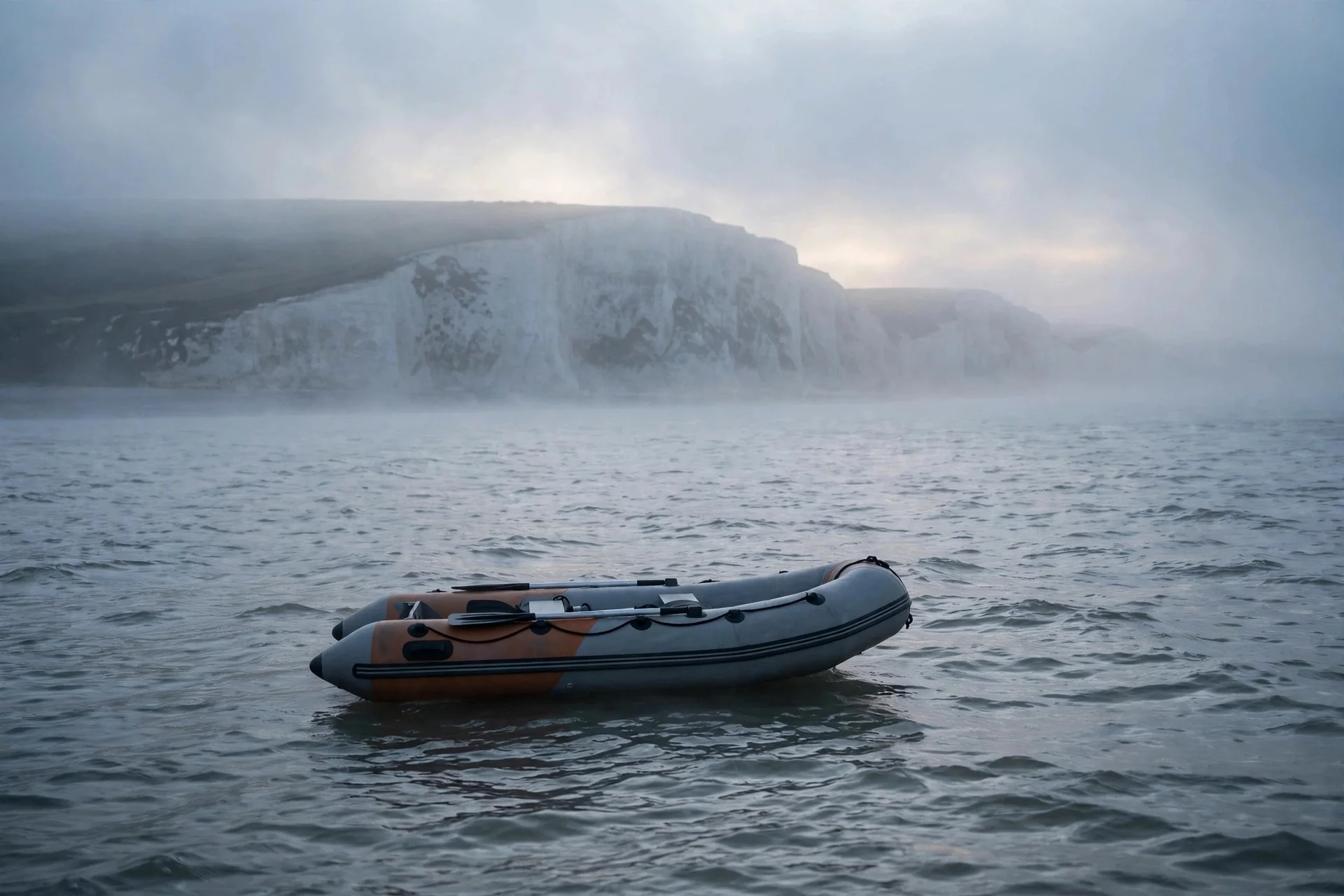
Imagen alusiva generada con IA de una embarcación inflable en aguas grises. · Imagen generada con IA para Erick Prometeo Media
MAIB will not open separate inquiry into Dover fatality
The MAIB completed its preliminary assessment of the 20 June 2026 fatality on an inflatable boat in the Dover Strait, identified no new safety issues and the…
No separate investigation after Dover Strait fatality
The MAIB preliminary assessment of the 20 June 2026 fatality in the Dover Strait identified no new safety issues, and the Chief Inspector exercised discretion…
--- The context ---
A criminally organised small boat crossing of the Dover Strait ended in a fatality on 20 June 2026 and again exposed the risks of the inflatable boats used to carry migrants.
--- The facts ---
The MAIB has completed a Preliminary Assessment into that fatality, which involved an inflatable boat carrying migrants in the Dover Strait. The circumstances were associated with the risks inherent in a criminally organised small boat crossing.
--- The positions ---
No new safety issues requiring a separate safety investigation have been identified, because those issues have previously been considered in MAIB migrant boat investigations. The Chief Inspector exercised the discretion under the Merchant Shipping (Accident Reporting and Investigation) Regulations 2026 not to commence one.
--- What remains unknown ---
The assessment gives no further details about the person who died, about other occupants or about the boat beyond its being inflatable. Those limits are part of what was communicated.
--- Unanswered questions ---
Which specific issues from previous investigations were applied to this case? Could more become known about the exact circumstances of the fatality? How will what was already learned reach those facing similar crossings?
--- EPM analysis ---
There is no new finding, but known risks repeating: criminal organisation, a small inflatable boat and a dangerous crossing. That continuity centres attention on prevention rather than on repeating earlier studies.
📌 EPM Take: In EPM's view, the decision not to open a separate investigation only holds up if what has already been learned is applied with real effect. When a fatality is linked to a criminally organised crossing and to issues already examined, prior knowledge should become effective protection and verifiable decisions, not a closure without practical consequences for the safety of migrants.
--- The context ---
The Dover Strait was the scene, on 20 June 2026, of a fatality on an inflatable boat carrying migrants on a criminally organised crossing. The case was examined to decide whether a separate safety investigation should begin.
--- The facts ---
The MAIB has completed a Preliminary Assessment into that fatality. The circumstances were associated with the risks inherent in a criminally organised small boat crossing and with safety issues previously considered in MAIB migrant boat investigations.
--- The positions ---
The position adopted was not to commence that investigation. No new safety issues requiring one have been identified, and the Chief Inspector exercised the discretion available under the Merchant Shipping (Accident Reporting and Investigation) Regulations 2026, resting on the current framework and prior work.
--- What remains unknown ---
No further details were communicated about the identity of the person who died, other occupants or features of the boat beyond its being small and inflatable, nor new conclusions beyond that decision.
--- Unanswered questions ---
Which issues from previous investigations were considered applicable here? What criteria guided the Chief Inspector's discretion under the Regulations 2026? Is any follow-up envisaged after that route was closed?
--- EPM analysis ---
The case shows institutional proportionality: with no new issues and the matter already examined, duplicating an investigation does not itself add safety. The emphasis falls on criminal organisation and the risks inherent in the crossing.
📌 EPM Take: In EPM's view, applying the rules with judgement is also a form of responsibility: not opening a separate investigation when no new issues have been identified avoids duplication and focuses attention on documented risks and on the criminal organisation of the crossing. The key will be whether that clarity is matched by real follow-up on safety issues already known.
MAIB no abrirá investigación separada por muerte en Dover
La MAIB completó la evaluación preliminar de la muerte del 20 de junio de 2026 en una embarcación inflable en el estrecho de Dover, no identificó nuevos…
Sin investigación separada tras la muerte en Dover
La evaluación preliminar de la MAIB sobre la muerte del 20 de junio de 2026 en el estrecho de Dover no identificó nuevos problemas de seguridad, y el inspector…
--- El contexto ---
Una travesía en embarcación pequeña por el estrecho de Dover, organizada criminalmente, terminó con una muerte el 20 de junio de 2026 y volvió a exponer los riesgos de las embarcaciones inflables usadas para transportar migrantes.
--- Los hechos ---
La MAIB completó una evaluación preliminar sobre esa muerte, ocurrida en una embarcación inflable en el estrecho de Dover. Las circunstancias se asociaron a los riesgos inherentes a una travesía en embarcación pequeña organizada criminalmente.
--- Las posiciones ---
No se identificaron nuevos problemas de seguridad que requieran una investigación separada, porque esos problemas ya se consideraron en investigaciones previas de la MAIB sobre embarcaciones de migrantes. El inspector jefe ejerció la discreción de las Merchant Shipping (Accident Reporting and Investigation) Regulations 2026 para no iniciarla.
--- Lo que falta saber ---
La evaluación no detalla datos adicionales sobre la persona fallecida, sobre otros ocupantes ni sobre la embarcación más allá de ser inflable. Esos límites forman parte de lo comunicado.
--- Preguntas sin respuesta ---
¿Qué problemas concretos de investigaciones previas se aplicaron a este caso? ¿Podrá conocerse más sobre las circunstancias exactas de la muerte? ¿Cómo llegará lo ya aprendido a quienes enfrentan travesías similares?
--- Análisis EPM ---
No hay un hallazgo nuevo, sino riesgos ya conocidos que se repiten: organización criminal, embarcación pequeña e inflable y un cruce peligroso. La continuidad de ese patrón centra la atención en la prevención.
📌 Conclusion EPM: A juicio de EPM, no abrir una investigación separada solo se sostiene si lo ya aprendido se aplica con efecto real. Cuando una muerte se vincula a una travesía organizada criminalmente y a problemas ya examinados, la exigencia es que ese conocimiento previo se traduzca en protección efectiva y decisiones verificables, no en un cierre sin consecuencias prácticas para la seguridad de las personas migrantes.
--- El contexto ---
El estrecho de Dover fue escenario, el 20 de junio de 2026, de una muerte en una embarcación inflable que transportaba migrantes en una travesía organizada criminalmente. El caso se examinó para decidir si correspondía una investigación de seguridad separada.
--- Los hechos ---
La MAIB completó una evaluación preliminar sobre esa muerte. Las circunstancias se asociaron a los riesgos inherentes a una travesía en embarcación pequeña organizada criminalmente y a problemas de seguridad ya considerados en investigaciones previas sobre embarcaciones de migrantes.
--- Las posiciones ---
La posición adoptada fue no iniciar esa investigación. No se identificaron nuevos problemas que la requirieran y el inspector jefe ejerció la discreción prevista en las Merchant Shipping (Accident Reporting and Investigation) Regulations 2026, apoyándose en el marco vigente y en el trabajo previo.
--- Lo que falta saber ---
No se comunicaron datos adicionales sobre la identidad de la persona fallecida, otros ocupantes ni características de la embarcación distintas de ser pequeña e inflable, ni conclusiones nuevas más allá de esa decisión.
--- Preguntas sin respuesta ---
¿Qué problemas de investigaciones previas se consideraron aplicables aquí? ¿Qué criterios guiaron la discreción del inspector jefe bajo las Regulations 2026? ¿Queda algún seguimiento previsto tras cerrar esa vía?
--- Análisis EPM ---
El caso muestra proporcionalidad institucional: sin problemas nuevos y con el asunto ya examinado, duplicar una investigación no añade seguridad por sí mismo. El foco recae en la organización criminal y en los riesgos inherentes al cruce.
📌 Conclusion EPM: A juicio de EPM, aplicar la norma con criterio también es responsabilidad: no abrir una investigación separada cuando no hay problemas nuevos evita duplicidades y concentra la atención en los riesgos documentados y en la organización criminal de la travesía. La clave será que esa claridad vaya acompañada de seguimiento real sobre los problemas de seguridad ya conocidos en embarcaciones de migrantes.