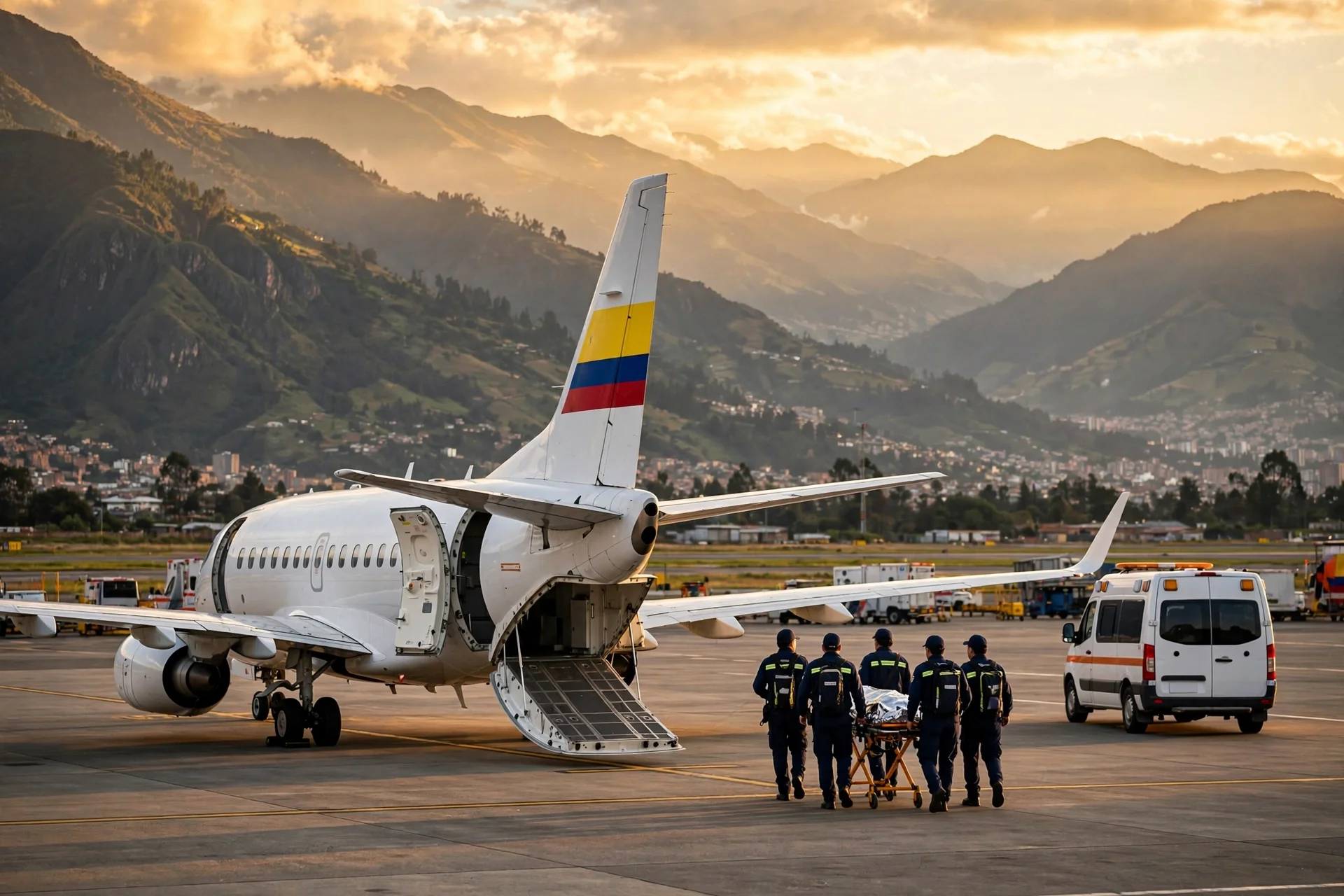
Imagen alusiva a la llegada de un vuelo medicalizado a Colombia. · Erick Prometeo Media
Henry Camargo returned to Colombia on a medical flight from New York
Former serviceman Henry Camargo arrived in Bogotá on October 13, 2026, on a medicalized flight from New York, financed by the Special Fund for Migrations and…
On presidential orders, Henry Camargo returned to Colombia for medical care
Henry Camargo, a former member of the Military Forces, returned to Colombia on October 13, 2026, on a medicalized flight from New York, after President…
--- The context ---
Henry Camargo, a former member of the Military Forces, was in the United States when in September 2026 he requested repatriation because of lung conditions and the need for a double lung transplant. His case brings together the care of a vulnerable patient and the real scope of State assistance to citizens abroad.
--- The facts ---
Camargo arrived in Colombia on October 13, 2026, on a medicalized flight from New York. The transfer was financed with resources from the Special Fund for Migrations and coordinated by the Foreign Ministry and the consulate in New York. In Bogotá he was received at the Central Military Hospital, where his care will continue under his affiliation to the special health regime of the Military Forces.
According to the Ministry of Foreign Affairs, President Abelardo de la Espriella ordered Foreign Minister Omar Bula to handle the case swiftly. During his stay in the United States, the consulate kept communication with Camargo, provided permanent support and arranged his return under adequate conditions.
--- The positions ---
The Foreign Ministry said the former serviceman is now home and will continue his recovery in Colombia, and it presented the wellbeing of all Colombians as a clear foreign policy priority under the name Patria Milagro. The president welcomed him on his X account, in a message signed with his initials.
Karen Camargo, the former serviceman's daughter, thanked the national Government at a press conference for its efforts and expressed the family's happiness, which saw the return as a reward for her father's work. During his hospital stay, Camargo is expected to be reunited with his mother, Nora Guzmán, after many years without contact.
--- What remains unknown ---
The specific lung diagnosis and the patient's current condition have not been detailed. No timetable has been reported for the double transplant, nor the cost of the transfer, nor the date of the expected family reunion.
--- Unanswered questions ---
When will the Central Military Hospital assess whether Camargo can enter the double transplant process? What was the cost of the medicalized flight and what share did the Special Fund for Migrations cover? What criteria will apply to other vulnerable Colombians who request a similar repatriation? When will the reunion with his mother, Nora Guzmán, take place?
--- EPM analysis ---
The case shows where consular protection helps and where it ends. The Foreign Ministry renewed its commitment to Colombians abroad, but recalled that its assistance is limited, does not replace health systems or amount to medical insurance, and that medical costs abroad fall on citizens or their insurers.
📌 EPM Take: In EPM's view, Henry Camargo's return is good human news and a practical warning for Colombians who live or travel abroad without sufficient coverage. The State acted to bring back a vulnerable patient, but the Foreign Ministry itself made clear that such help is limited, even in a case as serious as this one. The underlying lesson is that protection begins before the emergency, with international medical insurance that also covers health repatriation where applicable.
--- The context ---
Henry Camargo served in the Military Forces and was in the United States when in September 2026 he requested repatriation because of lung conditions and the need for a double lung transplant. His return raises how the State responds to a former member who needs specialized care in his own country.
--- The facts ---
On October 13, 2026, Camargo arrived in Colombia on a medicalized flight from New York. The transfer was financed with resources from the Special Fund for Migrations and coordinated by the Foreign Ministry and the consulate in New York. In Bogotá he was received at the Central Military Hospital, where his process will continue under the special military health regime.
According to the Ministry of Foreign Affairs, the process advanced after President Abelardo de la Espriella ordered Foreign Minister Omar Bula to handle the case swiftly. The consulate supported him permanently, kept constant communication with him and arranged a return in adequate conditions.
--- The positions ---
The Foreign Ministry stated that Camargo is now home, that he will continue his recovery in Colombia and that the wellbeing of Colombians is the foreign policy priority under the framework called Patria Milagro. The president reinforced that message by welcoming him on his X account, signed with his initials.
Karen Camargo, the former serviceman's daughter, thanked the national Government and the president at a press conference for making the transfer possible. The family expressed happiness and gratitude, and linked the outcome to her father's work. He is expected to be reunited in hospital with his mother, Nora Guzmán, after many years without contact.
--- What remains unknown ---
The patient's detailed lung progress and the timing of the eventual double transplant are not known. The cost of the operation has not been published, nor when the reunion with his mother will occur.
--- Unanswered questions ---
What assessment will the Central Military Hospital make of the viability and timing of the double transplant? How much did the medicalized flight from New York cost and how was the operation financed? What requirements must the patient meet within the special military health regime? At what point will the reunion with Nora Guzmán take place?
--- EPM analysis ---
The operation followed a clear institutional chain: presidential order, execution by the Foreign Ministry and the consulate, financing through a migrations fund and reception at the military hospital. The same institution set the limit clearly: its assistance is limited, it does not replace health systems or amount to medical insurance, and medical expenses abroad are borne by each citizen or their insurer.
📌 EPM Take: In EPM's view, Henry Camargo's return honours a basic duty of the State toward those who wore the uniform, and it does so through the correct institutional route, with a clear order, an identified fund and a competent hospital. That clarity makes it necessary not to turn a resolved case into a general promise the system cannot keep. Order in management, the family's gratitude and limits stated plainly form the most valuable part of this story.
Henry Camargo regresó a Colombia en vuelo medicalizado desde Nueva York
El exmilitar Henry Camargo llegó a Bogotá el 13 de octubre de 2026 en un vuelo medicalizado desde Nueva York, financiado por el Fondo Especial para las…
Por orden presidencial, Henry Camargo volvió a Colombia para su atención médica
Henry Camargo, exintegrante de las Fuerzas Militares, regresó a Colombia el 13 de octubre de 2026 en un vuelo medicalizado desde Nueva York, tras la orden del…
--- El contexto ---
Henry Camargo, exintegrante de las Fuerzas Militares, permanecía en Estados Unidos cuando en septiembre de 2026 pidió su repatriación por afectaciones pulmonares y por la necesidad de un doble trasplante de pulmón. Su caso cruza la atención de un paciente vulnerable con el alcance real de la asistencia estatal a los ciudadanos fuera del país.
--- Los hechos ---
Camargo llegó a Colombia el 13 de octubre de 2026 en un vuelo medicalizado desde Nueva York. El traslado fue financiado con recursos del Fondo Especial para las Migraciones y coordinado por la Cancillería y el consulado en Nueva York. En Bogotá fue recibido en el Hospital Militar Central, donde continuará su atención por su afiliación al régimen especial de salud de las Fuerzas Militares.
Según el Ministerio de Relaciones Exteriores, el presidente Abelardo de la Espriella ordenó al canciller Omar Bula atender el caso con celeridad. Durante su permanencia en Estados Unidos, el consulado mantuvo comunicación con Camargo, le brindó acompañamiento permanente y gestionó su retorno en condiciones adecuadas.
--- Las posiciones ---
La Cancillería sostuvo que el exmilitar ya está en casa y continuará su recuperación en Colombia, y presentó el bienestar de los colombianos como prioridad de la política exterior bajo la denominación de Patria Milagro. El presidente le dio la bienvenida en su cuenta de X, firmada con sus iniciales.
Karen Camargo, hija del exmilitar, agradeció en rueda de prensa las gestiones del Gobierno y expresó la felicidad de la familia, que vio el regreso como una recompensa por el trabajo de su padre. Se espera que en el hospital Camargo se reencuentre con su madre, Nora Guzmán, tras muchos años sin contacto.
--- Lo que falta saber ---
No se detalla el diagnóstico pulmonar concreto ni el estado actual del paciente. Tampoco se ha informado un cronograma para el doble trasplante, ni el costo del traslado, ni la fecha del esperado reencuentro familiar.
--- Preguntas sin respuesta ---
¿Cuándo evaluará el Hospital Militar Central si Camargo puede entrar al proceso del doble trasplante? ¿Cuál fue el costo del vuelo medicalizado y qué parte cubrió el Fondo Especial para las Migraciones? ¿Qué criterios se aplicarán a otros colombianos vulnerables que pidan una repatriación similar? ¿Cuándo podrá concretarse el reencuentro con su madre, Nora Guzmán?
--- Análisis EPM ---
El caso muestra dónde la protección consular ayuda y dónde termina. La Cancillería reiteró su compromiso con los colombianos, pero recordó que su asistencia es limitada, que no sustituye los sistemas de salud ni equivale a un seguro médico, y que los gastos médicos fuera del país corresponden a los ciudadanos o a sus aseguradoras.
📌 Conclusion EPM: A juicio de EPM, el regreso de Henry Camargo es una buena noticia humana y una advertencia práctica para colombianos que viven o viajan fuera sin cobertura suficiente. El Estado actuó para traer de vuelta a un paciente vulnerable, pero la Cancillería dejó claro que esa ayuda es limitada. La lección es que la protección empieza antes de la emergencia, con un seguro médico internacional que cubra la repatriación sanitaria cuando corresponda.
--- El contexto ---
Henry Camargo sirvió en las Fuerzas Militares y estaba en Estados Unidos cuando en septiembre de 2026 solicitó su repatriación por afectaciones pulmonares y la necesidad de un doble trasplante de pulmón. Su regreso plantea cómo responde el Estado frente a un antiguo integrante que necesita atención especializada en su país.
--- Los hechos ---
El 13 de octubre de 2026, Camargo llegó a Colombia en un vuelo medicalizado procedente de Nueva York. El traslado se financió con el Fondo Especial para las Migraciones y lo coordinaron la Cancillería y el consulado en Nueva York. En Bogotá lo recibió el Hospital Militar Central, donde seguirá su proceso conforme al régimen especial de salud militar.
De acuerdo con el Ministerio de Relaciones Exteriores, la gestión avanzó tras la orden del presidente Abelardo de la Espriella al canciller Omar Bula de atender el caso con celeridad. El consulado lo acompañó de forma permanente, mantuvo comunicación constante con él y gestionó un retorno en condiciones adecuadas.
--- Las posiciones ---
La Cancillería afirmó que Camargo ya está en casa, continuará su recuperación en Colombia y que el bienestar de los colombianos es prioridad de la política exterior en el marco denominado Patria Milagro. El presidente reforzó ese mensaje al darle la bienvenida en su cuenta de X, firmada con sus iniciales.
Karen Camargo, hija del exmilitar, agradeció en rueda de prensa al Gobierno nacional y al presidente las gestiones que hicieron posible el traslado. La familia expresó felicidad y gratitud, y vinculó el desenlace con el trabajo de su padre. El paciente podrá reencontrarse en el hospital con su madre, Nora Guzmán, tras muchos años sin contacto.
--- Lo que falta saber ---
No se conoce la evolución pulmonar detallada del paciente ni los tiempos del doble trasplante. Tampoco se publicó el costo del operativo ni cuándo ocurrirá el reencuentro con su madre.
--- Preguntas sin respuesta ---
¿Qué evaluación hará el Hospital Militar Central sobre viabilidad y tiempos del doble trasplante? ¿Cuánto costó el vuelo medicalizado desde Nueva York y cómo se financió el operativo? ¿Qué requisitos deberá cumplir el paciente dentro del régimen especial de salud militar? ¿En qué momento se producirá el reencuentro con Nora Guzmán?
--- Análisis EPM ---
La operación siguió una cadena institucional clara: orden presidencial, ejecución de la Cancillería y del consulado, financiación con un fondo de migraciones y recepción en el hospital militar. La misma entidad fijó el límite: su asistencia es limitada, no reemplaza los sistemas de salud ni equivale a un seguro médico, y los gastos en el exterior corren por cuenta de cada ciudadano o de su aseguradora.
📌 Conclusion EPM: A juicio de EPM, el regreso de Henry Camargo honra un deber del Estado con quienes vistieron el uniforme, y lo hace por la vía institucional, con orden, fondo identificado y hospital competente. Esa claridad obliga a no convertir un caso resuelto en una promesa que el sistema no puede cumplir. Orden en la gestión, gratitud de la familia y límites dichos sin rodeos forman la parte más valiosa de esta historia.