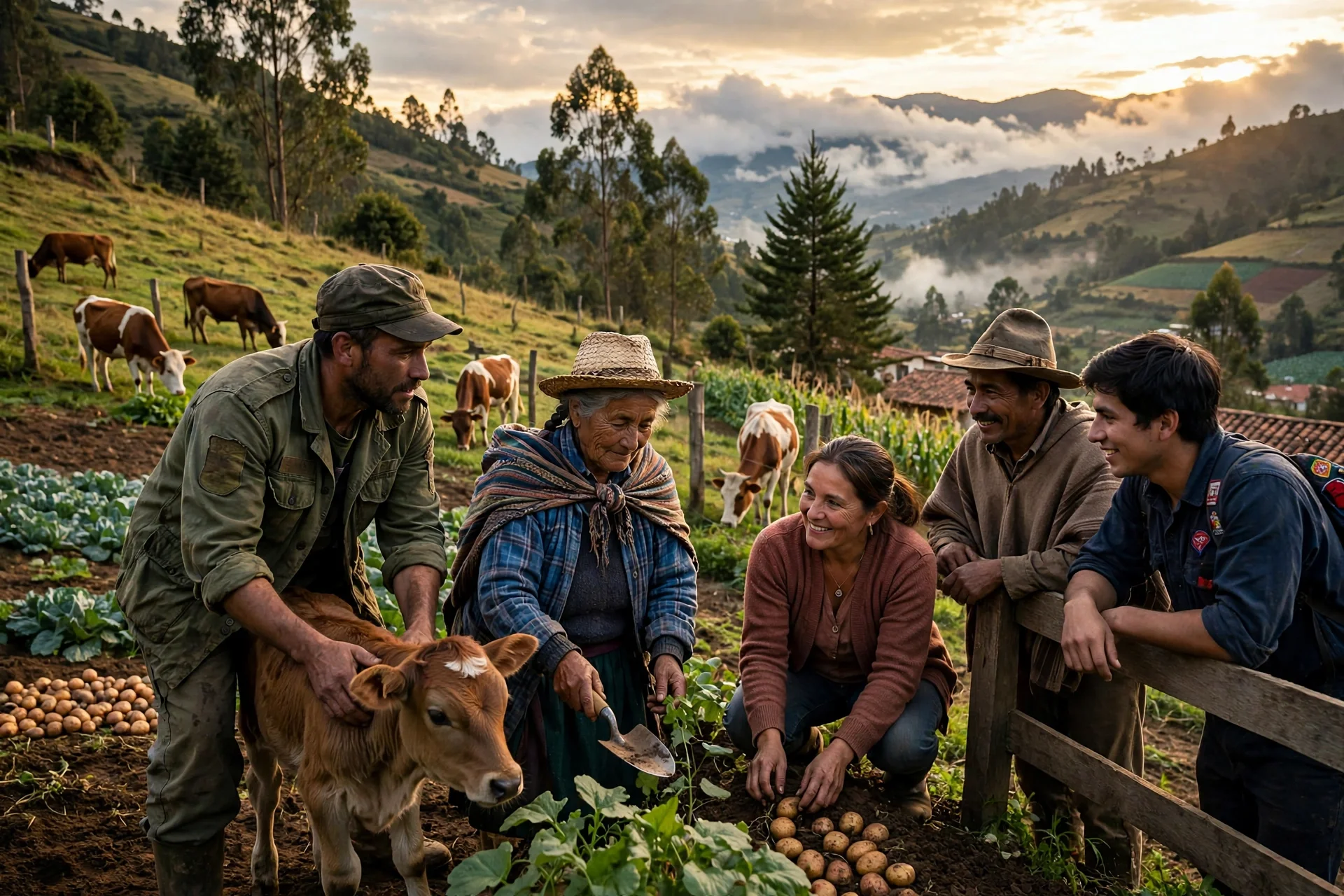
Granja comunitaria en las montañas de Colombia donde excombatientes, víctimas y vecinos comparten proyectos agrícolas y pecuarios. · EPM
Tibares farm fears loss of peace aid
Former FARC combatants and victims working together at the Tibares farm near Bogota voiced fear over a possible reduction of the reincorporation aid set out in…
Signatories seek to keep reincorporation income
Former combatants and victims at the Tibares farm expressed concern over a possible reduction of 2016 Peace Agreement aid.
--- The context ---
Colombia is approaching the tenth anniversary of the agreement signed on November 24, 2016 between the State and the former Revolutionary Armed Forces of Colombia, which ended the conflict between the two sides and opened processes of reincorporation, reparation and truth-seeking. Some 13,000 people linked to that guerrilla force laid down their arms that year and took on commitments to the State, regardless of the government in office. Almost a decade later, criticism of the pact from the government of President Abelardo de la Espriella has reopened debate over the economic aid.
--- The facts ---
At the Tibares farm, an hour and a half from Bogota and created in 2020, former guerrillas, victims and community residents work together on agricultural and livestock projects. Angelica Bayen Munoz, a victim of sexual violence during the conflict, arrived in Bogota a decade ago after two forced displacements from Cesar and Vichada. At the farm she listened to the testimonies of former guerrilla members and, as she recounted, that experience led her to forgive them. Signatories and victims said statements by the current government have generated unease and that they have felt threatened and intimidated. The concern centers on the basic income received by more than 8,000 signatories.
That monthly allowance is equivalent to 90 % of a minimum wage and is managed by the Agency for Reincorporation and Normalization. It was planned for 24 months, but was extended to help sustain reincorporation processes. Luis Gonzalez joined the guerrilla in his adolescence, after members of his family were executed by members of the Army, and after taking up the agreement he displaced twice because of threats from dissidents who wanted him to return to armed struggle. Tito Cuevas spent 30 years in the FARC and left Arauca to move to Bogota out of fear of the dissidents. Both cases show a reincorporation marked by displacement and a lack of job opportunities.
--- The positions ---
Alessandro Preti, director of the Verification area of the UN Mission in Colombia, argued that initiatives such as the farm show that a setting for peace and reconciliation exists, and that signatories are not only beneficiaries but can build peace together with communities. Isabelita Mercado, Bogota city councilor for Peace, Victims and Reconciliation, warned about the risk of reducing resources for the agency and recalled that the country and the government must answer to those with active processes who signed with the State. She also noted that the resurgence of violence is turning former combatants into victims of displacement again.
Rolando Albeiro Acevedo, known as Octavio, a former commander of the Jacobo Arenas Urban Front and leader of the project, said the agreement is entering its last four years of implementation without a perceived political will from the current government to continue the previous path. Acevedo left prison in 2017 after being convicted for a 2004 car bomb attack and appears before the Special Jurisdiction for Peace in cases 1 and 10. Gonzalez explained that the income is his main sustenance and that he does not regret having abandoned the armed struggle, although he described the process as harder than war. Cuevas warned that, without that income, many people could take up arms again.
--- What remains unknown ---
The available information does not confirm that the government has decided to suspend the basic income, nor does it specify a concrete reduction in resources for the agency. No amounts, deadlines or formal decisions are known. What can be verified is the fear of signatories, victims and local authorities, together with the warning about the risk of defunding.
--- Unanswered questions ---
Will the government decide to maintain, reduce or restructure the basic income currently received by more than 8,000 signatories? What will happen to projects such as the Tibares farm if the reincorporation agency's resources shrink? What protection will former combatants receive who keep being displaced by dissident threats? How will victims and signatories continue sharing spaces of reconciliation if the programs that sustain them are weakened?
--- EPM analysis ---
Tibares shows that reincorporation is not exhausted by a monthly payment, because the farm combines income, shared work and mutual recognition among people who stood on opposite sides of the conflict. When a victim recounts that she learned to forgive by listening to former guerrillas, the agreement stops being a text and becomes daily practice. That is why the budget debate goes beyond fiscal matters and touches the credibility of the state commitment of 2016. If the State reviews the aid, form and timing will matter as much as the figure.
📌 EPM Take: In EPM's view, the debate over aid should start from a clear distinction between reviewing a program and weakening the word of the State, because more than 8,000 signatories today depend on an income equivalent to 90 % of a minimum wage while trying to sustain projects such as the Tibares farm alongside victims and neighbors. Colombia gains when reincorporation produces verifiable work, coexistence and reparation, and loses when uncertainty settles over commitments signed in 2016. Any adjustment should be announced with deadlines, criteria and protection for those still under threat, so that peace does not depend on each month's fear.
--- The context ---
The agreement signed on November 24, 2016 between the Colombian State and the former Revolutionary Armed Forces of Colombia closed the conflict between the two sides and set commitments on reincorporation, reparation and truth-seeking. Some 13,000 people linked to the guerrilla force laid down their arms and assumed obligations toward the State, regardless of the government in office. Almost ten years later, criticism of the pact from the government of President Abelardo de la Espriella has reopened debate over the economic aid.
--- The facts ---
The Tibares farm, created in 2020 and located an hour and a half from Bogota, brings together former guerrillas, victims and community residents in agricultural and livestock projects. Angelica Bayen Munoz, a victim of sexual violence during the conflict, arrived in Bogota a decade ago after two forced displacements from Cesar and Vichada. As she recounted, listening at the farm to testimonies of former guerrilla members led her to forgive them. Signatories and victims said they felt threatened and intimidated by statements of the current government. The main fear centers on the basic income received by more than 8,000 signatories, equivalent to 90 % of a monthly minimum wage.
That income is managed by the Agency for Reincorporation and Normalization. It was planned for 24 months and later extended to contribute to the sustainability of the processes. Luis Gonzalez joined the guerrilla in his adolescence, after members of his family were executed by members of the Army, and once under the agreement he displaced twice because of threats from dissidents seeking his return to armed struggle. Tito Cuevas, who spent 30 years in the FARC, left Arauca and moved to Bogota out of fear of those dissidents. Gonzalez argued that displacements and the lack of job opportunities hinder his reincorporation and that he does not yet know peace because he is still fleeing.
--- The positions ---
Isabelita Mercado, Bogota city councilor for Peace, Victims and Reconciliation, warned that reducing resources for the agency would put at risk the answer that the country and the government owe to those with active processes who signed with the State, and noted that the resurgence of violence is turning former combatants into victims of displacement again. Alessandro Preti, director of the Verification area of the UN Mission in Colombia, stressed that the farm shows a setting for peace and reconciliation exists and that signatories can build peace together with communities, not only receive benefits.
Rolando Albeiro Acevedo, known as Octavio, a former commander of the Jacobo Arenas Urban Front and leader of the project, questioned the current government's political will by noting that the agreement is entering its last four years of implementation. Acevedo was convicted for a 2004 car bomb attack, left prison in 2017 thanks to the agreement and appears before the Special Jurisdiction for Peace in cases 1 and 10. Gonzalez explained that the income is his main sustenance and that he does not regret having left arms behind, although he called the process complex and harder than war. Cuevas warned that, without that income, many people could take up arms again.
--- What remains unknown ---
The available information contains no government decision to suspend the basic income and no official cut figure for the reincorporation agency. Nor are deadlines, targeting criteria or new conditions for beneficiaries known. What is documented is the concern of signatories, victims and Bogota's peace council office, together with the warning about possible defunding.
--- Unanswered questions ---
Will the government announce a formal decision on the continuity of the basic income and under what compliance criteria would it be maintained? What controls guarantee that reincorporation resources translate into productive projects and not permanent dependence? What security measures will protect signatories threatened by dissidents seeking to recruit them again? How will compliance with what was signed in 2016 be balanced with the reparation owed to the victims of the conflict?
--- EPM analysis ---
Honoring an agreement signed by the State is not optional for a country that wants its word to count, but honoring it does not mean an absence of requirements either. The income was born with a 24-month term and was extended, and that extension requires accountability on results, employment and permanence in legality. Tibares offers a measurable example of what is sought, shared work among former adversaries and real production. At the same time, the warning that without the income some would return to arms should be read as a security risk signal that the State must manage firmly, not as an argument that closes off all review of spending.
📌 EPM Take: In EPM's view, Colombia must fulfill what was signed in 2016 and at the same time demand verifiable results from every reincorporation program, because the credibility of the State is at stake in both directions and because victims deserve truth and reparation without delay. Maintaining an income equivalent to 90 % of a minimum wage for more than 8,000 signatories is only justified if it sustains legal work, projects such as the Tibares farm and a definitive abandonment of violence. A review, if it comes, should be announced with clear rules, public deadlines and protection against dissidents, never through uncertainty that erodes what was agreed.
Granja Tíbares teme perder ayudas de paz
Excombatientes de las antiguas FARC y víctimas que conviven en la granja Tíbares, cerca de Bogotá, expresaron temor ante una posible reducción de las ayudas de…
Firmantes piden mantener renta de reincorporación
Excombatientes y víctimas de la granja Tíbares expresaron preocupación por la posible reducción de las ayudas del Acuerdo de Paz de 2016.
--- El contexto ---
Colombia se aproxima al décimo aniversario del acuerdo firmado el 24 de noviembre de 2016 entre el Estado y las antiguas Fuerzas Armadas Revolucionarias de Colombia, que puso fin al conflicto entre ambas partes y abrió procesos de reincorporación, reparación y búsqueda de la verdad. Unas 13,000 personas vinculadas a esa guerrilla dejaron las armas ese año y asumieron compromisos con el Estado, con independencia del Gobierno de turno. Casi una década después, las críticas al pacto desde el Gobierno del presidente Abelardo de la Espriella reabrieron el debate sobre la continuidad de las ayudas económicas.
--- Los hechos ---
En la granja Tíbares, a una hora y media de Bogotá y creada en 2020, antiguos guerrilleros, víctimas y habitantes de la comunidad trabajan juntos en proyectos agrícolas y pecuarios. Angélica Bayén Muñoz, víctima de violencia sexual durante el conflicto, llegó a Bogotá hace una década tras dos desplazamientos forzados desde Cesar y Vichada. En la granja escuchó los testimonios de antiguos guerrilleros y, según relató, esa experiencia la llevó a perdonarlos. Firmantes y víctimas señalaron que las declaraciones del actual Gobierno han generado inquietud y que se han sentido amenazados e intimidados. La preocupación se concentra en la renta básica que reciben más de 8,000 firmantes.
Esa asignación mensual equivale al 90 % de un salario mínimo y la gestiona la Agencia para la Reincorporación y la Normalización. Estaba prevista para 24 meses, pero se extendió para contribuir a la sostenibilidad de los procesos. Luis González ingresó a la guerrilla en su adolescencia, después de que integrantes de su familia fueran ejecutados por miembros del Ejército, y tras acogerse al acuerdo se desplazó dos veces por amenazas de disidencias que pretendían que regresara a la lucha armada. Tito Cuevas permaneció 30 años en las FARC y abandonó Arauca para trasladarse a Bogotá por temor a las disidencias. Ambos casos muestran una reincorporación atravesada por desplazamientos y falta de oportunidades laborales.
--- Las posiciones ---
Alessandro Preti, director del área de Verificación de la Misión de la ONU en Colombia, sostuvo que iniciativas como la granja demuestran que existe un escenario de paz y reconciliación, y que los firmantes no son solo beneficiarios, sino que pueden construir paz junto con las comunidades. Isabelita Mercado, consejera de Paz, Víctimas y Reconciliación de la Alcaldía de Bogotá, advirtió sobre el riesgo de reducir los recursos de la agencia y recordó que el país y el Gobierno deben responder a quienes tienen procesos activos y firmaron con el Estado. También señaló que el recrudecimiento de la violencia vuelve a convertir a antiguos combatientes en víctimas de desplazamiento.
Rolando Albeiro Acevedo, conocido como Octavio, antiguo comandante del Frente Urbano Jacobo Arenas y líder del proyecto, planteó que el acuerdo entra en sus últimos cuatro años de implementación sin que se perciba voluntad política del Gobierno actual para seguir la senda anterior. Acevedo salió de prisión en 2017 tras ser condenado por un atentado con carro bomba en 2004 y comparece ante la Jurisdicción Especial para la Paz en los casos 1 y 10. González explicó que la renta es su principal sustento y que no se arrepiente de haber dejado las armas, aunque describió el proceso como más duro que la guerra. Cuevas advirtió que, sin esa renta, mucha gente podría volver a tomar las armas.
--- Lo que falta saber ---
La información disponible no confirma que el Gobierno haya decidido suspender la renta básica ni precisa si habrá una reducción concreta de los recursos de la agencia. Tampoco se conocen montos, plazos ni decisiones formales. Lo verificable es el temor de firmantes, víctimas y autoridades locales, junto con la advertencia sobre el riesgo de desfinanciación.
--- Preguntas sin respuesta ---
¿Decidirá el Gobierno mantener, reducir o reestructurar la renta básica que hoy reciben más de 8,000 firmantes? ¿Qué pasará con proyectos como la granja Tíbares si disminuyen los recursos de la agencia de reincorporación? ¿Qué protección recibirán los excombatientes que siguen desplazándose por amenazas de las disidencias? ¿Cómo seguirán compartiendo espacios de reconciliación víctimas y firmantes si se debilitan los programas que los sostienen?
--- Análisis EPM ---
Tíbares muestra que la reincorporación no se agota en un pago mensual, porque la granja combina ingreso, trabajo compartido y reconocimiento mutuo entre personas que estuvieron en lados opuestos del conflicto. Cuando una víctima relata que aprendió a perdonar escuchando a antiguos guerrilleros, el acuerdo deja de ser un texto y se vuelve práctica cotidiana. Por eso el debate presupuestario excede lo fiscal y toca la credibilidad del compromiso estatal de 2016. Si el Estado revisa las ayudas, la forma y los tiempos importarán tanto como la cifra.
📌 Conclusion EPM: A juicio de EPM, la discusión sobre las ayudas debe partir de una distinción clara entre revisar un programa y debilitar la palabra del Estado, porque más de 8,000 firmantes dependen hoy de una renta equivalente al 90 % de un salario mínimo mientras intentan sostener proyectos como la granja Tíbares junto a víctimas y vecinos. Colombia gana cuando la reincorporación produce trabajo, convivencia y reparación verificables, y pierde cuando la incertidumbre se instala sobre compromisos firmados en 2016. Cualquier ajuste debería anunciarse con plazos, criterios y protección para quienes siguen amenazados, de modo que la paz no dependa del temor de cada mes.
--- El contexto ---
El acuerdo firmado el 24 de noviembre de 2016 entre el Estado colombiano y las antiguas Fuerzas Armadas Revolucionarias de Colombia cerró el conflicto entre ambas partes y fijó compromisos de reincorporación, reparación y búsqueda de la verdad. Unas 13,000 personas vinculadas a la guerrilla dejaron las armas y asumieron obligaciones ante el Estado, con independencia del Gobierno de turno. Casi diez años después, las críticas al pacto desde el Gobierno del presidente Abelardo de la Espriella reabrieron el debate sobre las ayudas económicas.
--- Los hechos ---
La granja Tíbares, creada en 2020 y ubicada a una hora y media de Bogotá, reúne a antiguos guerrilleros, víctimas y habitantes de la comunidad en proyectos agrícolas y pecuarios. Angélica Bayén Muñoz, víctima de violencia sexual durante el conflicto, llegó a Bogotá hace una década tras dos desplazamientos forzados desde Cesar y Vichada. Según su relato, escuchar en la granja los testimonios de antiguos guerrilleros la llevó a perdonarlos. Firmantes y víctimas manifestaron sentirse amenazados e intimidados por las declaraciones del actual Gobierno. El temor se concentra en la renta básica que reciben más de 8,000 firmantes, equivalente al 90 % de un salario mínimo mensual.
Esa renta la gestiona la Agencia para la Reincorporación y la Normalización. Estaba prevista para 24 meses y luego se extendió para contribuir a la sostenibilidad de los procesos. Luis González ingresó a la guerrilla en su adolescencia, tras la ejecución de integrantes de su familia por miembros del Ejército, y ya acogido al acuerdo se desplazó dos veces por amenazas de disidencias que buscaban que regresara a la lucha armada. Tito Cuevas, que permaneció 30 años en las FARC, abandonó Arauca y se trasladó a Bogotá por temor a esas disidencias. González sostuvo que los desplazamientos y la falta de oportunidades laborales dificultan su reincorporación y que todavía no conoce la paz porque sigue huyendo.
--- Las posiciones ---
Isabelita Mercado, consejera de Paz, Víctimas y Reconciliación de la Alcaldía de Bogotá, advirtió que reducir los recursos de la agencia pondría en riesgo la respuesta que el país y el Gobierno deben a quienes tienen procesos activos y firmaron con el Estado, y señaló que el recrudecimiento de la violencia vuelve a convertir a antiguos combatientes en víctimas de desplazamiento. Alessandro Preti, director del área de Verificación de la Misión de la ONU en Colombia, destacó que la granja demuestra que existe un escenario de paz y reconciliación y que los firmantes pueden construir paz junto con las comunidades, no solo recibir beneficios.
Rolando Albeiro Acevedo, conocido como Octavio, antiguo comandante del Frente Urbano Jacobo Arenas y líder del proyecto, cuestionó la voluntad política del Gobierno actual al señalar que el acuerdo entra en sus últimos cuatro años de implementación. Acevedo fue condenado por un atentado con carro bomba en 2004, salió de prisión en 2017 gracias al acuerdo y comparece ante la Jurisdicción Especial para la Paz en los casos 1 y 10. González explicó que la renta es su principal sustento y que no se arrepiente de haber dejado las armas, aunque calificó el proceso de complejo y más duro que la guerra. Cuevas advirtió que, sin esa renta, mucha gente podría volver a tomar las armas.
--- Lo que falta saber ---
No consta una decisión del Gobierno de suspender la renta básica ni una cifra oficial de recorte para la agencia de reincorporación. Tampoco se conocen plazos, criterios de focalización ni condiciones nuevas para los beneficiarios. Lo documentado es la preocupación de firmantes, víctimas y de la consejería de paz de Bogotá, junto con la advertencia sobre una posible desfinanciación.
--- Preguntas sin respuesta ---
¿Anunciará el Gobierno una decisión formal sobre la continuidad de la renta básica y con qué criterios de cumplimiento se mantendría? ¿Qué controles garantizan que los recursos se traduzcan en proyectos productivos y no en dependencia permanente? ¿Qué medidas de seguridad protegerán a los firmantes amenazados por las disidencias que buscan reclutarlos de nuevo? ¿Cómo se equilibrará el cumplimiento de lo firmado en 2016 con la reparación debida a las víctimas?
--- Análisis EPM ---
Honrar un acuerdo firmado por el Estado no es opcional para un país que quiere que su palabra valga, pero honrarlo tampoco significa ausencia de exigencias. La renta nació con un plazo de 24 meses y se extendió, y esa extensión obliga a rendir cuentas sobre resultados, empleo y permanencia en la legalidad. Tíbares ofrece un ejemplo medible de lo buscado, trabajo compartido entre antiguos adversarios y producción real. La advertencia de que sin renta algunos volverían a las armas es una señal de riesgo que el Estado debe gestionar con firmeza.
📌 Conclusion EPM: A juicio de EPM, Colombia debe cumplir lo firmado en 2016 y a la vez exigir resultados verificables a cada programa de reincorporación, porque la credibilidad del Estado se juega en ambas direcciones y porque las víctimas merecen verdad y reparación sin dilaciones. Mantener una renta equivalente al 90 % de un salario mínimo para más de 8,000 firmantes solo se justifica si sostiene trabajo legal, proyectos como la granja Tíbares y abandono definitivo de la violencia. La revisión, si llega, debería ser anunciada con reglas claras, plazos públicos y protección frente a las disidencias, nunca mediante incertidumbre que erosione lo pactado.