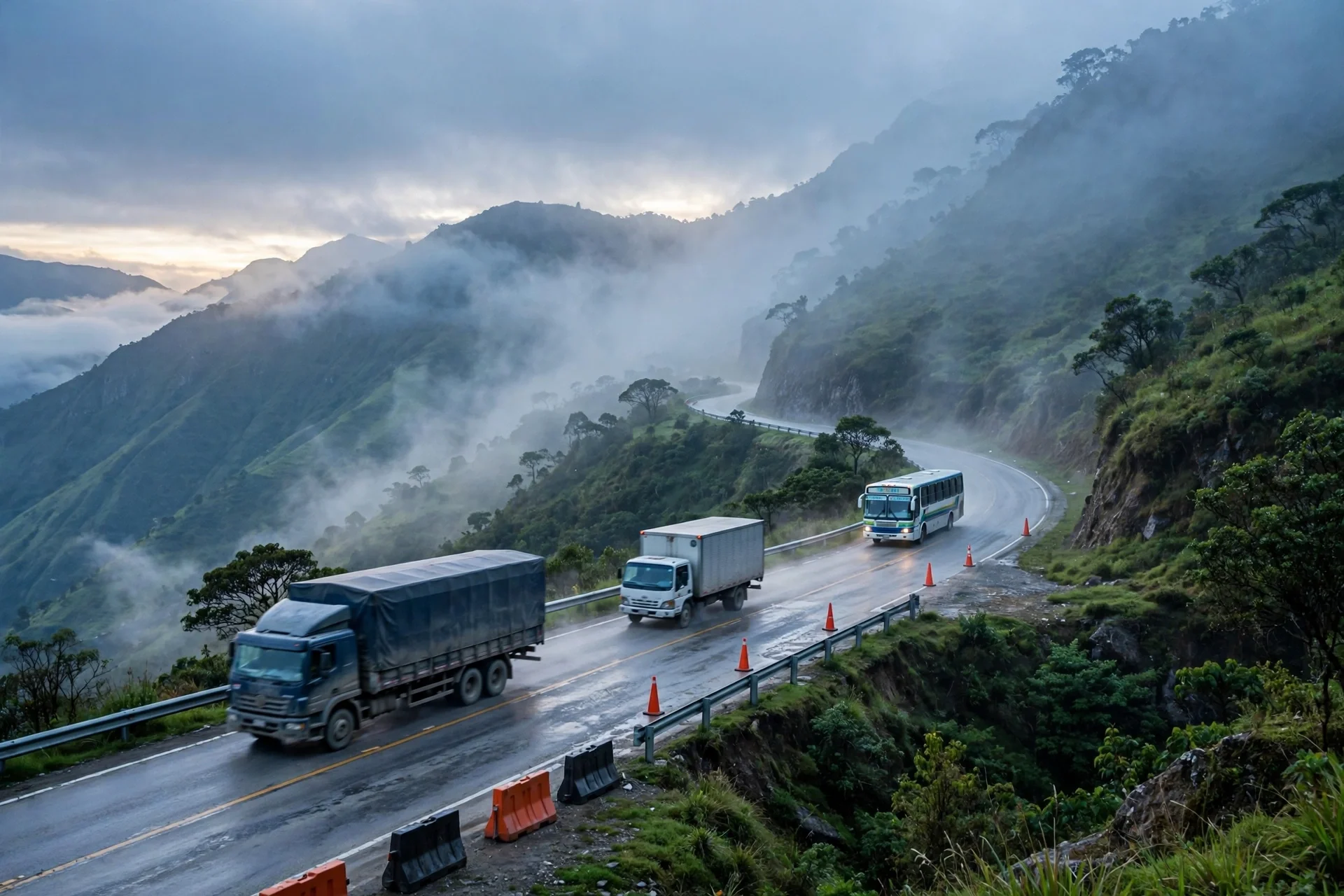
Un corredor de montaña al amanecer, con camiones y un autobús transitando entre conos y barreras de seguridad vial. · Imagen generada para EPM
Government speeds up safety measures for transport workers on Pan-American Highway
The Government of Abelardo De La Espriella announced measures after the alleged October 15 attempted assault on a bus with Ecuadorian plates, which left five…
Meteoro Plan and armored vehicles to restore security on the Pan-American Highway
After the alleged October 15 attempted assault on a bus with Ecuadorian plates, with five people dead and 59 injured, and the October 6 kidnapping between…
--- The context ---
The Pan-American Highway has become a corridor where transport workers and travelers face assaults, threats and acts that the national Government itself describes as terrorism. For the drivers who move goods and passengers along this route, every trip has turned into a gamble against fear, and the demand for protection has grown urgent.
The statement by the Government of Abelardo De La Espriella, issued through the Ministry of Transport, followed a sequence of grave events that alarmed the sector and pushed the executive branch to move from condemnation toward a concrete package of measures with announced dates and purchases.
--- The facts ---
On October 15, an alleged attempted assault was reported against a bus with Ecuadorian plates on the Pan-American Highway. The incident led to an overturn that left five people dead and 59 injured, the gravest toll in the recent wave of violence against road transport along this corridor.
The ministry also condemned the kidnapping reported between the municipalities of Timbío and El Remolino on October 6, as well as other cases in which the lives of transport workers and travelers using this corridor have been put at risk. According to the Government itself, these are not isolated episodes but a persistent threat over the route.
--- The positions ---
Transport Minister Elsa Noguera said it is unacceptable for criminals to threaten the lives of those who travel on the country's roads, conveyed the Government's condolences to the families of the deceased and expressed solidarity with the injured, their families and the entire transport sector. In her framing, traveling and working on Colombia's roads must be safe.
--- What remains unknown ---
The announcement does not yet detail the delivery timelines for the vehicles or the exact moment when the reinforced presence will become visible on the hardest-hit stretches of the corridor. Nor are the concrete agreements that will come out of the working table known yet, because that meeting has not taken place and its decisions are still pending.
--- Unanswered questions ---
When will the announced motorcycles, armored pickup trucks and armored vehicles actually reach the Pan-American Highway? What immediate measures will protect transport workers while the October 29 working table is being set up? What verifiable commitments will the Vice Minister of Defense, Invías and the Ministry of Transport assume before the sector? How will anyone measure whether the Meteoro Plan reduces assaults and threats along the corridor?
--- EPM analysis ---
The central value of this announcement is that it places the lives of the people behind the wheel at the center of the state response: grief is acknowledged, solidarity with the sector is explicit, and a table is set where transport workers will sit with the authorities to define measures. The equipment purchases will only make social sense if they translate into safe journeys for those who carry the country's food and merchandise.
📌 EPM Take: In EPM's view, the Government is right to treat the safety of transport workers as a state priority rather than a private problem of the sector. The October 29 table in Boyacá, the acceleration of the Meteoro Plan and the purchase of 600 motorcycles, 124 pickup trucks with level III armor and 20 armored vehicles form a serious package, but its legitimacy will depend on results drivers can feel on every trip: less fear, fewer assaults and corridors where working no longer costs anyone their life in Colombia.
--- The context ---
The Pan-American Highway has become a corridor where criminality openly defies the State: assaults, threats and acts of terrorism against transport workers and travelers have eroded order and free transit. Without effective authority over the road, there is no safe commerce and no guaranteed mobility for Colombians.
The Government of Abelardo De La Espriella, through the Ministry of Transport, answered this escalation with a statement of condemnation and a set of decisions aimed at regaining control of the corridor: coordination with the security forces, acceleration of the Meteoro Plan and equipment purchases to respond to threats.
--- The facts ---
On October 15, an alleged attempted assault was reported against a bus with Ecuadorian plates on the Pan-American Highway. The incident led to an overturn that left five people dead and 59 injured, a brutal demonstration of the human cost the country pays when criminals act with impunity on its highways.
The ministry also condemned the kidnapping reported between the municipalities of Timbío and El Remolino on October 6, as well as other cases in which the lives of transport workers and travelers using this corridor have been put at risk. The pattern described by the Government combines terrorism, assaults and threats against those who move the economy by road.
--- The positions ---
Transport Minister Elsa Noguera held that the situation on the Pan-American Highway demands a firm and coordinated response, and said the table with transport workers and the Vice Ministry of Defense will define the actions to accelerate the Meteoro Plan and strengthen the capacity of the security forces to protect life and guarantee free transit. She also stated that the safety of transport workers and travelers is a priority and that work will be done with the sector to confront criminality on the roads.
--- What remains unknown ---
The Government has not yet specified the delivery deadlines for the announced equipment or the exact distribution of the National Police and Army reinforcement along the corridor. Those definitions, according to the announcement, will come from the October 29 working table, whose concrete results are not yet known.
--- Unanswered questions ---
How soon will the 600 motorcycles, the 124 pickup trucks with level III armor and the 20 armored vehicles be operating along the corridor? What concrete results must the October 29 working table in Boyacá deliver? How will the reinforcement of the security forces be guaranteed as permanent rather than a temporary reaction? What will happen to those responsible for the attacks against transport workers?
--- EPM analysis ---
The announcement has the merit of speaking the right language in the face of crime: firmness, coordination and material means for the security forces. Buying mobility and armor is an investment in the capacity to patrol and respond, which is what a besieged corridor needs. Authority, however, is not decreed: it is exercised in a sustained manner, and the sector will judge this plan by the effective reduction of attacks.
📌 EPM Take: In EPM's view, the Government sends the right signal by responding with firmness and with investment in operational capacity against the criminality besieging the Pan-American Highway. The October 29 table, the push for the Meteoro Plan and the acquisition of motorcycles, armored pickup trucks and armored vehicles aim to restore state authority along the corridor. The country will need to verify that this presence is permanent, that free transit prevails without exceptions and that no criminal again feels ownership over Colombian highways or over the lives of those who travel them daily.
Gobierno acelera medidas de seguridad para transportadores en la vía Panamericana
El Gobierno de Abelardo De La Espriella anunció medidas tras el presunto intento de asalto del 15 de octubre contra un autobús de placas ecuatorianas, que dejó…
Plan Meteoro y vehículos blindados para recuperar la seguridad en la vía Panamericana
Tras el presunto intento de asalto del 15 de octubre contra un autobús de placas ecuatorianas, con cinco personas fallecidas y 59 heridas, y el secuestro del 6…
--- El contexto ---
La vía Panamericana concentra una crisis de seguridad que golpea a quienes viven de recorrerla: transportadores y viajeros han quedado expuestos a asaltos, amenazas y actos que el Gobierno nacional describe como terrorismo. Para el gremio, cada viaje se ha convertido en una apuesta contra el miedo.
El pronunciamiento del Gobierno de Abelardo De La Espriella, a través del Ministerio de Transporte, llega tras una secuencia de hechos graves que alarmó al sector y obligó al Ejecutivo a pasar de la condena a un paquete de medidas con fechas y compras anunciadas.
--- Los hechos ---
El pasado 15 de octubre se registró un presunto intento de asalto contra un autobús de placas ecuatorianas en la vía Panamericana. El hecho derivó en un volcamiento que dejó cinco personas fallecidas y 59 heridas, el saldo más grave de la reciente ola de violencia contra el transporte por carretera en este corredor.
La entidad también condenó el secuestro reportado entre los municipios de Timbío y El Remolino el pasado 6 de octubre, así como otros casos en los que se ha puesto en riesgo la vida de transportadores y viajeros que transitan por esta vía. No se trata, según el Gobierno, de episodios aislados, sino de una amenaza persistente sobre el corredor.
--- Las posiciones ---
La ministra de Transporte, Elsa Noguera, afirmó que es inaceptable que los delincuentes amenacen la vida de quienes transitan por las carreteras del país, expresó las condolencias del Gobierno a las familias de las personas fallecidas y extendió su solidaridad a los heridos, a sus familias y a todo el gremio transportador. En su planteamiento, viajar y trabajar en las carreteras de Colombia debe ser seguro.
--- Lo que falta saber ---
El anuncio no detalla aún los tiempos de entrega de los vehículos ni el momento exacto en que la presencia reforzada se hará visible en los tramos más golpeados del corredor. Tampoco se conocen todavía los acuerdos concretos que saldrán de la mesa de trabajo, porque ese encuentro aún no se ha realizado y sus definiciones están pendientes.
--- Preguntas sin respuesta ---
¿Cuándo llegarán efectivamente a la vía Panamericana las motocicletas, las camionetas blindadas y las tanquetas anunciadas? ¿Qué medidas inmediatas protegerán a los transportadores mientras se instala la mesa de trabajo del 29 de octubre? ¿Qué compromisos verificables asumirán el viceministro de Defensa, el Invías y el Ministerio de Transporte frente al gremio? ¿Cómo se medirá si el Plan Meteoro reduce los asaltos y las amenazas en el corredor?
--- Análisis EPM ---
El anuncio pone la vida de los trabajadores del volante en el centro de la respuesta estatal: hay duelo reconocido, solidaridad con el gremio y una mesa donde los transportadores se sentarán a definir medidas con las autoridades. La compra de equipos solo tendrá sentido si se traduce en trayectos seguros para quienes transportan las mercancías del país.
📌 Conclusion EPM: A juicio de EPM, la respuesta del Gobierno acierta al tratar la seguridad de los transportadores como una prioridad de Estado y no como un problema privado del gremio. La mesa del 29 de octubre en Boyacá, la aceleración del Plan Meteoro y la compra de 600 motocicletas, 124 camionetas con blindaje nivel III y 20 tanquetas forman un paquete serio, pero su legitimidad dependerá de resultados que los conductores puedan sentir en cada viaje: menos miedo, menos asaltos y corredores donde trabajar ya no cueste la vida a nadie en Colombia.
--- El contexto ---
La vía Panamericana se ha convertido en un corredor donde la criminalidad desafía al Estado: asaltos, amenazas y actos de terrorismo contra transportadores y viajeros han deteriorado el orden y el libre tránsito. Sin autoridad efectiva sobre la carretera, no hay comercio seguro ni movilidad garantizada para los colombianos.
El Gobierno de Abelardo De La Espriella, a través del Ministerio de Transporte, respondió a esta escalada con un pronunciamiento de condena y un conjunto de decisiones orientadas a recuperar el control del corredor: coordinación con la Fuerza Pública, aceleración del Plan Meteoro y adquisición de equipos para responder a las amenazas.
--- Los hechos ---
El pasado 15 de octubre se registró un presunto intento de asalto contra un autobús de placas ecuatorianas en la vía Panamericana. El hecho derivó en un volcamiento que dejó cinco personas fallecidas y 59 heridas, muestra del costo humano que paga el país cuando los delincuentes actúan con impunidad en sus carreteras.
La entidad también condenó el secuestro reportado entre los municipios de Timbío y El Remolino el pasado 6 de octubre, así como otros casos en los que se ha puesto en riesgo la vida de transportadores y viajeros que transitan por este corredor. El patrón descrito por el Gobierno combina terrorismo, asaltos y amenazas contra quienes mueven la economía por carretera.
--- Las posiciones ---
La ministra de Transporte, Elsa Noguera, sostuvo que la situación de la Panamericana exige una respuesta firme y coordinada, y planteó que en la mesa con los transportadores y el Viceministerio de Defensa se definirán las acciones para acelerar el Plan Meteoro y fortalecer la capacidad de la Fuerza Pública para proteger la vida y garantizar el libre tránsito. También aseguró que la seguridad de transportadores y viajeros es prioridad y que se trabajará con el sector contra la criminalidad en las vías.
--- Lo que falta saber ---
El Gobierno no ha precisado los plazos de entrega de los equipos ni la distribución del refuerzo de la Policía Nacional y el Ejército sobre el corredor. Esas definiciones saldrán de la mesa del 29 de octubre, cuyos resultados aún están por conocerse.
--- Preguntas sin respuesta ---
¿En cuánto tiempo estarán operando en el corredor las 600 motocicletas, las 124 camionetas con blindaje nivel III y las 20 tanquetas? ¿Qué resultados concretos debe entregar la mesa de trabajo del 29 de octubre en Boyacá? ¿Cómo se garantizará que el refuerzo de la Fuerza Pública sea permanente y no una reacción temporal? ¿Qué pasará con los responsables de los ataques contra los transportadores?
--- Análisis EPM ---
El anuncio tiene el mérito de hablar el idioma correcto frente al crimen: firmeza, coordinación y medios materiales para la Fuerza Pública. Comprar movilidad y blindaje es invertir en la capacidad de patrullar y responder, que es lo que un corredor asediado necesita. La autoridad, sin embargo, no se decreta: se ejerce con constancia, y el gremio juzgará este plan por la reducción de los ataques.
📌 Conclusion EPM: A juicio de EPM, el Gobierno envía la señal correcta al responder con firmeza y con inversión en capacidad operativa frente a la criminalidad que asedia la vía Panamericana. La mesa del 29 de octubre, el impulso al Plan Meteoro y la adquisición de motocicletas, camionetas blindadas y tanquetas apuntan a recuperar la autoridad del Estado en el corredor. El país necesitará verificar que esa presencia sea permanente, que el libre tránsito se imponga sin excepciones y que ningún delincuente vuelva a sentirse dueño de las carreteras colombianas ni de la vida de quienes las recorren.