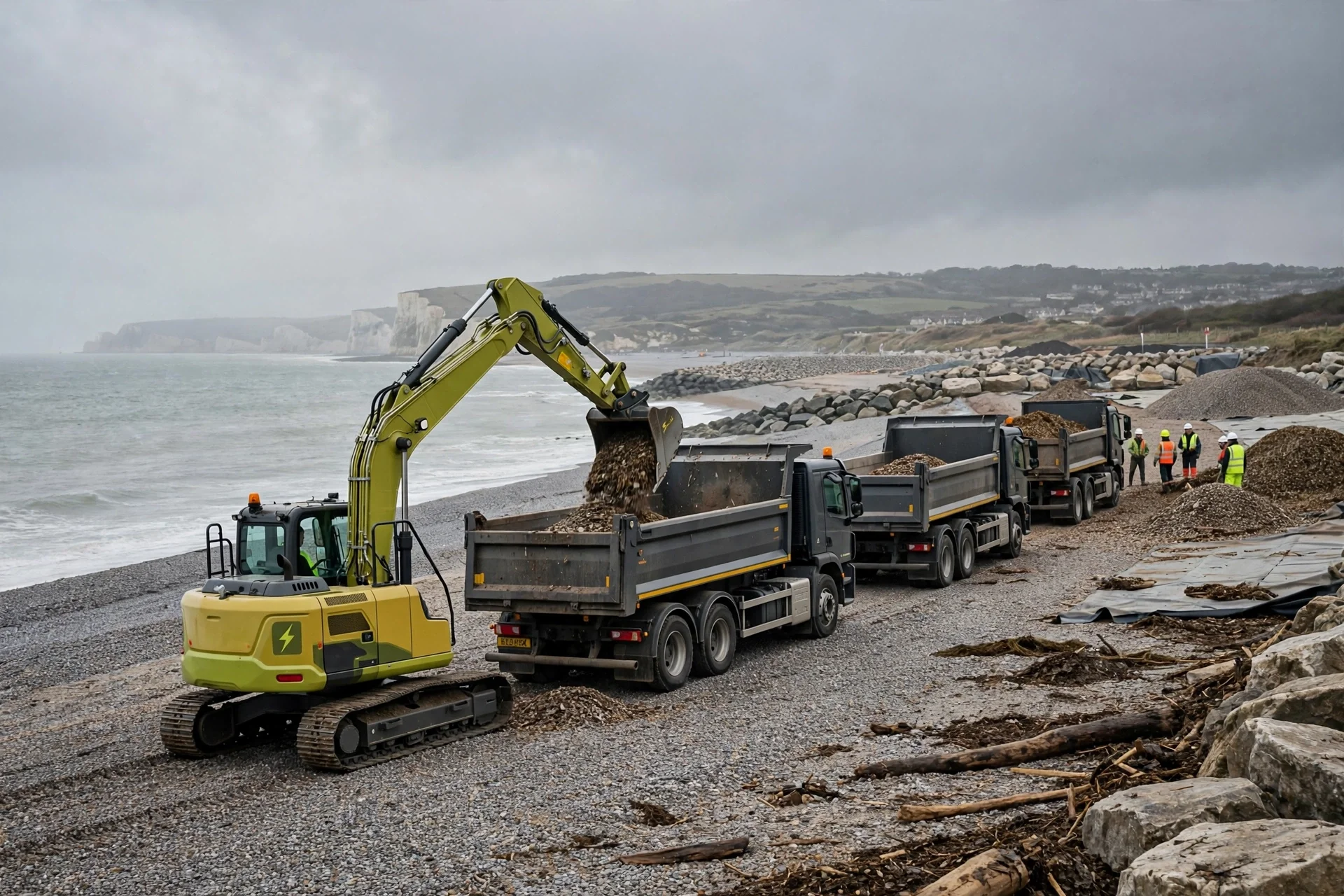
Excavadora eléctrica y camiones volquete mueven guijarros en una playa de Sussex durante la prueba de defensa costera. · Imagen generada para EPM
Electric coastal defence passes its test on a Sussex beach
The Environment Agency trialled an electric fleet in Sussex from 12 to 16 October that shifted shingle between Eastbourne and Sovereign Harbour, gathered…
Electric fleet delivers in Sussex as costs face careful test
An electric fleet with a 22-tonne excavator, tipper trucks, hybrid bulldozers and 4x4s shifted shingle in Sussex from 12 to 16 October, with productivity and…
The Environment Agency put electric construction vehicles through their paces on a Sussex beach and showed that clean technology can handle vital coastal defence work while cutting air and noise pollution.
--- The context ---
The work is part of annual efforts to protect the coast from flooding and erosion. Moving shingle along the beach maintains a natural barrier that protects homes, businesses and infrastructure, in an area where flood and coastal erosion risk management requires continuous work and heavy equipment.
--- The facts ---
From 12 to 16 October, an electric fleet shifted shingle from White Point in Eastbourne to North-east Beach in Sovereign Harbour. The fleet included a 22-tonne excavator, tipper trucks, hybrid bulldozers and 4x4s, and carried out the work as part of the annual coastal protection efforts.
The Electric October trial showed that battery-powered machinery can cope with the tough demands of a working beach while cutting emissions and fuel bills. Throughout the week the team gathered data on productivity, reliability, battery performance, energy consumption, charging requirements and operator experience, all pointing to electric machinery being able to do the job.
--- The positions ---
Amber Carr, Pevensey Bay to Eastbourne Beach Manager, said in indirect terms that the technology is not just a good idea because it can work in a real operational environment, and that watching the fully electric excavator keep pace gave confidence to run operations more sustainably. Nick Gray, Area Flood and Coastal Risk Manager, said moving shingle is essential to protecting homes, businesses and infrastructure and that low-carbon technology can do that job just as effectively as traditional machinery.
--- What remains unknown ---
The results will help shape future decisions on lower-emission equipment in beach management, coastal construction, and flood and coastal erosion risk management across the country. The Pevensey to Eastbourne Coastal Management Scheme covers 15km of coastline in southeast England and will cost around £140 million over the next 10 years. The agency currently manages the 9km Pevensey stretch and from June 2027 will also take over the Eastbourne Frontage from Eastbourne Borough Council, with further works planned between 2027 and 2037.
--- Unanswered questions ---
Will the electric fleet be extended to other stretches of coast after this trial? What charging requirements would a permanent deployment on working beaches need? How will the battery and energy data shape future equipment decisions?
--- EPM analysis ---
The trial was a joint innovation project with industry partners testing low-carbon machinery on live coastal defence works. Its strength is practical evidence gathered on the beach itself, covering productivity and reliability alongside a significant reduction in air and noise pollution for communities and crews working on essential flood protection.
📌 EPM Take: In EPM's view, this trial matters because it links public benefit and a clean transition in essential work that cannot pause. If electric machinery protects the coast just as effectively with fewer emissions, less noise and lower fuel bills, flood defence gains a more sustainable tool. The task now is to turn the data gathered into careful deployment decisions, with charging and upkeep resolved, so the Sussex experience can guide comparable projects across the country without losing daily operational reliability on the beach.
An electric construction fleet completed the annual shingle move for coastal defence in Sussex, and the Environment Agency concluded that it performs like traditional machinery with less air and noise pollution.
--- The context ---
Defending this coast depends on moving shingle constantly to hold back flooding and erosion. It is heavy, repetitive work that protects homes, businesses and infrastructure, so any change of equipment must first prove effectiveness, reliability and controlled costs before a wider replacement can be considered responsibly.
--- The facts ---
From 12 to 16 October, the fleet shifted shingle from White Point in Eastbourne to North-east Beach in Sovereign Harbour. The fleet included a 22-tonne excavator, tipper trucks, hybrid bulldozers and 4x4s, as part of annual efforts to protect the coast from flooding and erosion.
The Electric October trial showed that battery-powered machinery can cope with a working beach while cutting emissions and fuel bills. The team gathered data on productivity, reliability, battery performance, energy consumption, charging requirements and operator experience, concluding that electric machinery can do the job while significantly reducing air and noise pollution.
--- The positions ---
Amber Carr, Pevensey Bay to Eastbourne Beach Manager, said in indirect terms that the technology can work in a real operational environment and that watching the fully electric excavator keep pace gave confidence to operate more sustainably. Nick Gray, Area Flood and Coastal Risk Manager, said keeping shingle moving is essential to protecting homes, businesses and infrastructure and that low-carbon technology can do that job just as effectively as traditional machinery, offering a practical route to cleaner defence.
--- What remains unknown ---
The results will help shape future decisions on beach management, coastal construction, and flood and coastal erosion risk management projects across the country. The Pevensey to Eastbourne Coastal Management Scheme covers 15km of coastline in southeast England and will cost around £140 million over the next 10 years. The agency currently manages the 9km Pevensey stretch and from June 2027 will also take over the Eastbourne Frontage from Eastbourne Borough Council, with further works planned between 2027 and 2037.
--- Unanswered questions ---
What will it cost to scale the electric fleet compared with renewing traditional machinery? Will batteries withstand prolonged intensive use beyond a one-week trial? What charging infrastructure will each beach need before the model can be generalised?
--- EPM analysis ---
The trial was a joint innovation project with industry partners on live coastal defence works. That condition matters for a prudent assessment: performance was measured where it counts, on the beach, and future decisions should weigh those data against investment, charging and maintenance, without assuming an immediate rollout.
📌 EPM Take: In EPM's view, the strength of Electric October is the test itself, not the slogan: the electric fleet did the same essential job and the agency measured productivity, reliability and consumption before deciding. That prudence should govern what follows. With a £140 million scheme ahead, scaling up will only make sense if total costs and charging confirm the advantage, project by project. If the data support it, the transition will be credible precisely because it was verified on the ground first.
Defensa costera eléctrica supera su prueba en una playa de Sussex
La Agencia de Medio Ambiente probó del 12 al 16 de octubre una flota eléctrica en Sussex que movió guijarros entre Eastbourne y Sovereign Harbour, recogió…
Flota eléctrica cumple en Sussex y medirá costes antes de escalar
Una flota eléctrica con excavadora de 22 toneladas, camiones volquete, bulldozers híbridos y vehículos 4x4 movió guijarros en Sussex del 12 al 16 de octubre…
La Agencia de Medio Ambiente puso a prueba vehículos eléctricos de construcción en una playa de Sussex y comprobó que la tecnología limpia puede cumplir el exigente trabajo de defensa costera reduciendo la contaminación atmosférica y acústica.
--- El contexto ---
El trabajo forma parte de los esfuerzos anuales para proteger la costa frente a inundaciones y erosión. Mover guijarros a lo largo de la playa sostiene una barrera natural que resguarda hogares, empresas e infraestructuras, en un tramo donde la gestión del riesgo de inundación y erosión costera exige obras continuas y equipos pesados.
--- Los hechos ---
Del 12 al 16 de octubre, una flota eléctrica movió guijarros desde White Point en Eastbourne hasta North-east Beach en Sovereign Harbour. La flota incluyó una excavadora de 22 toneladas, camiones volquete, bulldozers híbridos y vehículos 4x4, y realizó el traslado dentro de las labores anuales de protección costera.
La prueba Electric October mostró que la maquinaria a batería soporta las duras condiciones de una playa de trabajo y reduce emisiones y costes de combustible. Durante la semana el equipo recogió datos de productividad, fiabilidad, rendimiento de batería, consumo de energía, requisitos de carga y experiencia del operador, y todos apuntaron a que la maquinaria eléctrica puede hacer el trabajo.
--- Las posiciones ---
Amber Carr, responsable de Pevensey Bay a Eastbourne, señaló en síntesis que la tecnología no es solo una buena idea, porque funciona en un entorno operativo real, y que ver a la excavadora totalmente eléctrica mantener el ritmo dio confianza para operar de forma más sostenible. Nick Gray, responsable de área de riesgo de inundación y costa, indicó que mover guijarros es esencial para proteger hogares, empresas e infraestructuras y que la tecnología baja en carbono lo hace tan eficazmente como la maquinaria tradicional.
--- Lo que falta saber ---
Los resultados orientarán decisiones futuras sobre equipos de menores emisiones en gestión de playas, construcción costera y gestión del riesgo de inundación y erosión en todo el país. El esquema Pevensey-Eastbourne cubre 15km de costa en el sureste de Inglaterra y costará alrededor de 140 millones de libras en los próximos 10 años. La agencia gestiona hoy el tramo de 9km de Pevensey y desde junio de 2027 asumirá también Eastbourne Frontage desde Eastbourne Borough Council, con más obras previstas entre 2027 y 2037.
--- Preguntas sin respuesta ---
¿Se extenderá la flota eléctrica a otros tramos de costa tras esta prueba? ¿Qué requisitos de carga exigirá un despliegue permanente en playas de trabajo? ¿Cómo se traducirán los datos de batería y consumo en las decisiones de compra futuras?
--- Análisis EPM ---
La prueba fue un proyecto conjunto de innovación con socios industriales para ensayar maquinaria baja en carbono en obras reales de defensa costera. Su valor está en la evidencia práctica: productividad y fiabilidad medidas en el terreno, no en un laboratorio, junto a una reducción significativa de contaminación atmosférica y acústica para comunidades y trabajadores.
📌 Conclusion EPM: A juicio de EPM, esta prueba importa porque une beneficio público y transición limpia en una obra esencial que no puede detenerse. Si la maquinaria eléctrica protege la costa con la misma eficacia y menos emisiones, menos ruido y menor gasto de combustible, la defensa frente a inundaciones gana una herramienta más sostenible. El reto ahora es convertir los datos recogidos en decisiones prudentes de despliegue, con carga y mantenimiento resueltos, para que la experiencia de Sussex oriente proyectos comparables en todo el país sin perder fiabilidad operativa diaria.
Una flota eléctrica de construcción completó en Sussex el traslado anual de guijarros para defensa costera, y la Agencia de Medio Ambiente concluyó que rinde como la maquinaria tradicional con menos contaminación atmosférica y acústica.
--- El contexto ---
La defensa de esta costa depende de mover guijarros de forma constante para contener inundaciones y erosión. Es un trabajo pesado y repetitivo que protege hogares, empresas e infraestructuras, por lo que cualquier cambio de equipo debe demostrar primero eficacia, fiabilidad y costes controlados antes de plantear una sustitución amplia.
--- Los hechos ---
Del 12 al 16 de octubre, la flota movió guijarros desde White Point en Eastbourne hasta North-east Beach en Sovereign Harbour. Formaron la flota una excavadora de 22 toneladas, camiones volquete, bulldozers híbridos y vehículos 4x4, dentro de los esfuerzos anuales para proteger la costa frente a inundaciones y erosión.
La prueba Electric October mostró que la maquinaria a batería soporta una playa de trabajo y reduce emisiones y costes de combustible. El equipo recogió datos de productividad, fiabilidad, rendimiento de batería, consumo de energía, requisitos de carga y experiencia del operador, y la conclusión fue que la maquinaria eléctrica puede hacer el trabajo reduciendo contaminación atmosférica y acústica.
--- Las posiciones ---
Amber Carr, responsable de Pevensey Bay a Eastbourne, afirmó en síntesis que la tecnología funciona en un entorno operativo real y que ver a la excavadora totalmente eléctrica mantener el ritmo dio confianza para operar de forma más sostenible. Nick Gray, responsable de área de riesgo de inundación y costa, sostuvo que mover guijarros es esencial para proteger hogares, empresas e infraestructuras y que la tecnología baja en carbono lo hace tan eficazmente como la maquinaria tradicional, como vía práctica hacia una defensa más limpia.
--- Lo que falta saber ---
Los resultados orientarán decisiones futuras en gestión de playas, construcción costera y gestión del riesgo de inundación y erosión costera en todo el país. El esquema Pevensey-Eastbourne cubre 15km de costa en el sureste de Inglaterra y costará alrededor de 140 millones de libras en los próximos 10 años. La agencia gestiona hoy el tramo de 9km de Pevensey y desde junio de 2027 asumirá también Eastbourne Frontage desde Eastbourne Borough Council, con más obras previstas entre 2027 y 2037.
--- Preguntas sin respuesta ---
¿Cuánto costará escalar la flota eléctrica frente a renovar la maquinaria tradicional? ¿Resistirá la batería un uso intensivo prolongado fuera de una semana de prueba? ¿Qué infraestructura de carga hará falta en cada playa antes de generalizar el modelo?
--- Análisis EPM ---
El ensayo fue un proyecto conjunto de innovación con socios industriales sobre obras vivas de defensa costera. Esa condición es clave para una valoración prudente: se midió el rendimiento donde importa, en la playa, y la decisión futura deberá pesar esos datos frente a inversión, carga y mantenimiento, sin dar por hecho un despliegue inmediato.
📌 Conclusion EPM: A juicio de EPM, lo sólido de Electric October es la prueba, no el eslogan: la flota eléctrica hizo el mismo trabajo esencial y la agencia midió productividad, fiabilidad y consumo antes de decidir. Esa prudencia debe mandar en lo que sigue. Con un esquema de 140 millones de libras por delante, escalar solo tendrá sentido si los costes totales y la carga confirman la ventaja, obra a obra. Si los datos lo sostienen, la transición será creíble precisamente porque habrá sido verificada en el terreno.