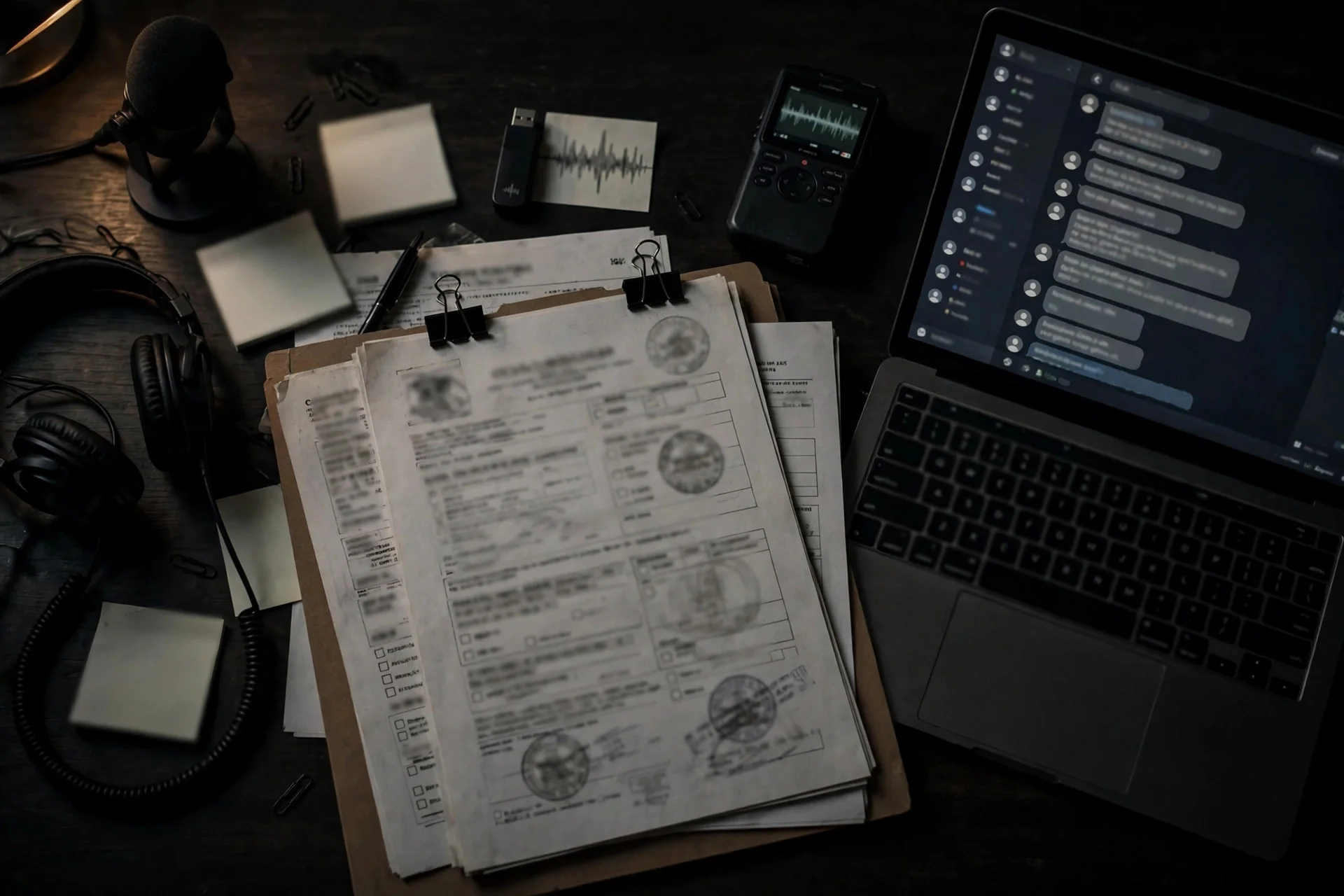
Un audio y un chat atribuidos a un asesor presidencial buscaban un golpe de opinión de Salvatore Mancuso contra Abelardo De La Espriella antes de la segunda vuelta. · Imagen generada para EPM
Audio and chat expose bid to sway Colombia presidential race
A May 23 chat and a June 13 audio show, according to a published investigation, that Víctor de Currea-Lugo, then a presidential adviser, asked Salvatore…
Adviser sought Mancuso to stop De La Espriella before runoff
According to a published investigation, Víctor de Currea-Lugo, then a presidential adviser, sent Salvatore Mancuso ten questions against Abelardo De La…
--- The context ---
Colombia entered its presidential runoff with a tight contest between Abelardo De La Espriella, winner of the first round and leader in the polls ahead of June 21, and Iván Cepeda, the candidate backed by the outgoing governing movement, who trailed in voting intention. In such a close race, a single statement from a widely heard figure could shift the final stretch. He is today president of the Republic.
There was already a sensitive precedent. In October 2025, the so-called Valledupar Pact failed, when the government of Gustavo Petro tried to have 11 former paramilitary chiefs testify against De La Espriella, former president Álvaro Uribe and former vice president Germán Vargas Lleras.
--- The facts ---
The magazine publishing the investigation released two central pieces attributed to Víctor de Currea-Lugo, then an adviser at the Administrative Department of the Presidency. The first is a chat message dated May 23, eight days before the first round, in which, according to the published material, he asked Salvatore Mancuso for an interview for his website in order to help in some way ahead of the elections, offering to send questions for Mancuso to choose from.
Attached to that request were ten questions focused on De La Espriella and his alleged links to paramilitarism. They asked how the first contact occurred during the years of greatest paramilitary expansion, whether there was a close political and social relationship with the AUC, whether the then candidate took part in related meetings or acted as an intermediary, messenger or facilitator, and how much he knew about the origin of money held by clients or allies close to that milieu.
The second piece is an audio recording dated June 13, before the runoff, also sent to Mancuso. In the recording, according to the investigation, De Currea described a tight election, warned that those who took power could betray the people who helped build peace, as in his account Uribe did by extraditing the paramilitary chiefs, and argued that De La Espriella would seriously harm them in order to remove them from the game.
In the same audio, De Currea recalled campaigns that turned in the final stretch through a major opinion shock and said a very large and significant opinion shock was needed to change the picture. According to the recording, he told Mancuso that without that shock they were going to lose, that the former paramilitary chief held that shock in his hand, that his words were not those of a left-wing man and that the country listened to him.
De Currea added, again according to the published audio, that what Mancuso said could be decisive in the elections, invited him to give the interview, offered him the choice of the questions already sent or new ones, and stressed that the message had to be clear. He also said that, failing that outcome, he personally would go into exile, and he closed by asking for help not for the left, in his framing, but for the country, at a moment when Cepeda trailed in the polls.
--- The positions ---
On the receiving end there is a minimal but relevant confirmation: Mancuso confirmed to the magazine publishing the investigation that he received De Currea's communications. That confirmation does not settle every political interpretation of the case, but it does support the basic fact that the messages reached their intended recipient.
On the sender's side, by contrast, there is silence. During the 24 hours before publication, the outlet that revealed the messages sought De Currea's version and he did not respond.
--- What remains unknown ---
De Currea's version is still missing, and it is essential to establish whether he acted on his own initiative, whether anyone else knew about the approach and on what authority a presidential adviser spoke with a former paramilitary chief during a campaign. It also remains to be established whether the proposed interview ever took place or whether the contact ended with the request and the audio.
--- Unanswered questions ---
Did Víctor de Currea-Lugo act alone, or was his approach to Mancuso known inside the government of Gustavo Petro? Did the proposed interview take place, and is there a recording or an answer from the former paramilitary chief to the ten questions? Will any electoral or judicial authority examine these communications to establish whether there was an attempt to alter electoral competition? Why has De Currea not yet offered his version of events?
--- EPM analysis ---
The immediate evidentiary value of the material lies in its sequence. First, in October 2025, the attempt attributed to the government to line up 11 former paramilitary chiefs against three political figures.
Taken together, the pattern drawn by the investigation is not that of a neutral journalistic interview, but of a search for testimony with a calculated electoral effect: the sender himself ties the usefulness of the conversation to its impact on the election and acknowledges that the recipient holds that shock in his hand.
📌 EPM Take: In EPM's view, a presidential adviser who asks a former paramilitary chief for an opinion shock to avoid an electoral defeat crosses a line that no campaign may normalize. The May 23 chat, the ten questions designed to link the leading candidate to the AUC and the June 13 audio form a sequence that demands an immediate public explanation. Mancuso has already confirmed that he received the communications and De Currea has remained silent for 24 hours. Colombia deserves to know who knew about this approach, on what authority it was made and whether the interview took place before the June 21 presidential runoff.
--- The context ---
Colombia's presidential campaign was decided in a climate of extreme polarization. Abelardo De La Espriella won the first round and led the polls ahead of June 21, while Iván Cepeda, the candidate of the governing movement, trailed in voting intention. He is today president of the Republic.
It was not the first time Salvatore Mancuso's name appeared in a maneuver attributed to the government of Gustavo Petro. In October 2025, the so-called Valledupar Pact failed, when that government tried to have 11 former paramilitary chiefs testify against De La Espriella, former president Álvaro Uribe and former vice president Germán Vargas Lleras.
--- The facts ---
The magazine publishing the investigation released a chat and an audio sent to Mancuso by Víctor de Currea-Lugo, then an adviser at the Administrative Department of the Presidency. The first contact came on May 23, eight days before the first round, when, according to the published message, he asked Mancuso for an interview for his website in order to help in some way ahead of the elections and announced he would send questions for Mancuso to choose from.
The ten questions that accompanied that request were not an open questionnaire. They probed the first contact between Mancuso and De La Espriella during the years of greatest paramilitary expansion, an alleged close political and social relationship with the AUC, possible meetings, and whether the then candidate acted as an intermediary, messenger or facilitator between sectors and paramilitary structures.
The second contact was an audio dated June 13, before the runoff. In the recording, according to the investigation, De Currea described a tight election, warned that those who took power could stab in the back the people who helped build peace, as in his account Uribe did with extradition, and asserted that De La Espriella would do them serious harm to remove them from the game.
In that audio, De Currea recalled campaigns that changed in the final stretch thanks to an opinion shock and concluded that a very large opinion shock was needed to modify the result. According to the recording, he told Mancuso that without that shock they were going to lose, that he held that shock in his hand, that his words were not those of a left-wing man and that the country listened to him closely.
The adviser added, according to the published material, that what Mancuso said could be decisive in the elections, invited him to give the interview using the questions already sent or others, insisted that the message had to be clear and stated that, in his personal case, he would go into exile if that shock did not occur. He closed by asking for help not for the left, in his formulation, but for the country, while Cepeda trailed in the polls.
--- The positions ---
Mancuso confirmed to the magazine publishing the investigation that he received De Currea's communications. That confirmation is the only direct statement by a protagonist contained in the published material, and it confirms at least the channel, the sender and the recipient of the approach that has now been revealed.
De Currea, for his part, has not given his version. During the 24 hours before publication, the outlet that revealed the messages sought his response and did not obtain it.
--- What remains unknown ---
It remains unknown whether De Currea acted alone or whether his contact with Mancuso followed an instruction or broader knowledge inside the government of Gustavo Petro. An adviser at the Administrative Department of the Presidency is not an ordinary citizen: his closeness to the presidency turns any such approach into a matter of state, above all when it seeks out a former paramilitary chief on the eve of a vote.
--- Unanswered questions ---
Who authorized or knew about the adviser's approach to Salvatore Mancuso inside the government of Gustavo Petro? Did the interview requested on May 23 take place, and is there a record of the answers to the ten questions that were sent? Was any statement by Mancuso against De La Espriella disseminated as a result of this contact before June 21? When will De Currea explain why he asked for an opinion shock and spoke of exile if it did not happen?
--- EPM analysis ---
The gravity of the case does not rest on a single phrase, but on the complete architecture of the approach. A ten-question questionnaire designed to lead a former paramilitary chief toward an incriminating statement, followed weeks later by an audio acknowledging defeat as the expected scenario unless an opinion shock appeared, describes a strategy, not an isolated impulse or an innocent conversation.
The October 2025 precedent completes the picture.
📌 EPM Take: In EPM's view, what has been revealed describes an attempt to use a former paramilitary chief as an electoral weapon against the candidate who led the race and who today presides over Colombia. The May 23 questionnaire sought prefabricated incriminating answers and the June 13 audio acknowledged that, without an opinion shock from Mancuso, defeat was the expected scenario. Mancuso confirmed receipt of the messages and De Currea has been silent for 24 hours. Colombian institutions cannot file this episode away without establishing who authorized the approach, whether the interview took place and what electoral use was made of it in the final stretch.
El audio y el chat que sacuden la campaña presidencial colombiana
Un chat del 23 de mayo y un audio del 13 de junio muestran, según una investigación publicada, que Víctor de Currea-Lugo, entonces asesor del Dapre, pidió a…
Un asesor buscó a Mancuso para frenar a De La Espriella
Según una investigación publicada, Víctor de Currea-Lugo, entonces asesor del Dapre, envió a Salvatore Mancuso diez preguntas contra Abelardo De La Espriella…
--- El contexto ---
Colombia llegó a la segunda vuelta presidencial con una contienda cerrada entre Abelardo De La Espriella, ganador de la primera vuelta y puntero en las encuestas hacia el 21 de junio, e Iván Cepeda, el candidato del petrismo, que aparecía por debajo en intención de voto. En ese escenario de máxima tensión, cualquier declaración de un actor con peso público podía alterar el tablero en la recta final. Hoy es presidente de la República.
Meses antes ya había existido un antecedente delicado. En octubre de 2025 fracasó el llamado Pacto de Valledupar, cuando el Gobierno de Gustavo Petro intentó que 11 exjefes paramilitares declararan contra De La Espriella, contra el expresidente Álvaro Uribe y contra el exvicepresidente Germán Vargas Lleras.
--- Los hechos ---
La revista que publica la investigación reveló dos piezas centrales atribuidas a Víctor de Currea-Lugo, entonces asesor del Departamento Administrativo de la Presidencia. La primera es un mensaje de chat del 23 de mayo, a ocho días de la primera vuelta, en el que, según el material difundido, pidió a Salvatore Mancuso una entrevista para su página web con el fin declarado de ayudar en algo de cara a las elecciones, y le ofreció enviarle las preguntas para que él decidiera cuáles responder.
Junto a esa solicitud, De Currea envió diez preguntas centradas en De La Espriella y en su supuesto vínculo con el paramilitarismo. Las preguntas indagaban cómo se produjo el primer contacto durante los años de mayor expansión paramilitar, si existió una relación política y social cercana con las AUC, si el entonces candidato participó en reuniones o actuó como intermediario, mensajero o facilitador, y cuánto sabía sobre el origen del dinero de clientes o aliados cercanos a ese entorno.
La segunda pieza es un audio del 13 de junio, ya antes de la segunda vuelta, enviado también a Mancuso. En la grabación, según la investigación, De Currea describió unas elecciones reñidas, advirtió del riesgo de que quienes llegaran al poder traicionaran a quienes ayudaron a construir la paz, como a su juicio hizo Uribe al extraditar a los jefes paramilitares, y sostuvo que De La Espriella les haría un daño grave para sacarlos del juego político.
En ese mismo audio, De Currea evocó repuntes de campaña logrados con un golpe de opinión en la recta final y afirmó que se necesitaba un golpe de opinión muy grande y significativo para cambiar el panorama. Según la grabación, le dijo a Mancuso que sin ese golpe iban a perder, que el exjefe paramilitar tenía en su mano ese golpe, que sus palabras no eran las de un hombre de izquierda y que en el país se le escuchaba.
De Currea añadió, siempre según el audio publicado, que lo que Mancuso dijera podría ser determinante en las elecciones, lo invitó a conceder la entrevista, le ofreció escoger entre las preguntas enviadas o formular otras, y subrayó que el mensaje debía ser claro. También afirmó que, si eso no ocurría, él personalmente se iría para el exilio, y cerró pidiendo una mano no para la izquierda, según su planteamiento, sino para el país, en un momento en que Cepeda iba abajo en las encuestas.
--- Las posiciones ---
Del lado del destinatario existe una confirmación mínima pero relevante: Mancuso confirmó a la revista que publica la investigación haber recibido las comunicaciones de De Currea. Esa confirmación no valida cada interpretación política del caso, pero sí respalda el hecho básico de que los mensajes llegaron a su destinatario.
Del lado del remitente, en cambio, hay silencio. En las últimas 24 horas previas a la publicación, el medio que reveló los mensajes intentó conocer la versión de De Currea y él no respondió.
--- Lo que falta saber ---
Falta la versión de De Currea, pieza indispensable para saber si actuó por iniciativa propia, si alguien más conocía la gestión y con qué autorización hablaba un asesor del Dapre con un exjefe paramilitar en plena campaña. También falta establecer si la entrevista propuesta llegó a realizarse o si la conversación quedó en la solicitud y en el audio.
--- Preguntas sin respuesta ---
¿Actuó Víctor de Currea-Lugo por cuenta propia o su gestión ante Mancuso era conocida dentro del Gobierno de Gustavo Petro? ¿La entrevista propuesta llegó a realizarse y existe alguna grabación o respuesta del exjefe paramilitar al cuestionario de diez preguntas? ¿Examinará alguna autoridad electoral o judicial estas comunicaciones para establecer si hubo un intento de alterar la competencia electoral? ¿Por qué De Currea no ha ofrecido hasta ahora su versión de los hechos?
--- Análisis EPM ---
El valor probatorio inmediato del material está en su secuencia.
Visto en conjunto, el patrón que dibuja la investigación no es el de una entrevista periodística neutra, sino el de una búsqueda de un testimonio con efecto electoral calculado: el propio remitente condiciona la utilidad de la conversación a su impacto en las elecciones y reconoce que el destinatario tiene en su mano ese golpe.
📌 Conclusion EPM: A juicio de EPM, un asesor presidencial que pide a un exjefe paramilitar un golpe de opinión para evitar una derrota electoral cruza una línea que ninguna campaña puede normalizar. El chat del 23 de mayo, las diez preguntas orientadas a vincular al candidato puntero con las AUC y el audio del 13 de junio forman una secuencia que exige explicación pública inmediata. Mancuso ya confirmó que recibió las comunicaciones y De Currea guarda silencio desde hace 24 horas. Colombia merece saber quién conocía esta gestión, con qué autorización se hizo y si la entrevista llegó a producirse antes de la segunda vuelta presidencial del 21 de junio.
--- El contexto ---
La campaña presidencial colombiana se definió en un clima de polarización extrema. Abelardo De La Espriella ganó la primera vuelta y punteaba en las encuestas de cara al 21 de junio, mientras Iván Cepeda, el candidato del petrismo, aparecía por debajo en intención de voto. Hoy es presidente de la República.
No era la primera vez que el nombre de Salvatore Mancuso aparecía en una maniobra atribuida al Gobierno de Gustavo Petro. En octubre de 2025 fracasó el llamado Pacto de Valledupar, cuando ese Gobierno intentó que 11 exjefes paramilitares declararan contra De La Espriella, contra el expresidente Álvaro Uribe y contra el exvicepresidente Germán Vargas Lleras.
--- Los hechos ---
La revista que publica la investigación dio a conocer un chat y un audio enviados a Mancuso por Víctor de Currea-Lugo, entonces asesor del Departamento Administrativo de la Presidencia. El primer contacto fue el 23 de mayo, a ocho días de la primera vuelta, cuando, según el mensaje difundido, le pidió una entrevista para su página web con el fin de ayudar en algo de cara a las elecciones y le anunció el envío de preguntas para que eligiera cuáles responder.
Las diez preguntas que acompañaron esa solicitud no eran un cuestionario abierto. Indagaban por el primer contacto entre Mancuso y De La Espriella en los años de mayor expansión del paramilitarismo, por una supuesta relación política y social cercana con las AUC, por posibles reuniones y por si el entonces candidato actuó como intermediario, mensajero o facilitador entre sectores y las estructuras paramilitares.
El segundo contacto fue un audio del 13 de junio, antes de la segunda vuelta. En la grabación, según la investigación, De Currea describió unas elecciones reñidas, advirtió que quienes llegaran al poder podían clavar el puñal a quienes ayudaron a construir la paz, como a su juicio hizo Uribe con la extradición, y aseguró que De La Espriella les haría un daño mayor para sacarlos del juego.
En ese audio, De Currea recordó campañas que cambiaron en la recta final gracias a un golpe de opinión y concluyó que se necesitaba un golpe de opinión muy grande para modificar el resultado. Según la grabación, le dijo a Mancuso que sin ese golpe iban a perder, que él tenía en su mano ese golpe, que sus palabras no eran las de un hombre de izquierda y que el país lo escuchaba con atención.
El asesor añadió, según el material publicado, que lo que Mancuso dijera podría ser determinante en las elecciones, lo invitó a dar la entrevista con las preguntas enviadas o con otras, insistió en que el mensaje debía ser claro y afirmó que, en su caso personal, se iría para el exilio si no se producía ese golpe. Cerró pidiendo ayuda no para la izquierda, según su formulación, sino para el país, cuando Cepeda iba abajo en las encuestas.
--- Las posiciones ---
Mancuso confirmó a la revista que publica la investigación haber recibido las comunicaciones de De Currea. Esa confirmación es el único pronunciamiento directo de un protagonista que consta en el material difundido, y confirma al menos el canal, el remitente y el destinatario de la gestión revelada.
De Currea, por su parte, no ha dado su versión. En las últimas 24 horas previas a la publicación, el medio que reveló los mensajes buscó su respuesta y no la obtuvo.
--- Lo que falta saber ---
Falta saber si De Currea actuó solo o si su contacto con Mancuso respondía a una instrucción o a un conocimiento más amplio dentro del Gobierno de Gustavo Petro. Un asesor del Dapre no es un ciudadano cualquiera: su cercanía con la Presidencia convierte cualquier gestión suya en un asunto de Estado, sobre todo cuando busca a un exjefe paramilitar en vísperas de una votación.
--- Preguntas sin respuesta ---
¿Quién autorizó o conocía dentro del Gobierno de Gustavo Petro la gestión de su asesor ante Salvatore Mancuso? ¿Se realizó la entrevista solicitada el 23 de mayo y existe registro de las respuestas a las diez preguntas enviadas? ¿Se difundió alguna declaración de Mancuso contra De La Espriella como consecuencia de este contacto antes del 21 de junio? ¿Cuándo explicará De Currea por qué pidió un golpe de opinión y habló de exilio si no se producía?
--- Análisis EPM ---
La gravedad del caso no depende de una sola frase, sino de la arquitectura completa de la gestión. Un cuestionario de diez preguntas diseñado para conducir a un exjefe paramilitar hacia una declaración incriminatoria, seguido semanas después por un audio que reconoce la derrota como escenario si no aparece un golpe de opinión, describe una estrategia, no un impulso aislado ni una conversación inocente.
El antecedente de octubre de 2025 completa el cuadro.
📌 Conclusion EPM: A juicio de EPM, lo revelado describe un intento de usar a un exjefe paramilitar como arma electoral contra el candidato que punteaba y que hoy preside Colombia. El cuestionario del 23 de mayo buscaba respuestas incriminatorias prefabricadas y el audio del 13 de junio reconoció que, sin un golpe de opinión de Mancuso, la derrota era el escenario esperado. Mancuso confirmó la recepción de los mensajes y De Currea calla desde hace 24 horas. La institucionalidad colombiana no puede archivar este episodio sin establecer quién autorizó la gestión, si la entrevista se produjo y qué uso electoral se hizo de ella en la recta final.